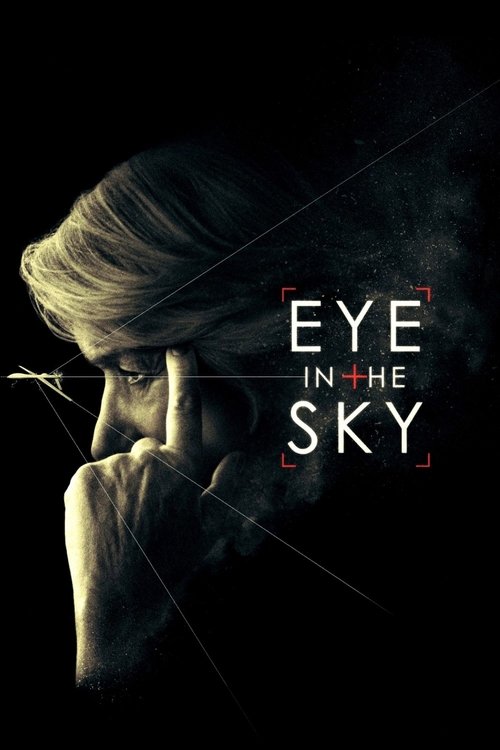
Eye in the Sky
2015 · Gavin Hood
For when you want to argue with your couch — a gripping, watch-in-one-breath thriller that doubles as a genuine ethical dilemma you'll debate afterward. Tense but accessible; great with another person to argue with.
What it's about
A British colonel commanding a drone operation over Nairobi watches her mission shift from capturing terrorists to killing them when surveillance reveals suicide vests being armed inside the target house. Then a nine-year-old girl sets up a bread stall at the edge of the blast radius, and the strike stalls into an agonizing chain of legal and political buck-passing that stretches from a Sussex bunker to Whitehall to a trailer in Nevada. The whole film plays out in something close to real time, with a child's life on one side of the ledger and a bombing on the other.
The experience
Relentlessly tense — a ticking-clock thriller where the suspense comes from meetings, screens, and moral hesitation rather than action. It keeps flipping you back and forth on what the right call is, and it doesn't let you off the hook.
Performances
Helen Mirren brings steel and barely contained frustration to the colonel driving the mission, and Alan Rickman, in his final on-screen role, is quietly devastating as the general stuck between soldiers and politicians.
The craft
The construction is the star: cross-cutting between four countries and half a dozen rooms, the film turns a single decision into a global relay of responsibility without ever losing clarity or momentum. The screenplay compresses drone warfare's whole moral machinery into ninety-odd minutes of escalating pressure.
Why it matters
It became the go-to dramatization of remote warfare — the film people cite when they talk about drones, kill chains, and who actually owns a lethal decision — and a staple of ethics classrooms as much as movie nights.
Snapshot
Eye in the Sky is a real-time procedural thriller that compresses the ethics of remote warfare into roughly ninety minutes of cross-cut deliberation. A multinational kill-chain — a British colonel running the operation from a bunker in Sussex, a commanding general inside a Whitehall briefing room, drone pilots in a Nevada container, image analysts in Hawaii, and a ground agent risking his life in a Nairobi slum — converges on a single house in Kenya where Al-Shabaab militants are arming suicide vests. When a nine-year-old girl, Alia, sets up a bread stall inside the blast radius, the operation stalls into a chain of moral and legal hesitations, each official "referring up" the decision rather than owning it. The film's signal achievement is structural: it dramatizes modern warfare as a problem of distributed responsibility, where no single person fires the shot and everyone shares the guilt. It is also remembered as Alan Rickman's final on-screen live-action role.
Industry & production
The film was directed by South African–born Gavin Hood, working from an original screenplay by the British writer Guy Hibbert, and produced through Raindog Films, the company founded by actor Colin Firth and Ged Doherty, in association with Entertainment One. Entertainment One (eOne) handled international distribution; the U.S. release was acquired by Bleecker Street, the then-young specialty distributor that platformed it in spring 2016 following a world premiere at the Toronto International Film Festival in September 2015.
This was a comparatively modest, independently financed production rather than a studio tentpole — a fact that shaped its aesthetic discipline. Principal photography took place largely in and around Cape Town, South Africa, with the city's neighborhoods and constructed sets standing in for the Nairobi suburb of Eastleigh; this returned Hood to a home production base he knew well from Tsotsi. The decision to shoot a Kenya-set story in South Africa is the kind of pragmatic geography common to the period and worth noting rather than concealing. I do not have a reliably documented production budget or box-office figure to cite, and will not invent one; the picture is generally understood to have been a critical and arthouse-commercial success relative to its scale rather than a blockbuster.
Technology
Eye in the Sky is unusual among war films in that its subject is technology — specifically the apparatus of persistent surveillance and remote killing — and the film foregrounds the hardware with documentary specificity. Its dramatis personae of devices include the MQ-9 Reaper drone loitering at altitude with its Hellfire missiles; a remotely piloted "beetle" micro-drone that crawls into the safe house; and a bird-shaped flying camera deployed at street level by the ground agent. Facial-recognition software cross-checks faces against a watch list in real time, and the entire operation is mediated through video feeds, chat windows, and split-screen monitors.
Crucially, the film treats these technologies not as spectacle but as the very grammar of its storytelling. The audience sees what the operators see — grainy overhead imagery, thermal blooms, the cross-hairs of a targeting reticle — so that the moral distance enabled by the technology becomes the viewer's distance too. The film is also pointed about the bureaucratic technology of warfare: the Collateral Damage Estimate (CDE), rendered here as a literal percentage probability of the girl's death, which characters attempt to game downward from above fifty percent to a "legally" acceptable figure. That a child's life is negotiated as a statistic is the film's sharpest technological indictment.
Technique
Cinematography
Haris Zambarloukos — a cinematographer better known for his glossy, classically composed work with Kenneth Branagh — shoots Eye in the Sky in a register of controlled realism. The film maintains a strict visual segregation between worlds: the sealed, cool, monitor-lit interiors of the command rooms, photographed with clean depth and deliberate framing, versus the warm, dusty, handheld-leaning street life of Nairobi, where the ground agent and the girl move among vendors and militiamen. This contrast is the film's thesis made visible — the antiseptic remove of the deciders against the embodied texture of the place where the bomb will fall. The surveillance imagery is integrated as a third visual layer, its degraded aesthetic lending an aura of objectivity that the drama steadily undermines.
Editing
Editor Megan Gill, a long-standing Hood collaborator, performs the film's hardest and most consequential work. Eye in the Sky lives or dies on parallel montage: it must hold five or more geographically dispersed spaces in simultaneous, escalating tension while preserving the illusion of unfolding real time. The cutting tightens as the deliberation circles, intercutting the legalistic stalling of the command chain with the girl arranging loaves of bread, so that bureaucratic delay and innocent vulnerability are bound together rhythmically. The film essentially weaponizes the Kuleshov principle across continents — meaning is generated in the cut between the war room and the bread stall.
Mise-en-scène / staging
The film is, in effect, a series of chamber dramas stitched together — a structure closer to a stage play (or to a courtroom procedural) than to a conventional war movie. Each location is a room defined by its hierarchy and its props: the COBR-style briefing room with its long table and government ministers; the cramped pilot's container with its instrument panels; the colonel's bunker dense with screens. Staging emphasizes confinement and seatedness — these are people who kill while sitting down — set against the open, mobile peril of the street. The recurring image of officials looking up at screens, deferring to images of a reality they will never physically enter, organizes the entire mise-en-scène around the theme of mediated witness.
Sound
Paul Hepker and Mark Kilian, the composing team behind Hood's Tsotsi and Rendition, supply a restrained, tension-sustaining score that mostly stays out of the way of the procedure, swelling only as the decision nears its terrible resolution. Sound design carries much of the dread: the drone's distant hum, the clipped radio protocol and chat-alert tones of military communication, the ambient market sound that humanizes the target zone. The film is careful to let silence and procedural chatter do the work, reserving musical emotion for the aftermath.
Performance
The ensemble is calibrated to types within a system rather than to arcs of personal transformation. Helen Mirren's Colonel Katherine Powell is steel and tunnel-vision — a commander who has hunted her target for years and pushes relentlessly toward the strike, embodying mission-focus as both competence and moral hazard. Alan Rickman's Lieutenant General Frank Benson is her gravelly, weary counterpart in the briefing room, fending off the ministers' evasions; his final line about a soldier knowing the cost of war lands with elegiac weight given that this was his last live-action screen role before his death in January 2016. Aaron Paul, as drone pilot Steve Watts, supplies the film's conscience and its tears — the man whose finger is literally on the trigger and who insists on a recalculation. Barkhad Abdi (of Captain Phillips) brings real physical jeopardy as the ground agent Jama Farah, the only principal who shares the target's ground. Phoebe Fox, Iain Glen, Jeremy Northam, Monica Dolan, and young Aisha Takow as Alia round out a cast in which each face represents a node in the kill chain.
Narrative & dramatic mode
The film operates in a near-real-time, multi-strand suspense mode best described as the "ticking-clock procedural." Its dramatic engine is not action but deliberation: the central question — will they fire, knowing the girl may die? — is repeatedly deferred as characters escalate it up the chain of command, from soldiers to lawyers to ministers to a Foreign Secretary abroad and an attorney general consulted by phone. This structure converts a war story into a moral-philosophical chamber piece, a dramatized trolley problem in which the audience is denied the comfort of a villain. The film withholds catharsis: the climax is not a battle but a calculation, and its resolution is engineered to leave every position partially vindicated and every participant implicated.
Genre & cycle
Eye in the Sky belongs to the cycle of post-9/11 War on Terror cinema and, more narrowly, to the small mid-2010s subgenre of drone-warfare films. Its closest sibling is Andrew Niccol's Good Kill (2014), which approached remote combat through the psychological collapse of a single pilot; Eye in the Sky is the more systemic, institutional treatment of the same anxiety. It also draws on the DNA of the political-procedural thriller and the war-room drama, hybridizing the moral-debate film with the surveillance thriller. Within the broader War on Terror cycle — alongside films about rendition, torture, and counterterrorism — it is distinguished by its refusal of either jingoism or simple condemnation.
Authorship & method
Gavin Hood's body of work supplies the clearest authorial frame. After winning the Academy Award for Best Foreign Language Film with Tsotsi (2005), Hood moved between Hollywood assignments (X-Men Origins: Wolverine, Ender's Game) and politically engaged dramas, the most relevant being Rendition (2007), his earlier reckoning with the War on Terror's legal gray zones. Eye in the Sky reads as the mature culmination of that strand — and his subsequent Official Secrets (2019) confirms a sustained authorial interest in individuals caught inside the machinery of state security and the ethics of complicity.
Hood's method here is one of structural restraint and casting precision, and he leans on a tight circle of long-term collaborators: composers Hepker and Kilian and editor Megan Gill, all carried over from his South African and Rendition work, give the film continuity of sensibility. The screenplay by Guy Hibbert — a writer known for morally exacting British dramas such as Omagh and Five Minutes of Heaven — is the film's true blueprint, engineering a debate in which competing ethical frameworks (utilitarian calculation versus deontological limits, military necessity versus political risk-aversion) are voiced by credible professionals rather than straw men. Cinematographer Zambarloukos contributes the disciplined two-world visual scheme described above.
Movement / national cinema
The film resists tidy national classification, which is itself thematically apt for a story about transnational warfare. It is a British-led production — British financing, writer, and much of its institutional setting (Whitehall, the British chain of command) — directed by a South African and shot in South Africa, with American characters and an American co-distributor, dramatizing an operation in East Africa. It is best understood as an Anglo–transnational political cinema rather than the product of a single national tradition, though its institutional satire of buck-passing ministers is recognizably in a British vein of state-skeptical drama.
Era / period
Eye in the Sky is a document of the mid-2010s drone era, arriving at the moment when remote-controlled targeted killing had become an established and publicly contested instrument of Western counterterrorism policy. Its release coincided with intensifying journalistic and legal debate over signature strikes, civilian casualties, and the opacity of the kill chain. The film's specificity about CDE percentages, legal sign-off, and the politics of "optics" reflects this contemporaneous discourse closely; it functions as a fictional distillation of arguments then circulating in policy and press. In hindsight it captures a particular historical anxiety — the dawning recognition that warfare conducted by screen and joystick had outpaced the moral and legal vocabulary available to govern it.
Themes
The film's governing theme is the diffusion of moral responsibility within bureaucratic and technological systems: the spectacle of credentialed people passing a lethal decision upward to avoid owning it. Adjacent to this run several others. Distance and mediation — the moral anesthesia produced by killing through a screen, and the film's insistence on collapsing that distance by cutting to the girl. The calculus of innocent life — proportionality made grotesquely literal as a probability figure. The optics of war — a running argument that ministers fear the propaganda cost of a dead child more than the death itself, and that being seen to kill is treated as worse than killing. And finally, the cost borne by the trigger-pullers, voiced in Benson's closing rebuke: the soldiers and pilots who carry the human weight of decisions made by those who will never see the bodies.
Reception, canon & influence
Eye in the Sky was widely and warmly received as one of the most intelligent and morally serious thrillers of its year, praised especially for its taut construction, its refusal of easy answers, and its ensemble performances; Rickman's and Mirren's work drew particular notice, and the film accrued additional poignancy as a memorial to Rickman after his death. Critics frequently positioned it as the definitive narrative treatment of drone warfare to that point. (Precise aggregate scores and award tallies are outside what I can verify here and I decline to cite figures I cannot confirm.)
Looking backward, the film's lineage is clear. Its structure descends from the single-issue moral-debate drama in the tradition of 12 Angry Men, and from the Cold War war-room procedural — Dr. Strangelove and Fail-Safe — in which technology and the chain of command conspire toward catastrophe while men argue in sealed rooms. The real-time, multi-location suspense owes something to the television grammar of 24 and to the political thrillers of directors like Costa-Gavras, while Hood's own Rendition is its most immediate authorial precursor.
Looking forward, Eye in the Sky helped consolidate the drone film as a recognizable mode and is now routinely cited, alongside Good Kill and documentaries such as National Bird, as a touchstone in discussions of cinema and remote warfare. Its most durable legacy is pedagogical and discursive: the film has become a standard teaching text in ethics, law, and military-studies contexts for dramatizing proportionality, the trolley problem, and the doctrine of double effect with rare procedural credibility. Its influence is felt less in direct stylistic imitation than in establishing a template for the institutionally literate moral thriller — proof that a war film could generate unbearable suspense entirely from the question of whether, and on whose authority, to act.
A Deleuzian reading
Start with the bread.
The full Deleuzian reading of Eye in the Sky →
Reception
A critical sleeper on release — strong reviews and a surprisingly healthy indie box-office run — it's now remembered less as a thriller than as a farewell: Alan Rickman's final on-screen live-action performance, which gives every rewatch an elegiac weight it didn't have in 2016.
How Eye in the Sky was received, from release to now →
Influences: the films it descends from and the films it influenced
- 12 Angry Men (1957) — Supplies the chamber-drama architecture in which a single irreversible decision is litigated in near-real time by an ensemble voicing competing ethical positions, generating suspense from deliberation rather than action.
- Dr. Strangelove (1964) — Establishes the war-room as theater, where men argue protocol and procedure in a sealed bunker while an automated chain of command grinds toward a catastrophe none of them fully controls.
- Fail-Safe (1964) — Cross-cuts a real-time crisis between sealed command centers and the field with clinical restraint, dramatizing the cold arithmetic of 'acceptable' calculated death that prefigures the proportionality math.
- The Battle of Algiers (1966) — Models the procedural credibility of a counter-terror operation rendered as an impersonal system, weighting operatives and targets as nodes in a machine rather than as heroes.
- Z (1969) — Provides the institutionally-literate political-thriller grammar built from rapid investigative montage that indicts a bureaucratic chain of complicity.
- The Day of the Jackal (1973) — Engineers ticking-clock suspense through parallel cutting between an operative closing on a target and the institution scrambling to intervene, deriving tension from mechanics rather than psychology.
- The Conversation (1974) — Makes surveillance imagery and audio the moral subject itself, with guilt accruing through technological mediation and the watcher's distance from the act being observed.
- Crimson Tide (1995) — Stages a chamber-drama standoff in which two officers voice deontological-versus-utilitarian arguments over an irreversible weapons-release order inside a rigid chain of command.
- Rendition (2007) — Hood's own War-on-Terror precursor, using a parallel multi-location structure to interrogate the legal gray zone and the diffusion of responsibility across complicit officials.
- Zero Dark Thirty (2012) — Extends the institutionally-literate procedural to surveillance-driven targeting, culminating in an authorization-to-strike debate conducted among credible professionals rather than straw men.
- Munich (2005) — Hood's real-time formal-debate structure — characters across multiple locations arguing the ethics of a drone strike while it is simultaneously being executed — directly extends Munich's dialogue-centered standoff staging, in which moral argument and operational irreversibility occupy simultaneous screen time, so that deliberation itself becomes a form of complicity.
- Body of Lies (2008) — The mature realization of Body of Lies's overhead-drone-view and cross-cut-conversation grammar: an entire film built on intercut command rooms watching a single feed, the surveillance-and-strike machinery made the form itself.
- National Bird (2016) — Carries the drone-film's concern with distance and diffusion of responsibility into documentary testimony, consolidating the remote-warfare mode the fiction films established.
- Official Secrets (2019) — Hood's later authorial extension of the same template — the individual conscience caught inside the machinery of state security and the ethics of complicity.
- Black Hawk Down (2001) — Pioneers the two-world command structure of officers reading a remote aerial/screen feed while violence unfolds elsewhere, carried by procedural radio-traffic sound design.
- United 93 (2006) — Runs a real-time, multi-location procedural that cross-cuts civilian and military command centers tracking a crisis through screens, performed by an ensemble-as-system with no individual hero.
- The Hurt Locker (2008) — Builds unbearable suspense entirely from the procedural mechanics of a disarm/kill decision under a ticking clock and a restrained, near-absent score.
- Good Kill (2014) — Works the same drone-warfare two-world scheme — sterile stateside control booth versus distant optical feed — to dramatize distance, mediation, and the moral erosion of remote killing.
- A War (2015) — Twins the proportionality problem: a commander's split-second strike call is later litigated through a deontological legal frame, the suspense relocated from the act to the judgment of it.
- 13 Hours: The Secret Soldiers of Benghazi (2016) — Simultaneous War on Terror siege structure using real-time procedural tension and linear compression; where 13 Hours grounds the siege in the compound, Hood disperses it across multiple control rooms — parallel formal solutions to the same dramatic material.
- A House of Dynamite (2025) — Distributed moral responsibility rendered through networked institutional procedure: the decision chain fragmented across hierarchical and geographic nodes, dramatic tension generated by procedural delay and the gap between what each institutional node can see and what the system requires it to authorize.
- Thirteen Days (2000) — Descendant that purifies the model to real-time, multi-room deliberation under a countdown, with civil-military tension and the moral weight of restraint as the entire engine of suspense.
Similar films
- Official Secrets (2019) — influence & lineage · same viewing thread
- Zero Dark Thirty (2012) — influence & lineage · same viewing thread
- Black Hawk Down (2001) — influence & lineage
- The Hurt Locker (2008) — influence & lineage
- Fail Safe (1964) — influence & lineage
- United 93 (2006) — influence & lineage
- Crimson Tide (1995) — influence & lineage · same viewing thread
- A House of Dynamite (2025) — same viewing thread
All the films related to Eye in the Sky →
Watch it with: curated runs of related films
- Inside the Security State — A run of modern espionage and national-security thrillers — globe-trotting spycraft, submarine brinkmanship, and the paper trail behind the black sites — where operatives and investigators race secretive institutions and catastrophic clocks.