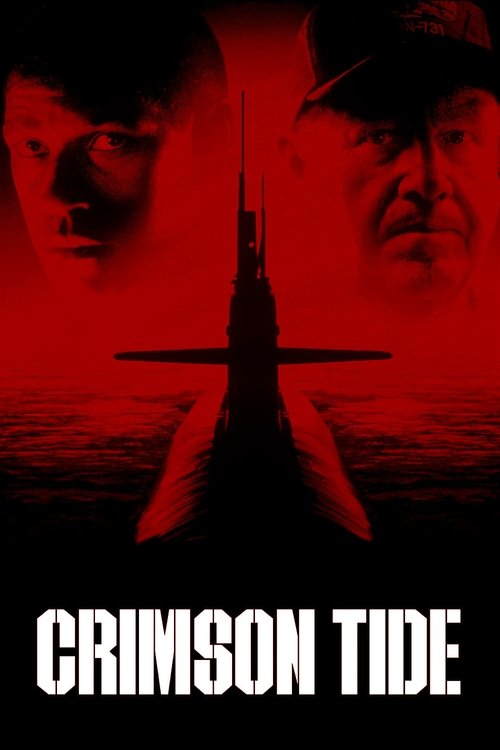
Crimson Tide
1995 · Tony Scott
For when you want a smart, muscular '90s thriller — edge-of-your-seat entertainment that still gives you a genuine moral dilemma to chew on with whoever's on the couch next to you.
What it's about
After a coup puts nuclear missiles in the hands of a Russian ultranationalist, the ballistic-missile submarine USS Alabama heads to sea with a hardened veteran captain and a new, Harvard-educated executive officer who don't see the world the same way. When a launch order arrives — followed by a second message cut off before it can be confirmed — the two men split over whether to fire, and their disagreement escalates into mutiny inside a steel tube at the bottom of the ocean.
The experience
A pressure-cooker thriller that gets its biggest jolts from two men arguing across a table, with the fate of the world as the stakes. It's fast, loud, and relentlessly tense, but the real electricity is watching two heavyweight actors go at each other.
Performances
Gene Hackman and Denzel Washington are a perfectly matched collision — Hackman all salty, folksy menace, Washington coiled principle and rising steel. Their verbal sparring is the action set piece.
The craft
Tony Scott shoots the sub's cramped interiors with saturated color, sweat, and momentum, cutting the debate scenes like combat, and the propulsive, anthemic score became one of the most imitated action themes of its era. The dialogue crackles well beyond the usual military-thriller standard. It rewards a good sound system — depth charges and klaxons included.
Why it matters
A peak of the Simpson–Bruckheimer blockbuster machine and one of the defining submarine films, it set the template for the post–Cold War thriller in which the enemy is ambiguity in the chain of command rather than the other side.
Snapshot
Crimson Tide is a submarine thriller built almost entirely from an argument. After a coup in the Russian Far East places nuclear missiles in the hands of an ultranationalist rebel, the ballistic-missile submarine USS Alabama puts to sea under veteran captain Frank Ramsey (Gene Hackman) and his newly assigned executive officer, Ron Hunter (Denzel Washington). When a launch order arrives, followed by a second, garbled message that is cut off before it can be authenticated, the two officers split over whether the rules permit them to fire. The standoff escalates into mutiny and counter-mutiny within the steel confines of the boat. Produced at the height of the Don Simpson–Jerry Bruckheimer era and directed by Tony Scott at his most stylistically aggressive, the film fuses the conventions of the Cold War submarine picture with the high-gloss action aesthetic of mid-1990s Hollywood. It is remembered as much for its central two-hander between Hackman and Washington — and for the uncredited dialogue contributions of Quentin Tarantino — as for its set pieces.
Industry & production
The film was a flagship product of the Simpson/Bruckheimer partnership, released through Hollywood Pictures, a Disney label. It arrived in May 1995, late in that producing team's run; Don Simpson died in January 1996, making Crimson Tide one of the last films to carry the full Simpson–Bruckheimer imprimatur during Simpson's lifetime. The production embodied the team's signature method: a recognizable star pairing, a propulsive Hans Zimmer score, glossy cinematography, and a marketable high-concept premise distilled to a single sentence — two men, one missile key apiece, irreconcilable readings of the same order.
The most consequential production fact is institutional: the United States Navy declined to cooperate with the film. A mutiny aboard a U.S. ballistic-missile submarine — officers drawing weapons on one another and physically seizing command — was incompatible with the Navy's standards for official assistance, which require a broadly favorable portrayal of service personnel and procedure. Without access to a real boat or fleet support, the production reconstructed the Alabama's interior on soundstages and sourced exterior and supporting footage by other means. The screenplay is credited to Michael Schiffer, with story by Schiffer and Richard P. Henrick. As discussed below, the shooting script passed through several uncredited hands.
Technology
Crimson Tide is a product of the analog-to-digital transition in studio filmmaking, and it is dominated by practical, photographic technique rather than digital effects. The submarine interiors were built as detailed sets that allowed Scott and his cinematographer to light with atmosphere — haze, hard sources, colored practicals — rather than relying on post-production manipulation. Submarine exteriors and undersea movement combine miniature/model photography and optical work characteristic of the period; the film predates the routine use of photorealistic CGI for large craft. The dramatic engine of the plot is itself a piece of communications technology: the Extremely Low Frequency / radio infrastructure by which a submerged boat receives Emergency Action Messages, and the procedural cryptography of authenticating a launch order. The severed second transmission — the "we lost the antenna / the radio is down" beat — is the technological hinge on which the entire moral conflict turns.
Technique
Cinematography
Shot by Dariusz Wolski, the film is a concentrated example of Tony Scott's house style: low-key, high-contrast lighting cut through by visible shafts of light, atmospheric smoke and haze in nearly every interior, and a palette that pushes toward steel blues, sodium ambers, and deep shadow. The confined geometry of the submarine is exploited rather than disguised — tight framings, foreground clutter of pipes and instruments, and faces isolated in pools of hard light. Wolski's camera favors restless movement and long lenses that compress the cramped corridors, heightening claustrophobia. The visual scheme reinforces the drama's binary: Ramsey and Hunter are repeatedly composed in opposition, lit so that the boat itself seems to take sides.
Editing
Chris Lebenzon, Scott's frequent collaborator, cut the film, and the editing is among its defining features. The submarine-warfare sequences — the torpedo evasion, the flooding, the race to the launch — are assembled in the rapid, percussive idiom that became a Scott–Bruckheimer hallmark, layering reaction shots, instrument close-ups, and spatial fragments into mounting pressure. Against this, the editing also has to sustain long dialogue confrontations, and it modulates accordingly: the rhythm tightens and slows around the Hackman–Washington exchanges, letting the actors hold the frame. The film's tension derives largely from this alternation between kinetic montage and sustained verbal duel.
Mise-en-scène / staging
The single set — the boat — is the film's whole world, and the staging makes a virtue of confinement. The control room, the captain's quarters, the missile-launch stations, and the narrow passageways become a fixed map across which authority shifts. Blocking is organized around the chain of command: who stands where, who controls the conn, who physically holds a position becomes the literal expression of who commands. The mutiny is staged as a series of spatial seizures — control of the bridge, of the radio room, of the missile keys — so that abstract questions of legitimacy are rendered as concrete contests over rooms and hardware.
Sound
Sound design is central to a film set in an environment defined by listening. Sonar pings, the groan of a hull under pressure, the alarm klaxons, and the mechanical vocabulary of the boat build a sustained acoustic tension; in submarine cinema, sound is the primary sense, and Crimson Tide foregrounds the discipline of silent running and the dread of being heard. Over this sits Hans Zimmer's score (treated below), which weaves a male chorus into the sound field so that the music and the ambient world of the boat sometimes seem to fuse.
Performance
The film is, finally, an actor's piece. Gene Hackman plays Ramsey as a charismatic, blunt-instrument traditionalist — certain, theatrical, and dangerous precisely because his conviction is grounded in long command experience. Denzel Washington's Hunter is his structural opposite: cerebral, controlled, morally exacting, a Harvard-educated officer who reasons rather than asserts. The two performances are calibrated to clash without either collapsing into caricature; the film's intelligence lies in making both men comprehensible. The supporting cast is notably deep and caught several actors near the start of major careers: Viggo Mortensen, James Gandolfini, Matt Craven, George Dzundza, and Rocky Carroll fill out the crew, each becoming a small index of which way the boat will tip.
Narrative & dramatic mode
Structurally, Crimson Tide is a chamber drama wearing the costume of an action blockbuster. Its dramatic mode is the moral-procedural debate: the conflict is not finally between the Alabama and an enemy submarine but between two readings of duty, law, and the meaning of an order. The narrative is built around an ambiguity engineered into military procedure itself — the requirement that a launch order be confirmed, and the catastrophe of a confirmation that never fully arrives. Ramsey holds that the last valid order stands and must be executed; Hunter holds that an incomplete message voids the authority to fire. Crucially, the film withholds easy resolution: each man's position is internally coherent, and the screenplay grants both real force. This is closer to the courtroom or the philosophical dialogue than to conventional action plotting, and it is the source of the film's lasting reputation.
Genre & cycle
The film sits at the intersection of two traditions. The first is the submarine film, with its built-in conventions of confinement, the depth-charge/torpedo duel, the cult of the captain, and the moral pressure of the sealed environment — a lineage running from Run Silent, Run Deep (1958) through Das Boot (1981) and The Hunt for Red October (1990). The second is the high-concept 1990s action thriller as refined by Simpson and Bruckheimer. Crimson Tide also belongs to a specific post–Cold War cycle: a wave of mid-1990s thrillers scrambling to locate a credible nuclear menace after the Soviet collapse, here finding it in Russian internal instability rather than in a superpower adversary. Its near contemporaries in the submarine-and-nuclear space make it part of a brief, identifiable moment when Hollywood reprocessed Cold War anxieties for a world without the Cold War's clear sides.
Authorship & method
Tony Scott directs with the visual signature he had developed across Top Gun, Days of Thunder, The Last Boy Scout, and True Romance: maximalist atmosphere, propulsive cutting, and a willingness to let style carry mood. What distinguishes Crimson Tide within his filmography is the discipline imposed by the single setting and the two-hander at its center; the confinement reins in his tendency toward spectacle and channels his intensity into performance and pressure. The film inaugurated his long, productive partnership with Denzel Washington, which would continue through Man on Fire (2004), Déjà Vu (2006), The Taking of Pelham 1 2 3 (2009), and Unstoppable (2010) — arguably the defining director-actor collaboration of Scott's later career.
The screenplay's authorship is famously layered. Michael Schiffer holds the writing credit, but the shooting script was the product of an extensive, largely uncredited rewrite process — common practice on Simpson–Bruckheimer productions. The best-documented contribution is Quentin Tarantino's dialogue work: he is widely credited in accounts of the production with the pop-culture digressions that give the film texture, most famously the wardroom argument over the Silver Surfer and Jack Kirby versus Stan Lee, alongside other references (Lipizzaner stallions, Star Trek) that punctuate the military procedure with character voice. Reports of the period name additional uncredited writers brought in for passes; specific attributions beyond Tarantino's are less reliably documented, and the precise division of labor among them is not something the public record settles cleanly.
Dariusz Wolski (cinematography), Chris Lebenzon (editing), and Hans Zimmer (score) round out the principal authorial team. Zimmer's contribution is significant in its own right: his main theme, scored for orchestra and male chorus, became one of his signature works of the decade and was recognized with a Grammy Award for Best Instrumental Composition. The choral motif — martial, surging, faintly liturgical — does much to elevate the film's register from thriller to something closer to tragedy.
Movement / national cinema
Crimson Tide is a mainstream Hollywood studio production and belongs to no art-cinema movement; its "movement," if it has one, is the commercial aesthetic of the Simpson–Bruckheimer brand and the broader glossy-action style that dominated American studio output in the late 1980s and 1990s. It is worth noting the international texture of its key craftspeople — Wolski is Polish, Zimmer German, Scott British — which is itself characteristic of the globalized Hollywood of the era, where the most distinctive "American" blockbusters were often assembled by émigré and foreign-born talent.
Era / period
The film is precisely of its moment: 1995, a few years after the dissolution of the Soviet Union, when American popular culture was still working out what threat would replace the one that had organized geopolitics for half a century. Its premise — a rogue Russian nationalist seizing nuclear weapons amid post-Soviet chaos — captures a specific early-1990s anxiety about "loose nukes" and the instability of the former Soviet arsenal. Aesthetically it is equally period-bound, representing the high-water mark of practical-effects, star-driven studio action just before digital effects and franchise architecture reshaped the form. As a late Simpson–Bruckheimer film, it also marks the end of an era in studio producing.
Themes
The film's governing theme is the nature of authority and the limits of obedience. Ramsey embodies command as decisiveness and tradition; Hunter embodies it as judgment and restraint. The screenplay refuses to reduce this to a simple contest between right and wrong, instead probing the conditions under which a subordinate is not merely permitted but obligated to refuse an order — and the terrifying fact that, in the nuclear case, the cost of either error is total. Adjacent themes include the moral architecture of nuclear deterrence (the system is designed so that no single person can fire, yet that very safeguard produces paralysis at the decisive moment); the relationship between race, education, and legitimacy, present in the texture of the Ramsey–Hunter dynamic without being made the film's overt subject; and the broader question of how institutions built for the Cold War function in a world that no longer fits their assumptions. Ramsey's much-quoted invocation — that the true enemy is war itself — distills the film's ambivalence about the warrior's vocation.
Reception, canon & influence
Crimson Tide was a substantial commercial success on release and was generally well received critically, with praise concentrated on the Hackman–Washington duel and on Scott's taut handling of a confined drama; reviewers frequently singled out the central debate as more compelling than the action surrounding it. (Precise box-office and award tallies beyond Zimmer's Grammy for the main theme are best confirmed against a dedicated reference; I won't reconstruct exact figures from memory.)
Its influences run backward to the submarine-film canon — the depth-charge tension of Run Silent, Run Deep and Das Boot, and the immediately preceding success of The Hunt for Red October, which had reestablished the commercial viability of the genre — and to the courtroom/command-dilemma tradition exemplified by The Caine Mutiny, whose questions about when defiance of a commanding officer is justified Crimson Tide directly echoes.
Forward, the film's legacy is twofold. Within Tony Scott's career it launched the Scott–Washington collaboration that would define his final fifteen years. More broadly, it became a durable reference point for the "two strong men arguing in a confined space" thriller and a frequently cited example of how uncredited script-doctoring — Tarantino's in particular — can leave an outsized mark on a studio film's voice; the Silver Surfer scene is regularly invoked in discussions of his uncredited work. The film also endures as a teaching text on nuclear command-and-control: its dramatization of the two-man rule and the failure mode of an incomplete launch order is used, informally and formally, to illustrate the genuine procedural and ethical dilemmas built into deterrence. That a glossy mid-1990s action picture should have become a touchstone for that serious conversation is the clearest measure of its staying power.
A Deleuzian reading
The message comes in, and then it dies.
The full Deleuzian reading of Crimson Tide →
Reception
A solid hit and crowd-pleaser in 1995, it's since ridden the great post-2012 Tony Scott reappraisal to 'actually one of the best thrillers of the decade' status — the go-to exhibit when cinephiles argue Scott was underrated all along.
How Crimson Tide was received, from release to now →
Influences: the films it descends from and the films it influenced
- The Caine Mutiny (1954) — Supplies the moral-procedural question of when relieving a commanding officer is lawful versus mutinous, the command-dilemma debate Crimson Tide's Articles-of-Mutiny standoff directly echoes.
- Das Boot (1981) — Defines the genre's sound vocabulary — groaning hull plates, pinging sonar, depth-charge silence — and the sweat-soaked confinement staging that Crimson Tide's sonar-and-hull mix and single-set pressure inherit.
- The Hunt for Red October (1990) — Reestablished the commercial viability of the red-lit control-room sonar procedural immediately before Crimson Tide, modeling the tech-talk tension and tracking-the-enemy-by-sound suspense Scott builds on.
- Fail Safe (1964) — Dramatizes nuclear command-and-control as a chamber drama of men reading orders under a ticking clock, the launch-authority procedural tension Crimson Tide rebuilds around a garbled EAM.
- Top Gun (1986) — Codifies Scott's low-key high-contrast military glamour — backlit smoke, hardware fetish, long-lens compression — the visual signature he disciplines and turns inward inside the sub.
- Enemy of the State (1998) — Scott and Bruckheimer's preceding collaboration established the specific telephoto-compression grammar, rapid-fire cutting rhythm, and institutional-pressure performance register—professionals under operational duress in enclosed command spaces—that Enemy of the State inherits and scales from submarine confinement to city-wide surveillance architecture.
- Spy Game (2001) — A talky, two-men-in-a-chamber moral standoff dressed in spectacle technique — proof of Scott's method of applying an action director's grammar to a fundamentally structural, dialogue-driven story.
- Eye in the Sky (2015) — Stages a chamber-drama standoff in which two officers voice deontological-versus-utilitarian arguments over an irreversible weapons-release order inside a rigid chain of command.
- The Rock (1996) — The immediate template: Zimmer's Media Ventures brass-and-choir ostinato scoring a moral standoff inside a military machine, plus the uncredited star-dialogue polish (Tarantino there, Quinn/Sorkin/Reynolds here) that gives two leads ornamental set-piece exchanges inside a procedural.
- Run Silent, Run Deep (1958) — Establishes the submarine captain-vs-executive-officer authority duel (Gable vs Lancaster) staged inside the cramped hull, the exact two-officer command-conflict structure Crimson Tide transplants to the missile age.
- Dr. Strangelove (1964) — Turns a garbled, un-authenticatable launch transmission (the CRM-114 device) into the plot engine, the same incomplete-order failure mode that drives Crimson Tide's central crisis.
- 12 Angry Men (1957) — Provides the single-set confinement template in which two opposing men force a room toward a moral verdict through escalating argument, the two-hander debate architecture of the Hackman–Washington confrontation.
- True Romance (1993) — First grafts Tarantino's pop-culture digression dialogue onto Scott's propulsive style, the same uncredited-Tarantino voice that produces Crimson Tide's Silver Surfer / Kirby-vs-Lee wardroom riff.
- Mutiny on the Bounty (1935) — The foundational authority-and-obedience-at-sea narrative whose Bligh-vs-Christian polarity underwrites Crimson Tide's contest between rigid command and conscientious defiance.
- Crimson Tide's score / Gladiator (2000) — Extends Hans Zimmer's martial orchestra-and-male-chorus motif — surging, faintly liturgical — that Crimson Tide pioneered into the decade's defining epic-action sound.
- Man on Fire (2004) — Launches the Scott–Washington partnership begun on Crimson Tide and pushes its percussive montage and rhythm-modulation editing into full fractured-frame intensity.
- Unstoppable (2010) — Reprises the Scott–Washington two-hander and the long-lens compression of hurtling machinery, confining moral stakes to men reasoning inside a single hurtling vehicle.
- K-19: The Widowmaker (2002) — Restages the submarine captain-vs-officer authority conflict under nuclear catastrophe, the command-legitimacy two-hander Crimson Tide reframed for post-Cold-War audiences.
- U-571 (2000) — Carries forward the depth-charge-and-sonar procedural suspense and the junior-officer-forced-into-command beat as direct genre descendants of Crimson Tide's revival.
- Greyhound (2020) — Distills the naval sonar-contact command procedural into near-real-time single-vessel confinement, extending the bridge-as-pressure-chamber craft Crimson Tide refined.
- Black Sea (2014) — Returns to the confined-submarine crew whose chain of command fractures under pressure, sustaining the single-set-confinement authority-breakdown drama at the heart of Crimson Tide.
Similar films
- The Hunt for Red October (1990) — influence & lineage
- Das Boot (1981) — influence & lineage
- The Caine Mutiny (1954) — influence & lineage
- Man on Fire (2004) — influence & lineage
- Fail Safe (1964) — influence & lineage
- Top Gun (1986) — influence & lineage
- True Romance (1993) — influence & lineage
- Enemy of the State (1998) — same viewing thread
All the films related to Crimson Tide →
Watch it with: curated runs of related films
- Inside the Security State — A run of modern espionage and national-security thrillers — globe-trotting spycraft, submarine brinkmanship, and the paper trail behind the black sites — where operatives and investigators race secretive institutions and catastrophic clocks.