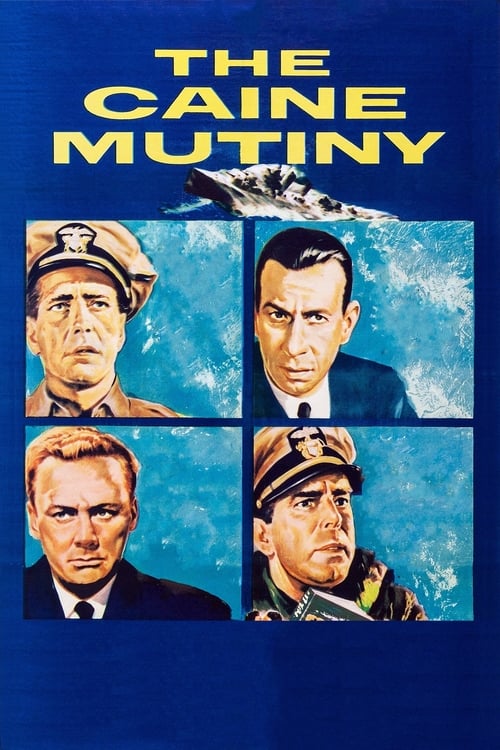
The Caine Mutiny
1954 · Edward Dmytryk
For when you want a meaty classic Hollywood drama that gives you something to argue about afterward — who was right, and at what cost. Absorbing rather than heavy; ideal for a night when you want substance without gloom.
What it's about
Aboard a shabby World War II minesweeper, the crew gets a new by-the-book captain, Queeg, whose rigid discipline slowly curdles into paranoia — obsessing over trivial infractions while endangering the ship. When his first officer relieves him of command during a crisis, the act triggers a court-martial for mutiny, and the film becomes a tense courtroom battle over duty, cowardice, and mental collapse.
The experience
A slow-tightening screw — it starts as a Navy service picture, turns into an unnerving character study, and lands as a gripping courtroom drama. The tension comes from watching authority fray in small, telling gestures, and the trial scenes are electric.
Performances
Humphrey Bogart's Queeg is one of his greatest late performances — the nervous ball bearings rolling in his hand, the strawberry obsession, the flashes of wounded dignity that make the man pitiable as well as frightening.
The craft
Herman Wouk's Pulitzer-winning novel is compressed into a sturdy three-act machine — service picture, breakdown study, courtroom showdown — shot in handsome Technicolor with real naval texture. The trial's writing is the payoff: cross-examinations that flip your sympathies scene by scene.
Why it matters
A major hit of 1954 and an enduring template for the military courtroom drama, it fixed Queeg in the culture as shorthand for authority cracking under pressure and gave Bogart one of his defining late roles.
Snapshot
The Caine Mutiny is a Technicolor adaptation of Herman Wouk's Pulitzer Prize–winning 1951 novel, produced independently by Stanley Kramer for release through Columbia Pictures and directed by Edward Dmytryk. It fuses three modes the postwar American cinema handled with confidence — the World War II service picture, the psychological character study, and the courtroom drama — around a single unstable center: Lieutenant Commander Philip Francis Queeg, the by-the-book captain of a shabby minesweeper whose rigidity curdles into paranoia under pressure. Humphrey Bogart's Queeg, twitching a pair of steel ball bearings through his fingers and litigating the theft of a quart of strawberries as though it were a capital crime, became one of the defining performances of his late career and one of the era's enduring portraits of authority in collapse. The film was a substantial critical and commercial success and drew seven Academy Award nominations, and it remains the best-known screen version of a property Wouk simultaneously mined for the stage. Its lasting interest lies less in the mutiny than in the trial that follows, and in the moral inversion of its closing argument, where the officers who deposed a broken man are made to reckon with the intellectual who goaded them.
Industry & production
The film is a characteristic product of Stanley Kramer's independent unit, which had migrated to Columbia under a distribution-and-financing arrangement with Harry Cohn's studio. Kramer had built a reputation on ambitious, socially minded pictures made outside the full machinery of a major, and The Caine Mutiny was among the most expensive and logistically demanding projects of that period for him. Wouk's novel was a genuine cultural phenomenon — a long-running bestseller and 1952 Pulitzer winner — which made the screen rights valuable and the adaptation high-stakes.
The single most consequential production fact is the United States Navy's cooperation. The Navy supplied real vessels, at-sea access, and technical guidance that give the film its documentary texture, but cooperation came with conditions. The picture opens with a printed foreword stating that there has never been a mutiny aboard a United States naval vessel — a disclaimer the service required to distance itself from the story's premise. That negotiation shaped the film's posture: it could dramatize a captain's breakdown and a subordinate's seizure of command only within a frame that ultimately affirmed the institution and the burdens of those who serve it.
Casting Bogart was itself an industry event. He was a major star nearing the end of his career (he would die in 1957), and Queeg gave him a role of unusual vulnerability. The ensemble mixed established names — José Ferrer, Van Johnson, Fred MacMurray — with newcomers, most poignantly Robert Francis as Ensign Willie Keith; Francis died in a plane crash in 1955, cutting short a career the film had been positioned to launch. Small parts went to actors on the rise, including Lee Marvin and Claude Akins.
Technology
The Caine Mutiny was made in Technicolor at a moment when Hollywood was scrambling to differentiate the theatrical experience from television through color, widescreen, and stereophonic sound. The film leans on color and on authentic naval hardware rather than on the new anamorphic formats; it presents its shipboard world in a relatively conventional frame rather than the wide compositions Columbia and its rivals were adopting elsewhere in 1954, a choice consonant with its emphasis on faces and confined interiors. The at-sea photography, made possible by Navy access, supplies a location realism that studio work alone could not. The film's most demanding technical set piece is the typhoon that precipitates the mutiny, an effects sequence combining full-scale deck action with miniature and process work; the exact division of methods is not something I can specify with confidence, but the sequence exemplifies the period's practical approach to large-scale weather effects before optical compositing matured.
Technique
Cinematography
Franz Planer, the Austrian-born cinematographer whose credits span noir, prestige melodrama, and later work such as The Nun's Story and Breakfast at Tiffany's, shot the film. His work here is disciplined rather than flamboyant: clean, legible Technicolor that serves performance and geography. The shipboard interiors are staged for clarity of hierarchy — who stands where, who looks at whom — and the courtroom is lit to keep the shifting balance of power among witnesses, counsel, and the panel continuously readable. Planer's restraint is a deliberate strategy: in a film whose drama is psychological and verbal, the camera's job is to isolate reaction, and the tightening framings on Bogart during his testimony do much of the film's most important work.
Editing
Cut by William A. Lyon and Henry Batista, the film earned an Academy Award nomination for its editing. Lyon was among Columbia's most accomplished editors of the period. The picture's structure poses a real cutting problem: it must compress Wouk's sprawling bildungsroman, deliver a physically kinetic storm-and-mutiny climax at sea, and then decelerate into a static, dialogue-driven trial. The editing manages that tonal shift — from the churn of the typhoon to the measured rhythm of cross-examination — and the courtroom sequences are built to let the camera hold on faces long enough for the testimony to detonate, particularly in the celebrated unraveling of Queeg on the stand.
Mise-en-scène / staging
The film's staging is organized around confinement and observation. The Caine itself — a tired, rusting minesweeper — is a deliberately unglamorous space, its cramped bridge and wardroom concentrating the officers into a pressure vessel where resentment festers. In the courtroom, the blocking is architecturally formal: the fixed geometry of bench, witness stand, and counsel tables against which the human drama of collapse plays out. The single most famous staging choice is behavioral rather than spatial — Queeg's compulsive rolling of the steel balls, a physical objectification of a mind seeking control, which the film introduces early and reserves for devastating payoff when the tic returns under courtroom stress.
Sound
The film received an Academy Award nomination for sound recording, credited to Columbia's sound department under John P. Livadary. Sound is doing heavy lifting on two fronts: the enveloping chaos of the typhoon, where wind, sea, and strained machinery register the ship's peril, and the acoustic intimacy of the trial, where the film depends on every hesitation, stammer, and shift in vocal register in the testimony being clearly heard. The contrast between those two soundscapes — overwhelming natural violence and hushed institutional procedure — mirrors the film's larger structural pivot.
Performance
Performance is the film's true medium. Bogart's Queeg is a study in a man's dignity being stripped away in real time; the courtroom breakdown, in which self-justification dissolves into paranoid grievance, is among the most analyzed acting sequences of 1950s Hollywood. José Ferrer, as defense attorney Barney Greenwald, anchors the film's moral argument, his controlled advocacy giving way to the disgust of the final scene. Van Johnson, cast against his genial type as Lieutenant Steve Maryk, plays the sincere, limited officer who acts in good faith, while Fred MacMurray's Lieutenant Tom Keefer — the cynical, novel-writing intellectual who plants the idea of Queeg's unfitness and then abandons the men who acted on it — supplies the film's most quietly damning portrait. Tom Tully, as the Caine's previous captain De Vriess, earned a Best Supporting Actor nomination for a brief but pointed role.
Narrative & dramatic mode
The film operates in two successive dramatic modes. The first two-thirds are a naval bildungsroman-cum-character study, following young Ensign Willie Keith aboard the Caine and charting the slow deterioration of Queeg's command until the typhoon forces Maryk, invoking Navy regulations on the relief of a mentally unfit captain, to take control. The final act converts entirely into a courtroom drama, retrying the event through testimony. This is a deliberately withholding structure: the audience believes it has witnessed a justified mutiny, and the trial appears to confirm it as Greenwald destroys Queeg on the stand. Then the film executes its signature reversal — Greenwald, drunk at the victory party, condemns his own clients, arguing that Queeg was a flawed career officer who nonetheless stood the watch while men like Keefer sneered from safety, and that the real guilt belongs to the intellectual who fomented rebellion and then took none of the responsibility. The dramatic mode, in other words, is a moral trap: the film earns the audience's judgment only to indict it.
Genre & cycle
The Caine Mutiny sits at the intersection of the postwar service picture and the courtroom drama, two of the most productive American genres of the early-to-mid 1950s. It belongs to a cycle of World War II films that had moved past straightforward combat heroics toward institutional and psychological reckoning — an interest in command, discipline, and the men who crack under them. It also participates in the decade's strong vein of trial films, where the courtroom functions as a machine for adjudicating not just facts but values. It is closely bound to the prestige literary adaptation cycle as well, sharing that lineage with Columbia's From Here to Eternity the previous year — another sprawling, bestselling novel of peacetime and wartime military life brought to the screen with major stars and Oscar attention.
Authorship & method
Edward Dmytryk directs with an efficiency that subordinates style to text and performance. His method here is essentially that of a strong studio craftsman marshaling first-rate collaborators around a proven property, and the film's power derives from its confidence in dialogue, actors, and structure rather than from directorial signature. Dmytryk's biography, however, gives the material an unavoidable charge: he had been one of the Hollywood Ten, jailed for contempt of Congress, and then reversed course to testify as a cooperative witness before the House Un-American Activities Committee, an act that returned him to employment but marked him permanently in the industry's memory. That a director who had navigated the era's most wrenching questions of loyalty, conscience, and institutional authority should helm a film whose climactic argument defends the flawed man who "stood the watch" and condemns the safe critic is a resonance scholars have often noted; the film does not comment on it directly, and I won't overstate authorial intent, but the alignment is striking.
His key collaborators: cinematographer Franz Planer supplied clean, performance-serving Technicolor; composer Max Steiner, the Warner Bros. veteran and one of the founding figures of the Hollywood symphonic score, wrote the music, earning a nomination; editors William A. Lyon and Henry Batista shaped the pivot from storm to trial. The screenplay was written by Stanley Roberts, with additional dialogue credited to Michael Blankfort, and Roberts's compression of Wouk's long novel — foregrounding Queeg and the trial while thinning Willie Keith's coming-of-age — earned a Best Screenplay nomination. Wouk himself was the presiding intelligence across media, having separately adapted the court-martial into a successful Broadway play in the same period, a parallel stage life that underscores how thoroughly the trial, not the mutiny, was understood to be the story's heart.
Movement / national cinema
The film is a work of mainstream Hollywood at its mid-century height, not of any avant-garde or national movement. It is best located within the specific institutional formation of the independent producer working through a major studio — Kramer's unit at Columbia — a model that gave a producer creative latitude while retaining studio resources and distribution. It is also, unmistakably, a product of the American film industry's entanglement with the Cold War state, both in its literal dependence on Navy cooperation and in its broader cultural argument for the value of institutional loyalty and the dignity of the career serviceman.
Era / period
1954 was a hinge year for Hollywood: television was eroding the theatrical audience, the studios were countering with color and widescreen spectacle, and the political aftershocks of the blacklist were still reshaping careers. The Caine Mutiny registers all three pressures. Its emotional core — the defense of a limited, dutiful organization man against the corrosive scorn of the sophisticated skeptic — reads clearly against the period's anxieties about conformity, loyalty, and the standing of institutions. Greenwald's closing speech, with its insistence that ordinary military men shielded the intellectuals who now mock them, is a document of its moment, and its politics have accordingly been read in more than one way over the decades.
Themes
The film's central theme is the burden of command and the fragility of authority: Queeg is not a villain but a man broken by the responsibilities of leadership, and the film asks what is owed to such a figure. Around this it develops a cluster of related concerns — loyalty versus conscience; the difference between acting and merely criticizing; the moral cowardice of the detached intellectual, embodied by Keefer; and the maturation of Willie Keith, whose education consists precisely in learning these distinctions. The trial dramatizes the gap between legal vindication and moral truth: Maryk may have been technically justified, yet the film insists that a justified act can still rest on ignoble foundations. Underlying all of it is a defense of the imperfect institution and the imperfect men who serve it — a theme the Navy's cooperation both enabled and constrained.
Reception, canon & influence
The film was well received on release and performed strongly, standing among the more successful pictures of its year, though I'll refrain from citing specific figures I cannot verify. It earned seven Academy Award nominations — including Best Picture, Best Actor for Bogart, Best Supporting Actor for Tom Tully, Best Screenplay, Best Film Editing, Best Sound Recording, and Best Music Score — and, in a notable outcome, won none, a near-sweep of nominations without a single statuette.
Its influences run backward to Wouk's novel and, through it, to the long tradition of naval and courtroom literature, as well as to Columbia's own recent success with From Here to Eternity as a model for the prestige military adaptation. Looking forward, the property's most durable afterlife has been on the stage: Wouk's The Caine Mutiny Court-Martial has been revived repeatedly and adapted for television more than once, most recently in a 2023 film version directed by William Friedkin, testifying to the courtroom scene's standing as a modern classic of the trial genre. Within film culture, Bogart's Queeg — the ball bearings, the strawberries, the disintegration on the stand — has become shorthand for authority undone by its own rigidity, referenced and parodied far beyond viewers who have seen the film. The picture endures as both a high point of Bogart's late career and a searching, ambivalent meditation on loyalty produced by an industry, and a director, that had just lived through a wrenching test of exactly that virtue.
Reception
A massive hit in 1954 — one of the year's top grossers, with seven Oscar nominations including Best Picture — it's now remembered less as a prestige epic than as the home of one late-career Bogart performance for the ages, and Friedkin's 2023 farewell remake of the court-martial sent a new wave of viewers back to it.
How The Caine Mutiny was received, from release to now →
Influences: the films it descends from and the films it influenced
- Mutiny on the Bounty (1935) — Charles Laughton's Captain Bligh fixed the template of the tyrannical naval martinet whose cruelty provokes mutiny — the performance archetype Bogart's Queeg psychologizes and inverts into pathos rather than menace.
- From Here to Eternity (1953) — Columbia's playbook (producer Buddy Adler) for compressing a sprawling military bestseller into a star-driven prestige ensemble — the immediate production model Caine reapplied, per the dossier.
- Twelve O'Clock High (1949) — Pioneered the 'burden of command' study of an officer cracking under the psychological weight of authority, framed by a retrospective inquiry — the exact dramatic engine of Queeg's disintegration.
- Command Decision (1948) — A talky chamber melodrama staking its power on officers debating the moral arithmetic of orders — dialogue-and-performance over spectacle, the confinement-drama method Caine's trial extends.
- The Informer (1935) — Max Steiner's Oscar-winning leitmotif-driven symphonic scoring — the founding Hollywood-score method Steiner carries directly into Caine's music.
- Casablanca (1942) — Codified Bogart's wounded-authority star persona over a Steiner score; Caine weaponizes the audience's accumulated trust in that persona to make Queeg's collapse land.
- Crossfire (1947) — Dmytryk's own tight, low-key social-problem procedural, where an investigation exposes psychological rot — the efficient, text-serving chamber method he brings to Caine.
- The Ox-Bow Incident (1943) — Its portrait of the ineffectual intellectual bystander complicit through cowardice supplies the dramatic figure Caine's cynical novelist Keefer extends.
- Paths of Glory (1957) — Turns the military court-martial itself into the indictment of command, extending Caine's structural discovery that the trial, not the mutiny, is where authority is judged.
- The Bridge on the River Kwai (1957) — Colonel Nicholson is the Queeg study writ large — an officer whose rigid devotion to code and command curdles into self-destructive obsession.
- Anatomy of a Murder (1959) — Builds its drama on the granular mechanics of cross-examination breaking a witness on the stand — the craft of Greenwald dismantling Queeg with the ball-bearings, extended to feature length.
- Judgment at Nuremberg (1961) — Testimony-as-moral-reckoning courtroom drama whose climaxes are witnesses cracking under cross-examination, inheriting Caine's legal-vs-moral-truth structure.
- The Bedford Incident (1965) — A rigid, paranoid destroyer captain whose inflexibility destroys his own command — a near-direct transposition of Queeg into Cold War confinement.
- A Few Good Men (1992) — A military-courtroom drama whose climax is a rigid officer shattered under cross-examination on the stand, its stage-to-screen structure (Sorkin) mirroring Wouk's own play-to-film lineage.
- Crimson Tide (1995) — Restages the mutiny question as a confined two-man argument over the legitimacy of a captain's authority — Caine's staging/confinement-observation dynamic under a submarine's pressure.
- The Caine Mutiny Court-Martial (2023) — A direct re-adaptation of Wouk's stage version, confirming that the trial's cross-examination — not the storm or mutiny — is the property's durable dramatic core, per the dossier.
- Breaker Morant (1980) — Court-martial drama built on a defense counsel's own ambivalence toward the men and the act he must defend, complicating easy sympathy exactly as Major Thomas's advocacy does.
- Mister Roberts (1955) — A same-era shipboard drama of a petty-tyrant captain and a crew simmering toward mutiny, likewise adapted from a hit stage/novel property foregrounding confinement and command friction.
- 12 Angry Men (1957) — Stakes everything on a confined-room deliberation carried by dialogue, performance, and the tonal pivot from dry procedure to a man's breakdown — Caine's courtroom method distilled to a single set.
Similar films
- The Bridge on the River Kwai (1957) — influence & lineage · same viewing thread
- A Few Good Men (1992) — influence & lineage
- Anatomy of a Murder (1959) — influence & lineage
- Twelve O'Clock High (1949) — influence & lineage
- From Here to Eternity (1953) — influence & lineage
- Crimson Tide (1995) — influence & lineage
- Judgment at Nuremberg (1961) — influence & lineage
- Paths of Glory (1957) — influence & lineage
All the films related to The Caine Mutiny →
Watch it with: curated runs of related films
- Discipline and Defiance — A run of men pitted against total institutions — prisons, wards, camps, the state — where the only freedom left is refusing to break.