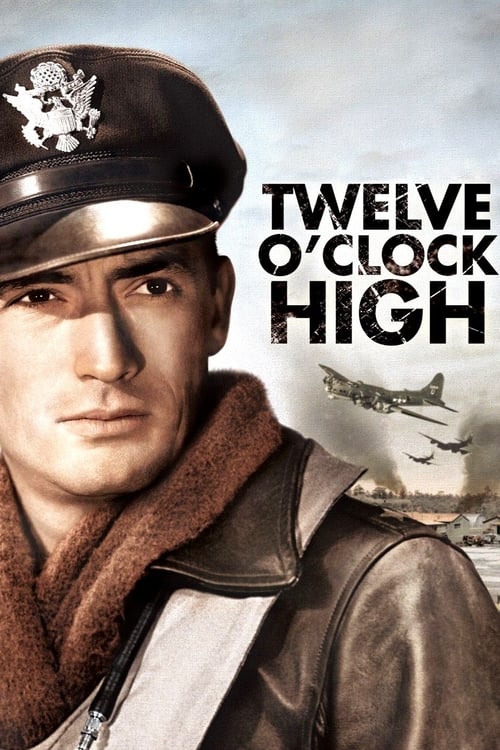
Twelve O'Clock High
1949 · Henry King
For when you want a serious, substantial classic about leadership and endurance — the kind of film you reach for when you're thinking about pressure, responsibility, and what it costs to carry other people. Challenge more than comfort, but deeply rewarding.
What it's about
England, 1942: American bomber crews are flying daylight raids over occupied Europe and dying in appalling numbers. General Frank Savage is sent to take over a 'hard luck' bomb group that has come apart under its losses, and to rebuild it he must make himself hated — driving exhausted young men back into the air while refusing to let himself feel what it costs them, or him. It's a war film where the real battlefield is the briefing room.
The experience
Sober, gripping, and quietly devastating — the tension comes less from combat than from watching men calculate how much more they can take. It builds a slow pressure that lands harder than most action ever does.
Performances
Gregory Peck gives one of his finest performances as Savage — the granite command slowly showing hairline cracks — and Dean Jagger won an Oscar as the older adjutant who watches it all with rueful understanding.
The craft
Henry King directs with unusual restraint for a 1949 war picture, locating the drama in offices, faces, and silences rather than spectacle, and folding in real combat footage for the raids. The result is a war film that feels closer to a psychological study than an adventure.
Why it matters
It became a founding text of the postwar reckoning with combat fatigue — so clear-eyed about command stress that militaries and business schools taught it for decades — and set the template for the serious air-war drama.
Snapshot
Twelve O'Clock High is a 1949 20th Century-Fox production about command, endurance, and the psychological arithmetic of attritional warfare. Set in 1942 among the American Eighth Air Force stationed in England, it follows Brigadier General Frank Savage (Gregory Peck), who is sent to rehabilitate the fictional 918th Bomb Group — a "hard luck" outfit demoralized by heavy losses during the early daylight precision-bombing campaign over occupied Europe and Germany. The film is unusual among 1940s war pictures for its interiority: the combat is real and terrible, but the drama is located in the office, the briefing room, and the officers' faces, and its true subject is the cost of leadership rather than the mechanics of victory. It arrived at the front edge of the postwar reckoning cycle, won two Academy Awards, and has enjoyed an exceptionally long institutional afterlife as a case study in leadership under stress. It remains one of the defining American films about the burden of command.
Industry & production
The film was a major-studio prestige production from 20th Century-Fox, developed under studio chief Darryl F. Zanuck, whose personal engagement with "serious" postwar subjects shaped much of Fox's output in this period. It derived from the 1948 novel of the same name by Sy Bartlett and Beirne Lay Jr., both of whom adapted their own book for the screen. That authorship matters: Lay had served as an officer in the Eighth Air Force and drew on lived experience of the daylight bombing campaign, giving the material a documentary authority that the studio foregrounded in its presentation.
The production benefited from cooperation with the U.S. Air Force, and portions were filmed at Eglin Air Force Base in Florida, where the Air Force could supply airfields, aircraft, and personnel. The picture's most celebrated production feat is the crash-landing of a B-17 Flying Fortress performed by the veteran stunt pilot Paul Mantz, who belly-landed the four-engine bomber solo — a genuinely hazardous single-take stunt widely cited as a landmark of aerial stunt flying. The film also incorporates authentic wartime combat footage, including gun-camera and captured German material, intercut with staged sequences; this hybrid of the real and the reconstructed is central to the film's texture and to its claim on credibility.
Technology
The film was shot in black-and-white on standard Academy-ratio 35mm, and its monochrome is not a limitation but a strategy: it allowed staged material to be married invisibly to grainy documentary and gun-camera footage of actual air combat. Where color would have exposed the seams between studio and archive, black-and-white absorbs them, and the newsreel-like quality of the real footage bleeds outward to lend the whole film an air of witnessed fact.
The subject itself is technological — the B-17 Flying Fortress, the doctrine of high-altitude daylight precision bombing, the Norden bombsight-era faith in accuracy over the German industrial heartland. The film treats this apparatus soberly: the aircraft are protagonists in the aerial sequences, and the drama repeatedly turns on the physical realities of the technology (formation flying, the vulnerability of bombers to frontal fighter attack — the title's own meaning, an enemy fighter closing from dead ahead and slightly above). The production's use of real aircraft and real bases, rather than models alone, reflects the period's preference for physical authenticity over optical trickery.
Technique
Cinematography
The cinematography is by Leon Shamroy, one of Fox's premier cameramen and a multiple Academy Award winner, working here in a restrained, functional black-and-white register rather than the lush style associated with his color work. The visual scheme is disciplined and unshowy, prioritizing legibility of faces and spaces — the crowded briefing room, the general's office, the control tower — over pictorial flourish. This plainness is purposeful: it keeps the register close to the documentary footage and refuses to aestheticize the war. The most memorable images are frequently the quietest — men waiting, counting returning aircraft, reading exhaustion in one another.
Editing
Editing was by Barbara McLean, Fox's head of the cutting department and a long-standing collaborator of both Zanuck and Henry King. The film's structural signature is its framing device: it opens in the postwar present with former adjutant Harvey Stovall revisiting the derelict Archbury airfield, then dissolves into an extended flashback that constitutes the body of the film. McLean's most demanding task was the integration of authentic combat footage with staged drama; the aerial sequences depend on cutting that fuses disparate film stocks and sources into coherent action while preserving the raw texture of the real. The pacing is deliberately weighted toward the ground — long dialogue scenes of command and confrontation — with combat used punctually rather than continuously.
Mise-en-scène / staging
Henry King stages much of the film in confined institutional interiors, and the claustrophobia is thematic: this is a war fought, dramatically, in offices and briefing huts. The recurring motif of counting the returning aircraft — figures on the ground scanning the sky, tallying who came back — organizes the film's emotional geography around absence. The Toby jug displayed in the officers' club functions as a talismanic object, a small piece of production design that carries the film's memory-and-loss theme and anchors the framing device. Staging favors the group in tension: Savage against his officers, the men against their own fear, authority against exhaustion.
Sound
The film won the Academy Award for Best Sound Recording (credited to the 20th Century-Fox sound department, under Thomas T. Moulton), and the recognition is apt. Sound is a primary carrier of realism here — the drone of massed engines, the specific acoustic world of the airfield and the combat sequences. The score by Alfred Newman, Fox's music director, is used with notable restraint for a film of its era; large stretches proceed without underscoring, so that the diegetic sound of the aircraft and the silences of the waiting scenes are allowed to dominate. This sparing musical strategy reinforces the film's documentary sobriety.
Performance
Performance is the film's center of gravity. Gregory Peck plays Savage as a man who deliberately makes himself hated in order to rebuild a broken unit, and whose own rigid control eventually fractures — culminating in a psychosomatic collapse that is the film's dramatic climax and one of the era's most unusual endings for a heroic lead. Peck's performance was nominated for the Academy Award for Best Actor. Dean Jagger, as the older adjutant Stovall — the film's memory and conscience — won the Academy Award for Best Supporting Actor and provides the framing narration and emotional grounding. Gary Merrill as the relieved commander Colonel Davenport, Hugh Marlowe, and Millard Mitchell round out an ensemble that plays command relationships with unusual naturalism and restraint.
Narrative & dramatic mode
The film's dramatic mode is the tragedy of command reframed as institutional realism. Its structure is a memory-frame: an elegiac present-day prologue and epilogue enclose a long flashback, so that the entire story is told under the sign of loss and retrospection. Within that frame the narrative is essentially a study of a single problem — how to restore the will to fight to men who have been asked to die at unsustainable rates — and it works that problem through with a procedural patience that anticipates later "professionalism under pressure" dramas.
Crucially, the film locates its catharsis not in triumph but in breakdown. Savage succeeds in remaking the group, but the effort consumes him; the same "maximum effort" he demands of his men exacts a hidden psychological toll on the commander. The film's willingness to treat combat stress and command collapse as legitimate dramatic subjects — rather than moral failings — gives it a psychological seriousness rare for its moment.
Genre & cycle
Twelve O'Clock High belongs to the wave of American war films made in the immediate postwar years, when Hollywood turned from wartime morale-building toward retrospective reckoning with the human cost of the conflict. It sits alongside other late-1940s pictures that examined combat's psychological aftermath and the strain of leadership, and it helped define a durable subgenre: the film in which the drama is the burden of command rather than the spectacle of battle. Within the aviation-war cycle specifically, it is the archetype of the "bomber group" film, and its DNA is visible in later air-war pictures. Its emphasis on the executive rather than the frontline soldier — the officer who orders others into danger — distinguishes it from the combat-platoon films with which it is often grouped.
Authorship & method
The film is a characteristic product of the Fox studio system at its most controlled, and its authorship is genuinely collaborative. Director Henry King was one of Fox's most reliable senior directors and a frequent collaborator with Gregory Peck (the two made several films together); his method here is one of self-effacing craftsmanship, subordinating visual style to performance and clarity. Producer Darryl F. Zanuck shaped the project's prestige ambitions. The screenplay by Sy Bartlett and Beirne Lay Jr., adapting their own novel, supplies the lived authenticity — Lay's Eighth Air Force service underwrites the film's procedural credibility. Cinematographer Leon Shamroy, editor Barbara McLean, and composer Alfred Newman were all department heads or leading figures within the Fox machine, and the film's coherence reflects the studio's integrated craft culture as much as any single vision. It is a director's film only in the sense that King orchestrates these forces toward restraint.
Movement / national cinema
The film is a product of classical Hollywood at the height of the studio system, exhibiting that tradition's virtues of narrative economy, invisible technique, and star-anchored ensemble drama. It does not belong to any avant-garde or self-conscious movement. Yet its heavy reliance on documentary and archival footage, and its plain black-and-white realism, place it in dialogue with the broader postwar impulse toward authenticity in war and social-problem cinema. Within American national cinema it functions as a semi-official artifact: made with military cooperation, drawn from firsthand experience, it participates in the nation's cinematic memorialization of the air war over Europe.
Era / period
Released in 1949, the film emerges from the specific cultural moment when the United States was assimilating the meaning of the Second World War at a distance of only a few years. This is the era of the reckoning film — pictures that could now acknowledge exhaustion, fear, and psychological damage that wartime production had muted. It also arrives on the cusp of the postwar institutional turn, in which the language of management, leadership, and organizational effectiveness began to permeate American life; the film's later career as a leadership text is inseparable from this timing. It looks back at 1942 from the vantage of a country beginning to build the Cold War military establishment.
Themes
The film's governing theme is the cost of command — the moral and psychological price paid by the man who must send others to die and who cannot afford to show his own fear. Closely bound to this is the theme of discipline as a form of care: Savage's cruelty is a deliberate instrument for restoring the unit's survival instinct, dramatizing the paradox that harshness can be the truest expression of responsibility. Attrition and endurance run throughout — the film is obsessed with limits, with the point at which men (and commanders) exceed their "maximum effort" and break. The recurring act of counting returning aircraft makes absence and loss literal and structural. Finally, the framing device foregrounds memory and commemoration: the entire narrative is an act of mourning, told by a survivor standing in the ruins of the place where it happened.
Reception, canon & influence
Twelve O'Clock High was well received on release and recognized by the industry with four Academy Award nominations, winning two — Dean Jagger for Best Supporting Actor and the Fox sound department for Best Sound Recording — while Gregory Peck was nominated for Best Actor and the film for Best Picture. It has since settled firmly into the canon of American war cinema as the definitive statement on the burden of command.
Influences on the film (backward): Its most direct source is the firsthand experience of the Eighth Air Force daylight bombing campaign, mediated through Beirne Lay Jr.'s service and the Bartlett–Lay novel; the film's fictional 918th Bomb Group draws on real units and figures of that campaign. The precise degree to which individual characters map onto historical officers is the sort of detail often blurred in adaptation, and I won't overstate specific one-to-one attributions. Stylistically it inherits the documentary-realist impulse of wartime combat filmmaking and the classical Hollywood dramaturgy of the Fox house style.
Legacy (forward): The film's afterlife is remarkable and in some ways exceeds its cinematic reputation. It became a fixture of leadership and management education — used in military instruction and business-school curricula as a case study in leading a demoralized organization, situational leadership, and the sustainability of "maximum effort." A television series adaptation ran through the mid-1960s, extending the property's reach. As a template, it established the modern "burden of command" drama and the bomber-group film, and its psychologically candid treatment of combat stress and command collapse anticipated later, more explicit explorations of the same terrain. Few Hollywood films of its era have proved as durable outside the cinema as within it.
A Deleuzian reading
Start with the counting.
The full Deleuzian reading of Twelve O'Clock High →
Reception
A critical and box-office hit in 1949 — praised for treating combat fatigue seriously when most war films were still flag-waving — it won Dean Jagger an Oscar and has since settled in as a canonical study of command, earning a National Film Registry spot in 1998.
How Twelve O'Clock High was received, from release to now →
How to watch Twelve O'Clock High: what to notice on a first viewing
- Notice the film open in the present, then slide into the past. An older man revisits a derelict airfield, and the film dissolves from that empty present into an extended flashback that becomes the entire story you watch. You already know this is a story being remembered, which changes how you watch everything that follows.
- Notice how much of the film happens indoors, in offices. Henry King stages command and confrontation in cramped briefing rooms and office interiors far more often than in the sky, so the war is fought largely at a desk. The drama of this war movie is located in a room, not in the air above Germany.
- Notice the small jug displayed in the officers' club. The Toby jug sits in the club through the film, a modest piece of production design that keeps returning attention to memory and to who is no longer there. One small object anchors the whole film's sense of loss without a single line explaining it.
- Watch men on the ground count the planes coming back. The film returns again and again to figures scanning the sky and tallying who has come home, organizing its emotional geography entirely around absence. A number on the runway tells you who is missing before anyone has to say a name.
- Listen for how often there is no music at all. Alfred Newman's score stays out of long stretches of the film, leaving the drone of massed engines and plain silence to carry the waiting scenes. Without music telling you what to feel, the quiet itself becomes the sound of dread.
The whole guide to watching Twelve O'Clock High, with the keys for a rewatch →
Influences: the films it descends from and the films it influenced
- The Dawn Patrol (1930) — Established the burden-of-command air-war template Twelve O'Clock High refines: a squadron leader who cracks under the daily arithmetic of signing off inexperienced flyers to near-certain death, then must absorb that same duty when he is promoted.
- Air Force (1943) — Modeled the B-17 crew as a single procedural organism, with cockpit-realist detail on formation flying and gun positions that Twelve O'Clock High inherits as its baseline of technical credibility.
- Memphis Belle: A Story of a Flying Fortress (1944) — Supplied the actual 16mm combat footage aesthetic of Eighth Air Force daylight raids; King's film integrates real gun-camera and mission footage into staged material, the documentary-footage-editing debt at the film's core.
- The Story of G.I. Joe (1945) — Pioneered the unglamorous naturalistic war ensemble — worn, understated performances over star heroics — the acting register Peck and the 918th's officers adopt.
- Command Decision (1948) — A near-simultaneous treatment of the identical subject — a general agonizing over deep daylight precision-bombing raids and their crew losses — staged almost entirely in confined institutional command-post interiors, the exact cost-of-command chamber drama.
- The Bridges at Toko-Ri (1954) — Reunites Peck as the flyer inside the cold institutional arithmetic of who gets ordered into the strike, extending the naturalistic-restraint performance and cost-of-command theme into the jet age.
- The Caine Mutiny (1954) — Extends the psychological study of a commander's on-the-job breakdown under sustained stress, the command-collapse portraiture Twelve O'Clock High made bankable.
- Paths of Glory (1957) — Carries forward the moral cost of command — generals spending lives from confined institutional interiors far behind the killing — as the film's structural spine.
- The Bridge on the River Kwai (1957) — Builds an entire drama around an officer whose sense of duty curdles into obsession, the psychology-of-command breakdown magnified to epic scale.
- The Gallant Hours (1960) — A near-documentary command study (Cagney as Halsey) built on isolation of the leader, sparing score, and staged restraint — directly extending King's self-effacing craftsmanship.
- Fail Safe (1964) — Transposes the confined-institutional-interior command drama and unbearable send-them-or-not decision onto SAC bombers, playing command pressure almost entirely in windowless war rooms.
- Catch-22 (1970) — Satirical inversion of the same material — a bomber group defined by the mounting mission count and combat-stress breakdown — turning the maximum-effort attrition drama inside out.
- Patton (1970) — Perfects the great-man command character study that Twelve O'Clock High's Peck vehicle prototyped, anchoring the war film to one officer's psychology of leadership and cost.
- Master and Commander: The Far Side of the World (2003) — Modern heir to the cost-of-command drama built on naturalistic ensemble and procedural authenticity, where leadership means husbanding a depleted crew's endurance under relentless attrition.
- Apollo 13 (1995) — The foundational Hollywood template for institutional ensemble drama in which collective competence under extreme operational pressure is the true subject — individual bravado subordinated to group function, command-chain decision-making, and the emotional cost of institutional authority; Howard maps this structure directly onto Mission Control's Gene Kranz.
- The Dirty Dozen (1967) — Early template for treating the WWII unit as a study in command psychology and institutional strain rather than pure heroics, grounding the film's officer-class scrutiny.
- The Gunfighter (1950) — King, Peck and editor Barbara McLean's immediately preceding collaboration establishes the interiorized, minimally demonstrative Peck performance — command exhaustion played through stillness — and McLean's habit of cutting away from the emotional peak rather than into it.
- The Best Years of Our Lives (1946) — Shares the postwar-reckoning frame and the candid treatment of combat stress carried past the war's end, dramatized through restrained ensemble realism rather than spectacle.
- Battleground (1949) — Released the same year with the same naturalistic-ensemble ethic — attrition and endurance rendered through a fatigued group rather than a single hero, and semi-documentary texture.
Similar films
- Fail Safe (1964) — influence & lineage
- The Best Years of Our Lives (1946) — influence & lineage
- The Caine Mutiny (1954) — influence & lineage
- Patton (1970) — influence & lineage · same viewing thread
- Where Eagles Dare (1968) — same viewing thread
- Lone Survivor (2013) — same viewing thread
- Darkest Hour (2017) — shared sensibility
- All Quiet on the Western Front (2022) — shared sensibility
All the films related to Twelve O'Clock High →
Watch it with: curated runs of related films
- Against Overwhelming Force — A run for when you want scale and physical punishment — men set against armies, tanks, and the frozen wild, holding a line that by rights should have broken them.