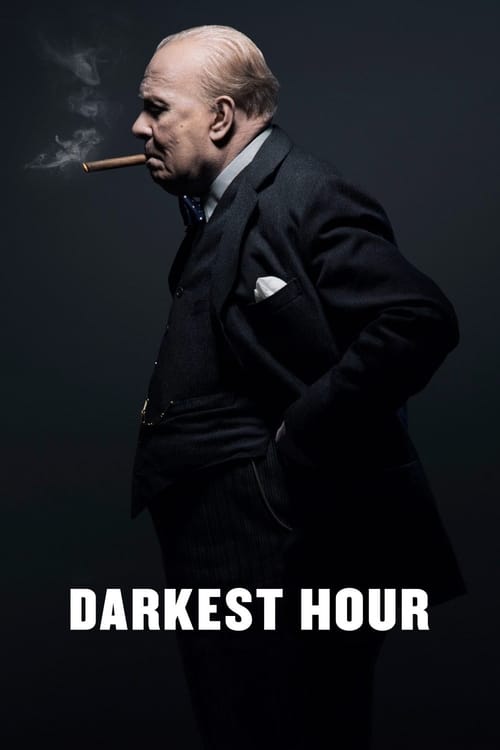
Darkest Hour
2017 · Joe Wright
When you want a meaty, actorly historical drama — something to sink into on a Sunday night that leaves you a little stirred. More comfort than challenge, but with real dramatic weight.
What it's about
May 1940: France is collapsing, the British army is trapped at Dunkirk, and Winston Churchill — newly installed as Prime Minister, distrusted by his own party and his king — must decide whether to negotiate with Hitler or fight on alone. The film follows roughly four weeks of cabinet-room warfare, as the war's biggest decision plays out in cramped bunkers and hushed corridors.
The experience
A pressure-cooker chamber drama: talky, urgent, and surprisingly funny in flashes, built on speeches that land like action sequences. You feel the isolation of one man being asked to gamble a nation.
Performances
Gary Oldman's Churchill is the event: a full-body transformation under heavy prosthetics that never becomes mere impression — irascible, doubting, mischievous, and thunderous by turns. It won him the Academy Award for Best Actor.
The craft
Joe Wright shoots history as portraiture — faces in shafts of light, Churchill dwarfed in elevators and war rooms — turning political process into visual drama. Anthony McCarten's screenplay builds toward the great speeches so they pay off like set pieces, and the prosthetic makeup work is genuinely remarkable.
Why it matters
Released the same year as another Dunkirk film told from the beaches, it became the definitive companion piece from inside the war rooms, and cemented a career-capping Oscar for Oldman.
Snapshot
Joe Wright's Darkest Hour is a chamber piece masquerading as epic: a film whose subject is the weight of history but whose method is the close-up and the confined room. Set across roughly four weeks in May–June 1940, it dramatizes Winston Churchill's first days as Prime Minister — his political isolation within his own War Cabinet, the simultaneous catastrophe at Dunkirk, and his eventual rejection of Halifax's proposal to open armistice negotiations through Mussolini. Where Christopher Nolan's Dunkirk (released in the same summer) renders the same historical crisis through kinaesthetic sensation and fragmented time, Wright renders it through oratory, portraiture, and the politics of the face. The film is primarily a vehicle for Gary Oldman's transformative performance, built around Anthony McCarten's screenplay and shot by Bruno Delbonnel in amber chiaroscuro that frames Churchill as a figure simultaneously crumbling and consolidating. It won Oldman the Academy Award for Best Actor and generated substantial awards-season attention while also provoking debate about its approach to historical truth, the limits of the "Great Man" biopic, and the ethics of invented episodes.
Industry & production
Darkest Hour was produced by Working Title Films — the British production company whose prestige strand had, by the 2010s, become a reliable mechanism for Oscar-calibre historical drama — alongside Perfect World Pictures, with Focus Features distributing in North America and Universal in other territories. The project originated with producer Eric Fellner and was developed with McCarten, who had established himself as a specialist in the literary biopic with The Theory of Everything (2014). Joe Wright was brought on after a difficult period: his blockbuster Pan (2015) had performed poorly both critically and commercially, and Darkest Hour was understood within the industry as a return to the terrain — British literary and historical prestige drama — on which he had built his early reputation.
The production faced a central casting challenge that became the film's most-discussed element: how to transform Oldman, lean and angular, into the broad-shouldered, jowled, cigar-wreathed Churchill. Makeup artist Kazuhiro Tsuji, who had largely retired from the industry, was persuaded to come back specifically for this role. The prosthetic application required roughly four hours each day; Tsuji and his collaborators David Malinowski and Lucy Sibbick won the Academy Award for Best Makeup and Hairstyling for their work. The production used authentic locations in London alongside carefully recreated studio sets — the Cabinet War Rooms, Chartwell, and the Houses of Parliament interiors were all reconstructed or dressed with period accuracy under production designer Sarah Greenwood, a frequent Wright collaborator.
Technology
The film was shot digitally on the ARRI Alexa, the dominant platform for high-end prestige production in this period. Bruno Delbonnel — whose work with Jean-Pierre Jeunet (Amélie, A Very Long Engagement) and the Coen Brothers (Inside Llewyn Davis) had established him as one of the foremost colorists working in cinema — developed a specific photochemical treatment that pushed the image toward amber, gold, and deep shadow. The result is a palette simultaneously historical and expressionistic: the warmth suggests period photography and lamplight, but the density and contrast are too extreme to be naturalistic, pushing the image toward something more psychologically saturated.
Delbonnel made particular use of tobacco smoke as a cinematographic element — Churchill's cigars become a recurring texture in the light, softening edges and creating a haze that further distances the image from documentary realism. The camera moves — tracking shots through corridors, slow zooms into Churchill's face — were choreographed to feel like acts of surveillance or disclosure, the camera discovering the man behind the public mask. Tsuji's prosthetics were designed partly with the high resolution of digital acquisition in mind: the work needed to withstand extreme close-up scrutiny.
Technique
Cinematography
Delbonnel's approach to Darkest Hour is one of systematic confinement. The dominant visual logic is enclosure: Churchill is repeatedly filmed in tight spaces — the car, the bedroom, the small private study — where ceiling and wall press in from frame edges. When the frame does open, as in the Parliament sequences, the sudden spatial expansion registers as theatrical, performative, Churchill finally finding the room his voice requires. Close-ups are used aggressively and sometimes fragmentarily: an eye, a hand gripping a tumbler, the set of a jaw. This fragmentation works in tandem with Oldman's physical transformation to turn Churchill's body itself into a landscape to be read.
The film's most tonally dissonant sequence — Churchill riding the London Underground and canvassing opinion from ordinary citizens — is shot with a warmer, slightly looser quality, more naturalistic light suggesting the street-level, democratic world Churchill rarely inhabits. Whether this visual contrast registers as meaningful or merely as a change of aesthetic register to suit the sentiment of the scene is a question critics debated sharply.
Editing
Valerio Bonelli edited the film, working to a rhythm set largely by Oldman's performance and the oratorical cadences of the script. The editing is essentially classical in its approach: cutting to performance, building toward speeches, sustaining moments of silence. The film's structure is ultimately subordinate to the spoken word — sequences build toward Churchill's addresses (to the Cabinet, to Parliament) and the editing withholds cutting to let speeches land whole. There is relatively little of the dynamic montage that might have been expected from the director of Atonement; Wright appears to have deliberately restrained himself, letting the words carry weight.
Mise-en-scène / staging
Wright stages many of the film's most important scenes as contests of space: Churchill physically positioned against Halifax and Chamberlain in the Cabinet War Rooms, their body language and placement encoding the political struggle. The War Cabinet sequences are notably theatrical — Wright draws on his experience with formally stylized production (most explicitly in Anna Karenina, where he staged large sections of the film within a theater) to treat the Cabinet room as a kind of arena. Churchill's movements through the space — the way he colonizes or retreats from it — are choreographed to track his fluctuating confidence.
The Churchill home sequences at Chartwell and Downing Street introduce a more intimate scale, with staging that emphasizes domestic fragility: the great man in dressing gown, the vulnerability of the private. Clementine Churchill (Kristin Scott Thomas) is staged consistently at Churchill's eyeline or slightly above it, granting her an authority the script arguably underserves.
Sound
The sound design emphasizes the weight of rhetoric — the resonance of Churchill's voice in stone rooms, the clatter of his typewriter at night, the distant sound of bombing that enters the film only obliquely, as rumor and report rather than spectacle. Dario Marianelli's score — his fifth collaboration with Wright following Pride & Prejudice, Atonement, Hanna, and Anna Karenina — is more orchestrally massed than his previous work with the director. Where his Atonement score famously integrated typewriter keystrokes into the body of the music, the Darkest Hour score is more conventionally weighty, using brass in particular to underpin the speeches. Some critics found this conventionality an artistic misstep; others felt it appropriate to the material's demands.
Performance
The film's center of gravity is so thoroughly Oldman's performance that discussing it separately from the whole is somewhat artificial. Oldman worked for months on Churchill's voice — the particular jaw-heavy, slightly impeded enunciation — and on his physical mannerisms: the way he walked, held a cigar, slumped in a chair. The performance is a construction of extraordinary technical precision that also convinces as lived feeling. Whether the two — technical mastery and emotional authenticity — always coexist comfortably has been a matter of critical opinion. Some reviewers found the transformation so complete it became its own subject, the film turning into a meditation on theatrical impersonation rather than Churchill; others found Oldman fully inhabiting the character from within the elaborate exterior.
Kristin Scott Thomas brings intelligent understatement to a role the script never fully develops; her Clementine reads clearly as a woman whose counsel is essential but who the film's structure treats as peripheral. Lily James as the secretary Elizabeth Layton and Ben Mendelsohn as King George VI offer solid, understated support in what are structurally functional roles.
Narrative & dramatic mode
Darkest Hour is a decisional drama: its architecture is that of a character arriving, through doubt and crisis, at an act of will. The narrative stakes are clear from the outset — negotiate or fight — and the film's dramatic work is to trace the interior process by which Churchill moves from genuine uncertainty to conviction. This is a mode that places enormous strain on performance, since the decision must be shown to cost something, to be genuinely in doubt, for the climax to carry weight.
The film's most structurally controversial choice is the Underground sequence, in which Churchill, departing from any historical record, rides the Tube and conducts an impromptu focus group with London citizens, drawing from them the resolve he carries into the War Cabinet. The scene has no historical basis — Churchill had not ridden the Underground in many years and did not do so during this period — and critics divided sharply on whether its emotional logic compensated for its historical invention, or whether it represented precisely the kind of manipulative sentimentality that the biopic form enables at its worst. Wright has acknowledged the scene's invented nature and defended it as dramatically necessary.
Genre & cycle
Darkest Hour belongs to a well-defined genre: the British prestige historical biopic, with its conventions of period authenticity, theatrical performance, awards-season release, and "Great Man" narrative architecture. The genre's markers are all present — the production design fetish for archival accuracy, the wig and prosthetics work as visible craft, the emphasis on interior crisis rather than external action. The closest generic neighbor is Tom Hooper's The King's Speech (2010), another film centered on a speech act of historical consequence, featuring a British monarch or leader overcoming personal limitation in a time of national crisis.
The film sits within a remarkable cluster: 2017 also produced Jonathan Teplitzky's Churchill, starring Brian Cox, which covered different but overlapping territory. The dual-release phenomenon is unusual and was noted at the time; Nolan's Dunkirk further crowded the year with WWII-adjacent British cinema. This clustering suggests a cultural appetite, in the Brexit-adjacent moment, for narratives about British exceptionalism under pressure — an appetite the films both serve and arguably consolidate.
Authorship & method
Joe Wright emerged from British television and established himself with Pride & Prejudice (2005) and Atonement (2007), films that demonstrated an unusually confident visual grammar for literary adaptation and a strong formal interest in the relation between surface elegance and internal disruption. Atonement's celebrated five-minute single take on the Dunkirk beach — ironically, the same historical moment Darkest Hour skirts — announced a filmmaker willing to let form bear interpretive weight.
His subsequent career was uneven: The Soloist (2009), Hanna (2011), and Anna Karenina (2012) were all formally ambitious but met with varying reception. Pan (2015) was a failure. Darkest Hour consolidated the view that Wright works best with strong source material and a dominant central performance to anchor his visual ambitions. His creative partnerships are remarkably stable: Bruno Delbonnel was new to his work, but Marianelli, Greenwood, and costume designer Jacqueline Durran (who won the Oscar for her Anna Karenina work) represent a repertory company of collaborators.
Anthony McCarten's contribution is substantial but also symptomatic of his strengths and limitations as a screenwriter. He builds toward speeches with craft — the scaffolding of narrative exists primarily to make the oration land — but his dramatic psychology is sometimes schematic, Churchill's doubts and certainties arriving in shapes that feel predetermined. McCarten subsequently wrote Bohemian Rhapsody (2018) and The Two Popes (2019), confirming his specialization in the literary-historical one-man-and-his-genius mode.
Movement / national cinema
Darkest Hour is firmly within the tradition of British prestige historical cinema, a strand that traces through David Lean's biographical epics, the Merchant Ivory productions of the 1980s and 1990s, and Working Title's own awards-season output in the 2000s and 2010s. The tradition is characterized by high production values, literary or theatrical derivation, theatrical performance conventions, and a tendency to equate Britishness with heritage, restraint, and moral seriousness.
The film's relationship to national cinema is more complicated than it might appear, however. Churchill's character as dramatized here — defiant, eccentric, driven by an almost Romantic sense of individual historical destiny — articulates a nationalist mythology that is itself a cultural construction. The film participates, consciously or not, in a particular British self-image at a particular moment: 2017, as Brexit negotiations began, was a year in which narratives of British solitary defiance against European accommodation had obvious political resonance.
Era / period
The film belongs to the industrial formation sometimes called the "awards-season biopic" — a category of prestige production developed primarily for the autumn festival circuit (Venice, Toronto, Telluride) and oriented toward Academy Award nominations. In this mode, technical craft (prosthetics, period design, cinematography) and performance are foregrounded as visible excellence, and the narrative architecture tends toward the confirmatory: a great figure confirmed in their greatness. The cycle produced a remarkable series of films in the 2010s — The King's Speech, Lincoln (2012), The Theory of Everything, The Danish Girl (2015), Darkest Hour — each sharing broadly similar assumptions about what serious historical cinema looks like and who it is about.
The era is also characterized by a growing critical backlash against this mode: by 2017, the consensus around such films had begun to fracture, with critics increasingly willing to challenge not just individual examples but the generic conventions and their ideological implications.
Themes
The film's explicit subject is decision under catastrophic pressure, and it treats this through the lens of oratory: Churchill's power, as the screenplay constructs it, is fundamentally rhetorical. Words are the operative instrument of politics, and Churchill's genius is his capacity to align language with historical reality in a way that moves people to act. The film is in this respect a meditation on the political function of the spoken word — on how rhetoric creates reality rather than merely describing it.
Beneath this runs the theme of democratic accountability. The Underground scene, whatever its historical deficiencies, stages a thesis: that Churchill's mandate ultimately derives from ordinary people rather than the Cabinet elites who tolerate him grudgingly. This reading of Churchill's authority is politically tendentious but structurally central to the film.
The burden of historical agency — the condition of knowing that one's decisions will determine whether millions live or die — is treated with genuine gravity in the film's best scenes. Churchill's private doubt, rendered in scenes of sleeplessness and vulnerability, complicates the mythology the public sequences build. The tension between public performance and private uncertainty is the film's most consistently interesting territory.
Reception, canon & influence
Darkest Hour received broadly positive reviews on its festival debut at Telluride in 2017, with criticism primarily focused on Gary Oldman's performance and the film's visual ambition. Wider critical reception was warm but not uniformly enthusiastic: while Oldman was virtually universally praised, the film itself was often characterized as a distinguished vehicle for a great performance rather than a great film in its own right. The Underground scene attracted specific and sustained criticism as a manipulative intrusion of populist sentimentality. The comparison to The King's Speech was ubiquitous and not always flattering — some critics felt Wright's film shared Hooper's film's tendency toward emotional manipulation without matching its structural economy.
The film's antecedents include not only the post-Lean tradition of British prestige cinema but the specific tradition of Churchill portraiture. Albert Finney's performance in the television film The Gathering Storm (2002) and Brendan Gleeson's in Into the Storm (2009) preceded Oldman, and the challenge of the role — physical transformation, vocal impersonation, the weight of myth — was well established before Wright's film. The visual scheme borrows from expressionist precedents: the amber palette and deep shadow recall aspects of Carol Reed's postwar British films, and Delbonnel's evident interest in the aesthetics of the 1940s photograph and newsreel gives the film a partly archaeological texture.
Darkest Hour's forward influence is difficult to assess at this early distance. Its most immediate contribution may be to have established Kazuhiro Tsuji's prosthetic transformation technique as a viable template for the prestige biopic. Oldman's Oscar win confirmed the continuing power of physical transformation in Academy recognition and likely encouraged subsequent productions in the same vein. The film's place in Churchill mythology is more ambiguous: arriving alongside Dunkirk and the Brian Cox Churchill, it contributed to a moment of densely layered cultural renegotiation of the Churchill legacy — a renegotiation that has continued and complicated considerably in subsequent years as scholarly reassessments of Churchill's record (particularly on Empire and India) have entered mainstream discourse. Whether Darkest Hour's hagiographic framing will continue to read as adequate or will appear, with time, as a product of a specific and passing cultural moment remains an open question.
A Deleuzian reading
A hand closes around a whisky tumbler.
The full Deleuzian reading of Darkest Hour →
Reception
In 2017 it landed as the classy awards-season companion to Dunkirk — Gary Oldman's transformation was hailed as a lock from the first trailer, and the film duly won him the Oscar. Since then the performance and Kazuhiro Tsuji's makeup have kept their luster while the film around them is increasingly filed under handsome, conventional Oscar-bait.
How Darkest Hour was received, from release to now →
Influences: the films it descends from and the films it influenced
- The Third Man (1949) — Delbonnel's deep amber chiaroscuro and tobacco-smoke interior atmospherics directly cite Reed's postwar British visual grammar — the same moralizing weight of low-key light on faces in confined, shadow-drenched rooms that the dossier names as an expressionist precedent.
- Lawrence of Arabia (1962) — Darkest Hour inherits Lean's template for British prestige historical biography: fragmentary close-up cutting that isolates the great man's physiognomy against the sweep of events, and a decisional drama structure that builds the entire narrative toward a single oratorical or action climax.
- The Remains of the Day (1993) — Ivory's amber-lit, compression-framed British institutional interiors — corridors, studies, drawing rooms as arenas of repression — established the visual and tonal grammar of British heritage prestige cinema that Wright's War Cabinet rooms directly inherit.
- Nixon (1995) — Stone legitimizes the invented dramatized episode as a biopic device (Nixon alone in the Lincoln room) and renders institutional interiors through chiaroscuro as the visual correlate of moral crisis — both techniques McCarten and Wright deploy for Churchill's private doubts.
- The Gathering Storm (2002) — Albert Finney's BAFTA-winning Churchill established the specific demands of oratorical impersonation as the credibility test for the role — total physical and vocal transformation requiring prosthetic augmentation — that Oldman and Tsuji's technique consciously answers.
- Downfall (2004) — Hirschbiegel frames the confined underground bunker as a political arena where the staging of bodies around the leader enacts the collapse of authority; Delbonnel's confinement framing of the War Cabinet rooms deploys the same spatial grammar with inverted moral valence.
- Pride & Prejudice (2005) — Wright and Marianelli's first feature collaboration established their shared scoring approach: Marianelli's piano enters in the pauses between spoken lines rather than underscoring them, carrying the emotional charge the screenplay withholds from dialogue — the same technique recurs in Darkest Hour's oratorical build-ups.
- Atonement (2007) — The Dunkirk beach single take invented the formal vocabulary Wright later applies to Darkest Hour's confined spaces: a sustained camera grammar that reads collective historical catastrophe through isolated physiognomy, with Marianelli scoring the silences between diegetic action and emotional release.
- The King's Speech (2010) — Hooper co-establishes the structural template Darkest Hour follows: British wartime leader isolated in a confined space, oratorical failure as the dramatic problem, a single public speech as climactic resolution, with confinement framing rendering political crisis as intimate psychodrama — the comparison the dossier calls inescapable.
- Lincoln (2012) — Spielberg builds his decisional drama entirely through confined-chamber deliberation, using speech-withholding cutting that delays Lincoln's key argument until the dramatic preparation is complete — the same narrative engineering McCarten uses to scaffold toward Churchill's speeches so the oration lands with maximum force.
- Gandhi (1982) — Gary Oldman's prosthetics-and-weight-gain physical transformation to inhabit Churchill directly extends the Kingsley-Gandhi transformation as the defining performance method of British prestige biography; Delbonnel's use of extreme close-ups against cavernous parliamentary wides to dramatize a leader's spiritual isolation inherits Gandhi's wide-to-closeup contrast as a grammar of moral interiority.
- J. Edgar (2011) — Gary Oldman's prosthetic transformation under Kazuhiro Tsuji — internalized performance of a historical figure's private psychology beneath physically distorting makeup — extends J. Edgar's prosthetic-constraint performance mode into British prestige biography, with the same critical split between performance praise and makeup distraction.
- The Favourite (2018) — Lanthimos borrows the British prestige biopic's amber candlelit chiaroscuro and takes the confinement-framing-as-political-arena to a formal extreme — fish-eye wide-angle in enclosed palace rooms makes spatial enclosure itself the political argument, pushing the grammar Darkest Hour consolidates into open distortion.
- Vice (2018) — McKay extends the prosthetic-transformation great-man decisional drama Darkest Hour consolidates: Bale's Cheney uses the same physical impersonation grammar — prosthetics, vocal replication, gestural study — to satirical rather than hagiographic ends, demonstrating the template's range immediately after Oldman's Oscar win ratified it.
- Spencer (2021) — Larraín uses the British prestige biopic's confinement framing — Diana trapped in Sandringham's corridors, the architecture as political instrument — while grounding invented episodes (the pearls, the Anne Boleyn ghost) in the same dramaturgical legitimacy tradition Darkest Hour claims for its invented Underground tube-carriage scene.
- Oppenheimer (2023) — Nolan's tribunal sequences deploy confinement framing and speech-withholding cutting in the same structural pattern as Darkest Hour's cabinet meetings: bodies arranged under institutional pressure in an enclosed room, the dramatic question of whether the speech succeeds held in suspension until the cutting releases it.
- Bohemian Rhapsody (2018) — McCarten's second biopic screenplay before Bohemian Rhapsody; prosthetic-aided physical impersonation of a historical figure (Oldman's Churchill makeup) plus the 'darkest hour before the triumphant public moment' narrative arc that the Live Aid climax directly replicates.
- Pressure (2026) — Bruno Delbonnel's shafted, smoke-carried light through map rooms and bunkers, inside a deliberation structure purpose-built to hold one withheld-then-released star performance as its principal engine.
- Anna Karenina (2012) — Wright's experiment with theatrical staging — the social world as literal stage set — extends the spatial-as-political grammar Darkest Hour applies to the War Cabinet, while costume designer Jacqueline Durran and composer Dario Marianelli carry their collaborative vocabulary directly into the Churchill picture.
- Dunkirk (2017) — Nolan ends his film with the public reading aloud of Churchill's 'We shall fight on the beaches' speech as emotional culmination — Churchill's words doing the work an unseen Churchill cannot — placing Darkest Hour and Dunkirk in deliberate dialogue as complementary accounts of the same historical moment from opposite vantage points.
- Thirteen Days (2000) — Inherits the wartime-leadership chamber drama — a head of government weighing capitulation versus resolve in confined war rooms, decision-making itself staged as the climax.
- De Gaulle: Liberté (2026) — The contemporary wartime-leader biopic template of cabinet-room rhetoric and besieged decision-making, the Churchill counterpart-piece to Liberté's de Gaulle.
Similar films
- Lincoln (2012) — influence & lineage · same viewing thread
- Oppenheimer (2023) — influence & lineage · same viewing thread
- Vice (2018) — influence & lineage · often watched together
- Dunkirk (2017) — influence & lineage
- The Gathering Storm (2002) — influence & lineage
- The King's Speech (2010) — influence & lineage
- Downfall (2004) — influence & lineage
- The Remains of the Day (1993) — influence & lineage
All the films related to Darkest Hour →
Watch it with: curated runs of related films
- Great Men, Grand Reckonings — A run of prestige true stories about singular, obsessive men chasing an epochal achievement — the bomb, the moon, the checkered flag, a nation — and reckoning with what it cost them and everyone around them.