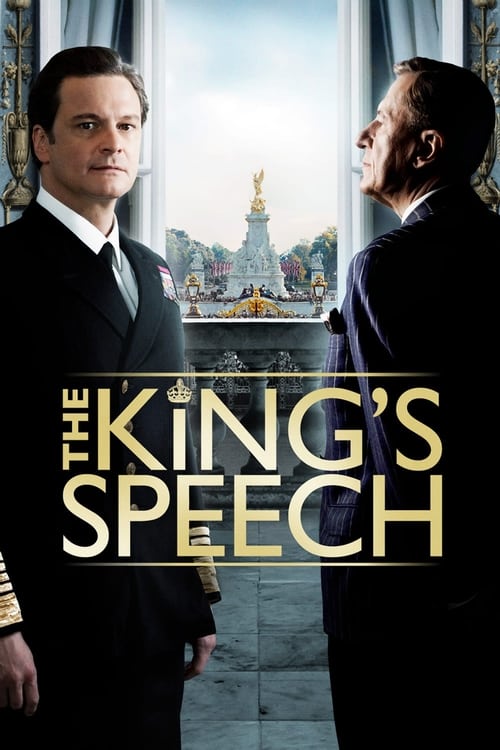
The King's Speech
2010 · Tom Hooper
For a cozy, satisfying night when you want to root wholeheartedly for someone — an underdog story in a palace, comforting rather than challenging, and great to share with parents or anyone who loves British period drama.
What it's about
A reluctant royal, Prince Albert — 'Bertie' — is pushed toward the British throne just as radio makes a king's voice matter more than his crown, and his crippling stammer threatens to undo him. He seeks help from Lionel Logue, an unorthodox Australian speech therapist with no credentials and no patience for palace protocol. What begins as treatment in a shabby consulting room turns into an unlikely friendship, with the abdication crisis and the approach of World War II raising the stakes on every syllable.
The experience
Warm, witty, and quietly tense — the drama lives in pauses, held breaths, and words that won't come out, so a single radio address can feel as suspenseful as a battle. It builds toward a payoff that earns real emotion without ever getting syrupy.
Performances
Colin Firth won the Oscar for his portrayal of Bertie, making the stammer feel physically painful and the man behind it proud, frightened, and funny; Geoffrey Rush matches him beat for beat as Logue, all cheek and compassion, and their sparring is the whole engine of the film.
The craft
David Seidler's Oscar-winning script turns speech therapy sessions into duels of wit and vulnerability, and Tom Hooper shoots the two men in wide, off-center frames that make even a small room feel like an arena. The climactic broadcast is a masterclass in tension built from silence, breath, and a swelling score.
Why it matters
It swept the 2011 Oscars — Best Picture, Director, Actor, and Original Screenplay — and became the defining British prestige drama of its decade, cementing Colin Firth's late-career ascent.
Snapshot
The King's Speech is a British historical drama about Prince Albert, Duke of York — the future King George VI — and his treatment for a debilitating stammer by Lionel Logue, an Australian-born, credential-less speech therapist working out of a shabby Harley Street consulting room. Set across the 1920s and 1930s and culminating in the wartime radio address of September 1939, the film converts a story of national crisis and constitutional rupture into an intimate two-hander about voice, authority, and the labor of being heard. It became one of the most decorated films of its era — winning the Academy Awards for Best Picture, Best Director, Best Actor (Colin Firth), and Best Original Screenplay (David Seidler) — and a touchstone of twenty-first-century British prestige cinema. Its lasting interest lies in how a conventional uplift narrative is rendered through a markedly unconventional visual grammar of distortion and confinement.
Industry & production
The film was produced by See-Saw Films (Iain Canning and Emile Sherman) with Bedlam Productions, financed with backing from the UK Film Council's Premiere Fund, Momentum Pictures, and other UK and Australian sources, reflecting the Commonwealth co-production logic that also shaped its casting. It was made on a modest budget — widely reported in the region of fifteen million dollars — and returned an enormous multiple, grossing well into the hundreds of millions worldwide and standing as one of the most profitable independent films of its moment. The Weinstein Company handled North American distribution and ran the awards campaign that propelled it to Best Picture.
The screenplay had an unusually long gestation. David Seidler, himself a childhood stammerer who had grown up during the war and identified with the King's broadcast voice, researched the story for decades. By his own account he sought the Queen Mother's blessing and was asked to wait until after her lifetime; she died in 2002, after which the project moved forward in earnest. The material was developed and workshopped as a stage piece as well as a screenplay. Late in production the filmmakers gained access to the actual diaries and notebooks of Lionel Logue, held by his grandson Mark Logue, which supplied authentic detail and dialogue color and lent the finished film documentary ballast it might otherwise have lacked.
A notable industry footnote concerns the film's certification. The therapy scenes contain a cathartic torrent of profanity, earning an R rating in the United States; the Weinstein Company later released a re-edited, muted version to secure a PG-13 and broaden the audience, a maneuver widely criticized as commercially driven tampering with an award-winning film.
Technology
The King's Speech is technologically conservative by design; its innovations are optical and compositional rather than digital. It was shot on 35mm film in and around London, using real historical and architectural locations dressed to period rather than extensive digital set extension. Cinematographer Danny Cohen worked extensively with wide-angle lenses — a choice usually reserved for landscapes and action — applied instead to cramped interiors and faces, exploiting the format's spatial exaggeration. The production made limited, restrained use of digital tools, primarily for set cleanup and the reconstruction of period London and Wembley rather than for spectacle. This is a film whose "technology" is essentially a lens-and-framing strategy: the apparatus is bent toward psychological interiority, not toward visible effects.
Technique
Cinematography
Cohen's photography is the film's most discussed formal feature and its boldest gamble. Rather than the centered, tasteful symmetry expected of British heritage drama, he and Hooper repeatedly push Bertie to the edge of the frame, surrounding him with oppressive expanses of empty wall, so that the composition itself enacts the character's marginalization and unease. Wide-angle lenses distort the proportions of rooms — most memorably Logue's consulting space with its scarred, peeling plaster — making intimate interiors feel vast, alien, and faintly hostile. Faces are often shot close with these wide lenses, subtly warping perspective and intensifying discomfort. The camera tends to hold and observe; the visual confinement loosens, and framing moves toward conventional balance and warmth, as Bertie gains command of his voice, so that the film's emotional arc is legible in its geometry alone.
Editing
Tariq Anwar's editing favors patience over propulsion. The film is built around sustained two-shots and held reactions, giving the performances room to breathe and allowing the comedy and tension of the Logue–Bertie sessions to develop in real conversational time. The cutting tightens for the set-piece broadcasts, where the intercutting of the King at the microphone, Logue conducting him like an orchestra, and listeners across the nation builds the climactic 1939 address into a sustained suspense sequence — suspense generated entirely by whether a man can speak.
Mise-en-scène / staging
Production designer Eve Stewart and costume designer Jenny Beavan ground the film in a tactile, deliberately unglamorous materiality. Logue's rooms are a study in genteel decay — water-stained, distempered walls that read as a democratic, unintimidating counter-space to the gilded formality of palace and cathedral. The staging consistently contrasts these two worlds: the rigid ceremonial blocking of royal life against the loose, floor-sitting, first-name informality Logue imposes as therapy. Costume tracks status and constraint, with Bertie's stiff uniforms and collars visually literalizing the strictures around him.
Sound
Sound design is, fittingly, central to a film about a voice. The film foregrounds the grain and texture of broadcast technology — the looming Art Deco microphones, the hiss and hum of early radio — making the apparatus of public address into an antagonist. The treatment of the stammer is acoustically precise, dwelling on the silences, blocks, and effortful repetitions so that the audience experiences the agony of the gap. The contrast between the resonant amplified public voice and the small private one is a recurring sonic motif.
Performance
Performance is the film's engine. Colin Firth's George VI is a study in suppressed effort — the physical labor of the stammer rendered without caricature, the jaw and breath visibly fighting the words, the shame and flashes of temper kept under a carapace of duty. Geoffrey Rush's Logue supplies wit, irreverence, and a wounded dignity, his theatrical bravado masking a frustrated actor's ambitions. Helena Bonham Carter plays Elizabeth with a brisk, protective warmth, and a supporting bench of British character actors — Guy Pearce as the abdicating Edward VIII, Michael Gambon as the formidable George V, Timothy Spall as Churchill, Derek Jacobi as Archbishop Cosmo Lang, Jennifer Ehle as Logue's wife Myrtle — gives the institutional world density. The film lives or dies on the Firth–Rush chemistry, and the partnership carries it.
Narrative & dramatic mode
The screenplay marries two durable structures: the therapeutic narrative of a patient and an unconventional healer, and the reluctant-leader arc of a man who must grow into a role he never sought. Its dramatic mode is essentially that of the chamber play — much of the story unfolds as conversation between two men in a room — punctuated by public ordeals (the 1925 Wembley address that opens the film, the coronation, the wartime broadcast) that externalize the private struggle. The genuine tension is interior and is given a fixed external deadline by history: the abdication crisis forces the throne upon Bertie, and the outbreak of war forces him to the microphone. The friendship across class lines — therapy reframed as an unlikely equality — supplies the emotional spine, while a vein of comedy in the sessions keeps the uplift from curdling into solemnity.
Genre & cycle
The film belongs to the British "heritage" tradition — period drama steeped in royal pageantry, country houses, and impeccable production values — but it refreshes that cycle by relocating its center of gravity from spectacle to psychology and by treating the monarchy as a site of personal damage rather than aspirational glamour. It sits within a long line of royal screen biographies and within a 2000s–2010s vogue for sympathetic dramatizations of the modern Windsors (a lineage that includes work by writers and filmmakers returning repeatedly to Elizabeth II's family). It also participates in the broader prestige-biopic cycle organized around a single transformative performance and an awards-season release.
Authorship & method
Tom Hooper came to the film from television, including acclaimed period work, and brought a TV-honed attentiveness to performance and a willingness to break compositional rules in pursuit of psychological truth — the off-center framing and wide-lens distortion are his and Cohen's signature gambit here. His method centered on extensive rehearsal and on building the film around two actors' interplay. David Seidler's screenplay, the product of decades of research and personal identification, supplies the film's wit and its structural clarity; his own history as a stammerer is inseparable from the material's authenticity. Cinematographer Danny Cohen executed the visual scheme of confinement and release. Editor Tariq Anwar shaped its patient rhythm. Composer Alexandre Desplat provided a score built largely on repeated, hesitant string and piano figures that mirror the halting cadence of the stammer and resolve into fuller statements as Bertie finds fluency. The climactic broadcast is famously scored not to original music but to the Allegretto of Beethoven's Seventh Symphony, whose solemn, building ostinato carries the speech — a choice that drew some debate but undeniably amplifies the sequence's gravity. The collaboration of these hands — writer, director, cinematographer, composer, editor, and two lead actors — is unusually balanced for a star-driven prestige film.
Movement / national cinema
This is emphatically a British national cinema product, publicly co-financed and consciously engaged with British institutions and self-image, yet its production reflects a Commonwealth and transatlantic reality: Australian creative and financial partners (mirroring the Australian Logue), and American distribution and Oscar campaigning. It can be read as part of a recurring British soft-power export in which the monarchy and the heritage film function as cultural ambassadors abroad. Within national film history it stands as a high-water mark for the publicly funded, mid-budget British prestige drama of its period.
Era / period
The film depicts the interwar years and the threshold of the Second World War — the 1925 Empire Exhibition, the death of George V in 1936, the abdication of Edward VIII, the 1937 coronation, and the September 1939 declaration of war. Its dramatic stakes are inseparable from the rise of broadcast radio, which is treated as a genuinely new and frightening instrument of leadership: for the first time a monarch must speak directly and continuously into millions of homes, and the demands of mass-mediated authority are precisely what make the King's affliction a matter of state. The film is acute about this technological-historical hinge, even as it compresses and rearranges some events for dramatic economy.
Themes
The governing theme is voice — literal and figurative — as the precondition of authority and selfhood: to lead is to be heard, and the film treats the recovery of speech as the recovery of agency. Around this cluster ideas of duty versus desire (counterposing Bertie's reluctant service to Edward's abdication for love), the performance of leadership in an age of media, and friendship as a leveler of class and rank. The Logue–Bertie relationship dramatizes the therapeutic premise that fluency is bound up with confidence, history, and being permitted to speak as an equal. Underneath runs a study of shame, paternal severity, and inherited expectation, with the stammer functioning as the somatic residue of a constrained, loveless upbringing.
Reception, canon & influence
Critically, the film was warmly received and commercially it vastly outperformed its budget; it premiered at the Toronto International Film Festival, where it won the People's Choice Award, a frequent bellwether for the awards season that followed. Its Academy Awards sweep — Best Picture, Director, Actor, and Original Screenplay from a field of twelve nominations — cemented its canonical standing, though that very triumph also made it a lightning rod in the perennial debate over the Academy's preference for tasteful, uplifting historical drama; some critics framed its Best Picture win, over more formally adventurous competition, as emblematic of "Oscar-bait" prestige.
Backward, the film draws on the deep well of British heritage cinema and royal biography, on the chamber-drama tradition of the two-hander, and on the documentary substrate of the real Logue diaries that surfaced during production. Forward, its success helped sustain the appetite for sympathetic, character-driven dramatizations of the modern monarchy and for the single-performance prestige biopic; it confirmed Colin Firth's standing as a leading dramatic actor and raised Tom Hooper's profile substantially. Within disability and speech-therapy communities it became a widely cited, broadly humane representation of stammering, valued for dramatizing the condition's emotional toll rather than using it for pathos or comedy alone. Its boldest formal legacy — the use of wide-angle distortion and edge-of-frame composition to externalize interior states within an otherwise traditional genre — remains its most distinctive contribution, a reminder that even the most conventional prestige material can be visually reconceived.
A Deleuzian reading
Start the clock at Wembley, 1925.
The full Deleuzian reading of The King's Speech →
Reception
Adored on release — a crowd-pleasing festival hit that swept to the Best Picture Oscar — but its reputation has curdled since, now routinely cited as the textbook case of safe, handsome 'Oscar bait' triumphing over bolder work.
How The King's Speech was received, from release to now →
Influences: the films it descends from and the films it influenced
- The Madness of King George (1994) — Establishes the template of the afflicted monarch as chamber-drama subject — the king's private bodily failing (madness vs. stammer) staged as intimate two-hander between sovereign and a non-deferential medical man who flouts royal protocol.
- A Man for All Seasons (1966) — Model for the dialogue-driven British prestige biopic built on sustained verbal duels in paneled interiors, where conflict is carried by performance and language rather than spectacle.
- My Left Foot (1989) — Pioneers the single-performance prestige biopic organized around an actor's sustained physical embodiment of a speech/motor disability, dramatizing the condition's emotional toll rather than mining it for pathos or comedy.
- Amadeus (1984) — Supplies both the two-hander rivalry structure (genius vs. envious foil) and the device of scoring an emotional climax to a pre-existing classical work — a precedent for laying the broadcast over Beethoven's Seventh rather than original cues.
- Chariots of Fire (1981) — Defines the interwar-Britain heritage drama of personal struggle against institutional reticence, the genteel-period substrate the film inhabits and visually subverts.
- Citizen Kane (1941) — Gregg Toland's wide-angle lenses bending verticals and ballooning foregrounds are the origin point for Hooper and Cohen's distorted close framing — wide-angle as a tool to externalize a man dwarfed and warped by his own room and role.
- Frost/Nixon (2008) — Adapts a stage two-hander into a film where a private duel between unequal men is engineered to climax in a broadcast-media performance, with the texture of microphones and transmission as the arena of reckoning.
- The Gathering Storm (2002) — Chamber-scaled royal biography organized around a two-hander and the private cost of a public role — and literally extends the same historical milieu, featuring Churchill on the eve of war.
- A Beautiful Mind (2001) — Runs the affliction-plus-prestige template — an awards anchor built on a star's meticulous performance of impairment as the obstacle the drama resolves.
- My Left Foot: The Story of Christy Brown (1989) — Builds an awards biopic around impaired, dysarthric speech as performance and the theme of articulate expression won against physical constraint.
- Shine (1996) — Reunites Geoffrey Rush in the patient-mentor relay, dramatizing a speech/communication disability overcome through a tested intimate partnership, as a polished prestige-performance vehicle.
- The Iron Lady (2011) — Extends the single-performance prestige biopic of a 20th-century British leader, foregrounding an actor's vocal/physical transformation and a public figure's private frailty as the film's center of gravity.
- The Theory of Everything (2014) — Inherits the disability-performance prestige biopic formula — an actor's progressive embodiment of speech and motor impairment within a tasteful British period frame, pitched at awards-season uplift.
- The Imitation Game (2014) — Carries forward the interwar/wartime British prestige biopic of a socially halting outsider whose private impediment is overcome in service of the nation, scored and structured for the same sympathetic uplift.
- Darkest Hour (2017) — Most direct heir: same interwar Britain, same reliance on wide-angle expressionist framing to externalize a leader's interior crisis, climaxing in a do-or-die radio/Commons address that the whole film is engineered to deliver.
- Les Misérables (2012) — Hooper amplifies his own King's Speech grammar — extreme wide-angle close-ups, subjects jammed into frame edges, live-captured vocal performance — pushing the distortion-as-interiority device to its expressionist limit.
- The Crown (2016) — Sustains the appetite the film confirmed for sympathetic, character-driven dramatization of the modern monarchy, treating royal duty and private vulnerability as chamber drama across an episodic prestige format.
- One Night in Miami... (2020) — Editor Tariq Anwar's variable cutting rate in dialogue — very long holds while a speaker struggles, then rapid shot exchange as the argument catches — is the same rhythmic technique he carries into the motel room's escalations.
- Fish Tank (2009) — Danny Cohen's prior collaboration: the same cinematographer's habit of pushing the subject to the edge of frame against negative space, here carried from kitchen-sink naturalism into a prestige interior to register psychological confinement.
- This Is England (2006) — Earlier Danny Cohen film establishing his off-center, lens-forward portraiture of constrained figures — the cinematographer's method that Hooper recruits and formalizes into the film's confinement-and-release scheme.
- The Damned United (2009) — Hooper's immediately prior feature, built identically around two actors' rehearsed interplay and a reluctant, prickly protagonist — proof of his TV-honed method of constructing a film as an extended chamber two-hander.
- Longford (2006) — Hooper's TV two-hander of a stubborn public figure and his confidant, where he first married wide-lens, rule-breaking framing to performance-driven period intimacy.
- Elling (2001) — A therapeutic two-hander where rehabilitation proceeds through rehearsed practice between two contrasting men in confined rooms — the comedy-of-rehabilitation structure given a stage-rooted, dialogue-driven form.
- The Queen (2006) — A royal-institution two-hander turning on the sovereign's private impediment versus the demand of public broadcast performance — the same private-feeling-vs-public-duty axis.
- I Swear (2025) — Speech-disorder dignity drama that earns its uplift through the sufferer's public vocal ordeal, in the same prestige British crowd-pleaser register.
Similar films
- The Madness of King George (1994) — influence & lineage
- Darkest Hour (2017) — influence & lineage
- The Iron Lady (2011) — influence & lineage
- The Father (2020) — shared sensibility
- The Queen (2006) — shared sensibility
- The King's Man (2021) — shared sensibility
- Henry V (1989) — shared sensibility
- Hamlet (1948) — shared sensibility