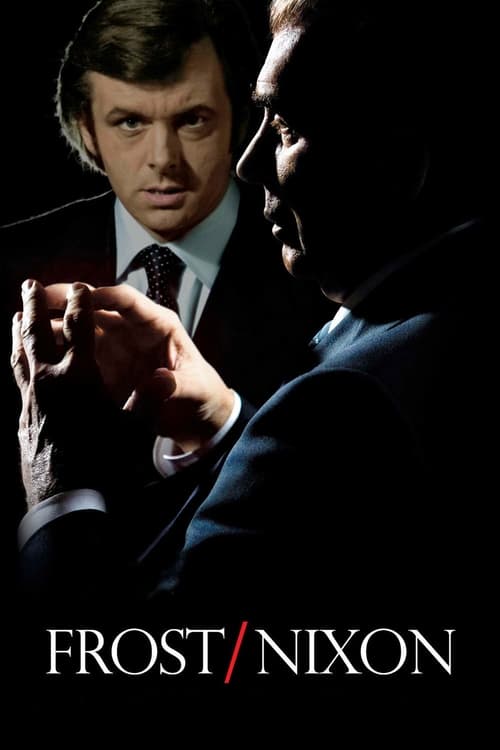
Frost/Nixon
2008 · Ron Howard
For when you want smart, grown-up tension without a single explosion — a battle of wits to savor. Great for a night when conversation and stakes are all the spectacle you need.
What it's about
Three years after resigning in disgrace, Richard Nixon agrees to a series of paid television interviews — and chooses David Frost, a breezy British talk-show host everyone underestimates, as his questioner. What follows is a duel of preparation and nerve: Frost gambling his career and his own money on landing the confession about Watergate that Nixon has no intention of giving.
The experience
A verbal boxing match — tense, talky in the best way, and genuinely thrilling even though it's mostly two men at a table. You lean in a little more with each round.
Performances
Frank Langella doesn't imitate Nixon so much as inhabit his wounded pride and menace — a towering performance — while Michael Sheen's Frost hides real steel under the showman's grin; both honed the roles on stage and it shows in every exchange.
The craft
Peter Morgan's script turns interviews into gladiatorial combat, and Ron Howard shoots the duel in ever-tighter close-ups until a face on a TV monitor carries the weight of a verdict. The editing gives conversation the rhythm of a title fight.
Why it matters
A defining example of the modern political docudrama, it cemented Peter Morgan as the dramatist of power behind closed doors and earned Oscar nominations including Best Picture.
Snapshot
Ron Howard's adaptation of Peter Morgan's stage play reconstructs the 1977 television interviews between British chat-show host David Frost and disgraced former U.S. president Richard Nixon as a gladiatorial contest, a drama of preparation and capitulation played out under studio lights. The film belongs to a lineage of political docudrama that frames the private negotiation as the engine of history — two men circling each other across a table while the fate of public memory hangs in the balance. Frank Langella and Michael Sheen reprise their stage roles, importing the charged physical grammar of the theater into a film that gradually dismantles the proscenium arch in favour of extreme close-up and restless handheld observation. Released in the closing weeks of the 2008 presidential election cycle, the film arrived at a moment when questions of executive accountability and media spectacle had renewed urgency, giving its period subject matter an unmistakable contemporary edge.
Industry & production
Frost/Nixon originated at the Donmar Warehouse in London in 2006, where Michael Grandage directed the world premiere with Langella and Sheen. The play transferred to Broadway at the Bernard B. Jacobs Theatre in 2007, where it ran for 137 performances, winning Langella a Tony Award for Best Actor. Universal Pictures acquired the film rights, with Brian Grazer and Ron Howard producing through their Imagine Entertainment banner — the same partnership responsible for A Beautiful Mind (2001) and Cinderella Man (2005). Morgan wrote the screenplay himself, adapting his own text.
The production navigated the peculiar challenge of all theatrically derived films: how to honor the spatial economy of the stage while justifying the cinema's capacity for visual expansion. Howard and his collaborators chose to open the frame rather than abandon it entirely, shooting the interview sequences in purpose-built studio sets that reproduced the airless formality of the Monarch Bay location where the original taping occurred, while using location work — Washington D.C., London, and the California coast — to anchor the preparatory sequences in geographic and historical specificity. The film carried a reported production budget in the range of twenty to thirty million dollars, modest by studio standards, which concentrated resources on performance and period design rather than spectacle.
Universal distributed the film in North America with a limited release in November 2008 before wide expansion, positioning it squarely in the awards-season conversation. It received five Academy Award nominations: Best Picture, Best Director, Best Actor (Langella), Best Adapted Screenplay, and Best Film Editing. It did not win in any category — the ceremony was dominated by Slumdog Millionaire — but the nominations consolidated its reputation as a serious prestige work.
Technology
Frost/Nixon was shot on 35mm film by cinematographer Salvatore Totino using anamorphic lenses that yield the 2.39:1 widescreen ratio characteristic of classical Hollywood dramaturgy. The choice of anamorphic is significant: it imposes a horizontal grandeur on the frame that periodically conflicts with the intimate, claustrophobic subject matter, creating a productive tension between epic scope and chamber drama. The film predates the wholesale industry migration to digital acquisition; its grain structure and tonal warmth signal period authenticity while also evoking the look of 1970s broadcast television, which the narrative explicitly references.
Within the interview sequences, Howard and Totino deploy multiple cameras simultaneously — a practice derived from television production itself — to capture the spontaneous micro-expressions of their actors without the interruption of repeated setups. This mirrors the methodology of the original 1977 taping, where multiple camera configurations covered Nixon and Frost simultaneously. The resulting footage gives the editing a flexibility that single-camera drama would have foreclosed: the rhythm of reaction and counter-reaction can be constructed in post-production rather than pre-planned on the floor.
Technique
Cinematography
Totino's approach shifts register between the film's two dominant modes. The framing sequences — the retrospective talking-head interviews with supporting characters that provide the film's mockumentary scaffolding — are shot with a slight telephoto compression and a restrained, almost verité formality, evoking the grammar of documentary journalism. The dramatic reconstruction sequences, by contrast, use a much broader tonal palette: wide establishing shots in warm California light for the pre-interview sequences; an increasingly confined, blue-gray palette as the interview sessions begin; and a sustained move toward extreme close-up as the psychological temperature rises.
The climactic Watergate exchange is photographed almost entirely in close-up and extreme close-up, with Howard cutting between Langella's and Sheen's faces in a rhythm that approaches the cutting patterns of a boxing match. The frame becomes so tight in these moments that the architecture of the set — the studio, the chairs, the microphones — disappears entirely. What remains is skin, eye, the slight tremor of a jaw muscle. The film earns this visual compression because it has spent ninety minutes establishing the spatial geography: the viewer knows where every figure sits in relation to every other, and the abandonment of that geography in the climax registers as a formal correlative to psychological rupture.
Editing
Mike Hill and Daniel P. Hanley, Howard's longtime collaborators, construct the film's temporal structure around the logic of a procedural thriller: preparation, setback, renewed preparation, confrontation, and — for one side — resolution. The mockumentary talking heads, positioned strategically throughout, perform a dual function: they establish retrospective dramatic irony (we know the interview happened, we know Nixon eventually broke), and they provide tonal release valves between sequences of escalating tension.
The intercutting between Frost's late-night cramming sessions and Nixon's parallel preparations — feeding on intelligence from his own team, rehearsing his defenses — borrows the grammar of the heist film, building parallel momentum toward an inevitable collision. The editing of the interview sequences themselves is formally rigorous: shot-reverse-shot dominates, but Hill and Hanley vary the rhythm of cuts to modulate intensity, slowing down in moments of psychological ambiguity and accelerating toward the Watergate admission with a momentum that has the texture of inevitability.
Mise-en-scène / staging
Howard is a classical studio director in the tradition of efficient, transparent storytelling, and Frost/Nixon is among his most disciplined deployments of that tradition. The interview set — its chairs positioned at a precise angle, the cameras and crew visible at frame periphery in certain shots, the lighting rigs looming overhead — is staged as a theatrical space that is simultaneously a television studio and an arena. The physical distance between Langella and Sheen across the interview table is managed with geometric precision; its maintenance or violation in the staging of specific moments registers as meaning.
The famous fictional invention of the film — a late-night telephone call from Nixon to Frost the night before the Watergate session, in which Nixon delivers a monologue conflating his own resentment of the American establishment with Frost's outsider status as a British entertainer — is staged almost entirely on Langella's face, with Sheen reduced to a listening presence. Peter Morgan acknowledged the call never happened; it is a dramatic compression, a device for externalizing what the historical record cannot give us: Nixon's private psychology on the eve of his capitulation. Howard stages it as if it were found footage, the camera handheld, the lighting harsh and unflattering, acknowledging the scene's status as imaginative reconstruction even as it delivers the film's emotional centerpiece.
Sound
Hans Zimmer's score is unusually restrained for a composer associated with thematic maximalism. The musical palette is largely percussive and electronic, evoking the rhythms of broadcast television and political procedure without the swelling orchestration Zimmer brings to more conventionally dramatic material. The score functions primarily as texture rather than commentary, underlining transitions and punctuating silences rather than telling the audience how to feel. The sound design in the interview sequences — the hiss of tape machines, the click of camera shutters, the controlled ambient noise of a working studio — grounds the drama in the materiality of 1970s broadcast journalism, making the technology of the original event audibly present.
Performance
The film's central distinction, and the clearest argument for its theatrical origins, is the quality of its leading performances. Frank Langella's Nixon is a performance of extraordinary physical intelligence: the hunched posture, the heavy jowls, the eyes that slide sideways before they settle — all meticulously observed without tipping into caricature. Langella had spent months studying Nixon's movement and speech patterns for the stage version, and the film inherits the distilled authority of that preparation. Crucially, he finds the pathos in Nixon without exculpating him; his Nixon is vain, cunning, self-pitying, and, in the final interview session, genuinely broken — not because Frost has destroyed him but because the performance of confidence finally fails.
Michael Sheen deploys a different strategy: where Langella subsumes himself in historical impersonation, Sheen keeps Frost legible as a construction, a man performing competence while gradually becoming it. The performance is more open, more reactive, calibrated to register doubt and recovery in real time. Their dynamic — Langella's monumental interiority against Sheen's mercurial surface — creates the dramatic electricity the film depends on. In the supporting cast, Sam Rockwell as Frost's researcher James Reston Jr. provides the film's ideological conscience: the man for whom this is not a television event but a matter of historical justice.
Narrative & dramatic mode
The film operates as a two-hander structured like a court case — or, more precisely, like the trial that never happened. The drama's central thesis, articulated explicitly by Reston, is that the formal legal process of Watergate failed to deliver the confession that history required; the television interview becomes a substitute tribunal. This is Morgan's central dramatic idea: that in the post-Watergate media landscape, accountability migrates from the courtroom to the studio, and the power to elicit confession belongs to the interviewer rather than the prosecutor.
The mockumentary framing — retrospective testimonies from Frost's team, from Nixon's aides, from Jack Brennan — establishes the known historical outcome from the outset, creating a dramatic irony that operates throughout. We know Nixon will eventually confess; the dramatic question is not what but when and how, and what it will cost both men to arrive there. This is the structure of classical tragedy re-deployed as political docudrama: the outcome is known; the drama is the process of its becoming inevitable.
Genre & cycle
Frost/Nixon occupies a specific and crowded genre niche: the prestige political docudrama adapted from legitimate theatrical sources, aimed at adult audiences and awards consideration. Its immediate cycle includes films like Michael Mann's The Insider (1999), Andrew Dominik's The Assassination of Jesse James by the Coward Robert Ford (2007), and — most directly — Stephen Frears's The Queen (2006), for which Peter Morgan also wrote the screenplay and Michael Sheen also starred. The Queen–Frost/Nixon pairing constitutes a kind of diptych in Morgan's career, both films concerned with the private psychology of political figures in moments of public crisis, both filtering that psychology through an outsider protagonist (Blair; Frost) who serves as the audience's point of entry into otherwise inaccessible power.
The film also participates in a longer Hollywood tradition of "two men in a room" chamber dramas — a tradition running from 12 Angry Men (1957) through Frost/Nixon and forward into films like Lincoln (2012) — in which the negotiation of language and power substitutes for physical action as the primary dramatic engine.
Authorship & method
Ron Howard is best understood as a craftsman-producer director in the post-New Hollywood tradition: technically fluent, commercially minded, and at his most effective when working with strong source material that provides the structural framework he excels at executing rather than inventing. His auteurist signature is less a distinctive visual style than a consistent set of professional values: clarity, pace, performance-centred staging, and a democratic faith in the legibility of human emotion. Frost/Nixon is arguably his most formally disciplined film, partly because Morgan's play provided an unusually rigorous armature, and partly because the material resisted the sentimentality that occasionally softens his work.
Peter Morgan's screenplay is faithful to the play's architecture while judiciously expanding into spaces the theater could not access: the California exteriors, the Frost team's London fundraising, the recreation of the original interviews' technical apparatus. Morgan's signature method — reconstructing political history through invented private moments that extrapolate psychologically from the public record — is both the film's greatest strength and its most contested feature. The fictionalized phone call is the most debated of these inventions.
Salvatore Totino had previously shot Howard's Cinderella Man (2005), and their collaboration here reflects a shared comfort with period reconstruction and a preference for classical compositional grammar inflected by verité technique.
Hans Zimmer delivers one of his more understated scores, reflecting either the material's resistance to conventionally dramatic music or a directorial decision to let the performances carry the emotional weight without orchestral amplification.
Mike Hill and Daniel P. Hanley have been Howard's editors across much of his career, and their Oscar nomination for this film reflects the particular difficulty of the editing task: sustaining dramatic tension across what is, structurally, a series of conversations.
Movement / national cinema
Frost/Nixon is a Hollywood film that takes British institutions and characters as its lens on American political history, a transatlantic structure that reflects both the film's theatrical origins (the Donmar Warehouse; the West End) and Morgan's own position as a British writer engaging systematically with Anglophone political culture on both sides of the Atlantic. The film belongs less to any national cinema tradition than to the international prestige film ecosystem centered on the Oscars and the British awards season simultaneously — a mode of production that increasingly characterized Anglo-American co-productions in the 2000s.
Era / period
The film was produced and released in 2008, in the waning months of the George W. Bush presidency and during the final stages of the Obama–McCain campaign. The resonances were not incidental: questions of executive overreach, the use of "national security" to justify illegal conduct, and the adequacy of existing accountability mechanisms were live political concerns that gave the film's 1977 subject matter an immediate urgency. Howard and Morgan were publicly aware of this context, though the film does not explicitly telegraph it.
The 1970s setting is rendered with careful period specificity: the clothes, the television equipment, the fonts of the on-screen titles, the physical texture of analog broadcast culture. The film participates in the ongoing 2000s cultural fascination with the 1970s as the decade in which American political innocence definitively ended — a fascination visible across film, television, and publishing in the period.
Themes
The interview as tribunal. The film's central argument is that television journalism can perform, under specific conditions, the accountability function that formal legal institutions failed to deliver. The dramatic climax — Nixon's admission that he let the American people down — is framed as both a personal collapse and a civic event, a moment of public reckoning achieved through private confrontation.
Celebrity vs. gravity. The film is acutely interested in the cultural gulf between Frost's world — show business, celebrity, entertainment journalism — and Nixon's — statecraft, constitutional law, the solemn registers of political power. Nixon's initial contempt for Frost, his certainty that he can outmanoeuvre a man whose métier is light entertainment, is the engine of the film's irony: Frost's very lightness, his freedom from the ideological gravity that weighs down Nixon's opponents, allows him to approach from an unexpected angle.
Preparation and knowledge as power. The film narrativises research itself as dramatic action: the night Frost's team finds the key document — Nixon's conversation implicating him in the obstruction of justice — is staged as a discovery sequence with the tension of a thriller. The film treats rigorous preparation as a moral as well as a tactical virtue.
The performance of confidence. Both protagonists are performing certainty they do not possess. Nixon performs the rehabilitated statesman; Frost performs the heavyweight political interviewer. The drama consists in watching those performances sustain, falter, and — in Nixon's case — collapse.
Confession, accountability, and the limits of closure. The film is careful not to sentimentalize the interview's outcome. Nixon's admission — "I let the American people down" — is partial, managed, arrived at through exhaustion and ambush as much as genuine contrition. The film holds open the question of whether television confession is adequate to political crime, a question it poses but does not answer.
Reception, canon & influence
Critical reception was strongly positive, with particular and near-universal admiration for Langella's performance. Critics noted the film's theatrical origins as both a strength — the dialogue's economy and the structural rigor of the two-hander form — and a limitation, with some reviewers finding that the film never fully escapes the proscenium even in its most cinematically ambitious moments. Roger Ebert awarded the film four stars and wrote with particular attention to Langella's physical intelligence. The film's handling of its fictional elements — especially the phone call — attracted some scrutiny from Nixon scholars and political journalists who noted the risks of presenting dramatic inventions within a broadly realistic frame.
Influences on the film include All the President's Men (1976), which established the dramatic grammar for Watergate as cinema and whose shadow falls over any subsequent film engaging with Nixon. The Queen (2006) is the most direct precedent in Morgan's own career: the same basic method (private scene as the key to public event; the outsider as the audience's surrogate), the same formal sobriety, the same central performance by Sheen as a figure navigating between public duty and personal limitation. Errol Morris's The Fog of War (2003) is a plausible documentary ancestor — its portrait of Robert McNamara in extended interview, gradually arriving at something resembling accountability, anticipates the dramatic situation of Frost/Nixon, though Morris was working in non-fiction with actual footage.
Legacy. The film's most significant long-term contribution may be to the careers and methods of its principal collaborators rather than to film form as such. Peter Morgan went on to create The Crown (2016–), in which his method of dramatizing private psychology within public institutions found its fullest expression. Michael Sheen's Frost became part of a celebrated sequence of Morgan-written political impersonations — Blair, Frost, Brian Clough in The Damned United (2009) — that collectively constitute an unusual case of sustained writer-actor collaboration in contemporary British cinema. Frank Langella's Nixon stands as one of the most sustained and technically accomplished feats of political impersonation in the prestige film tradition, frequently cited alongside Anthony Hopkins's Nixon (1995) and Daniel Day-Lewis's Lincoln (2012) in discussions of historical performance.
The film occupies a stable if not defining position in the canon of political docudrama. It is taught as a case study in the adaptation of theatrical material for cinema, in the ethics of historical dramatization, and in the use of performance-centred narrative to engage questions of political accountability. Its hold on the cultural conversation has been periodically renewed by the continued relevance of its central questions — about media power, executive impunity, and the conditions under which public figures can be compelled to account for themselves — questions that have not become less urgent in the years since its release.
A Deleuzian reading
The shot everyone remembers comes near the end.
The full Deleuzian reading of Frost/Nixon →
Reception
A five-Oscar-nominee prestige hit in 2008 that went home empty-handed, it's since settled into 'solid, slightly forgotten' status — often the first name dropped when people rank that year's Best Picture field.
How Frost/Nixon was received, from release to now →
Influences: the films it descends from and the films it influenced
- 12 Angry Men (1957) — Lumet's progressive lens-compression strategy — opening with wide angles to map the full jury room, then incrementally switching to telephoto close-ups as psychological pressure mounts — is the direct cinematographic precedent for Totino's climactic compression in the Watergate interview sequence.
- Primary (1960) — Drew's pioneering use of hand-held 16mm cameras to film JFK's Wisconsin primary campaign establishes the vérité grammar of the political figure observed under uncontrolled pressure, the stylistic precedent for Frost/Nixon's mockumentary talking-head scaffolding and its handheld inserts.
- The Manchurian Candidate (1962) — Frankenheimer, trained in live multi-camera CBS broadcasts, imports simultaneous multi-camera staging into theatrical filmmaking to capture unrepeatable performance — the identical production methodology Howard and Totino deploy for the interview sequences, mirroring the original 1977 Nixon taping setup.
- Judgment at Nuremberg (1961) — Kramer establishes the substitute tribunal as a narrative form — a formal legal proceeding that doubles as a moral reckoning conducted through dialogue — and uses sustained extreme close-up during testimony to externalize the psychological exposure of a witness who has something to confess, both strategies central to Frost/Nixon.
- The Conversation (1974) — Walter Murch's sound design, in which tape machines and surveillance microphones become instruments that mediate contested truth rather than simply document it, establishes the formal grammar of the recording apparatus as moral agent — directly relevant to Frost/Nixon's treatment of television interview technology as an instrument of exposure.
- Network (1976) — Lumet configures the television broadcast studio as a gladiatorial arena and uses extreme close-up on performers mid-broadcast to frame media performance as psychological combat, the essential visual and spatial grammar that Frost/Nixon adopts wholesale for its studio interview sequences.
- All the President's Men (1976) — Gordon Willis's institutional close-up grammar — telephoto compression in newsroom and office spaces, a palette of institutional gray and amber, architecture partially occluding faces — provides the visual language Totino adapts for the interview room, and Pakula's procedural assembly of evidence establishes the structural template for Watergate-adjacent accountability docudrama.
- Quiz Show (1994) — Redford constructs the prestige media-accountability docudrama through the substitute tribunal form — Congressional hearings staged as moral theater with a congressional investigator as the Frost-proxy — and uses period-accurate production design to indict the television industry itself, establishing the genre template Frost/Nixon inhabits.
- Nixon (1995) — Stone deploys historical impersonation of Nixon as psychodrama while shifting between archival footage, documentary inserts, and dramatic reconstruction, directly licensing Frost/Nixon's own hybrid mockumentary mode; Anthony Hopkins's sustained extreme close-up work in the confrontation scenes is the performance-film grammar Langella extends.
- The Queen (2006) — Peter Morgan's screenplay uses an identical structural grammar to his Frost/Nixon text: a formal encounter between a commoner-proxy (Blair) and an institution-bound historical figure (Elizabeth II) that forces a private reckoning under public pressure, with the chamber two-hander rhythm, historical impersonation, and shifting register between public ceremony and private crisis as shared craft devices.
- Good Night, and Good Luck. (2005) — Howard directly inherits the historical-inhabitation mode and retrospective framing, centering the broadcast interview as the arena where political accountability is partially sought and partially won—the same dramaturgy as Murrow's confrontation with McCarthy conducted through the television apparatus.
- Cinderella Man (2005) — Extends Howard's polished humane true-story prestige with the same Totino cinematography and Hanley-Hill editing partnership.
- The Social Network (2010) — Fincher uses deposition proceedings as mockumentary scaffolding for reconstructing past events through parallel intercutting between present-tense legal proceedings and dramatic recreation, and Baxter and Wall's editing constructs a procedural thriller rhythm from dialogue-driven confrontation in closed rooms — techniques that Frost/Nixon's editing blueprint makes available.
- Rush (2013) — Howard and Totino repeat the anamorphic 35mm grammar and chamber two-hander rivalry structure — two historical figures in a zero-sum contest whose fates are structurally linked — with parallel intercutting sustaining moral equivalence between protagonists and the same approach to physical and vocal historical impersonation.
- Vice (2018) — McKay inherits Frost/Nixon's mockumentary scaffolding — here through an unreliable narrator and direct-address breaks — and applies it to another prestige political docudrama about Republican executive power, using historical impersonation and the substitute tribunal form (Congressional testimony staged as confessional chamber) as the film's structural armature.
- J. Edgar (2011) — Howard's model of a political biography as retrospective unmasking — the institutional American power figure whose self-presentation collapses under the pressure of testimony, revealing private damage behind public legend — is the immediate template for J. Edgar's interrogation structure.
- The Imitation Game (2014) — Howard stages the interview room as the primary theatrical container for historical confrontation — the two-shot interrogation as the space in which historical reckoning is conducted — directly modeling the police-interview framing device that brackets The Imitation Game's narrative.
- Brexit: The Uncivil War (2019) — Recent political history staged as a thriller built on a contest of methods between two adversaries, plus the prosthetic-light transformation impersonation Cumberbatch extends.
- The King's Speech (2010) — Adapts a stage two-hander into a film where a private duel between unequal men is engineered to climax in a broadcast-media performance, with the texture of microphones and transmission as the arena of reckoning.
- Steve Jobs (2015) — A stage play adapted as filmed theater that builds an entire film toward a single one-on-one verbal duel as its climax.
- Pressure (2026) — The model for opening out a stage-tested text while preserving its two-hander architecture and the rhythms its originating theatrical run had already stress-tested — the adaptation problem Haig's decade-old play poses.
- Goodnight, and Good Luck (2005) — Clooney shoots in anamorphic widescreen and configures the television broadcast studio as the site of a media accountability confrontation, using institutional close-up to dramatize the broadcaster's moral reckoning with executive political power — the same arena-as-studio staging and media-accountability subject Frost/Nixon occupies.
- Capote (2005) — Philip Seymour Hoffman's historical impersonation and Miller's use of extreme close-up during Capote's interview sequences with Perry Smith establish the interviewer-who-extracts-confession-through-seduction as a formal device, a direct structural precedent for Howard's treatment of Frost's psychological ambush preparation.
- Doubt (2008) — Shanley and Roger Deakins solve the stage-to-film adaptation challenge — how to justify the camera when power already lives in the dialogue — by concentrating psychological pressure through extreme close-up in confrontational sequences between two performers of matched intensity, the same formal solution Howard and Totino reach for the climactic Watergate exchange.
- Path to War (2003) — Howard's two-hander uses blocking-as-power-dynamics as its primary cinematic grammar, staging verbal dominance through spatial geometry and camera distance in explicit debt to the political drama tradition that Frankenheimer's institutional compositions perfected.
- Conspiracy (2001) — A largely single-room verbal duel between two intelligent, dangerous men, sustained on reaction-shot coverage of listening and advantage rather than on event — the two-hander tension at Conspiracy's Heydrich/Eichmann core.
Similar films
- Nixon (1995) — influence & lineage
- All the President's Men (1976) — influence & lineage
- The Conversation (1974) — influence & lineage
- The Queen (2006) — influence & lineage
- Doubt (2008) — influence & lineage
- Network (1976) — influence & lineage
- Quiz Show (1994) — influence & lineage
- Good Night, and Good Luck. (2005) — influence & lineage
All the films related to Frost/Nixon →
Watch it with: curated runs of related films
- Great Men, Grand Reckonings — A run of prestige true stories about singular, obsessive men chasing an epochal achievement — the bomb, the moon, the checkered flag, a nation — and reckoning with what it cost them and everyone around them.