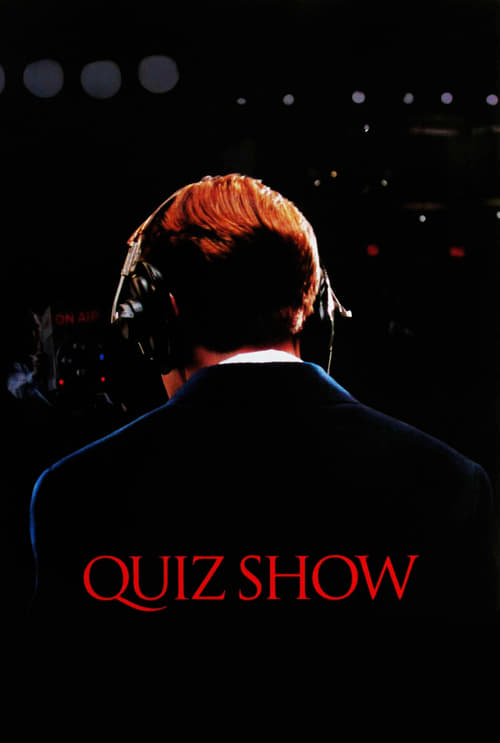
Quiz Show
1994 · Robert Redford
For when you want a smart, grown-up drama about ambition and compromise — something to argue about afterward rather than escape into. Comfortable to watch, uncomfortable to sit with.
What it's about
In late-1950s New York, the beloved TV quiz show Twenty-One dumps its abrasive working-class champion, Herbert Stempel, for Charles Van Doren — a handsome, patrician Columbia instructor the network can sell. Stempel cries fraud, and a young congressional investigator, Richard Goodwin, starts pulling at the thread of how the show really works. What unfolds is a true-story anatomy of television's first great scandal: the moment the medium learned it could manufacture authenticity.
The experience
Talky in the best way — literate, tense, morally slippery, built on conversations where everyone is half-lying to themselves. It moves like a courtroom drama without a courtroom, and it leaves you chewing on how much you'd have taken the deal too.
Performances
John Turturro is all wounded, grating pride as Stempel; Ralph Fiennes makes Van Doren's slide into fraud feel seductive rather than villainous; and Paul Scofield, as his eminent father, does devastating work with quiet disappointment.
The craft
Robert Redford directs with polish and patience, letting Paul Attanasio's sharp, morally layered script carry the weight — the period detail evokes the glow of early television and the class textures of 1950s New York without ever turning into costume-drama wallpaper. The real craft is structural: three men's stories braided so your sympathies keep shifting.
Why it matters
A four-time Oscar nominee that became the definitive screen account of the quiz-show scandal, and a touchstone for every later film about media manipulation and manufactured truth.
Snapshot
Quiz Show reconstructs the 1958–59 television quiz-show scandal, in which the NBC program Twenty-One was revealed to have fed answers to favored contestants. Robert Redford's fourth feature as director dramatizes the collision of three men: Herbert Stempel (John Turturro), the abrasive Queens everyman deposed as champion; Charles Van Doren (Ralph Fiennes), the patrician Columbia instructor groomed to replace him; and Richard Goodwin (Rob Morrow), the young congressional investigator who exposes the fraud. Working from Paul Attanasio's adaptation of Goodwin's memoir, Redford treats a rigged game show as the primal scene of a larger American corruption — the moment television learned it could sell counterfeit authenticity to a trusting public. Polished, literate, and morally deliberate, the film earned four Academy Award nominations, including Best Picture and Best Director, and stands as one of the more intelligent studio dramas of the mid-1990s about the commodification of truth.
Industry & production
The film was produced under Redford's Wildwood Enterprises with Baltimore Pictures (Barry Levinson's company) and released by Hollywood Pictures, the adult-oriented Disney label, in September 1994. Its screenplay derives from a chapter of Richard N. Goodwin's Remembering America: A Voice in the Sixties (1988); Goodwin, later a speechwriter for Kennedy and Johnson, served as a consultant, and the adaptation by Paul Attanasio (a former film critic making his screenwriting debut) is faithful to the broad architecture of events while compressing and dramatizing motive.
The production is notable for its density of directorial talent in supporting and cameo roles: Barry Levinson appears as Today show producer Dave Garroway, and Martin Scorsese takes a sharp, memorable turn as Martin Rittenhome, the fictionalized Geritol sponsor who articulates the film's cynical commercial logic. Casting positioned two rising actors — Fiennes, fresh from Schindler's List (1993), and Turturro, a Coen brothers and Spike Lee regular — against the gravitas of Paul Scofield as Van Doren's father. Critically the film was among 1994's most admired dramas and drew significant awards attention; commercially it was a comparatively modest performer relative to its prestige, a pattern common to Redford's more austere directorial work. Precise budget and gross figures should be treated with caution, but the record is consistent that its reputation outran its box office.
Technology
The story is itself a document of a specific media technology's adolescence: live network television and the emergent power of the isolation booth, the close-up, and the home broadcast to manufacture drama and intimacy. The film reproduces late-1950s studio hardware — the Twenty-One set, the soundproof booths, the kinescope and control-room apparatus — as both period texture and thematic engine, since the scandal turns on television's capacity to stage the appearance of unrehearsed thought. Redford and his cinematographer are attentive to how the medium flatters and falsifies: the sweat on Van Doren's brow, the theatrical pauses, the framing of a face in apparent agony of recall are shown to be as constructed as any fiction.
On the filmmaking side, Quiz Show is a conventionally photochemical 35mm production of its era, with no reliance on the digital effects then transforming blockbuster cinema. Its technological interest lies less in production novelty than in its subject: the film argues that television, not any single villain, is the agent of corruption — a machine whose commercial imperatives make deception structural rather than incidental.
Technique
Cinematography
The cinematography is by Michael Ballhaus, the German-born master associated with Rainer Werner Fassbinder and, in America, with Martin Scorsese. Ballhaus gives the film a warm, burnished, amber-and-mahogany palette that evokes the affluent glow of Eisenhower-era prosperity — wood-paneled apartments, gleaming automobiles, the honeyed light of the Van Doren family's Connecticut idyll. This nostalgic surface is deliberately seductive and slightly suspect: the beauty of the image participates in the film's argument about the allure of appearances. Ballhaus's characteristically fluid, mobile camera lends the quiz-show sequences a heightened, almost operatic tension, while more intimate scenes are staged with classical restraint. The visual contrast between Stempel's cramped, fluorescent-lit outer-borough world and Van Doren's soft, patrician spaces encodes the film's class argument in light and texture.
Editing
Stu Linder, Barry Levinson's regular editor, cuts the film in a measured, classical style that privileges performance and dialogue over montage flash. The editing sustains suspense in the booth sequences through rhythm and reaction — the cutaway to a face, the held pause before an answer — reproducing the very grammar by which television manufactured its drama. The parallel construction that tracks Goodwin's investigation against Van Doren's rise and Stempel's resentment is handled with clean, legible cross-cutting rather than showy juxtaposition.
Mise-en-scène / staging
Redford's staging is precise and unshowy, favoring balanced compositions, period-accurate production design (by Jon Hutman) and costume, and a strong sense of social geography. The film is meticulous about the semiotics of class: the Van Doren dinner table, with its literary sparring and inherited ease, is staged as a kind of American aristocracy, against which Stempel's household and Goodwin's striving Jewish-Harvard ambition are set. Objects carry weight — the coveted Chrysler that opens the film, the isolation booth as confessional and cage — and the direction trusts the audience to read meaning from arrangement rather than emphasis.
Sound
The score is by Mark Isham, whose restrained, jazz-inflected cues underscore the period without sentimentalizing it. The soundtrack's use of period and period-flavored popular song is pointed: the recurring association with "Mack the Knife" — the ballad of a charming, well-dressed murderer — functions as a wry thematic gloss on Van Doren, the likable con at the film's center. Sound design in the studio sequences reproduces the hush of the booth and the ambient hum of live broadcast, heightening the theatricality of the staged contests.
Performance
Performance is the film's greatest strength. Fiennes plays Van Doren with a caught, ambivalent charm — a fundamentally decent man rationalizing his own corruption, undone as much by vanity and paternal shadow as by greed. Turturro's Stempel is deliberately grating, needy, and self-defeating, a performance brave in its refusal to be ingratiating; it insists on the discomfort of a truth-teller no one wants to believe. Morrow's Goodwin is the ambitious idealist seduced by proximity to the Van Dorens' world. Above them, Paul Scofield's Mark Van Doren — the poet-father — supplies the film's moral and emotional summit; his scenes of wounded dignity give the drama its tragic weight.
Narrative & dramatic mode
Quiz Show operates in the mode of the moral investigation drama, structurally akin to the detective story: Goodwin is the outsider who pulls a thread until an institution unravels. But its deeper mode is tragic, particularly around Van Doren, whose arc follows a Faustian pattern — temptation, ascent, corruption, and a confession that is also a fall. The film braids three trajectories (Stempel's aggrieved fall, Van Doren's compromised rise, Goodwin's disillusioned pursuit) into a study of complicity that resists easy villainy: nearly everyone is guilty, and the least sympathetic man, Stempel, is the one telling the truth. The screenplay's literate, aphoristic dialogue — a legacy of Attanasio's script and the Van Dorens' bookish milieu — gives it the texture of a talk-driven adult drama rather than a thriller.
Genre & cycle
The film sits at the intersection of the historical/period drama, the based-on-true-events exposé, and the American media-critique picture. It belongs to a lineage of films skeptical of television and mass communication — a tradition that runs through A Face in the Crowd (1957) and Network (1976) — and to the 1990s cycle of prestige studio dramas revisiting mid-century America and its institutional scandals. It also participates in the courtroom-and-hearing genre, culminating in the congressional testimony that serves as the story's climax. Within Redford's own output it forms part of a persistent concern with American ideals betrayed by institutions, visible from his acting work in All the President's Men (1976) through his directorial preoccupations.
Authorship & method
Redford directs in the classical, actor-centered, socially conscious idiom he established with his Oscar-winning debut Ordinary People (1980) and continued through A River Runs Through It (1992). His method here is restraint: he suppresses stylistic flourish in favor of clarity, letting theme emerge through performance, staging, and script. His well-documented ambivalence about celebrity and the machinery of image — Redford being himself a product and critic of American myth-making — informs the film's skepticism toward manufactured fame.
The key collaborators sharpen this vision. Screenwriter Paul Attanasio supplies the intelligent, epigrammatic dialogue and the tri-partite structure; his adaptation earned an Oscar nomination and launched a major screenwriting career. Cinematographer Michael Ballhaus brings a European classicism and a nostalgic warmth that the film uses ironically. Editor Stu Linder and production designer Jon Hutman anchor the period reconstruction, and composer Mark Isham supplies its cool, unsentimental musical register. The recurring presence of directors in the cast (Scorsese, Levinson) reflects Redford's stature and the collegial prestige of the production.
Movement / national cinema
This is a work of mainstream American studio cinema in its prestige mode — the literate, mid-budget adult drama that the major studios still supported in the 1990s before such films migrated largely to independents and, later, streaming. It carries a strong current of American self-examination, interrogating national mythologies of merit, honesty, and self-invention. Through Ballhaus, it also inherits a strand of the German émigré tradition in Hollywood cinematography, joining European craft to an American subject.
Era / period
Made in 1994, the film reflects a moment of cultural reckoning with the media's role in public life — the era of tabloid television, the O.J. Simpson spectacle, and rising anxiety about the blurring of news and entertainment. Its diagnosis of 1950s television as the origin point of a corrupted media culture resonated with 1990s concerns about spectacle displacing substance. In depicting the late 1950s, it captures the tension between postwar affluence and incipient disillusion, positioning the quiz-show scandal as a small crack that anticipates the larger fractures of the 1960s — a reading consonant with its source, Goodwin's memoir of that decade.
Themes
The film's central theme is the corruption of truth by commerce and image: television discovers that authenticity can be counterfeited and sold, and a nation proves willing to be deceived because the deception is pleasant. Closely bound to this is class and ethnicity — the WASP patrician Van Doren is embraced by the public and the network while the abrasive Jewish Stempel is discarded, a contrast the film reads as an American preference for pedigree and surface over uncomfortable substance. Intellectualism as commodity runs throughout: knowledge itself becomes a performance, and the life of the mind, embodied by the Van Doren name, is debased into a marketable persona. The Faustian bargain and the weight of inheritance and paternal expectation shape Van Doren's tragedy, while complicity — the way institutions diffuse guilt so that no one feels culpable — is the film's mordant final note, sharpened by its coda suggesting that the sponsors and networks escaped while the contestants took the fall.
Reception, canon & influence
Quiz Show was received as an intelligent, elegantly crafted, and morally serious film, praised especially for its performances (Scofield, Fiennes, Turturro) and Attanasio's screenplay, and drew strong year-end recognition; it earned four Academy Award nominations — Best Picture, Best Director, Best Supporting Actor (Scofield), and Best Adapted Screenplay — winning none. Some critics judged it handsome but cool, its restraint verging on the schematic, and a strain of commentary questioned its compression and dramatization of the historical record (notably its treatment of Goodwin's centrality and certain characterizations). Commercially it was a modest performer given its prestige, a discrepancy noted at the time.
Backward influences are legible: the film descends from the tradition of American media critique in A Face in the Crowd and Network, from the investigative-drama template of All the President's Men (in which Redford starred), and from the classical Hollywood social-problem picture. Its European-inflected craft, via Ballhaus, links it to a longer transatlantic lineage.
Forward legacy: Quiz Show has endured as a touchstone reference for the manipulation of reality television and the manufacture of televised authenticity, its relevance arguably deepening in the era of reality TV, "fake news," and engineered spectacle. It is frequently cited in discussions of media ethics and remains a model of the literate, adult studio drama — a form whose subsequent decline lends the film a certain retrospective poignancy. Its precise, sober reconstruction of an institutional scandal anticipates later prestige dramas about corporate and media malfeasance. Within Redford's career it consolidated his standing as a director of thoughtful Americana, and it helped launch Attanasio, who went on to a significant screen and television writing career.
A Deleuzian reading
The film opens on a car.
The full Deleuzian reading of Quiz Show →
Reception
A critical darling in 1994 — four Oscar nominations including Best Picture — that nonetheless fizzled at the box office; today it's Exhibit A in the 'smart mid-budget adult dramas Hollywood stopped making' conversation, and its stock keeps rising.
How Quiz Show was received, from release to now →
How to watch Quiz Show: what to notice on a first viewing
- Notice how warm and golden the Van Doren scenes look compared to Stempel's world. Michael Ballhaus lights the Van Doren home and Connecticut idyll in amber, wood-paneled warmth, while Stempel's cramped outer-borough spaces stay flatter and more fluorescent. The color contrast makes the film's argument about class and pedigree visible before any character states it.
- Notice the isolation booth used first as a stage, later as a cage. The same booth that showcases contestants' brilliance recurs across the film, its meaning shifting as the audience learns more about what happens before a contestant enters it. A single recurring object changes meaning entirely once you know what it's really for.
- Listen for how often the film returns to Mack the Knife. The recurring ballad about a charming, well-dressed murderer plays across scenes involving Van Doren. A song about a likable con functions as commentary on the film's most charming character without a single line of dialogue saying so.
- Watch how differently Fiennes and Turturro are allowed to be likable. Fiennes plays Van Doren with caught, ambivalent charm, while Turturro plays Stempel as deliberately grating and needy, refusing to make him easy to root for. The film gives its warmth to the man in the wrong and withholds it from the man telling the truth.
- Notice the held pause before a contestant answers a question. The editing repeatedly cuts to reaction shots and holds on the pause before an answer, echoing the very suspense grammar television used to manufacture drama. The film's own editing borrows the trick it's exposing, letting you feel how the manipulation worked.
The whole guide to watching Quiz Show, with the keys for a rewatch →
Influences: the films it descends from and the films it influenced
- All the President's Men (1976) — Supplies the investigative-procedural template of reconstructing an institutional scandal through methodical two-hander interrogations, the exact patient fact-gathering rhythm Goodwin's inquiry follows — and Redford lived it as a lead actor.
- Network (1976) — Models the American media-critique drama in which television is an amoral engine manufacturing spectacle for ratings, the network's complicity that Quiz Show cools from satire into sober tragedy.
- A Face in the Crowd (1957) — Establishes the arc of an ordinary man morally corrupted by the camera's manufacture of televised fame — Van Doren played as a genteel, self-deceiving Lonesome Rhodes.
- Ordinary People (1980) — Redford's own founding of his actor-centered restraint idiom — suppressing stylistic flourish so theme emerges through quiet performance and charged domestic staging, the method he reapplies here.
- The Age of Innocence (1993) — Ballhaus's nostalgic warm palette and gliding camera deployed ironically over period surfaces and fine-grained class semiotics — the immediate precedent for his Quiz Show look.
- GoodFellas (1990) — The roving, long-take mobile camera Ballhaus perfected with Scorsese, carried into the quiz-show green rooms and studios to charge institutional spaces with movement.
- The Marriage of Maria Braun (1979) — Ballhaus's fluid, circling camera and European formal classicism, the transatlantic craftsmanship he transplanted into American prestige drama.
- The Threepenny Opera (1931) — Origin of the 'Mack the Knife' / Kurt Weill Brechtian ballad used as ironic, cynical commentary glossing corrupted commerce — the film's recurring musical motif.
- The Sting (1973) — The elegantly staged period-con structure (Redford again the lead) that makes the audience complicit in an engineered deception, mirrored in the rigged-quiz mechanics.
- The Insider (1999) — Extends the sober prestige reconstruction of media-and-corporate malfeasance and television-news ethics, the institutional whistleblower drama built from methodical investigation.
- Good Night, and Good Luck (2005) — Recreates period live television as a moral arena, using the same restraint and archival-broadcast texture to interrogate the ethics of the medium.
- Frost/Nixon (2008) — Stages television itself as the arena where authenticity is performed and truth manufactured, a based-on-true-events drama pivoting on a single broadcast confrontation.
- The Truman Show (1998) — Carries forward the manufacture of televised authenticity and engineered reality into pure allegory, the reality-TV logic Quiz Show diagnosed at its origin.
- Spotlight (2015) — Inherits the literate, unshowy procedural — reconstructing an institutional scandal through patient, undramatized investigation and clarity over flourish.
- Donnie Brasco (1997) — Extends screenwriter Paul Attanasio's method — epigrammatic, morally textured dialogue and character-first adaptation of true events launched by his Quiz Show script.
- Nightcrawler (2014) — Dramatizes the commodification of truth into televised spectacle and the moral rot beneath manufactured on-screen authenticity, Quiz Show's theme pushed to predatory extreme.
- Primetime (2026) — A docudrama about a rigged real broadcast that shows sponsor, network and producer as one complicit system, the template for treating a TV scandal as institutional entanglement rather than one person's sin.
- Wag the Dog (1997) — Satirizes the manufacture of media spectacle and staged reality; Levinson appears in Quiz Show, and both anatomize engineered on-screen authenticity.
- The Social Network (2010) — The literate adult studio drama of epigrammatic verbal duels and ambition-as-Faustian-bargain inside an institutional milieu, the form Quiz Show exemplified.
Similar films
- GoodFellas (1990) — influence & lineage
- The Sting (1973) — influence & lineage
- All the President's Men (1976) — influence & lineage
- The Insider (1999) — influence & lineage
- Spotlight (2015) — influence & lineage
- The Truman Show (1998) — influence & lineage
- Frost/Nixon (2008) — influence & lineage
- The Age of Innocence (1993) — influence & lineage