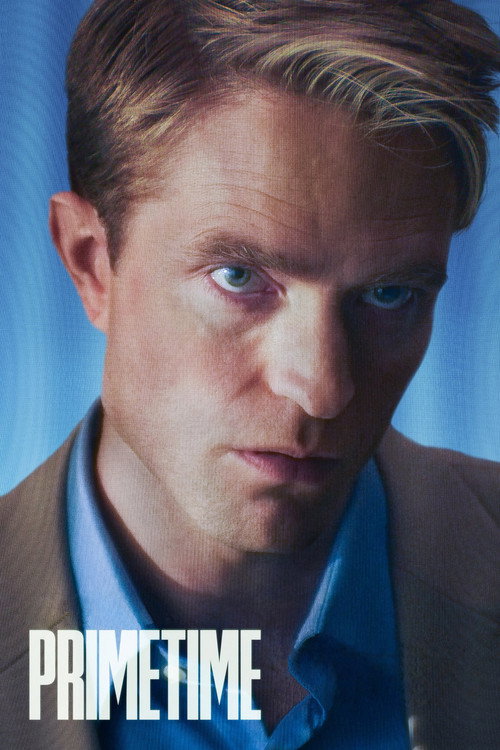
Primetime
2026 · Lance Oppenheim
For when you want a tense, morally thorny true-story thriller that leaves you arguing about it afterward — a challenge, not a comfort watch. Reach for it when you're in the mood to feel implicated, not reassured.
What it's about
In 2006, Dateline NBC host Chris Hansen is turning hidden-camera stings into appointment television: decoys pose as minors online, men show up to a rigged suburban house, and Hansen walks in with his catchphrase while cameras roll. The film follows Hansen and his crew — a seasoned lead producer, an eager young staffer, the vigilante group feeding them targets, the police waiting outside — as the show's success pushes the operation toward bigger risks. Drawn from the real making of To Catch a Predator, it builds toward a high-stakes sting in a small Texas town where the machinery of televised justice starts to slip out of anyone's control.
The experience
Queasy and gripping at once — it uses the suspense tricks of the very show it's dissecting, so you're pulled along even as you squirm at what you're complicit in watching. The grainy, saturated mid-2000s video texture makes the whole thing feel slightly feverish, and the tension ratchets steadily toward something you sense can't be taken back.
Performances
Robert Pattinson is the draw: a near-exact Hansen facsimile that critics called devilish, all unflinching composure and pursed-lip control hiding something hollow underneath. Skyler Gisondo steals scenes as a young crew member, Merritt Wever grounds the production side, and Phoebe Bridgers makes a natural, unforced acting debut.
The craft
Director Lance Oppenheim, making his first fiction feature after acclaimed documentaries, shot it in roughly thirty different camera formats to recreate the mongrel textures of 2000s TV — hidden surveillance cams, handheld news rigs, camcorder grain. David Bolen's cinematography is greasy and livid with grain, full of mirrors and monitors that keep asking who's watching whom; it rewards a big screen precisely because it makes ugly video feel tactile. Ari Balouzian's score and an original Phoebe Bridgers song round out the unease.
Why it matters
An A24 Venice-competition title that opened strong and immediately became a flashpoint — the real Chris Hansen publicly condemned it, folding the film into the ongoing argument over who gets to dramatize real people. It marks Oppenheim's leap from documentary to fiction and extends Pattinson's run of producer-star character work.
Snapshot
Primetime is Lance Oppenheim's first fiction feature. Before it he was known for observational documentary work: Some Kind of Heaven (2020), about the Florida retirement community The Villages, and the HBO docuseries Ren Faire (2024). The film dramatizes the making of To Catch a Predator, the Dateline NBC segment series in which correspondent Chris Hansen, working with the online vigilante group Perverted-Justice and local police, confronted men lured by decoys posing as minors, all on hidden camera. Robert Pattinson plays Hansen and is also a producer. Merritt Wever plays Hansen's lead producer, Skyler Gisondo plays a young member of the operation named Dan, and the musician Phoebe Bridgers makes her acting debut. Ajon Singh wrote the screenplay. It is based on Luke Dittrich's 2007 Esquire article "Tonight on Dateline This Man Will Die." That article reconstructed the November 2006 sting in Murphy, Texas, in which Kaufman County assistant district attorney Louis William "Bill" Conradt Jr. shot himself as police entered his home, with the show's cameras outside. A24 backed and distributed the film. It premiered in competition at the 2026 Venice Film Festival, runs about 110 minutes, and opened in US cinemas on 25 September 2026, coming second at the weekend box office with a reported $8.49 million.
The film's central question is how investigative television turned into performance, and what happens when the performance kills someone. Critics disagreed on how well it answers that. They were much closer to agreement on Pattinson.
Industry & production
Primetime follows a familiar A24 move: pairing a festival-credentialed young director with a star whose recent choices lean toward auteur projects. Since roughly 2017 Pattinson has worked mostly with distinctive directors (the Safdie brothers on Good Time, Robert Eggers on The Lighthouse, Bong Joon Ho on Mickey 17), and his producing role here fits that pattern. Reports say he was involved in casting, production and editing. The source is an established magazine article, not a book or an existing screenplay. That puts the film in a recent run of features built from long-form journalism about American media scandals.
Its release was shadowed by public objections from Hansen himself. After a screening he called the film "so detached from reality" and "an insult to the thousands of men and women who work hard every day to protect children from predators," and complained that it turned the work into "essentially a horror film." Pattinson responded publicly. The dispute became part of the film's press cycle. Detailed figures on budget, shoot length and locations are not substantially documented in the public record so far.
Technology
The best-documented technical fact about the film is Oppenheim's statement that it was shot in about thirty different camera formats. The variety partly reproduces the mixed image sources of mid-2000s newsmagazine production: hidden surveillance cameras, handheld ENG (electronic news-gathering) rigs, broadcast-studio video and the domestic camcorder. Some of the shooting reportedly mirrored the chaos of Hansen's own operations. A camera test of Pattinson in the Hansen role was released before the Australian opening, which shows how far the production treated the period look as something to research and build. A full public breakdown of the formats has not yet been published.
Technique
Cinematography
David Bolen, Oppenheim's director of photography, gives the film what The Film Stage's Venice review called "greasy, saturated images" so "livid with grain" they seem to leave "dirt under your fingernails." The texture sits deliberately between cinema and broadcast. The film imitates the grimy look of early-2000s standard-definition video, and its camerawork also implicates the viewer in the act of watching. Coverage of Bolen's work stresses "the many sides" of Hansen and the use of mirroring and reflective surfaces. In a film about a man whose persona depends on being seen, the camera repeatedly treats self-image as a theme. Bolen previously shot Oppenheim's documentaries, so the visual approach continues a working partnership rather than being a fresh hire's style.
Editing
Published sources so far say little about who edited Primetime or how the editing process worked, apart from reports that Pattinson was involved. Critics' descriptions suggest a structure that builds toward the Murphy, Texas operation as a climax. The film cuts between the production machinery (producers, decoys, police coordination) and the staged confrontations. Some reviewers felt the cutting between registers worked well. Others felt the plotting around it was contrived.
Mise-en-scène / staging
The sting house is the film's key set: a suburban kitchen rigged with cameras, where Hansen enters from the side and delivers his catchphrase. That space was a kind of television stage, and the film's design has to rebuild it while also showing everything behind it: control rooms, vans, police staging areas. The 2006 period is carried by broadcast graphics, monitors and newsroom furnishings. Gisondo's character wants to perform in musicals, which adds a backstage-theatre current and fits the film's view of the whole enterprise as theatre.
Sound
The composer is Ari Balouzian, who also scored Oppenheim's earlier documentary work. Bridgers contributes an original song, "On Video," whose title echoes the film's concern with mediated experience. Reviews give little technical detail about the sound design. The source material does suggest the obvious tension between the rough live sound of hidden-camera recording and the polished narration of a network newsmagazine.
Performance
Reviewers singled out Pattinson's performance. Several described his Hansen voice as a near-exact facsimile. One described the characterization as "serial-killer sly," built on an "practically unflinching face and pursed lips." Sight and Sound's review headline calls it "devilish." In interviews Pattinson called the part "irresistible." The performance continues his habit, since the late 2010s, of playing men whose surface control hides moral emptiness or instability. Critics named Gisondo a scene-stealer, and some called his and Pattinson's work career-best. Wever's producer subplot was widely called solid. Bridgers's debut was noted favourably as natural and unforced.
Narrative & dramatic mode
The film is a docudrama: a dramatization of real events filtered through a journalistic source, with composite or invented supporting characters alongside real public figures. It opens with ambition (Hansen "sets out to make television history") and ends in catastrophe as the Conradt operation "goes fatally wrong." The arc borrows from the rise-and-fall media satire and from the procedural thriller, and the trade press described the film as a thriller. That mix is where reviewers divided. The Film Stage called it "a thrilling indictment" and "impossible to peel your eyes away from." Screen International called it "visually striking" but "dramatically contrived." The South China Morning Post said the satire was "blunted." Those who were less convinced seem to have felt that the thriller machinery undercuts the moral seriousness. Those who admired it saw that very tension as the point: the film uses the suspense techniques it is criticizing.
Genre & cycle
Primetime sits at the meeting point of several lines:
- The newsroom/media satire, from Ace in the Hole (1951) through Network (1976) and Broadcast News (1987) to Nightcrawler (2014). These are films in which the hunger for an audience corrupts the practice of reporting.
- The true-crime-about-true-crime cycle of the 2010s–2020s. This cycle reflects on media ethics and the spectacle of punishment, including dramatizations of real broadcast and tabloid scandals.
- The reckoning with 2000s reality television, which has become a strong strand of recent documentary and drama. To Catch a Predator has itself been revisited in documentary form in recent years, most notably David Osit's Predators (2025). The two films can be seen as companion pieces, one documentary and one dramatized.
Authorship & method
Lance Oppenheim came out of short-form documentary, notably work for The New York Times Op-Docs. His documentaries look at Americans living inside elaborately built fantasies: the retirement utopia of Some Kind of Heaven, the fertility subculture of Spermworld (2024), the power struggles of a Texas Renaissance fair in Ren Faire. Those works share a distinctive stylization. They use formal, often symmetrical compositions and heightened scoring, which treat observational material almost like fiction. Primetime reverses that method. It brings documentary concerns (recording, staging, the ethics of the camera) into fiction. Its subject, a "news" program that built events in order to film them, is close to a critique of documentary staging itself. A recent AV Club interview says an encounter with Hansen connected to Oppenheim's earlier work started the project. Further details are best taken from that interview than paraphrased here.
Key collaborators:
- Ajon Singh (screenplay), adapting Luke Dittrich's 2007 Esquire article.
- David Bolen (cinematography), a long-time Oppenheim collaborator.
- Ari Balouzian (music), also a returning Oppenheim collaborator.
- Robert Pattinson (lead and producer).
- Editor: not yet clearly recorded in the sources consulted.
Movement / national cinema
The film belongs to American independent-to-specialty cinema in the A24 mould: festival premiere, star-driven, director-led, with wide release following the festival launch. No movement strictly defines it. It does show a broader recent trend: documentarians moving into fiction while keeping a documentarian's suspicion of images. As a Venice competition title from an American specialty distributor, it also fits the festival's established role as a launch pad for awards-season American releases. Coverage reported Oscar buzz, which Hansen mocked.
Era / period
The film depicts 2006, the peak of To Catch a Predator (the segments aired roughly 2004–2007). That was a moment just before social media and smartphones transformed both online predation and public shaming. Network newsmagazines were still a powerful mass medium, and the "gotcha" format worked as both journalism and entertainment. The film was made in the mid-2020s, when a wide cultural reckoning was looking back at how 2000s television treated its subjects. Its release also came during ongoing argument over vigilante "predator-catching" content on YouTube and streaming platforms. Those formats are direct descendants of Hansen's show, and Hansen himself has continued versions of the format in later projects.
Themes
- Justice as performance. The synopsis's phrase "performative justice" names the main theme: what happens when exposing wrongdoing is designed for ratings, with catchphrases, reveals and the walk into the kitchen.
- The camera's complicity. The film uses many image formats and reflective surfaces to ask who is watching, who is being watched, and what recording does to its subjects.
- Ambition and celebrity. Hansen's "veneered dream of fame" sets personal stardom against public service.
- Institutional entanglement. Network, vigilante group and police became fused. The film looks at how responsibility spreads out and disappears in such collaborations, which was the central issue in the Murphy case and the criticism that followed it.
- Consequence. Conradt's death is the moral centre of Dittrich's article. The film's arc turns on the moment the spectacle produces an outcome that cannot be undone.
Reception, canon & influence
Critical reception. At Venice, Primetime reportedly received a seven-minute standing ovation. Its notices were warm but divided. Praise focused on Pattinson's transformation, Gisondo's supporting work and Bolen's textured photography. Reservations focused on the dramatic construction and on whether the satire bites (Screen International's "dramatically contrived"; the South China Morning Post's "blunted satire"). A US opening of $8.49 million, second place for the weekend, is respectable for an A24 adult drama. The film's longer-term canonical standing cannot yet be judged.
Influences on the film (backward).
- Luke Dittrich's Esquire reporting is the direct source.
- The To Catch a Predator broadcasts themselves are its visual and rhetorical raw material.
- The American media-satire tradition (Network, Broadcast News, Nightcrawler) offers the closest dramatic models.
- Pattinson's collaborations with the Safdies, and the wider post-Good Time grime-thriller aesthetic, are a likely reference point for the film's textured look. That is an inference from critics' descriptions, not something the filmmakers have stated.
- Oppenheim's own documentary practice of stylized observation is the most direct authorial precedent.
Legacy (forward). It is too soon to make firm claims. The film's likely significance is threefold:
- as Oppenheim's move from documentary to fiction;
- as a marker in Pattinson's run of producer-star character work;
- as one of the main fiction texts in the reassessment of 2000s reality and newsmagazine television, alongside documentary treatments like Osit's Predators.
Hansen's public condemnation also ensures the film will be part of the continuing argument over who gets to dramatize real people and events.
Sources: Wikipedia) · The Film Stage · Screen Daily · SCMP · Sight and Sound · Variety Australia · Irish News · AV Club interview · MPA / Bolen interview · Rotten Tomatoes · Local10/AP
Reception
Primetime premiered at Venice on September 5 to a lengthy standing ovation and a 93% early Rotten Tomatoes score that cooled to 86% from 242 critics (Metacritic 67) once A24 opened it wide on September 25. Audiences were more lukewarm, giving it a B CinemaScore.
How Primetime was received, from release to now →
Influences: the films it descends from and the films it influenced
- Ace in the Hole (1951) — Its reporter keeps a disaster going so he can manage it as a news event, the first full model of a journalist who builds the story he then covers, which is the structure behind a sting staged in order to be filmed.
- Network (1976) — Chayefsky's script shows network programmers turning moral outrage and real violence into a ratings format, the satirical model for a newsmagazine that packages 'justice' as appointment television.
- Broadcast News (1987) — The scene where the anchor's tears are faked in a reshot reaction cutaway puts the ethics of a newsroom on the edit itself, the same lens Primetime turns on the manufactured confrontations in To Catch a Predator.
- Close-Up (1990) — Kiarostami restages a real impersonation case with the real participants playing themselves, the founding documentary-fiction hybrid in which the act of staging is the subject.
- Quiz Show (1994) — A docudrama about a rigged real broadcast that shows sponsor, network and producer as one complicit system, the template for treating a TV scandal as institutional entanglement rather than one person's sin.
- The Insider (1999) — Adapted from Marie Brenner's Vanity Fair article about 60 Minutes, it is the key precedent for building a newsmagazine drama from long-form magazine reporting while impersonating living broadcast journalists.
- Bamboozled (2000) — Ellen Kuras shot this TV satire largely on consumer MiniDV, an early case of choosing low-grade standard-definition video so the image itself carries the cheapness and complicity of the medium being satirized.
- Shattered Glass (2003) — Taken from Buzz Bissinger's Vanity Fair piece, it charts a journalist's rise and exposure through fabricated stories, the rise-and-fall-by-fabrication arc of a docudrama drawn from magazine journalism.
- Nightcrawler (2014) — Lou Bloom moves a crash victim's body into frame and later sets up a shootout for his camera, the closest dramatic model for a news crew that stages the scene of the crime before it films it.
- Good Time (2017) — Sean Price Williams's grainy, close telephoto photography and Pattinson's buried, prosthetic character work set the post-Safdie grime look and star-transformation mode that critics read in Primetime (an inference, not a stated influence).
- Some Kind of Heaven (2020) — Oppenheim's symmetrical, fiction-like framing and Ari Balouzian's heightened score treat observed reality as built spectacle, the authorial method Primetime turns around by bringing documentary questions into fiction.
- Kate Plays Christine (2016) — A documentary about an actress preparing to play a real news anchor, which makes the ethics and mechanics of impersonating a broadcast figure its main formal subject.
- Christine (2016) — It rebuilds the look of 1970s local-news production around a real anchor's on-air death, a fiction biopic that recreates period broadcast textures to question what a newsroom is willing to put on air.
- Casting JonBenet (2017) — Green turns casting auditions and repeated reenactments into a study of the public's appetite for a true-crime case, true crime about true crime built from staging rather than evidence.
- American Animals (2018) — A documentarian's first fiction feature intercuts the real participants with the actors playing them, the documentarian-turned-fiction move of letting the recording question the dramatization.
- The Apprentice (2024) — It casts a star to impersonate a living media figure and moves between period film and video formats to date each era, and like Primetime it drew public condemnation from its real subject.
- September 5 (2024) — Set almost entirely in a broadcast control room, it blends archive footage with period broadcast equipment to dramatize the ethics of airing violence as it happens.
- Predators (2025) — Osit's documentary takes apart To Catch a Predator's sting staging, hidden cameras and editing, the nonfiction companion that examines the same apparatus Primetime dramatizes.
Similar films
- Good Time (2017) — influence & lineage
- September 5 (2024) — influence & lineage
- The Drama (2026) — shared sensibility
- Woman of the Hour (2024) — shared sensibility
- You Can See Everything (2026) — shared sensibility
- Late Night with the Devil (2024) — shared sensibility
- Strange Darling (2024) — shared sensibility
- The Rip (2026) — shared sensibility