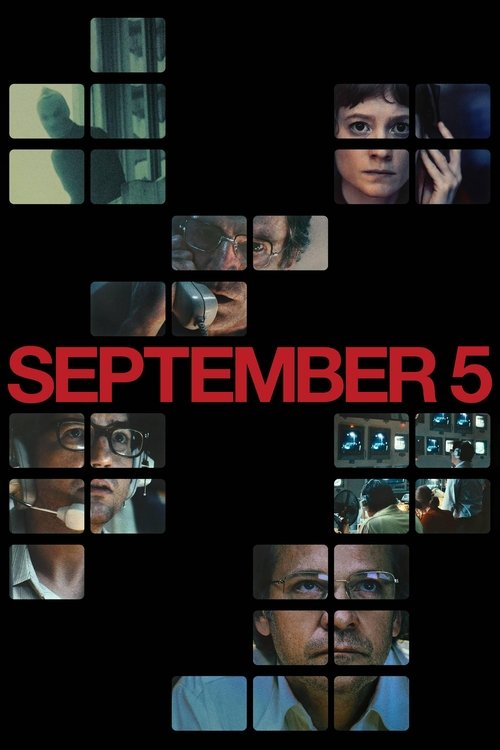
September 5
2024 · Tim Fehlbaum
For when you want a lean, gripping thriller that doubles as a moral problem you'll argue about afterward — a challenge, not a comfort watch, but a fast and absorbing one.
What it's about
Munich, 1972: an American sports broadcasting crew is there to cover swimming and track when armed men seize the Israeli Olympic team in the athletes' village next door. Suddenly the people who film ballgames control the world's only live window on a hostage crisis, and every decision — what to show, what to say, whom to trust — has to be made in seconds, on air.
The experience
Claustrophobic and relentless — nearly the whole film unfolds inside one cramped control room, and the tension comes from monitors, phone lines and split-second judgment calls rather than action. It leaves you unsettled about what watching the news actually means.
Performances
Peter Sarsgaard brings calm, calculating authority as the executive making the calls, and Leonie Benesch is quietly essential as the German translator who becomes the room's conscience.
The craft
Tim Fehlbaum shoots the control room like a pressure vessel — analog switchboards, tape decks and wall-of-monitor compositions, cut to the rhythm of a live broadcast. The period television craft is lovingly exact, and the sound design of overlapping feeds and phone lines does much of the work of tightening your chest.
Why it matters
It joined the ongoing reckoning with how live media shapes tragedy, approaching one of the most covered events of the twentieth century from the one angle nobody had tried — the people holding the cameras.
Snapshot
September 5 reconstructs the morning of the Munich Olympic hostage crisis not from the perspective of the athletes, the kidnappers, or the German police, but from inside the cramped control room of ABC Sports, the American broadcasting unit that happened to have its cameras and satellite uplink already trained on the Games when Black September seized the Israeli team. Tim Fehlbaum's film is a single-location procedural thriller that compresses a day of improvised crisis journalism into a taut chamber drama: a sports crew, equipped to cover swimming heats and track finals, suddenly finding itself the world's primary live window onto a terrorist atrocity. The film's animating question is ethical and epistemological — what does it mean to broadcast an unfolding act of violence in real time, before anyone knows how it ends — and it stages that question almost entirely through the technical and human machinery of television itself. It is a film about media made out of the texture of media: monitors, tape decks, intercoms, telex, and the contested authority of the word "live."
Industry & production
September 5 is a German production with American casting and subject matter, produced through Constantin Film alongside Projected Picture Works, the production company associated with Sean Penn and John Ittenbach; Penn is credited among the producers. The screenplay is credited to Moritz Binder and Tim Fehlbaum, from a story by Alex David, and the project marked Fehlbaum's move from genre science fiction toward historical reconstruction. Paramount Pictures handled the U.S. theatrical release, positioning the film as a fall awards-season title.
The film premiered at the Venice International Film Festival in 2024 (out of competition) and traveled the autumn festival circuit, including Telluride, before a platform release. Its most conspicuous industry marker came at the 97th Academy Awards, where the screenplay earned a nomination for Best Original Screenplay — a notable result for a modestly budgeted, single-set German-financed picture and confirmation that its central conceit (history seen through the apparatus of its first telling) resonated with the industry. Precise budget and box-office figures are not something I can state reliably here; the film was understood as a mid-budget, contained production rather than a large-scale historical epic, an economy that its one-room setting made possible.
Technology
The film's most distinctive production challenge was the faithful recreation of 1972 broadcast technology and its seamless interleaving with surviving archival material. ABC's actual coverage — including the on-air presence of anchor Jim McKay — survives, and September 5 incorporates genuine period footage rather than restaging it, most importantly McKay's reporting. This forced the production to build a control room and studio environment whose recreated, staged imagery would cut invisibly against real CRT monitor feeds, kinescope, and broadcast-grade video of the era.
The fictional, in-world footage therefore had to be degraded and shaped to match the look of early-1970s analog television and the film stocks of the period, while the surrounding dramatic action — the people in the room — needed a contemporary cinematic finish that nonetheless felt continuous with those screens. The result is a layered image: digitally captured drama wrapped around, and reflected in, banks of low-resolution monitors carrying a mixture of real and fabricated transmissions. The production also leans on the physical vocabulary of the period newsroom — videotape spooling, telephone lines, the satellite slot that had to be fought for and held — as both set dressing and dramatic engine. Where exact camera and lens specifications are concerned, the record available to me is thin enough that I will not assert particulars; what is clear is that the technical design prioritized the credible coexistence of archival and staged imagery.
Technique
Cinematography
The photography is by Markus Förderer, Fehlbaum's longtime collaborator since Hell (2011). Förderer's work here is an exercise in constraint: a single, low-ceilinged interior shot to feel both claustrophobic and electrically alive. The camera stays close to bodies and faces, threading the crowded console rows, and it is constantly drawn to the glow of the monitor wall — the only window the characters, and we, have onto the events outside. Light sources are largely diegetic or motivated by the equipment: the cool wash of screens, fluorescent overheads, the warmer pools of desk lamps. The visual argument is that the room's reality is mediated, that these professionals experience the crisis the same way the audience does, as images on glass, and Förderer repeatedly composes so that human faces and broadcast images share the frame, the one reflected in or lit by the other.
Editing
Editing — handled by Hansjörg Weißbrich, an experienced German editor — is the film's structural spine, and appropriately so for a story about cutting between feeds under pressure. The film's tension is generated less by physical action than by decisions: which camera to take, when to go live, whether to air an unconfirmed report. The cutting mirrors that vocational rhythm, moving between the operators, the producers, and the monitors with the same urgency the characters bring to their own switching. The compression of roughly a day's events into a continuous, near-real-time experience is an editorial achievement, sustaining momentum without recourse to the conventional thriller's set pieces.
Mise-en-scène / staging
The recreated control room is the film's entire world, and the staging treats it as a pressure vessel. Bodies are packed into the space; sightlines are blocked by equipment; the geography of authority is legible in who sits where and who can reach which switch. Fehlbaum stages the drama as a series of negotiations across a few feet of console — between the seasoned executive, the young producer thrust into command, the technicians, and the German interpreter who is the room's only fluent link to the world outside. The single setting is not a limitation the film works around but the source of its meaning: the gap between the small, sweating room and the vast global audience it is addressing.
Sound
Sound design carries much of the crisis. The aural field is dense with the chatter of intercoms, the squawk of telephone lines, overlapping instructions, and the audio of the broadcast itself bleeding through the room. The famous on-air audio of the period — including the moment of grievous misinformation when the hostages were wrongly reported safe, and McKay's later confirmation of the worst — is woven into the texture. Lorenz Dangel's score is restrained, more atmosphere and tension than melody, ceding the foreground to the procedural noise of broadcasting. Silence and the sudden absence of sound are used at the key turns, when the room runs out of words.
Performance
The ensemble is built around restraint and professional competence under duress. Peter Sarsgaard plays Roone Arledge, the visionary head of ABC Sports, with a producer's mixture of ambition and judgment; John Magaro plays Geoffrey Mason, the comparatively junior control-room producer on whom command improbably devolves, and the film tracks his arc from execution to decision-making. Ben Chaplin plays the operations figure Marvin Bader, the conscience weighing what should and should not be aired. Leonie Benesch plays Marianne Gebhardt, a German interpreter who functions as the room's ear to the outside and as the film's German moral register; the character appears to be a composite or invention serving that perspective rather than a one-to-one historical figure, and the film uses her to introduce the unbearable specificity of Jews being murdered again on German soil. Performances are pitched low and fast, the cadence of people doing a hard job in real time.
Narrative & dramatic mode
The film is a real-time (or near-real-time) procedural thriller, a mode that derives suspense from process rather than spectacle. Its dramatic engine is the sequence of professional choices — go live or hold, confirm or report, show the violence or withhold it — each freighted with consequences the characters cannot yet see. The unities of time, place, and action are nearly classical: one room, one continuous crisis, one escalating chain of decisions. Crucially, the film withholds the events outside except as the characters receive them, so that the audience is locked into the same partial, mediated, error-prone knowledge as the broadcasters. The dramatic irony is total — most viewers know the catastrophic outcome — yet the film generates genuine tension from watching competent people grope toward a truth that arrives, devastatingly, wrong before it arrives right.
Genre & cycle
September 5 sits at the intersection of the newsroom drama and the real-time crisis thriller. Its lineage in the first includes All the President's Men (1976), Broadcast News (1987), Network (1976), and more recently The Post (2017) and Spotlight (2015) — films that find drama in the discipline and ethics of journalism. In the second it belongs with the confined-crisis procedural: Apollo 13 (1995) and its Mission Control as theater of decision, and especially Paul Greengrass's United 93 (2006), with which it shares a commitment to real-time tension, ensemble professionalism, and the refusal of conventional heroics around an atrocity. It also belongs to the durable cycle of films about how media shapes reality, the question Sidney Lumet's Network posed satirically and September 5 poses soberly.
Authorship & method
Tim Fehlbaum, a Swiss director, came to September 5 from genre filmmaking — the post-apocalyptic Hell (2011) and the science-fiction Tides (also released as The Colony, 2021), both shot by Markus Förderer. The continuity of the Fehlbaum–Förderer partnership is central to the film's method: a director and cinematographer who had built immersive, atmosphere-driven worlds turning that craft toward a documentary-adjacent reconstruction. Fehlbaum's method here is one of constraint and research — committing to the single set, to the integration of archival footage, and to the period apparatus as the film's grammar. The screenplay, written with Moritz Binder from Alex David's story, makes the consequential decision to locate the entire drama at the broadcast desk, a choice that distinguishes the project from every prior treatment of Munich. Key collaborators — Förderer on camera, Weißbrich cutting, Dangel scoring — execute a unified design in which technical fidelity and dramatic compression are inseparable.
Movement / national cinema
The film is best understood as a German-financed, internationally cast production rather than the expression of a national-cinema movement. It reflects a now-established mode of European-produced, English-language historical filmmaking aimed at a global and awards-season audience, drawing on German production infrastructure (Constantin Film) and craft while telling a story centered on American broadcasters and a German national trauma. That dual vantage — American media professionals operating on German soil twenty-seven years after the Holocaust — is not incidental; it is the film's subject, and the German production identity sharpens the weight of the setting.
Era / period
September 5 is a period film set in 1972 but made for and about a present saturated by live, unfiltered media. It reconstructs the moment broadly credited as a hinge in broadcast history — when sports television, with its satellite reach and multi-camera apparatus, became, almost by accident, the delivery system for live news of terrorism to a vast simultaneous global audience. The film is conscious of standing at the origin of something: the rolling-news sensibility, the live feed of catastrophe, the audience as witness to violence in progress. Made in the 2020s, it cannot help but be read as a commentary on the streaming-and-social present, in which the dilemmas the ABC crew confronted once — whether to show a death live, how to handle unconfirmed reports — have become the daily condition of media.
Themes
The film's governing theme is the ethics of live witness: the responsibility incurred by the power to transmit reality as it happens, and the near-impossibility of exercising judgment at the speed the technology demands. Around this cluster several others. There is the theme of mediation — the recurring image of people experiencing reality only through screens, and the collapsing distance between covering an event and becoming part of it. There is the contagion between media spectacle and terrorism: Black September's choice of the Olympics as a stage presupposes the cameras, and the film quietly registers that the broadcast may be doing the kidnappers' work of amplification. There is professional competence as a moral arena — the dignity and the danger of people simply trying to do their jobs well under impossible conditions. And there is the specific historical wound of the setting: the murder of Jewish athletes on German soil, the German interpreter's anguish, the long shadow of the Holocaust over a nation hosting "the cheerful Games." Underlying all of it is the catastrophe of misinformation — the moment the world was told the hostages were safe — which the film treats as the era's founding lesson in the perils of reporting faster than one can know.
Reception, canon & influence
Critical reception was strong, with particular praise for the film's discipline, its formal ingenuity in confining the drama to the control room, and the ensemble's understated work; the Academy Award nomination for Best Original Screenplay reflected that critical regard. Reviewers tended to credit the film for finding a genuinely fresh angle on an exhaustively documented event and for resisting both sensationalism and easy moralizing, though some discussion attended the inevitable question of whether dramatizing an atrocity through its broadcasters risks the very aestheticization it interrogates.
Looking backward, the film's influences are clear. It descends from the journalistic procedurals of the 1970s and after — All the President's Men, Network, Broadcast News — and from the real-time atrocity reconstructions of Paul Greengrass, United 93 above all. Its subject has a substantial nonfiction and dramatic predecessor literature: Kevin Macdonald's Academy Award–winning documentary One Day in September (1999) and Steven Spielberg's Munich (2005), which treats the aftermath and the reprisals. September 5 deliberately distinguishes itself from these by refusing both the documentary's panoramic reconstruction and Munich's geopolitical sweep, staying instead inside the room and the hour.
Its forward legacy is still forming, given its recency. Its most likely lasting contribution is as a model for the confined, media-apparatus-driven historical film — a demonstration that a single set and a wall of monitors can carry a major historical reckoning, and that the story of how an event was first told can be as charged as the event itself. In an age when the questions it dramatizes have become universal, September 5 reads less as a period piece than as an origin story for the present, and that contemporaneity is likely to sustain its place in discussions of media, ethics, and the cinema of real time.
A Deleuzian reading
The thing you keep is a face lit from below by glass.
The full Deleuzian reading of September 5 →
Reception
It rode a wave of Venice and Telluride acclaim in late 2024 straight to a Best Original Screenplay Oscar nomination — but landing mid-Gaza-war, its reception was immediately shadowed by arguments over whether its tight control-room POV was rigorous or evasive.
How September 5 was received, from release to now →
Influences: the films it descends from and the films it influenced
- All the President's Men (1976) — Establishes process-as-suspense: the patient, undramatic labor of verifying a story — phone calls, corrections, deadline checks — staged as a thriller, the exact procedural grammar September 5 applies to the broadcast desk.
- Network (1976) — Dramatizes the television control apparatus itself and the ethical slide of broadcasting human catastrophe for ratings, the media-and-terrorism interrogation September 5 inherits and confines to one room.
- Broadcast News (1987) — Choreographs the live control booth under deadline — the director cueing camera, audio, and feed in real time — the booth-as-orchestra blocking September 5 reproduces beat for beat.
- Good Night, and Good Luck (2005) — Confines a media-ethics drama to studio and control room while integrating period archival broadcast footage with staged action, the same archival-staged-integration technique and monochrome apparatus fidelity.
- United 93 (2006) — The real-time atrocity reconstruction model — unknown ensemble, restrained performance, suspense generated by cross-cutting between ops/control rooms watching a catastrophe they can't stop — September 5's most direct template.
- The China Syndrome (1979) — Builds the control-room-as-pressure-vessel: a crisis read off banks of monitors and gauges by technicians, with the wall of screens as the primary dramatic surface.
- The Conversation (1974) — Turns the technician's booth and a dense procedural soundscape of feeds, playback, and signal into the engine of suspense, modeling September 5's sound design and screens-within-frame.
- Dog Day Afternoon (1975) — Stages a hostage crisis as a live-media event, the standoff refracted through TV cameras and crowds — the recursion of an atrocity becoming broadcast that September 5 makes its whole subject.
- Medium Cool (1969) — Interrogates the ethics of the news camera by blending staged drama with real footage of catastrophe, the founding statement of the live-witness ethics September 5 dramatizes.
- 12 Angry Men (1957) — The single-location, classical-unities pressure vessel — one room, near-continuous time, an ensemble's escalating tension carrying an entire moral argument without leaving the set.
- One Day in September (1999) — The archival reconstruction of the identical Munich event, against whose panoramic documentary sweep September 5 deliberately defines itself by staying inside the hour and the room.
- Munich (2005) — The prior dramatic treatment of the same atrocity's aftermath, whose geopolitical reach September 5 consciously refuses, narrowing to the broadcasters at the moment of first telling.
- The Guilty (2018) — A confined real-time thriller in which an offscreen catastrophe is mediated entirely through one operator's screens and comms, extending September 5's principle that the apparatus, not the event, is the stage.
- Nightcrawler (2014) — Pushes the ethics-of-live-witness to its predatory extreme — the camera that captures atrocity for broadcast as the moral center — the same question September 5 asks from inside the newsroom.
- Spotlight (2015) — Sustains the ensemble-restraint journalistic procedural, suspense built from documents, verification, and quiet collective labor rather than individual heroics.
- Tides (2021) — The immediate prior Fehlbaum–Förderer collaboration whose immersive, atmosphere-driven, diegetic-light craft is redirected in September 5 toward documentary-adjacent reconstruction — the same authorial partnership and lighting method.
Similar films
- Munich (2005) — influence & lineage
- One Day in September (1999) — influence & lineage
- United 93 (2006) — influence & lineage
- The Guilty (2018) — influence & lineage
- Dog Day Afternoon (1975) — influence & lineage
- Four Days in September (1997) — shared sensibility
- A House of Dynamite (2025) — shared sensibility
- Funny Games (1997) — shared sensibility