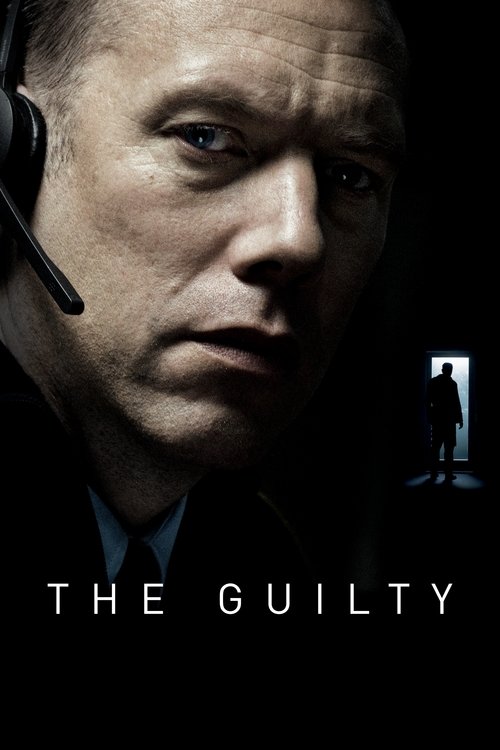
The Guilty
2018 · Gustav Möller
For when you want pure, concentrated suspense and only have 85 minutes — one sitting, phone off, lights down. It's a challenge to your nerves but an easy commitment.
What it's about
Asger, a Copenhagen police officer demoted to answering emergency calls, picks up the phone one night and hears a frightened woman who seems to be speaking in code — she's been taken, and she can't talk freely. Stuck at his dispatch desk, he has only the phone, his wits, and his own flawed judgment to piece together where she is and how to save her. The whole film unfolds in that one room, over that one night.
The experience
White-knuckle tense for its entire lean running time — you lean toward the screen straining to hear what he hears, building the whole crime in your imagination. It's the rare thriller that gets more gripping the less it shows you.
Performances
Jakob Cedergren is on screen nearly every second and holds the entire film with his face and voice alone — you watch certainty, panic, and doubt fight it out in real time.
The craft
A masterclass in doing more with less: one location, near-real time, and a sound design that makes the unseen world at the other end of the line feel vividly physical. Watch it with good headphones or speakers — the film essentially happens in your ears.
Why it matters
A Sundance audience-award winner that became one of the most celebrated debut thrillers of its decade and spawned a Hollywood remake, proving how far a single room and a telephone can go.
Snapshot
A police officer demoted to emergency dispatch takes a call from a woman who may be a kidnapping victim. Over the course of a single night, in a single room, with nothing but a telephone and his own unreliable judgment, Asger Holm (Jakob Cedergren) attempts to orchestrate a rescue — and slowly discovers that every assumption he has made is wrong, including assumptions about himself. Gustav Möller's debut feature (Den skyldige in Danish) runs approximately 85 minutes in near-real time, generates sustained suspense from a near-total absence of visual incident, and ends by turning the genre logic of a rescue thriller against its protagonist. It won the World Cinema Dramatic Audience Award at Sundance 2018 and remains one of the most economically conceived thrillers of its decade.
Industry & production
The Guilty was produced by Nordisk Film Production with support from the Danish Film Institute, the state body that has historically underwritten the country's art-cinema ambitions. The project was Möller's first feature, developed from a script he co-wrote with Emil Nygaard Albertsen. By Danish standards the budget was modest even within the framework of publicly subsidized production; the single-location constraint was in part a practical response to limited resources, though Möller has consistently framed it as an aesthetic choice rather than a compromise. The film was shot over a very short production window — reportedly around ten days — which placed enormous pressure on Cedergren and demanded rigorous pre-production design of the sound world.
The film's domestic theatrical run was followed by prominent international festival exposure. Its Sundance audience prize accelerated sales across territories and attracted the attention of Netflix, whose American remake (2021, dir. Antoine Fuqua, starring Jake Gyllenhaal) gave the property a much wider global footprint. The original film was handled internationally by TrustNordisk.
Technology
The Guilty is a film largely defined by deliberate technological minimalism in the image track and corresponding richness in the sound track. Möller and cinematographer Jasper Spanning shot on digital, working within the narrow spatial confines of the dispatch center set. The production's technical signature is the aggressive disjunction between what the camera can show — one man, one desk, a few screens — and what the sound mix allows the audience to experience: car interiors, a highway, a darkened apartment, a child's terror.
The telephone itself, the Nokia-era hardware of a police call center, functions as a diegetic prosthesis that structures every scene. Unlike smartphone thrillers of the same period that exploit screen graphics and notification interfaces for visual information, The Guilty denies the audience almost all secondary visual data. What technology renders is not presence but absence — the film's central formal proposition is that what we cannot see is more disturbing than what we can.
Technique
Cinematography
Jasper Spanning's work here is a study in restraint disciplined to the point of formal argument. The framing is almost unrelentingly tight: close-ups of Cedergren's face, medium shots that reveal the institutional bleakness of the dispatch room, the occasional cutaway to a window or door that marks Asger's physical confinement. There are no establishing shots of an exterior world to provide spatial relief. The color temperature runs cool — fluorescent office light, the bluish wash of computer screens — reinforcing the sense of a purgatorial holding space outside ordinary time.
Spanning avoids expressive camera movement as a rule. When the camera does shift — a slow push toward Cedergren's face as comprehension dawns, or pulls back slightly when he is most isolated — the effect is magnified by the surrounding stillness. This economy means that even minor adjustments in focal distance carry narrative weight that in a conventionally photographed thriller would require a full scene change.
Editing
Carla Lütken's editing faces an unusual problem: the conventional tools of cross-cutting, which generate suspense by alternating between parallel spaces, are structurally unavailable. Everything must be built within or across phone calls, in the pauses, the half-heard sounds, the held reactions. Lütken and Möller use these constraints productively, treating the phone conversations as self-contained units with their own rhythmic arc — tension building inside a call, then a cut to the silence after the line drops, where Asger (and the audience) must sit with uncertainty.
The overall rhythm is tighter than the single-location format might suggest. The film never becomes static; the editing is consistently active in managing the duration of reactions, the timing of revelations, and the small visual punctuation marks — a hand on a receiver, a cursor blinking — that mark transitions in the emotional logic.
Mise-en-scène / staging
The dispatch center is Möller's entire world, and every element of it is pressed into service. The design is deliberately generic — institutional furniture, motivational notices, the ergonomic detritus of shift work — so that the setting cannot provide the kind of environmental characterization that would relieve pressure on Cedergren. Asger is isolated even within the room; his colleagues recede into background noise. The staging consistently returns to him at the desk as a figure of self-imposed constraint, someone who has chosen to act from within a cage.
The single significant staging shift occurs when Asger steps away from his desk — a physical violation of the rules he has set himself that the film treats as a kind of moral rupture, immediately consequential.
Sound
Sound is the film's primary expressive register, and the design — credited to Oskar Skriver and the broader sound team — is among the most rigorously conceived in recent Scandinavian cinema. The audience must construct an entire parallel physical world from acoustic information: the quality of a voice (road noise, echo, proximity), the sounds behind it (a child crying in another room, a car engine, the ambient texture of different built environments), and the silences when calls drop or are placed on hold.
The ethical and dramaturgical stakes of this design are high. Because we hear exactly what Asger hears, and because his interpretive errors are our interpretive errors, the sound design becomes an instrument of unreliable narration. We are manipulated by the same acoustic cues that manipulate him. When the film's central reversal arrives — when we understand that Iben has not been kidnapped by a stranger but is in flight from her estranged husband, and that the situation is both less and more terrible than Asger assumed — the retrospective reordering of what we thought we heard is viscerally disorienting.
Carl Coleman's score works sparingly, supporting rather than foregrounding the narrative; the film's most intense sequences are largely unscored, trusting the sound design and Cedergren's performance entirely.
Performance
Jakob Cedergren carries the film with a performance that must accomplish, largely through facial micro-expression and vocal register, what most thrillers distribute across ensemble action and location. Cedergren was already well established in Danish cinema — his work in Thomas Vinterberg's Submarino (2010) among other films had confirmed his range — but The Guilty is a different kind of demand: sustained interiority under pressure, with almost no relief from reaction.
What Cedergren manages is to make Asger's competence and his pathology feel inseparable. His character's controlling disposition — the thing that makes him effective as a dispatcher, able to project authority down a phone line and direct people in crisis — is precisely the quality that leads him to override what he is being told, impose his own narrative on the situation, and cause harm. The film asks us to watch a man trying to be a hero while we gradually understand he is not the person he believes himself to be. The performance never tips into self-conscious villainy; Cedergren sustains genuine ambiguity throughout.
Narrative & dramatic mode
The Guilty is a procedural thriller organized around a structural irony: the genre conventions it invokes — the race against time, the resourceful protagonist, the innocent woman in danger — are systematically revealed to be projections of the protagonist's desire rather than accurate descriptions of reality. Asger's investigative activity, his urgency, his growing emotional investment, are all in the service of a narrative he has constructed from partial information filtered through his own assumptions about gender, class, and victimhood.
The film operates in near-real time, which intensifies the claustrophobia and makes the audience co-complicit in Asger's errors. We have no information he lacks; we are not positioned to see his mistakes from outside. The dramatic irony is thus not dramatic irony in the classical sense but something closer to shared delusion — a technique more common in literary fiction (the unreliable narrator) than in mainstream cinema.
The title's double (or triple) meaning is characteristic of the film's moral economy: Iben's husband Michael is guilty of domestic violence; Asger is guilty of a shooting that is under investigation and that he has concealed from his superiors; and the film implies that guilt — the sense of it, the need to expiate it — may be the real engine of Asger's behavior throughout. His rescue attempt is partly a performance for himself.
Genre & cycle
The Guilty belongs to a loose but identifiable cycle of single-location, technologically mediated thrillers that emerged in the 2000s and 2010s: Phonebooth (Schumacher, 2002), Buried (Rodrigo Cortés, 2010), Locke (Steven Knight, 2013), Housebound (Brugh, 2014). Each of these films uses a single spatial or technological constraint as both practical framework and metaphoric engine. Möller's contribution to the cycle is its most ethically complex entry: where Locke and Buried generate sympathy through straightforward victimhood or stoic endurance, The Guilty eventually implicates its protagonist in the moral disorder he is trying to resolve.
Within Scandinavian genre cinema, the film engages the tradition of socially critical crime fiction — the Stieg Larsson and Jo Nesbø pipeline, but also the film tradition of Susanne Bier and others who use genre as a vehicle for social diagnosis. Möller's critique is institutional (police culture, the failure of emergency services to address domestic violence) as well as individual.
Authorship & method
Gustav Möller developed the script over several years with Nygaard Albertsen, and by multiple accounts the formal constraint was intrinsic to the conception rather than imposed during development. His background in short film and commercial work gave him facility with tight formal problems; The Guilty extends the logic of the short-form constraint into feature length.
The collaboration with Cedergren was central to the project's realization. Möller has discussed designing the sound world in collaboration with actors performing the off-screen voices — ensuring that what Cedergren was responding to was real performance rather than placeholder audio, which was essential to the authenticity of his reactions. This method also allowed the off-screen voices to be carefully shaped for the acoustic misleads the script requires.
Jasper Spanning's partnership with Möller established a visual language of deliberate withholding, and Carla Lütken's editing shaped the film's unusual pacing. The project is, in many respects, a director's thesis: a controlled demonstration of how much cinema can be made from almost nothing.
Movement / national cinema
The Guilty is a product of Danish state-supported cinema but sits at some distance from the prestige literary adaptations and ensemble social dramas that define its most internationally visible tradition. It is perhaps most useful to read it alongside the post-Dogme generation of Danish filmmakers who inherited the movement's interest in formal austerity and psychological realism without adhering to its manifesto.
The Dogme 95 movement — Vinterberg, von Trier, Kragh-Jacobsen — had established a global brand for Danish cinema built on stripped-back technique and emotional intensity. Möller's approach shares the anti-spectacular disposition of Dogme (no locations that cannot be justified by the story; no non-diegetic music except the minimum necessary) without the movement's ideological apparatus. The single-location constraint is in some ways a more extreme version of Dogme's location-over-studio principle. The film's moral seriousness and its implication of the viewer in its protagonist's errors belong to a Danish tradition of discomforting psychological drama running from Carl Theodor Dreyer to Vinterberg's Festen (1998).
Era / period
The film is a product of the mid-2010s moment in which technologically mediated social reality had become available as serious cinematic subject matter — after The Social Network (2010), Her (2013), and the proliferation of "phone screen" films — but before that subject matter had been thoroughly domesticated into genre convention. It appeared at a moment of heightened cultural conversation about domestic violence in Scandinavia and about police accountability more broadly. Its gender politics — the way Asger projects a conventional rescue narrative onto a situation that is structurally about a woman's agency and a failure of institutional protection — resonated with critical discourse that was actively interrogating such projections.
Themes
The film's central preoccupations are guilt (individual, institutional, irreducible), the violence of projection (treating another person as a screen for one's own narrative needs), and the limits of mediated knowledge. Asger cannot see; he can only hear and interpret. The film asks whether seeing — access to direct perceptual evidence — would actually improve his judgment, or whether the problem is not epistemological but ethical: a prior commitment to a certain story about himself as the rescuer, the competent one, the good officer.
The emergency dispatch center is also a figure for a broader institutional failure: the film implies that the system Asger works within is structurally incapable of addressing the kind of domestic crisis he is dealing with. His improvisations are partly heroic and partly a workaround for a system that cannot help Iben in the way she actually needs.
Reception, canon & influence
The Guilty was released to strong reviews in Denmark in late 2018 and debuted internationally at the Sundance Film Festival in January 2018, where it won the World Cinema Dramatic Audience Award — a prize with a strong track record of identifying durable international art cinema. Critics consistently praised Cedergren's performance and the film's formal rigor; several noted its capacity to generate genuine suspense from what is, on paper, an almost impossibly restricted formal premise. It collected multiple Robert Award nominations (the Danish Film Academy's prizes), and became one of the more commercially successful Danish exports of its cycle.
Influences on the film (backward): The clearest antecedents are the single-location thriller and the radio drama, both of which the film synthesizes. Phonebooth and Buried are obvious genre predecessors in the confined-space thriller mode. Rear Window (Hitchcock, 1954), while spatially different, establishes the epistemological template of the voyeuristic detective whose interpretive projection shapes (and distorts) what he observes. The acoustic construction of off-screen space has a longer history in art cinema — Robert Bresson's use of sound to evoke what the image refuses to show is a useful if indirect reference point. The moral structure of the film — a protagonist whose competence is continuous with his culpability — has precedent in Scandinavian crime drama and in the tradition of the guilt-ridden hero in Danish literary culture.
Legacy and forward influence: The most measurable downstream effect is the Netflix American remake (The Guilty, dir. Antoine Fuqua, 2021), which transferred the basic structure intact with Jake Gyllenhaal in the lead role and updated the setting to a California wildfire emergency. The remake received mixed reviews but demonstrated the durability of the original's premise and gave Möller's concept an audience of tens of millions. It also accelerated interest in Möller's subsequent work.
More broadly, The Guilty stands as a proof of concept for the kind of ultra-low-budget, formally constrained thriller that can penetrate the international festival circuit and generate substantial remake value — a model that has influenced producers and emerging directors in Scandinavia and beyond. Its demonstration that an entire emotional and narrative world could be constructed from sound design and performance alone has been cited in discussions of phonological filmmaking and acoustic narration in contemporary cinema. Whether it will prove a lasting canonical entry or primarily a key text in the history of constraint-based genre filmmaking remains to be seen, but its influence on the decade that followed it is clear.
A Deleuzian reading
A man in a headset, alone in a cool blue room, listening to a child cry somewhere he will never go.
The full Deleuzian reading of The Guilty →
Reception
A word-of-mouth hit out of Sundance 2018 — where it won the World Cinema Audience Award — it's since become the film cinephiles reflexively defend whenever the 2021 Jake Gyllenhaal remake comes up: 'just watch the Danish one.'
How The Guilty was received, from release to now →
Influences: the films it descends from and the films it influenced
- Rear Window (1954) — Establishes the epistemological architecture Möller inherits: a protagonist fixed to one vantage point who projects narrative onto fragmentary sensory data, with dramatic irony hinging on the gap between what is perceived and what is actually occurring offscreen.
- Rope (1948) — Demonstrates that suspense can be generated entirely within a single unbroken space in near-real-time, with the audience's superior knowledge of offscreen events producing dread the protagonist cannot access — the chamber-thriller grammar Möller distills to its minimum.
- 12 Angry Men (1957) — Establishes the single-room performance model in which all tension is derived from actors' voices and bodies, and where the protagonist's judgment of others ultimately reveals his own psychological wound — the moral structure The Guilty replicates in its dispatch-booth setting.
- A Man Escaped (1956) — Bresson's sound-design strategy — substituting dense acoustic texture (footsteps, distant voices, material objects) for visual exposition — is the formal ancestor of Möller's method of constructing an entire offscreen dramatic world exclusively through telephone audio.
- Phone Booth (2002) — Installs the telephone receiver as the sole instrument of confinement and the only channel of agency: the protagonist's access to the crisis and his only means of acting on it are identical, the device functioning simultaneously as trap and tool.
- Pontypool (2008) — Grant Mazzy's radio studio is the structural precursor to Asger Holm's dispatch booth: both protagonists interpret and rebroadcast a crisis they can access only acoustically, without visual confirmation, and both are undone by the gap between the account they construct and what is actually happening.
- Buried (2010) — Cortés refuses all cutaways outside Paul Conroy's coffin, establishing the formal discipline that the audience's knowledge is strictly bounded by what the confined protagonist can perceive — a rule Möller adopts and executes through sound design alone, without a physical enclosure.
- Compliance (2012) — Explores how a disembodied telephone voice can fabricate authority and compel action, anatomizing the same mechanism by which Asger Holm's interpretive errors compound — both films hinge on the phone as an instrument that distorts and mediates institutional power rather than transmitting it neutrally.
- The Hunt (2012) — Gives Möller his Danish moral template — a protagonist whose guilt or innocence cannot be adjudicated from outside, where a community constructs catastrophically wrong reality from partial, acoustically and socially mediated information — wrapped in post-Dogme formal restraint.
- The Guilty (2021) — Direct American remake that transfers Möller's formal architecture intact — single dispatch room, phone-only drama, near-real-time compression, performance-dependent offscreen world — demonstrating the premise's industrial durability while substituting a California wildfire for the Danish setting.
- Oxygen (2021) — Extends Möller's single-location confinement model into a cryogenic pod, where the protagonist reconstructs her identity and an offscreen crisis entirely through voice interfaces and fragmented data streams — the same dramatic grammar as the dispatch booth, applied to science fiction in the post-Guilty Netflix confinement-thriller cycle.
- Carnage (2011) — Strict theatrical unity of place and near-real-time duration is itself a dramatic instrument: Polanski demonstrates that the formal pressure of a sealed space with no exit generates mounting tension independently of plot mechanics, a principle Möller applies to a single desk and a headset.
- Locke (2013) — Proves that a feature can sustain entirely through one actor receiving phone calls in a confined moving space, constructing an elaborate offscreen drama through voice performance and selective audio alone, with no cross-cutting to the events under discussion — the closest formal precedent to The Guilty's dispatch-room method.
- Coherence (2013) — Demonstrates that radical location constraint (no spaces outside one house, no special effects) can generate genuine philosophical unease on an ultra-low budget through performance and spatial tension alone — a proof-of-concept Möller extends into a single room and a headset.
- Force Majeure (2014) — Östlund's cool palette, locked-off framings, and subject — a male professional whose self-image collapses under a revealed moral failure he cannot explain away — runs directly parallel to Möller's method and thematic architecture, representing the Scandinavian social-drama strand feeding the same craft tradition.
- Searching (2018) — The contemporaneous counterpart within technologically mediated cinema: where The Guilty constructs its offscreen world acoustically through telephone, Searching does so visually through screen interfaces — both films' entire dramatic reality is composed of mediated rather than direct experience, and both premiered at Sundance 2018.
- September 5 (2024) — A confined real-time thriller in which an offscreen catastrophe is mediated entirely through one operator's screens and comms, extending September 5's principle that the apparatus, not the event, is the stage.
Similar films
- A Man Escaped (1956) — influence & lineage
- Searching (2018) — influence & lineage
- Rope (1948) — influence & lineage
- Insomnia (1997) — shared sensibility
- Revanche (2008) — shared sensibility
- Forgotten (2017) — shared sensibility
- The Conversation (1974) — shared sensibility
- Case 137 (2025) — shared sensibility
All the films related to The Guilty →