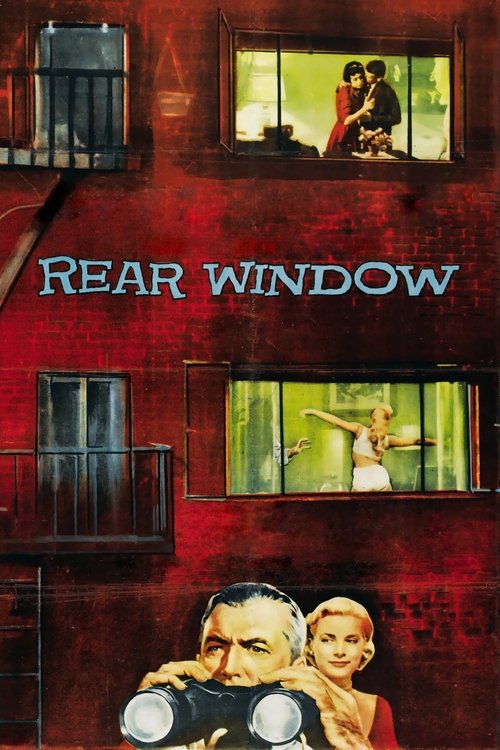
Rear Window
1954 · Alfred Hitchcock
When you're craving a proper thriller that doesn't need gore to get your pulse up — an ideal date-night mystery, comfortable to start and genuinely nerve-shredding by the end.
What it's about
A magazine photographer is stuck in his apartment with a broken leg during a New York heat wave, with nothing to do but watch his neighbors across the courtyard. One of them — a traveling salesman with an ailing wife — starts behaving strangely, and the photographer becomes convinced he's witnessed the traces of a murder. His glamorous girlfriend and his no-nonsense nurse get pulled into the amateur investigation, all of it conducted through a window with a telephoto lens.
The experience
Suspense that tightens one turn at a time until the final stretch has you physically leaning back from the screen. It's also funny and unexpectedly romantic — the murder plot and the will-they-commit relationship comedy run on the same track, and both pay off.
Performances
James Stewart does career-best work almost entirely from a chair, acting with his eyes and a pair of binoculars, while Grace Kelly is luminous and much sharper than her society-girl entrance suggests. Thelma Ritter steals scenes as the nurse who says what everyone's thinking.
The craft
Hitchcock shot the whole film on one gigantic purpose-built courtyard set and confines the camera to the hero's apartment, so you only ever know what he knows — a constraint that turns you into a fellow snoop. Every window across the way runs its own tiny wordless movie, and the courtyard's ambient sound — piano, traffic, arguments — replaces a conventional score for long stretches.
Why it matters
One of the most analyzed and imitated thrillers ever made — the template for every watching-the-neighbors suspense story since, and a peak of Hitchcock's golden decade.
Snapshot
Alfred Hitchcock's Rear Window is a psychological thriller of extraordinary formal economy: a man immobilized by a broken leg watches his New York neighbors from his window, becomes convinced one of them has murdered his wife, and is nearly killed for his trouble. Shot entirely on a single purpose-built studio set, the film converts the spatial limitation of its premise into an argument about cinema itself — about what it means to look, to interpret, to be implicated in observation. It is simultaneously a Woolrich pulp mystery, a romantic comedy about commitment anxiety, and a reflexive meditation on spectatorship that film theory has returned to ever since. Among the five films Hitchcock withheld from circulation after their initial runs, it was re-released in 1983 and has since become one of the most written-about works in the classical Hollywood canon.
Industry & production
Rear Window was produced by Hitchcock's own company, Patron Inc., and distributed by Paramount Pictures, part of an arrangement Hitchcock negotiated after leaving Warner Bros. that gave him unusual creative autonomy — final cut, control over casting and crew, and eventual ownership of the negative in several pictures. The source material was Cornell Woolrich's 1942 short story "It Had to Be Murder," published in Dime Detective Magazine; Hitchcock acquired the rights and commissioned screenwriter John Michael Hayes to expand it to feature length. Hayes's adaptation is a substantial transformation: the original story is a first-person interior monologue with no female romantic lead; Hayes invented the character of Lisa Fremont, integrated the subplot about Jeff and Lisa's stalled courtship, and wrote the film's notably sharp, double-entendre-laden dialogue. Hayes would go on to write three more films for Hitchcock (To Catch a Thief, The Trouble with Harry, The Man Who Knew Too Much), but the Woolrich story represents the most wholesale reconception of a source the partnership produced.
The production's defining physical challenge was the construction of a rear-courtyard set on Paramount's largest available soundstage, Stage 18. Under the supervision of art directors Hal Pereira and Joseph MacMillan Johnson, with set decoration by Sam Comer and Ray Moyer, the crew built a Greenwich Village–style apartment complex comprising 31 individual units arranged around a communal garden, complete with functioning plumbing for a small fountain and landscaping that included actual plants and grass. The scale was exceptional even by major-studio standards of the period; the set required its own rigging infrastructure to simulate changing times of day through shifting overhead lighting rigs involving hundreds of individual instruments. The entire principal photography was confined to this set. Hitchcock's decision to shoot without leaving the protagonist's apartment — almost without exception — was not an arbitrary constraint but a structural commitment: the set had to carry narrative weight that exterior locations ordinarily distribute across geography.
Technology
The film was photographed in Technicolor and released at a widescreen aspect ratio reflecting Paramount's transition toward wider theatrical formats in 1953–54, as the studios competed with television. The color palette, managed by cinematographer Robert Burks, uses saturation strategically: the apartments across the courtyard are warm and domestic, while the shadows in Jeff's own room carry a cooler, more isolated tone.
The courtyard set's lighting system deserves particular note as a technological achievement. Burks and his gaffer crew devised a rig capable of cycling through dawn, full daylight, afternoon, dusk, and night within the same enclosed space, giving the film a convincing diurnal rhythm despite never going outdoors. This required coordination between the lighting department and the visual effects unit handling back-projections through Jeff's window during certain night sequences. The telephoto lenses used extensively throughout the production — necessary to maintain the illusion that the camera shares Jeff's physical position in his apartment while reaching into the windows across the courtyard — created a characteristic spatial compression: the neighbors' apartments look flattened, crowded together, slightly unreal in the way that long-glass surveillance footage always does. This optical quality is not incidental to meaning; it turns the act of looking into an instrument of distortion as well as revelation.
Technique
Cinematography
Robert Burks, Hitchcock's principal cinematographer from Strangers on a Train (1951) through Marnie (1964) with the single exception of Psycho, built the film's visual grammar around a strict discipline: nearly every shot originates from Jeff's window or from within his apartment, and the camera angle changes only to track Jeff's own point of view as he pivots between windows. The telephoto footage of the neighbors constitutes what the audience sees; the close-up of James Stewart's face — rendered by conventional focal lengths — constitutes what the audience reads. This alternation is the film's basic sentence structure. Burks calibrates the telephoto work so that each neighbor's apartment has a distinct visual identity: the musician's ground-floor space is seen in close proximity and near-normal perspective, while the Thorwald apartment above requires a noticeably longer glass, making Raymond Burr's movements slightly uncanny and metronomic. The lighting scheme across the courtyard, warm and golden in the heat of a New York summer, emphasizes the ordinary pleasures of domestic life that Jeff is observing — which makes the exception of the Thorwald window, often shown in harsher, more isolated light, carry an immediate tonal wrongness.
Editing
George Tomasini, Hitchcock's editor on the Paramount pictures, builds the film as a sustained exercise in what Lev Kuleshov demonstrated decades earlier: a neutral face given adjacent images acquires specific emotional meaning from the juxtaposition. The editing pattern — Jeff watching, object of gaze, Jeff reacting — is repeated dozens of times and never becomes mechanical, because the content of the middle term (what he sees) is always different, and because Stewart's face is responsive enough to carry genuine variation. The critical sequences — Jeff watching Thorwald carry something out of the apartment at night, the repeated inventory of Miss Lonelyhearts — gain their dread not from what is shown but from what the cut implies Jeff has understood. Tomasini and Hitchcock also manipulate the duration of shots in ways that function almost like punctuation: a held close-up of Jeff's face before he picks up the telephone communicates more than any line of dialogue could.
Mise-en-scène / staging
The single-set conceit requires that all dramatic variation be generated by changes within a fixed frame. Hitchcock's staging solution is to treat Jeff's window as a proscenium and the courtyard as a stage on which multiple dramas run simultaneously and obliquely comment on one another. The neighbors — the honeymooners who retreat from the window as their marriage settles into routine; the childless couple who lavish affection on a small dog; Miss Lonelyhearts alone at her table; Miss Torso juggling admirers; the sculptor; the musician; and the Thorwalds — are arranged by Hitchcock so that their positions on the courtyard's map correspond to different possible futures for Jeff and Lisa. This spatial argument is entirely a function of staging: no character articulates it aloud. The film also uses the changing light from Jeff's own window — open, with curtains parted; closed off as danger approaches — as a staging element that signals his degrees of exposure and concealment.
Sound
Franz Waxman's score is used sparingly and tactically; for long stretches, the film runs on diegetic sound alone: the ambient noise of the courtyard, the radio, the distant traffic. This is deliberate and pointed. The composer neighbor's unfinished song, which Jeff hears evolving fragment by fragment across the film, functions as an embedded dramatic arc — its completion near the climax carries emotional weight that a conventional scored theme could not have earned. Waxman's non-diegetic music enters predominantly in the suspense sequences and at the climax, when the film's formal contract with realism is most pressured. The sound design overall is a model of the period's spatial audio work: the way voices, music, and ambient noise from the courtyard appear to drift and layer according to shifts in temperature and wind reinforces the film's insistence on environmental texture as a narrative medium.
Performance
James Stewart had by 1954 already complicated his prewar image through his collaborations with Anthony Mann (Winchester '73, The Naked Spur, The Man from Laramie), and Hitchcock uses the ambivalence those films created. Jeff is passive, controlling, and somewhat cruel to Lisa in ways the film does not entirely excuse — Stewart brings a genuine edge to scenes of dismissal and condescension that a less complicated star persona would have smoothed over. Grace Kelly's Lisa Fremont is the film's most underestimated performance: Kelly plays intelligence, self-possession, and suppressed frustration simultaneously, and her arc from decorative socialite to active agent — she crosses the courtyard herself, where Jeff cannot — is carried by physical confidence rather than dialogue. Thelma Ritter as the insurance nurse Stella provides not mere comic relief but a class-inflected counter-perspective, her working-class practicality a constant corrective to Jeff's obsessive armchair detection. Raymond Burr as Lars Thorwald is almost entirely a performance of body and distance — seen across the courtyard through glass, largely without legible facial expression, his presence conveying threat through weight and deliberateness of movement.
Narrative & dramatic mode
The film is structured as a procedural mystery in which the investigative method is exclusively visual and inferential: Jeff accumulates observations, proposes hypotheses, tests them by continued watching. The dramatic irony — the audience, sharing Jeff's POV, knows roughly what he knows, no more — is sustained throughout and exploited most sharply in the climax, when Thorwald turns and looks directly across the courtyard, breaking the invisible wall of observation. The romantic subplot is fully integrated into the thriller structure: Lisa's increasing involvement in the investigation is both a narrative convenience and a thematic resolution — she becomes real to Jeff precisely by doing what he cannot. The film's final images, in which Jeff now has two broken legs and Lisa has quietly replaced her Harper's Bazaar with a mountaineering book, are delivered with the wry economy of a comedy, but they close the thematic argument about gendered paralysis with exact precision.
Genre & cycle
Rear Window participates in the 1950s suspense-thriller cycle but is equally informed by the "confined space" subgenre Hitchcock had been developing since Lifeboat (1944) and Rope (1948), films that treat spatial constraint as a generative rather than limiting principle. The Woolrich source material aligns it with the paranoid pulp tradition — urban isolation, the unreliable senses, the conspiracy that might be delusion — and the film absorbs the film noir's distrust of surface appearances without adopting noir's visual grammar (the color cinematography and the bright comedy of the Lisa-Jeff relationship keep it formally distinct from noir convention). It also carries a romantic-comedy strand strong enough that some critics have read the genre as hybrid: the love story is the mystery, structurally, not incidental to it.
Authorship & method
Hitchcock's working relationship with Hayes was notably collaborative for a director often characterized as a pre-planner who arrived on set with the film already conceived. Hayes has spoken in subsequent interviews about the latitude Hitchcock gave him in the dialogue scenes and the romantic comedy dimensions; the characterization of Lisa and the witty verbal sparring of the first act bear the marks of Hayes's particular skills. Robert Burks's contribution to the film's visual system was essential — he was the technical architect of the set's lighting and the lens choices that maintain the voyeuristic conceit. Edith Head's costume design for Grace Kelly is a collaboration that functioned at the level of character psychology: each of Lisa's outfits — the white evening dress, the ice-blue skirt — signals her social world while also tracking her trajectory toward action. Waxman's integration of diegetic music as structural device represents a compositional decision that shaped the entire narrative arc.
Movement / national cinema
Rear Window is a product of late classical Hollywood, produced at the moment when the studio system's infrastructure remained intact but the forces that would dismantle it — television, antitrust consent decrees, the talent-package deal — were well advanced. Hitchcock's independent production arrangement with Paramount is precisely the kind of producer-director relationship that would become standard in the New Hollywood of the 1960s–70s; in this sense the film's production context is transitional. Hitchcock's position as a British filmmaker working in Hollywood had by 1954 been fully naturalized — he had been working in America since Rebecca (1940) — but the Cahiers du Cinéma critics who were developing auteurist theory in the mid-1950s grouped him with the great Hollywood directors while distinguishing him from them: a European sensibility operating from within American generic conventions.
Era / period
The film is embedded in early Cold War America in ways that surface obliquely. The paranoia structure — the neighbor who may be a murderer, the community that does not see what is happening, the observer who cannot act through official channels — carries a period resonance that the film declines to allegorize explicitly. The anxiety about television runs closer to the surface: Jeff's window is an analog for the domestic screen, the neighbors a channel one cannot turn off, and Hitchcock's reflexive foregrounding of spectatorship invites the comparison. The postwar pressure on domesticity and marriage — the ideology of the suburban home, the expectation of female domestication — is precisely what the film puts under the voyeur's lens.
Themes
Voyeurism as a condition of cinema spectatorship is the film's governing theme, and it is developed without sentimentality: Jeff's watching is invasive, his interpretations are repeatedly wrong before they are right, and the audience shares his complicity. The film's most persistent inquiry is into the relationship between observation and knowledge — what we can and cannot know from looking — and into the ethics of the gaze when its object does not consent. Laura Mulvey's foundational 1975 essay "Visual Pleasure and Narrative Cinema" reads the film as a structural exposition of the gendered scopophilic gaze of classical Hollywood cinema, and while subsequent scholarship has complicated that reading, the film's self-awareness about the act of looking remains inexhaustible as a critical subject. Marriage and commitment anxiety run through every subplot: each neighbor apartment is a hypothesis about what Jeff and Lisa's future might look like, arranged around the courtyard like exhibits in an argument Jeff would rather not have.
Reception, canon & influence
Influences on the film. Woolrich's pulp-paranoia tradition is the primary literary source, filtered through Hayes's romantic-comedy sensibility. Hitchcock's own prior confined-space experiments (Rope, Lifeboat) are the immediate formal predecessors. The subjective camera — placing the audience inside a single character's perceptual frame — had been theorized and occasionally practiced in silent cinema, but Rear Window is its most sustained and rigorous application in sound film to that point.
Initial reception. Rear Window was among the most commercially successful films of 1954 and received strong reviews on release; the critical consensus recognized it as a major Hitchcock work, though the theoretical vocabulary for what made it significant would come later. Hitchcock withdrew the film from circulation — along with Rope, The Trouble with Harry, The Man Who Knew Too Much, and Vertigo — in the late 1950s and early 1960s, citing rights considerations and a desire to hold the films for his estate. The five-film withdrawal lasted until 1983–84, which had the inadvertent effect of making them objects of legend and intensifying their critical reappraisal on re-release.
Canon formation and theoretical influence. François Truffaut's extended interview with Hitchcock, conducted in 1962 and published in 1967 as Hitchcock/Truffaut, treated Rear Window as a central exhibit in the argument for Hitchcock as a rigorous formal artist; Truffaut's description of the film as a demonstration of "pure cinema" — storytelling through image juxtaposition rather than dialogue — shaped decades of pedagogical use. Robin Wood's Hitchcock's Films (1965) provided one of the first extended academic analyses. Mulvey's 1975 essay inscribed the film permanently into film theory's foundational texts. By the time of the 1983 re-release, Rear Window had been reconstituted not merely as a popular thriller but as a limit case for cinema's relationship to looking.
Legacy and influence. The film's most direct cinematic descendants are Brian De Palma's Body Double (1984), which transposes and amplifies the voyeurism-and-murder premise with explicit self-consciousness about its source, and D.J. Caruso's Disturbia (2007), a teenage-demographic remake that transposes the immobilization to house arrest. More diffusely, the film established a template for the thriller built around perceptual unreliability and the ethics of surveillance that runs through Blow-Up (1966), The Conversation (1974), Sliver (1993), and many subsequent works. Michael Powell's Peeping Tom (1960), made in the same cultural moment, shares the meditation on the camera as instrument of violence and desire; the two films are regularly taught in parallel. The set design concept — the protagonist's window as frame, the world beyond as theater — has been returned to repeatedly in prestige television, particularly in the single-location episode as a format. The film's enduring presence on canonical lists (Sight & Sound, AFI, various critics' polls) reflects both its formal perfection and its unusual richness as a theoretical object; few studio films of its era have generated comparable scholarly literature.
A Deleuzian reading
Start with the shot Hitchcock repeats until it becomes the film's heartbeat: James Stewart's face at the window, then the thing across the courtyard, then his face again.
The full Deleuzian reading of Rear Window →
Reception
A hit in 1954 (four Oscar nominations), it then vanished for nearly three decades as one of the 'Five Lost Hitchcocks' Hitchcock withdrew from circulation — its triumphant 1983-84 re-release turned an admired thriller into an untouchable masterpiece.
How Rear Window was received, from release to now →
Influences: the films it descends from and the films it influenced
- The 39 Steps (1935) — Establishes the hybrid thriller-as-romantic-comedy structure — two strangers whose sexual antagonism resolves through shared danger — that John Michael Hayes formalized as the Jeff–Lisa courtship subplot, converting Woolrich's solitary male narrator into a man whose refusal to commit is dramatized through the investigation itself.
- Laura (1944) — Detective thriller structured entirely around a male investigator's voyeuristic obsession with a woman known only through her portrait and other men's testimony; the methodology of constructing a woman from a distance through mediated images is the investigative mode Hitchcock then distributes across Jeff's telephoto surveillance of Lisa and Miss Lonelyhearts.
- Rope (1948) — Hitchcock's prior formal experiment with single-set theatrical staging in a Manhattan apartment — the entire film confined to one room containing a hidden crime — directly prefigures Rear Window's structural commitment to Stage 18's purpose-built courtyard as a self-sufficient theatrical world where physical confinement generates rather than limits narrative tension.
- Sorry, Wrong Number (1948) — Barbara Stanwyck as a physically immobilized woman who overhears a murder being planned through telephone cross-connections; the premise of Rear Window — fragmentary knowledge of a crime gained through technological mediation while confined and unable to intervene — is precisely anticipated here, with telephone replacing telephoto lens.
- The Window (1949) — Adapted from a Cornell Woolrich story — the same source author as Rear Window — a boy who witnesses a murder through a tenement window cannot get adults to believe him; the exact mechanism of window-as-investigative-instrument, knowledge without credibility, and the immobile witness whose evidence is dismissed is Rear Window's narrative engine, five years earlier, at the same studio.
- Strangers on a Train (1951) — Robert Burks continuing the DP partnership inaugurated here; the telephoto-lens observation of suspected murder is the structural extension of Miriam's fallen spectacles — both films organize their violence around mediated, distanced witnessing that implicates the passive protagonist in the violence he watches without acting to prevent.
- Shadow of a Doubt (1943) — The protagonist who alone possesses dangerous knowledge and cannot act on it without destroying his romantic relationship, the lover's disbelief as the dramatic obstacle—Shadow's core restricted dramatic irony architecture—is extended here into the film's entire spatial and voyeuristic logic.
- Lifeboat (1944) — Converts confinement from survival premise into epistemology — the immobilized protagonist can only look and infer — making Lifeboat's discipline of knowing nothing the boat cannot see into the entire subject of the film.
- Peeping Tom (1960) — Directly inverts Rear Window's structure — the protagonist is a cameraman-murderer whose 16mm lens is his weapon — so where Hitchcock implicates the audience in the pleasure of observation, Powell converts that implication into explicit accusation, making the act of watching a film about watching into the crime for which the audience is charged.
- Psycho (1960) — Norman's peephole scene is Rear Window in miniature: the close-up of the watching eye, the POV shot of the observed woman undressing, the Kuleshov-effect attribution of desire to the watcher — but Hitchcock sharpens the voyeurism-complicity argument by engineering full audience identification with a murderer, making the charge against the spectator explicit rather than symptomatic.
- Blow-Up (1966) — A fashion photographer discovers possible evidence of murder in photographs he did not know he was taking; darkroom enlargement as the precise formal analog of Jeff's telephoto zoom — both films use the act of optical magnification to reveal and simultaneously destabilize photographic truth, demonstrating that the technology of surveillance does not guarantee knowledge.
- The Conversation (1974) — Coppola transposes Rear Window's voyeuristic procedural to audio surveillance — a professional eavesdropper records a conversation that may evidence a murder — and inherits the Kuleshov-effect ambiguity structurally: the same recording, reread when context shifts in the final act, inverts its meaning exactly as Jeff's telephoto footage reframes when he reconsiders the evidence.
- Body Double (1984) — De Palma's most explicit formal appropriation: a protagonist stationed at a fixed vantage point watches a woman through a telescope, telephoto surveillance made overtly fetishistic and murderous; De Palma literalizes every element Hitchcock kept metaphorical — the staged set-up, the manufactured sightline, the manipulated watcher — exposing the voyeuristic machinery Rear Window operates with classical restraint.
- Blue Velvet (1986) — Jeffrey watches Frank's violence from inside a closet, the complicity of witnessing without intervening made spatially literal; Lynch inherits Rear Window's structure of domestic surfaces concealing criminal interiors visible only to the hidden observer, and its insistence that the pleasure of looking cannot be separated from the moral compromise of having looked.
- The Truman Show (1998) — A purpose-built theatrical environment housing an entire life, surveilled through embedded fixed cameras whose grid replaces Jeff's single telephoto; Weir inverts Rear Window's reflexive spectatorship by making the observed man rather than the observing protagonist the narrative subject, completing the film's implicit argument that the audience's pleasurable complicity in watching is itself the ethical problem.
- Caché (2005) — Haneke reverses Rear Window's geometry — the protagonist receives surveillance footage of his own household from an unknown watcher, becoming the observed rather than the observer — while retaining the Kuleshov-effect ambiguity as structural engine: the same recording reread across the film shifts from evidence to accusation without altering a single frame.
- Disturbia (2007) — A conscious transposition: a teenager under court-ordered house arrest surveils neighbors through windows and binoculars, updating Rear Window's physical-immobility-as-constraint premise to electronic house arrest while preserving intact the telephoto-observation-as-investigation structure and the protagonist's credibility problem with disbelieving authority figures.
- Absolute Power (1997) — The one-way-mirror robbery sequence directly imports Hitchcock's voyeur-trapped-by-architecture grammar, staging the witness as a body paralyzed by the act of seeing, with crosscutting calibrated so the observer's immobility—not action—generates suspense.
- North by Northwest (1959) — Robert Burks's technique of isolating a protagonist inside an architectural frame and measuring suspense through the held duration of reaction shots rather than cutting to the threat establishes the editing rhythm NxNW extends from the enclosed courtyard to open prairie.
- To Catch a Thief (1955) — John Michael Hayes's screenplay method of encoding sexual desire in coded dialogue and double entendres, and George Tomasini's editing rhythm of controlled tension accumulation rather than assertive cutting, were developed in this immediately prior collaboration and carried intact into To Catch a Thief.
- Dial M for Murder (1954) — A parallel Hitchcock confined-space thriller from the same year, adapted from Frederick Knott's stage play; where Rear Window converts single-set confinement into a meditation on spectatorship, Dial M uses its apartment as a diagram of a criminal plot — showing Hitchcock simultaneously developing the theatrical-unit thriller in two distinct formal registers within one production cycle.
- Vertigo (1958) — Shares the telephoto compression of male obsessive desire: Scottie tails Madeleine from a distance using long-lens surveillance, the gap between observer and observed producing the same distortions of desire visible in Jeff's courtyard watching — the morally ambivalent male star paralyzed by looking at a woman pushed here from diagnostic comedy to explicit pathology.
Similar films
- Vertigo (1958) — influence & lineage · same viewing thread · often watched together
- Psycho (1960) — influence & lineage · same viewing thread · often watched together
- The Conversation (1974) — influence & lineage · often watched together
- Dial M for Murder (1954) — influence & lineage
- Rope (1948) — influence & lineage
- The 39 Steps (1935) — influence & lineage
- Laura (1944) — influence & lineage
- Body Double (1984) — influence & lineage
All the films related to Rear Window →
Watch it with: curated runs of related films
- The Golden Age of Suspense — A run of immaculate mid-century crime pictures — Hitchcock plus his sharpest rivals — where guilt, obsession, and dangerous romance are staged in gorgeous black-and-white; watch them close together and the shared DNA of the perfect-murder plot lights up.