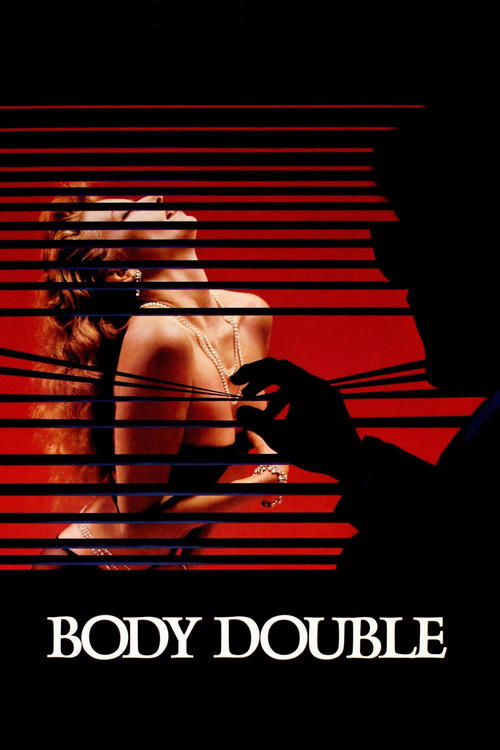
Body Double
1984 · Brian De Palma
For a midnight-movie mood — when you want a thriller that's trashy and brilliant at the same time and don't mind feeling a little implicated. Not one for a first date or the easily embarrassed.
What it's about
Jake Scully, a claustrophobic actor who's just lost a role and a girlfriend in the same week, catches a break: house-sitting a futuristic home in the Hollywood Hills. Through its telescope he watches a beautiful neighbor dance in her window every night — until he witnesses what looks like her murder, and the search for answers drags him into the porn industry's neon underworld.
The experience
Sleazy, playful, and nerve-shredding by turns, with long wordless stretches of pure suspense where you realize you've become the peeping tom. It's funny and lurid and then suddenly has you by the throat.
Performances
Melanie Griffith is the jolt of life here as porn star Holly Body — brash, funny, and completely unashamed, a breakout turn that steals the movie the moment she arrives.
The craft
De Palma builds suspense like a watchmaker: gliding camera moves, elaborate dialogue-free set pieces, and a shameless delight in the machinery of the thriller itself, all soaked in glossy 1980s Los Angeles — glass houses, music video, real estate fantasy. It's engineered for a big screen, where the long stalking sequences really tighten.
Why it matters
A scandal on release and savaged by critics, it's since been reclaimed as a cult classic and one of the purest statements of De Palma's obsession with watching, doubling, and being conned by movies.
Snapshot
Body Double is Brian De Palma's most flagrant exercise in cinephile provocation: a Hitchcock pastiche that fuses Rear Window and Vertigo and then drags their voyeuristic premises into the daylight world of 1980s Los Angeles pornography, real-estate fantasy, and music video. Jake Scully (Craig Wasson), a claustrophobic, out-of-work actor, house-sits a UFO-shaped Hollywood Hills home, watches a neighbor's nightly striptease through a telescope, witnesses what appears to be her brutal murder, and is led by porn star Holly Body (Melanie Griffith) toward the trick behind the trap. Made in the immediate aftermath of the Scarface succès de scandale, the film was De Palma's deliberate retreat into pure mechanism — a movie about looking, doubling, and being conned by the apparatus of cinema itself. It arrived to hostile reviews, accusations of misogyny built around an infamous power-drill killing, and modest commercial returns, then accrued, over decades, a reputation as one of the purest distillations of De Palma's method and a touchstone for critics who read his "plagiarism" of Hitchcock as deconstruction rather than theft.
Industry & production
Body Double was produced and distributed by Columbia Pictures, De Palma's first film for the studio after the Universal-released, Oliver Stone–scripted Scarface (1983). De Palma developed the story himself and wrote the screenplay with Robert J. Avrech. The project is widely understood as a reaction to two pressures: the censorship battle over Scarface (which had skirmished with the MPAA over an X rating before securing an R), and the critical pile-on that greeted Dressed to Kill (1980) and Blow Out (1981), the latter a commercial disappointment despite strong reviews. De Palma's response was characteristically combative — to make a film even more explicitly about voyeurism, sex, and violence, daring the same critics to object again.
The casting carried its own meta-narrative. Melanie Griffith, daughter of The Birds and Marnie star Tippi Hedren, was cast as Holly Body, threading the production directly back to Hitchcock's own troubled relationships with his blonde leads. Griffith's performance — brash, funny, and unexpectedly tender — is generally credited as the film's saving grace and a turning point that pointed toward her later success in Something Wild and Working Girl. Craig Wasson, fresh from Ghost Story, took the lead after the part proved difficult to cast; the role's passivity and neurosis made it an awkward fit for conventional leading men. Gregg Henry, a De Palma regular, plays the duplicitous Sam Bouchard. The production also famously enlisted the band Frankie Goes to Hollywood, whose single "Relax" had been banned by the BBC; their performance of the song anchors the film's bravura porn-shoot set piece, in which Jake "falls into" a music video — a synergy of the nascent MTV economy with theatrical cinema.
The R rating was secured only after negotiation with the MPAA, particularly over the drill murder and the explicitness of the pornographic sequences. The film was shot largely on Los Angeles locations, most memorably John Lautner's Chemosphere house standing in for the futuristic hilltop residence.
Technology
Body Double is a film acutely conscious of its own viewing technologies, and they are foregrounded as plot devices: the telescope through which Jake watches; the answering machine; the videotape; and the apparatus of film and music-video production itself. The film opens and closes on a movie set — a cheap vampire picture — making explicit that everything between is also a constructed image. Technically, the production relied on De Palma's by-then signature toolkit: the Steadicam (the operating tradition he had helped popularize since Carrie and The Fury) for fluid, stalking long takes, and split-diopter lenses to hold foreground and background simultaneously in focus, a device that visualizes the film's obsession with what is near and what is watched at a distance. The early-1980s context also matters: this is a film made as home video and cable were reshaping how and where people consumed both Hollywood movies and pornography, and its plot — a murder staged to be witnessed, a star "doubled" for the camera — is fundamentally about the manipulability of recorded images.
Technique
Cinematography
Cinematographer Stephen H. Burum, who would become De Palma's most frequent collaborator (The Untouchables, Casualties of War, Carlito's Way, Mission: Impossible, Snake Eyes), shot Body Double, and the film is one of the clearest demonstrations of their shared sensibility. The camera is restlessly mobile and self-consciously beautiful: the L.A. light is glossy and saturated, the hilltop vistas postcard-clean, in pointed contrast to the sordid acts they frame. Burum executes the celebrated 360-degree embrace between Jake and Gloria on the beach — a direct, almost parodic quotation of the dizzying kiss in Vertigo — as well as the extended Steadicam pursuit through a Beverly Hills shopping mall and into a tunnel and a hotel, a sequence that lifts and recombines the silent following of Madeleine from Vertigo with the spatial logic of suspense. Split-diopter compositions recur throughout, and the telescope POV shots literalize the cinematic gaze as a piece of optical hardware.
Editing
Edited by Jerry Greenberg and Bill Pankow, the film alternates between long, unbroken Steadicam takes that build dread through duration and sharply orchestrated suspense cutting in its set pieces. De Palma's editorial signature — the slow-motion suspense sequence scored to music, withholding and then delivering shock — governs the murder and the climactic confrontations. The film's structure is itself a kind of edit: the mid-film "fall" into the Frankie Goes to Hollywood video ruptures the realist surface and reframes the whole movie as a meditation on montage and illusion, before the narrative reassembles itself around Holly Body.
Mise-en-scène / staging
The film's spaces are thematic instruments. The Chemosphere — a single-pillar octagon hovering over the city — is a literal panopticon-in-reverse, a perch built for looking out, and its alien geometry estranges the domestic voyeurism at the story's center. The pornographic milieu, the antiseptic malls and hotels, and the soundstage bookends all stage the film's argument that Los Angeles is a continuous apparatus of performance and surveillance. De Palma blocks his actors as figures caught in geometric, watched compositions, and the staging repeatedly positions the audience in Jake's compromised sightline, implicating the viewer in the act of watching.
Sound
Pino Donaggio, De Palma's recurring composer (Carrie, Dressed to Kill, Blow Out), supplied a lush, Herrmannesque orchestral score that openly evokes Bernard Herrmann's music for Vertigo — soaring, romantic, and ironic against the tawdry action. Against this classical register sits the diegetic pop of "Relax," whose pulse defines the film's most famous sequence; the collision of symphonic pastiche and synth-pop new wave is itself a statement about high and low, old Hollywood and new. Sound design exploits the answering machine, the off-screen scream, and the menacing approach of the drill to manufacture suspense.
Performance
The performances are deliberately pitched at different temperatures. Craig Wasson plays Jake as a near-passive vessel — anxious, gullible, sweaty with claustrophobia — a choice that frustrated some viewers but suits a protagonist designed to be manipulated by the plot and, by extension, by the film. Melanie Griffith's Holly Body is the engine of the film's energy: her breezy professionalism and comic candor about her trade ("I do not do animal acts...") puncture the surrounding solemnity and give the second half a human center. Gregg Henry's amiable menace and Deborah Shelton's role as the doomed Gloria complete a cast organized around appearances and substitutions.
Narrative & dramatic mode
The film operates in the mode of the suspense thriller built on dramatic irony and the withheld reveal — but its deeper subject is the con. Like the Hitchcock films it cannibalizes, Body Double gives the audience a "Hitchcockian" superiority of vision (we watch with Jake) only to reveal that the watching was itself the trap: the murder Jake witnesses has been staged for his benefit, a performance designed to recruit an unreliable eyewitness. The narrative thus folds back on its own form, exposing the machinery of suspense as a swindle. De Palma's two-part structure — the Rear Window watching plot, then the Vertexigo-inflected obsession and descent into the porn underworld — is less a coherent mystery than a demonstration model of how cinema constructs and betrays belief.
Genre & cycle
Body Double belongs to the erotic thriller, a cycle De Palma helped define with Dressed to Kill and that would dominate Hollywood's adult-skewing output into the early 1990s (Basic Instinct, Sliver, the films of Adrian Lyne and Paul Verhoeven's Hollywood period). It also sits within the broader giallo-influenced strain of stylized, sexualized murder mysteries, and within the long American tradition of the paranoid voyeur thriller. Within De Palma's own filmography it forms a loose voyeurism trilogy with Dressed to Kill and Blow Out — three films about a watcher/listener who witnesses a crime and is undone by the gap between perception and reality.
Authorship & method
Body Double is among the purest statements of De Palma's authorial method, which is built openly on appropriation. He treats Hitchcock not as an influence to be absorbed and disguised but as a public text to be quoted, recombined, and pushed to excess — a practice critics have variously condemned as derivative hackwork and defended as a sophisticated, deconstructive cinema about cinema. The film's collaborators are central to that method: screenwriter Robert J. Avrech co-built the doubling architecture; cinematographer Stephen H. Burum rendered the glossy, optically self-aware images; composer Pino Donaggio supplied the knowingly Herrmannesque score; editors Jerry Greenberg and Bill Pankow shaped the suspense rhythms. De Palma's hand is most visible in the set-piece — the long take, the slow-motion crisis, the split-diopter, the camera that becomes a stalker — and in the reflexive framing devices (the film-within, the video-within) that announce the whole as artifice. His casting of Tippi Hedren's daughter is itself an auteurist signature, a biographical footnote folded into the text.
Movement / national cinema
The film is a product of New Hollywood's later phase, made by a director who emerged from the "movie brat" generation alongside Scorsese, Spielberg, Coppola, and Lucas — filmmakers steeped in film history and the auteur theory imported via Cahiers du cinéma and American critics. De Palma's particular inheritance was a Hitchcock-centered cinephilia married to an avant-garde, formalist streak traceable to his late-1960s independent films. By 1984 the New Hollywood's freedoms were giving way to the high-concept blockbuster era, and Body Double can be read as a defiant, even self-marginalizing assertion of personal authorship against that tide — an American art film disguised as an exploitation thriller.
Era / period
Body Double is saturated in the early-Reagan-era Los Angeles of 1984: the gleaming, acquisitive surfaces of conspicuous consumption, the rise of MTV and the music-video economy, the mainstreaming and home-video proliferation of pornography, and an anxious cultural relationship to sex and surveillance. The Frankie Goes to Hollywood sequence is a precise period marker, capturing the moment cinema and the pop-video industry began to converge. The film's glossy sleaze — beautiful homes, beautiful bodies, ugly acts — is very much of its decade.
Themes
The film's governing theme is voyeurism and the complicity of the gaze: it implicates the spectator in Jake's watching and then punishes that pleasure by revealing it as the mechanism of a crime. Doubling and substitution run through every level — the body double of the title (one woman performing another's striptease), the actor doubled by another, the film doubling Hitchcock — extending into questions of authenticity, performance, and the impossibility of trusting an image. Related strands include impotence and inadequacy (Jake's claustrophobia and professional failure as a kind of male crisis), the commodification of sex and the female body, and the continuity between "respectable" filmmaking and pornography, both presented as industries of staged desire. Above all, the film is about cinema's capacity to deceive — to make us believe we have seen what we have only been shown.
Reception, canon & influence
Body Double was met largely with hostility on release in 1984. Reviewers attacked it as derivative, cold, and misogynistic, with the power-drill murder becoming a focal point for charges that De Palma trafficked in stylish violence against women — a controversy continuous with the protests that had dogged Dressed to Kill. Defenders, including critics sympathetic to De Palma's formalism, argued that the film's "plagiarism" was the point: a self-aware essay on Hitchcock and the gaze rather than a failed imitation. Commercially it was a modest performer, far from the cultural event of Scarface. Within this divided response, Melanie Griffith's performance drew consistent praise and is frequently cited as the film's standout.
Its backward influences are worn on its sleeve and are essentially the project's subject: Hitchcock's Rear Window (the immobilized watcher who sees a murder) and Vertigo (obsessive pursuit, the manufactured woman, the staged death, the spiraling embrace), with Bernard Herrmann's scoring idiom channeled through Donaggio. Beyond Hitchcock, the film draws on the Italian giallo's eroticized, baroque killings and on De Palma's own prior voyeur thrillers.
Forward, the film's reputation has steadily risen among cinephiles and critics who treat De Palma as a major American formalist; Body Double now appears in serious reappraisals (the 2015 documentary De Palma gave him a fresh hearing) as one of his essential works. Its DNA is visible in the erotic-thriller cycle of the late 1980s and 1990s and in later filmmakers who foreground voyeurism and the cinematic apparatus — Quentin Tarantino has cited De Palma among his touchstones, and the film is regularly invoked in discussions of meta-cinema and the politics of the gaze. The precise extent of its direct influence on specific later films is debated rather than documented, so claims of lineage should be read as critical genealogy rather than established fact. What is secure is its status as the most concentrated, most divisive expression of De Palma's lifelong argument that to watch a movie is to be willingly, pleasurably deceived.
A Deleuzian reading
Start with the telescope.
The full Deleuzian reading of Body Double →
Reception
Trashed on release in 1984 — critics called it sleazy and misogynist, protests and thinkpieces followed, and it flopped — but decades of reappraisal have turned it into one of the most beloved entries in the De Palma cult, now read as his most gleefully self-aware movie about voyeurism and moviemaking itself.
How Body Double was received, from release to now →
Influences: the films it descends from and the films it influenced
- Rear Window (1954) — Supplies the core architecture of the immobilized watcher who pieces together a murder through an optical aid across a courtyard — Body Double rebuilds it shot-for-shot with the telescope, the apartment vantage, and the spying-on-a-woman ritual.
- Vertigo (1958) — Source of the vertiginous 360-degree embrace, the obsessive trailing of a 'manufactured' decoy woman, and the staged death the hero is gulled into witnessing — De Palma lifts the spiraling-camera kiss and the whole con structure wholesale.
- Psycho (1960) — Model for the eroticized, elaborately edited murder set-piece and the mid-film narrative rupture; the power-drill killing is engineered as a baroque analog to the shower montage.
- Peeping Tom (1960) — Establishes the camera/apparatus itself as the instrument of voyeuristic violence and folds the spectator into the act of looking — the reflexive guilt De Palma weaponizes.
- Blow-Up (1966) — Prototype of the protagonist whose recording/optical apparatus may have captured a murder, making the unreliable image an epistemological problem rather than evidence.
- The Bird with the Crystal Plumage (1970) — Giallo template of the trapped witness who half-sees a killing through glass, plus the eroticized, fetishistically staged murder choreography De Palma adopts for the drill sequence.
- Sisters (1973) — De Palma's own first full deployment of split-screen/split-diopter voyeurism and a doubling architecture, scored by Herrmann himself — the formal kit Body Double refines.
- Obsession (1976) — His earlier explicit Vertigo riff on the obsessively reconstructed lost woman, scored directly by Bernard Herrmann — establishing the Herrmannesque idiom Donaggio later channels.
- Dressed to Kill (1980) — The immediate template: a wordless Steadicam stalking set-piece (the museum), Donaggio's overtly Herrmannesque scoring, and eroticized slasher violence that Body Double simply intensifies.
- Blow Out (1981) — Companion essay on the cinematic apparatus — here sound recording rather than the lens — using the media-within-the-film and a tragic staged-con reveal in the same reflexive register.
- Basic Instinct (1992) — Carries forward the high-gloss erotic-thriller grammar of Hitchcockian set-piece suspense plus the eroticized phallic murder weapon (ice pick echoing the drill) into the 90s cycle Body Double seeded.
- Sliver (1993) — Literalizes Body Double's voyeur premise into a surveillance-apparatus thriller where the watched woman and the watching screen are the entire engine of plot and arousal.
- Boogie Nights (1997) — PTA, an avowed De Palma disciple, borrows both the bravura Steadicam long-take and the adult-film-industry milieu that Body Double detoured into for its 'Holly Does Hollywood' sequence.
- Mulholland Drive (2001) — Extends the manufactured/recast woman and the 'it was all a staged Hollywood performance' reveal, treating cinematic artifice and doubling as the subject the way Body Double does.
- Femme Fatale (2002) — De Palma's own late return to the form — a doubling/staged-con thriller built on the manufactured-woman gambit and dialogue-free, slow-motion set-pieces that directly continue Body Double's method.
- The Substance (2024) — Hollywood-set industry satire that deploys split-diopter framing and surveillance geometry to make the camera apparatus — and by extension the viewer — complicit in the voyeuristic logic the film simultaneously depicts and critiques.
- MaXXXine (2024) — Sets porn-industry-as-subject inside a Hollywood self-portrait, voyeurism mediated through screens and split staging — the closest structural ancestor to MaXXXine's world.
- Casualties of War (1989) — Pairs Burum's anamorphic voyeur set-pieces with the theme of a helpless watcher of murder, making explicit the seduction-of-spectatorship that Casualties weaponizes morally.
- I Want Your Sex (2026) — De Palma builds an erotic thriller out of conspicuously artificial sets and a film-within-a-film apparatus so the genre's voyeurism is indicted by its own staging — the same self-aware artifice Araki uses to detune the form comedically.
- The Untouchables (1987) — The immediate preceding De Palma–Burum collaboration where they refined the predatory Steadicam glide as formal grammar: the slow tracking movement through architectural space as surveilling menace, which The Untouchables repurposes from erotic suspense into institutional dread.
- Decision to Leave (2022) — Extends the voyeur-detective into a surveillance thriller where telescopic watching becomes erotic complicity and the watched woman is a constructed lure.
- The 4th Man (1983) — Builds an erotic thriller around paranoid voyeuristic subjectivity where the protagonist's perceptions may be delusional, sharing the fantastic/unreliable-narrator device.
Similar films
- Dressed to Kill (1980) — influence & lineage
- Sisters (1973) — influence & lineage
- Basic Instinct (1992) — influence & lineage
- Rear Window (1954) — influence & lineage
- Blow Out (1981) — influence & lineage
- Blow-Up (1966) — influence & lineage
- Mulholland Drive (2001) — influence & lineage
- The Bird with the Crystal Plumage (1970) — influence & lineage
All the films related to Body Double →