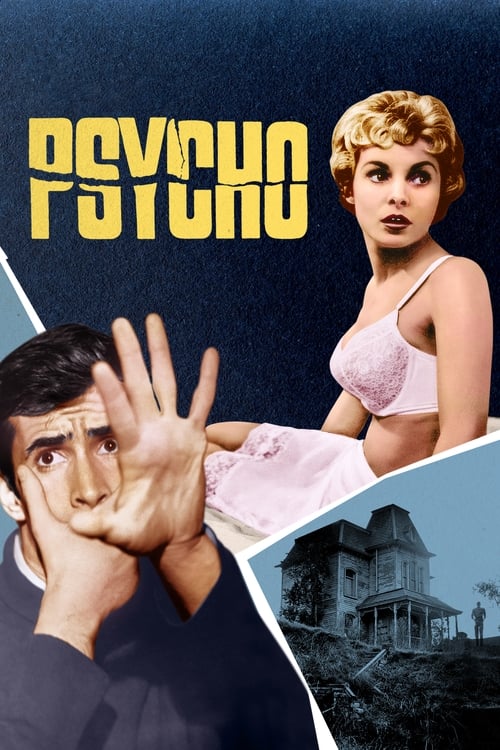
Psycho
1960 · Alfred Hitchcock
When you're craving a real scare with brains behind it — the kind of classic that still gets under your skin instead of just being homework. A challenge dressed as comfort food.
What it's about
A real estate clerk in Phoenix makes a split-second decision to steal a thick envelope of cash and drive out of her old life for good. Rain and exhaustion push her off the highway to the Bates Motel, a lonely stopover run by Norman Bates, a polite, twitchy young man who lives in the looming house behind it caring for his invalid mother. What starts as a getaway story becomes something else entirely — the less you know going in, the better.
The experience
It plays you like an instrument: long stretches of quiet guilt and small talk wound so tight that when the film finally strikes, it's genuinely shocking even now. Unsettling in a way that lingers — you'll think about it in the bathroom that night.
Performances
Anthony Perkins gives one of the great screen performances — boyish, apologetic, and quietly wrong in ways you can't put your finger on. Janet Leigh grounds the first act with a guilt so palpable you root for a thief.
The craft
Hitchcock shot it fast, cheap, and in black and white, and every choice is a weapon: Bernard Herrmann's shrieking all-strings score is arguably the most famous music cue in movies, and the editing in its key sequence has been studied frame by frame for sixty years. The stark photography makes the motel and the house behind it feel like they're watching you back. Sounds fantastic loud, in the dark.
Why it matters
It effectively invented the slasher film and the spoiler warning at once — audiences were barred from entering late — and proved a major director could shock mainstream Hollywood with pulp material. Almost every horror movie since owes it something.
Snapshot
Alfred Hitchcock's Psycho is among the most consequential films in the history of American cinema — a work that demolished narrative convention, reoriented the grammar of screen violence, and permanently altered the relationship between Hollywood and its audience. Adapted from Robert Bloch's 1960 pulp novel, itself loosely inspired by the Ed Gein murders in Wisconsin, the film follows real estate clerk Marion Crane as she absconds with stolen cash, stops for the night at the remote Bates Motel, and is murdered in a shower — roughly forty-five minutes into the picture — by a figure who turns out to be neither a stranger nor a woman. What remains is a second film conducted in the psychological wreckage of the first: a portrait of Norman Bates, taxidermist, dutiful son, and fractured self. Psycho is a horror film, a noir, a Freudian case study, and a formal experiment conducted under the sign of commercial cinema. It arrived in 1960 as a scandal and departed as a monument.
Industry & production
Paramount Pictures declined to produce Psycho when Hitchcock proposed it; the studio considered the material too sordid and the budget too modest to merit prestige treatment. Hitchcock responded by self-financing the production through his television company, Shamley Productions, at a cost of approximately $800,000 — a fraction of his recent budgets. He deferred his customary director's fee in exchange for 60 percent ownership of the negative, a gamble that would return many times over. Paramount agreed to distribute, but the film's physical and logistical infrastructure was assembled around the crew of Alfred Hitchcock Presents, the television anthology series Hitchcock had been producing since 1955. Shooting took place at Revue Studios (the Universal lot where the television series was made) and on location in the Phoenix area, over a tight schedule of approximately thirty shooting days. The production operated with the economy and dispatch of a television unit, an approach that gave Psycho an unusual rawness relative to Hitchcock's more lavishly mounted films of the 1950s. The novel's source in Ed Gein — a Wisconsin murderer whose crimes included exhumation and the fashioning of trophies from corpses — was not publicized; Bloch's book had already absorbed and fictionalized that material, and Hitchcock's primary acknowledged debt was to the novel.
Technology
Psycho was shot in black and white on 35mm, a deliberate regression from the color widescreen productions Hitchcock had been making throughout the late 1950s (Vertigo, North by Northwest). The choice was partly economic, partly tonal: black and white reduced costs while aligning the film with the low-budget horror pictures then occupying drive-in markets, and it permitted the use of chocolate syrup (Bosco brand, a detail that has passed into standard film lore) to simulate blood in the shower sequence — liquid that would have registered as orange rather than crimson in color. The film was shot in a close approximation of the Academy ratio (1.85:1 for theatrical projection), reinforcing its unpretentious, workmanlike visual register. Bernard Herrmann's score was realized exclusively with string instruments — no brass, woodwinds, or percussion — a deliberate austerity that amplified rather than filled the film's silences. Psycho also became the first major American studio film to show a flushing toilet on screen, a detail that caused consternation with censors and is often cited as a small but genuine marker of the Production Code's declining authority.
Technique
Cinematography
The film was photographed by John L. Russell, a television veteran who brought efficient coverage and a clean, functional style far removed from the atmospheric expressionism of Robert Burks, Hitchcock's principal cinematographer during the peak prestige period. Russell worked primarily with wide-angle and normal lenses, achieving depth of field suited to the confined spaces of the Bates Motel and the Bates house. The overhead shot that reveals Mother as a skeleton — the camera mounted directly above the fruit cellar — is a compositional climax earned over ninety minutes of mostly eye-level staging. The famous overhead shot looking down on Marion in the shower, in which the knife never visibly penetrates the body, was achieved by mounting the camera at a height that created spatial ambiguity. Where exactly the visual ideas originated — with Russell, Hitchcock, or graphic designer Saul Bass, who produced detailed storyboards for the shower sequence — has been a source of genuine scholarly dispute. The critical consensus, reinforced by the testimony of surviving crew members, is that Hitchcock directed the sequence himself, with Bass's boards serving as a planning document.
Editing
George Tomasini, Hitchcock's primary editor since Rear Window, cut Psycho with a ferocity that was unprecedented in mainstream American cinema. The shower sequence assembles approximately seventy discrete shots in roughly forty-five seconds — a count that has been cited with slight variation across analyses, but whose general magnitude is undisputed. The editing violates continuity without registering as error: spatial relations shift, the knife's trajectory is implied rather than traced, Marion's body is fragmented into hands, feet, shoulder, eye. The sequence operates through rhythm and visceral suggestion rather than explicit depiction; viewers consistently misremember seeing things the film never shows. Tomasini's editing throughout the second half of the film maintains a nervous, propulsive tempo that prevents the audience from recovering the stable identification the first half has destroyed.
Mise-en-scène / staging
The Bates Motel is a study in architectural meaning. The low, modern motel cabins are set against the Victorian house on the hill behind them — a visual rhyme between the contemporary and the archaic, the motel's cheapness against the house's gothicism, the social space against the private. Hitchcock stages Norman and Marion's conversation in the motel parlor surrounded by mounted birds — taxidermied specimens whose fixed, glassy eyes anticipate the surveillance dynamics the film is building. The parlor scene is also structured around a wall painting of a classical nude; when Norman moves it aside to reveal a peephole, the film makes explicit the connection between art, looking, and violation that runs through Hitchcock's late work. The Bates house interior, when finally penetrated, is rendered with an obsessive period specificity — overstuffed Victorian furniture, framed embroidery, a rocking chair — that situates Norman's psychology in a particular temporal stasis.
Sound
Bernard Herrmann's score is among the most analyzed in film history. After the cheerful, mundane opening — Marion's motel room tryst in Phoenix, scored with warmth — the strings enter as threat, as texture, as psychological pressure. Herrmann initially composed music for the shower scene over Hitchcock's stated intention to leave the sequence silent; Hitchcock heard the cue and reversed his decision. The famous "staccato strings" of the shower sequence — screeching, slashing figures in the high registers — function not as accompaniment but as violence itself, the sonic equivalent of the knife. Throughout the film, Herrmann's scoring sustains unease in scenes that would otherwise pass as exposition, making the audience aware of dread in apparently neutral spaces.
Performance
Janet Leigh anchors the film's first movement with a performance calibrated to ordinary moral failure — Marion is frightened, guilty, convincing herself of things she doesn't quite believe. Her interiority is projected through close-ups during a long driving sequence, shot against rear-projection, in which she imagines the reactions of those she has wronged. The performance demands audience identification built on recognition of a relatable transgression, which makes her death both more shocking and more structurally disorienting. Anthony Perkins's Norman Bates has become so thoroughly absorbed into cultural memory that recovering the original performance requires effort. Perkins was cast partly against the grain of his established screen persona — the gentle, boyish lead of Friendly Persuasion — and he brought to Norman a skittery, self-interrupting quality, a man visibly managing something he cannot name. The performance calibrates carefully between warmth and wrongness, inviting sympathy while permitting the retrospective horror of the revelation. Leigh received an Academy Award nomination for Best Supporting Actress and a Golden Globe in the same category — a recognition notable for its acknowledgment that a performance lasting less than half a film could anchor the whole.
Narrative & dramatic mode
Psycho organizes its dramatic materials through two linked destructions of audience expectation. The first is generic: it presents itself as a noir thriller about stolen money and a fugitive woman, then kills the protagonist — an act so radical that Hitchcock reportedly insisted theater owners enforce a no-late-admission policy to prevent audiences from entering mid-film and missing the shift. The theft of Marion Crane from the audience creates a structural vertigo that the second half exploits: we are left with Norman, an unstable substitute identification figure, and a murder we partially understand before the narrative does. The MacGuffin of the money — the $40,000 — dissolves into irrelevance after the shower, sinking into the swamp with Marion's car, acknowledged and discarded. The revelation of Norman's dissociative identity — "Mother" as an internalized persona who has murdered to preserve her dominance — is delivered through a forensic lecture from a psychiatrist, a deliberately flat expository strategy that has attracted critical attention as either masterly irony or Hitchcock's concession to an audience needing explanation.
Genre & cycle
Psycho arrived at the intersection of several genre histories. American horror film had been, through the 1950s, largely the province of science fiction and monster pictures — nuclear anxieties in creature form. The Gothic thriller tradition represented by Val Lewton's RKO productions of the 1940s had receded. In France, Henri-Georges Clouzot's Les Diaboliques (1955) had demonstrated that mainstream audiences could sustain extreme suspense and a withholding of key narrative information, while simultaneously popularizing the "twist" ending as an event requiring protection from spoilers. Hitchcock was alert to Les Diaboliques; the no-late-admission policy and the marketing campaign around secrecy were directly informed by Clouzot's approach. Psycho absorbed the Gothic (the house, the mother, the family secret), the noir (the stolen money, the femme on the run, the moral corruption underlying the surface), and the nascent horror cycle around real-crime pathology, and it synthesized them into something that belonged cleanly to none. Its legacy runs forward into the slasher film — Halloween (1978) and Friday the 13th (1980) are its direct formal descendants — and into the psychological thriller as a prestige form.
Authorship & method
Hitchcock's production method on Psycho drew on techniques refined over four years of television. His reputation as a director who pre-visualized everything and shot to a locked cut is both accurate and somewhat mythologized; he was responsive to performance and circumstance, and the contributions of his collaborators were substantial. Joseph Stefano's screenplay departed significantly from Bloch's novel, most crucially in moving point-of-view more deeply inside Marion Crane in the first act — a decision that intensifies the shock of her death. Stefano has noted that Hitchcock was initially less interested in Marion than in Norman, and that building audience investment in Crane was the writer's primary contribution to the film's structure. Saul Bass designed the opening credit sequence — a field of horizontal bars interrupted by bold typography — and produced storyboards for the shower scene whose influence on the final edit remains contested. Bernard Herrmann's creative independence was significant enough that Hitchcock reversed a major decision at Herrmann's urging. Tomasini's editing shaped the film's second half as much as any other element. Psycho is, in the most rigorous sense, a collectively authored work that nevertheless coheres around a singular controlling intelligence — Hitchcock's capacity to integrate the contributions of strong collaborators into a unified experience is itself the authorial act.
Movement / national cinema
Psycho belongs formally to American studio cinema but was made by a British émigré whose sensibility had been formed in silent film and in the British thriller tradition of the 1930s. Hitchcock's transatlantic position — his distance from the American grain, his European formalism, his comfort with irony and darkness — is part of what allowed him to make Psycho at all. The film arrived in the same year as the French New Wave's most visible productions and has sometimes been read in relation to that moment: its rejection of classical narrative continuity, its violence against the protagonist, its self-reflexive camera. The connection is suggestive but inexact; Psycho was conceived within industrial constraints the New Wave deliberately discarded. Its disruptions are managed, its breaks strategic rather than philosophical. It belongs to American cinema as an internal rupture rather than an external challenge.
Era / period
The early 1960s marked the late phase of the Hollywood Production Code, whose authority was visibly eroding. Psycho pressed against Code restrictions at multiple points — the motel-room scene in underwear, the toilet, the explicit violence — and navigated them through indirection and implication rather than confrontation. The film's success accelerated the Code's declining legitimacy and is often cited as a transitional document between classical Hollywood and the New Hollywood that would consolidate after 1967. It captures a moment when mass entertainment was becoming newly permissive, when the cultural conversation around crime, psychology, and sexuality was shifting, and when the horror genre was preparing to move from the fantastic to the domestic.
Themes
Psycho is organized around the gaze: who looks, at what, through what frame, and what looking costs. Marion is observed from the moment she is introduced — by her boyfriend, by her employer, by a highway patrolman who stares through her car window in a scene of sustained, wordless threat, and finally by Norman through a peephole. Hitchcock implicates the audience in this surveillance by giving us Marion's subjectivity and then removing it, leaving us to watch with Norman. The Freudian architecture of Norman's psychology — the mother who cannot be relinquished, the self split between desire and prohibition — was legible to contemporary audiences through popular psychoanalytic discourse, and the film deploys it with confidence. More durable as a formal theme is the film's interest in performance and concealment: every major character in Psycho is managing a secret, and the film tracks the physical and psychological cost of sustained pretense. The swamp that receives Marion's car — and her money, and eventually her body — functions as the film's central symbol of repression: what is pushed below the surface, and what it costs to keep it there.
Reception, canon & influence
Psycho opened in June 1960 to a reception divided along lines of cultural authority. Serious critics, including Bosley Crowther at The New York Times, were largely hostile or ambivalent, treating the film as exploitation beneath Hitchcock's gifts. Popular audiences responded with immediate and extraordinary enthusiasm, making Psycho one of the highest-grossing American films of 1960 despite — or because of — its controversial content and its unconventional distribution strategy. The reversal of critical and popular responses has itself become part of the film's history; Psycho is among the clearest examples in American cinema of a work that critical consensus initially mislabeled.
The film drew on several antecedents beyond Bloch's novel. Clouzot's Les Diaboliques established the model for withholding narrative information and enforcing audience compliance. The Gothic literary tradition — Mary Shelley, Poe, the Victorian sensation novel — provided the house, the maternal secret, and the theme of the monstrous double. Fritz Lang's and F.W. Murnau's expressionist manipulation of architecture as psychological projection belongs to the film's visual lineage, mediated through Hitchcock's own British work of the 1930s.
Psycho's forward legacy is extensive and well-documented. The slasher film as a cycle — the killer with a blade, the isolated setting, the systematic elimination of characters — derives directly from Psycho's formal innovations and from the cultural figure of Norman Bates. Brian De Palma's work of the 1970s and early 1980s (Sisters, Dressed to Kill, Blow Out) constitutes the most sustained direct engagement with Psycho's techniques, including split-screen references to subjective fragmentation and the use of the shower as a site of gendered vulnerability. Jonathan Demme's The Silence of the Lambs (1991) and the broader tradition of the psychological serial-killer thriller descend from Psycho's psychological architecture, even as they develop its terms in new directions. Gus Van Sant's shot-for-shot remake of 1998 remains a curiosity — a conceptual art project disguised as a commercial film — that paradoxically confirmed the original's irreducibility. The shower scene has generated more scholarly attention than perhaps any other sequence in Hollywood cinema: readings in feminist film theory (Laura Mulvey's foundational account of the male gaze, while not developed specifically around Psycho, created a framework within which the film has been repeatedly analyzed), psychoanalytic criticism, and formal analysis of editing rhythm have produced a literature proportionate to the sequence's density. In the canon, Psycho is secure — a film that changed what cinema was permitted to do, and how audiences were expected to understand what they were watching.
A Deleuzian reading
Watch the drain.
The full Deleuzian reading of Psycho →
Reception
Critics were initially sniffy — several reviewers dismissed it as a cheap shocker beneath Hitchcock — while audiences lined up around the block under his famous 'no admission after the film starts' policy. Now it's untouchable canon, routinely called the film that rewired the horror genre.
How Psycho was received, from release to now →
Influences: the films it descends from and the films it influenced
- The Cabinet of Dr. Caligari (1920) — The framing-narrative psychiatric reveal that inverts madman and authority figure — Caligari is the asylum director, not a patient — establishes the structural device Psycho inherits: a final exposition that retroactively reframes every prior interaction as performance by a fractured self whose institutional authority masked the pathology.
- Battleship Potemkin (1925) — The Odessa Steps sequence establishes the formal grammar Tomasini inherits for the shower scene: violence assembled from rapid montage of fragmented body parts — feet, hands, faces — without depicting the act itself, constructing kinetic dread through rhythm and ellipsis so that viewers misremember seeing what the editing only implies.
- M (1931) — Lang's rendering of Hans Beckert through subjective POV shots and empathetic performance — a compulsive killer given psychological interiority and pitiable vulnerability rather than monster-movie distance — is the behavioral and casting template for Norman Bates's warmth-wrongness calibration and for the structural gambit of soliciting identification with a murderer.
- Shadow of a Doubt (1943) — Hitchcock's own warmth-wrongness calibration of the Merry Widow Murderer embedded in a small-town family establishes the performance grammar Anthony Perkins refines in Norman — genuine charm, slight awkwardness, and real warmth that coexist with lethal interiority — and the Victorian house in Santa Rosa prefigures the Bates house as Gothic domestic architecture.
- Double Indemnity (1944) — The noir structure in which stolen money functions as MacGuffin — driving all initial action but dissolving in moral weight once the protagonist's death spiral begins — is the direct structural template for Marion's $40,000 theft, which Psycho abandons as irrelevant the moment her body hits the shower floor, stranding the audience in a film about something else entirely.
- Sunset Boulevard (1950) — The noir-gothic hybrid in which a decaying Victorian mansion traps a figure performing a fractured identity around a lost self — Norma Desmond staging stardom for a phantom audience — prefigures Norman Bates's performance of 'Mother,' with the same architectural duality of imposing exterior and psychic ruin, and the same male interloper drawn in and then destroyed.
- Les Diaboliques (1955) — Psycho's direct formal competition: Clouzot established the no-latecomers theatrical distribution policy, the bathtub as primary murder scene with water as ritual element, and the twist-within-twist structure in which a figure revealed as murdered reappears — all absorbed and radicalized by Hitchcock, who purchased Bloch's novel partly to prevent Clouzot from filming it first.
- Rear Window (1954) — Norman's peephole scene is Rear Window in miniature: the close-up of the watching eye, the POV shot of the observed woman undressing, the Kuleshov-effect attribution of desire to the watcher — but Hitchcock sharpens the voyeurism-complicity argument by engineering full audience identification with a murderer, making the charge against the spectator explicit rather than symptomatic.
- The Man Who Knew Too Much (1956) — Herrmann's string writing and Tomasini's editing return from the Albert Hall sequence, but the decelerated cross-cut build is violently punctuated rather than sustained: the shower sequence converts the 1956 film's real-time restraint into a montage of rapid percussion, inverting the formal principle by which the Albert Hall maximizes dread through withheld cutting speed.
- Strangers on a Train (1951) — Norman Bates is the logical extension of Bruno Anthony — charming, mother-fixated, simultaneously pitiable and monstrous — and the transfer-of-audience-guilt mechanics (the viewer roots for Norman to successfully conceal Marion's murder) directly extend Hitchcock's technique of implicating the audience in Bruno's delight and Guy's passivity.
- Witness for the Prosecution (1957) — Hitchcock directly adopted Wilder's 'do not reveal the ending' marketing embargo, extending it into a no-late-admission policy that became industry precedent; the sympathy-manipulation architecture of the first act — engineering identification with a character whose guilt is then systematically revealed — replicates Witness's structural move in a different genre register.
- Spellbound (1945) — Caps the analyst-detective device Spellbound popularized — ending with a literal psychiatrist's expository diagnosis of the disturbed mind, the schematic Freudian explanation taken to its limit.
- Repulsion (1965) — Polanski extends Psycho's identification-rupture by constructing the entire film within a dissociating female protagonist's subjectivity — the London apartment expressing psychic breakdown through literally closing walls and hands erupting from plaster — literalizing the architectural duality that Hitchcock renders as behavioral surface in Norman's contested interior.
- Sisters (1972) — De Palma literalizes Psycho's dissociative identity as Siamese twins — one killer, one psychically present 'dead' sibling — deploying split-screen as the formal equivalent of split selfhood, while repeating Psycho's protagonist-death-at-midpoint structure and explicitly citing its voyeurism apparatus through a neighbor who witnesses the murder through binoculars.
- Don't Look Now (1973) — Roeg's celebrated intercutting of a sex scene with shots of the couple already dressing afterward deliberately scrambles temporal sequence for emotional dislocation, directly extending Tomasini's discovery in the shower scene that continuity violation creates dread precisely by defying grammatical expectation; Roeg also deploys the overhead shot as moment of death revelation.
- The Texas Chain Saw Massacre (1974) — Hooper extends Psycho's rural Gothic — the remote motel as trap replaced by the isolated farmhouse — and the taxidermist-killer's obsession with preserved bodies as sculptural objects, deploying an overhead shot during the final slaughterhouse chase that rhymes compositionally with Psycho's overhead fruit-cellar revelation of the mummified mother.
- Halloween (1978) — Carpenter literalizes the killer-POV shot that Psycho implies in the shower sequence — opening Halloween with sustained first-person perspective and returning to it throughout — transforming Hitchcock's implicit voyeurism apparatus into the defining formal technique of the slasher genre that Psycho's proto-slasher template made possible.
- Dressed to Kill (1980) — De Palma's most deliberate structural homage: the apparent female protagonist murdered at the midpoint by a figure whose gender disguise conceals a dissociative identity, with the shower scene relocated to an elevator and the warmth-wrongness calibration of a psychiatrist who cannot control his alternate personality repeating the Norman/Mother dynamic with declared formal consciousness.
- Blue Velvet (1986) — Lynch deploys Psycho's voyeurism apparatus as the film's structural principle — Jeffrey hidden in the closet watching, the camera descending through a severed ear into a psychosexual underworld — while the MacGuffin dissolves in significance once the noir-gothic architecture beneath suburban normality is exposed, completing the identification-rupture Hitchcock initiated.
- The Silence of the Lambs (1991) — Demme inherits Psycho's warmth-wrongness calibration in Lecter — genuinely warm toward Clarice, genuinely dangerous — and the identification-rupture problem it creates for the viewer, deploying the overhead shot at the moment of Clarice's descent into Lecter's basement cell to rhyme structurally with Psycho's overhead fruit-cellar and shower reveals.
- A Fistful of Dollars (1964) — Herrmann's score, employing only string orchestra to produce abrasive timbral shock in place of conventional orchestral warmth, demonstrated that genre scoring could operate through unexpected sonic texture rather than melodic illustration—the principle Morricone radicalized by substituting electric guitar distortion, whip cracks, and Alessandroni's wordless vocals for the Western's brass-and-strings idiom.
- Marnie (1964) — Tomasini's suspense-intercutting grammar — cutting between Marion's movements and an encroaching threat to build tension through precision withholding — and Herrmann's dissonant scoring are transferred directly to Marnie's theft sequences, with the opening-withholding device also reprised.
- Fight Club (1999) — Hitchcock's structural technique of withholding the protagonist's true split identity, then retroactively reorienting every prior scene through a single revelation, is Fight Club's direct formal template for the Narrator/Tyler Durden twist.
- The Birds (1963) — Herrmann's strings-only score demonstrated that radical restriction of orchestral palette could perform the full range of cinematic affect, laying the direct ground for Hitchcock's more extreme decision in The Birds to eliminate composed music entirely and replace it with Sala's electronic bird-sounds as functional score.
- Peeping Tom (1960) — Both 1960 films arrived independently at the same conclusion: cinema is voyeurism and therefore complicity; Powell literalizes what Hitchcock implies — the camera as murder weapon, the audience's gaze structurally indistinguishable from the killer's — and both films study a psychosexually disturbed killer whose compulsion is encoded by a parent's deliberate manipulation.
- Eyes Without a Face (1960) — Franju's clinical visual detachment — clean, unhurried compositions applied to surgical horror — produces the same paradox Psycho exploits: formal elegance that amplifies rather than softens atrocity; both 1960 films deploy the visual grammar of control and precision to generate maximum moral discomfort from minimal graphic content, arriving simultaneously at horror-as-aesthetic-problem.
- High Anxiety (1977) — Brooks transposes the shower sequence shot-for-shot into the newspaper-stabbing gag, parodying Hitchcock's fragmented Saul-Bass-cut montage of slashing inserts and Herrmann's shrieking string stabs.
- Volver (2006) — The domestic-murder-cleanup as suspense set piece — the woman scrubbing blood and disposing of a body in real, tactile time — which Almodóvar restages when Cruz mops the kitchen and hides the corpse in the freezer.
- Scream (1996) — Pioneers slaughtering the marquee star in the first reel to detonate audience expectation — the move Scream reprises by killing top-billed Drew Barrymore in the cold open (the subverted cameo).
- Phantom of the Paradise (1974) — The tiled-bathroom shower-murder grammar (curtain, plumbing, stabbing rhythm) parodied in Beef's plunger death, plus the Herrmann-style shrieking suspense scoring.
- Manichitrathazhu (1993) — Its third-act psychiatrist's monologue that clinically diagnoses a split personality is directly echoed by Dr. Sunny's rational explanation of Ganga's dissociation, converting supernatural dread into pathology.
- Final Destination 3 (2006) — The shower sequence's fragmented, object-fixated cutting fused to a stabbing sound accent is the suspense-montage template on which FD3 assembles each death — inserts of hazard components edited into inevitability.
- Final Destination Bloodlines (2025) — Models the misdirection-editing and protagonist-expendability the series lives on — cutting so the viewer anticipates one threat while the fatal one arrives from an unexpected vector, and killing 'safe' characters against genre expectation.
- The Wrong Man (1956) — Descendant of the same experiment in stripped-down realism — a small-budget, near-monochrome, semi-documentary opening ('Phoenix, Arizona… two forty-three P.M.') — and the mature fruit of the Herrmann partnership that The Wrong Man inaugurated.
- The Misfits (1961) — George Tomasini's kinetic cross-cutting and precision rhythm as an editorial signature — the same cutter shaping The Misfits' roundup tempo the year prior.
- Cairo Station (1958) — Breaks the star contract the same way — audience sympathy migrates to the killer, and the murder of the desired woman is staged in a cramped utilitarian space built from subjective looking; two years after Cairo Station, with no traceable contact.
Similar films
- Double Indemnity (1944) — influence & lineage · same viewing thread · often watched together
- Diabolique (1955) — influence & lineage · same viewing thread
- Sunset Boulevard (1950) — influence & lineage · same viewing thread
- Repulsion (1965) — influence & lineage · often watched together
- Vertigo (1958) — same viewing thread · often watched together
- Halloween (1978) — influence & lineage
- Peeping Tom (1960) — influence & lineage
- Shadow of a Doubt (1943) — influence & lineage
All the films related to Psycho →
Watch it with: curated runs of related films
- The Golden Age of Suspense — A run of immaculate mid-century crime pictures — Hitchcock plus his sharpest rivals — where guilt, obsession, and dangerous romance are staged in gorgeous black-and-white; watch them close together and the shared DNA of the perfect-murder plot lights up.
Film essays and courses that include it
- How Cuts Think: From Soviet Montage to New Hollywood Rhythm
- What the Ear Sees: A Century of Cinematic Sound
- Alfred Hitchcock
- Shadow, Psyche, Flesh: The Formal Breakthroughs of Horror Cinema
- The Fractured Mind: Twelve Landmarks of the Psychological Thriller
- Portrait of the Killer: Serial Murder from Lang to Fincher
- Portrait of a Killer: How Cinema Learned to Inhabit the Monster
- The Hidden Frame: A Century of the Cinematic Twist
- The Grammar of Dread: Twelve Films That Built Cinema's Language of Unease
- Premeditated: Cinema's Century of the Kill
- The Tyranny of Reason: Cinema Inside the Breaking Mind
- The Other Self: A Century of Doubling
- No Vacancy: A Century of Rooms
- The Film That Watches You Back
- The Monster Moves Closer
- The Sound of the Inside
- The Meaning Is in Your Head
- The Allegory Machine