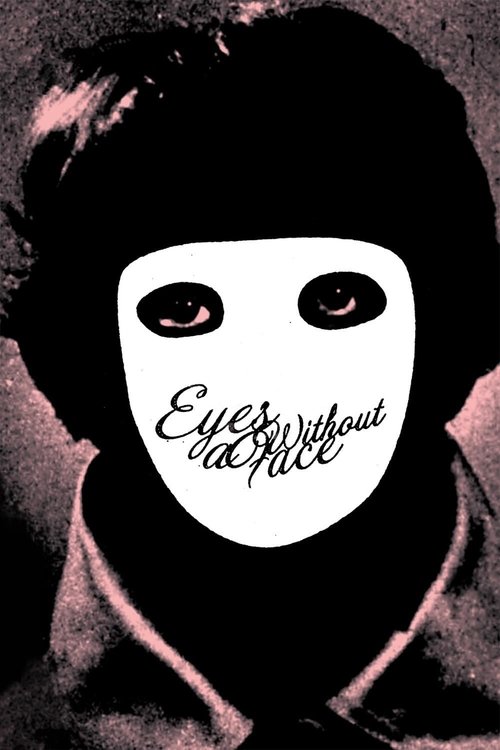
Eyes Without a Face
1960 · Georges Franju
For when you want horror with elegance — a haunting, poetic scare instead of a loud one, best on a quiet night when you're open to being genuinely disturbed by mood alone. Firmly on the challenge side, but a hypnotic watch.
What it's about
A brilliant surgeon caused the car accident that destroyed his daughter's face, and the world believes she died. Instead she drifts through the family mansion behind an expressionless white mask while her father and his devoted assistant lure young women to the estate, determined to give her a new face — whatever it costs. A police investigation slowly circles the disappearances.
The experience
Eerie and strangely beautiful rather than gory — it moves with a dreamlike calm that makes its clinical moments land harder. Sad and unsettling in equal measure, it lingers like a fairy tale you shouldn't have been told.
Performances
Édith Scob does something extraordinary with almost nothing: acting through a featureless mask, she conveys grief, hope, and longing with just her eyes and the way she moves through rooms.
The craft
Georges Franju shoots horror like a medical procedural crossed with a Gothic dream — luminous black-and-white photography, unhurried pacing, and one surgical sequence that was scandalous in 1960 and still makes audiences look away. Maurice Jarre's carnival-tinged score gives the whole thing an off-kilter lullaby quality.
Why it matters
Its imagery — above all that blank white mask — has echoed through horror, art cinema, and even pop music for sixty years, and it proved horror could be as formally beautiful as any prestige drama.
Snapshot
A surgeon's obsessive guilt mutates into atrocity: Dr. Génessier abducts young women, excises their faces, and attempts to graft living skin onto his disfigured daughter Christiane, who drifts through the family estate in a featureless white mask. Released in France as Les Yeux sans visage, Franju's film occupies a singular position in European horror—clinically precise where contemporaries were sensational, elegiac where they were lurid. Its imagery (the mask, the surgical extraction, the dove-carrying figure walking into night) has saturated world cinema for six decades, yet the film itself resists easy genre placement, hovering between medical procedural, Gothic fairy tale, and moral nightmare. It remains among the most formally controlled horror films ever made.
Industry & production
Les Yeux sans visage was produced by Jules Borkon for Champs-Élysées Productions in co-production with Lux Film (Italy), a Franco-Italian arrangement typical of late-1950s European genre filmmaking. The Italian partnership helped unlock financing for material that French studios regarded with unease: the face-transplant premise and its surgical explicitness made producers and distributors nervous. Franju had previously made La Tête contre les murs (1959) for the same producer, establishing a working relationship that gave him relatively unusual latitude.
The screenplay was adapted from Jean Redon's 1959 novel by Pierre Boileau and Thomas Narcejac—the crime-writing duo whose novels had already furnished Alfred Hitchcock with Vertigo (1958) and Henri-Georges Clouzot with Les Diaboliques (1955). Their involvement lent the project genre credibility. Dialogue was written by Claude Sautet, then working as a writer-for-hire years before he became one of France's most celebrated directors of psychological drama. The multiple-writer structure is visible in the film's tonal range: Boileau-Narcejac supply its thriller architecture, while Sautet sharpens the clinical exchanges and the subsidiary characters' texture.
For the American market, the film was distributed in a substantially altered form—dubbed into English, trimmed, and in some exhibition contexts paired with exploitation pictures under the title The Horror Chamber of Dr. Faustus. This packaging obscured the film's register for years in the English-speaking world; its recovery as a canonical text is partly the story of later critical reassessment divorcing it from that exploitation framing.
Technology
Cinematographer Eugen Schüfftan—the German-born technician who had devised the "Schüfftan process," a mirror-and-miniature compositing technique used in Fritz Lang's Metropolis (1927)—shot the film in black and white on 35mm. Schüfftan's career had moved across Germany, France, and eventually Hollywood; he would win the Academy Award for Best Cinematography for Robert Rossen's The Hustler (1961), shot just after this film. For Eyes Without a Face, he exploited deep-shadow compositions and a delicate modulation of gray tones that gave the film its characteristic quality: not the expressionist chiaroscuro of Universal horror, but a paler, more diffuse luminosity—clinical, almost fluorescent in the surgical scenes, softly Gothic in the mansion interiors.
No notable in-camera special effects processes have been documented beyond standard optical printing of the period. The surgical extraction scene—in which the camera watches Génessier's scalpel trace the perimeter of a donor's face in an unbroken, nearly real-time sequence—achieves its effect through prosthetics, practical makeup, and the refusal of editorial relief. The make-up team created a peeled-face effect that reportedly shocked audiences unprepared for its matter-of-fact presentation; the specific craftspersons responsible are not well documented in available production records.
Technique
Cinematography
Schüfftan's work is the film's structural spine. He shoots the Génessier estate with a cool, surveilling eye: wide shots that place Christiane in rooms too large for her, corridors she moves through like a specter. The mask is lit to collapse depth—it reads as surface without volume, an object rather than a face—while Scob's eyes, always visible, become the film's primary locus of interiority. The surgery sequence is filmed with the camera positioned as an observing presence rather than a participant: static shots, close but not intimate, generating discomfort through their refusal of editorial intervention. The Paris street scenes that open the film, in which Louise deposits a body into the Seine at night, use location shooting with tight, controlled fill lighting, pressing the genre toward a documentary unease that connects directly to Franju's nonfiction roots.
Editing
Gilbert Natot's editing is deliberately unobtrusive by the standards of horror cutting. Franju and Natot resist the impulse to fragment scenes of tension or violence; instead, sustained takes accumulate dread. The surgical extraction scene is the clearest instance: cuts are deferred, allowing the procedure to unspool with a duration that implicates the viewer. The pacing overall is measured—slow enough to be lyrical, never so slow as to become slack—and the film's rhythm derives more from Schüfftan's compositions and Maurice Jarre's score than from editorial rhythm.
Mise-en-scène / staging
Franju's staging reflects a documentary sensibility applied to fantastic material: actors are positioned with geometric clarity, space is rigorously mapped, and movement carries semantic weight. Christiane's movements are choreographed as near-floating—Scob glides rather than walks, arms slightly away from the body—creating the uncanny impression of a ghost inhabiting her own house. The motif of the cage recurs in staging logic: Christiane is perpetually framed through doorways, windows, and architectural apertures that mark her confinement without literalizing it. The kenneled dogs Génessier maintains for experiments are staged as parallel presences—heard and glimpsed throughout—before they acquire narrative function in the film's coda. The final image, Christiane walking into the darkened garden holding a white dove with doves settling on her arms and shoulders, belongs entirely to the register of surrealism; it is staged as a vision rather than a scene.
Sound
Maurice Jarre's score—composed early in his career, well before his international breakthrough with David Lean's Lawrence of Arabia (1962)—is one of the film's most disorienting formal elements. The principal musical motif is a circus-style waltz, deceptively light, deployed against images of abduction, surgical violence, and disfigurement. The effect is not ironic in the familiar sense but something more unnerving: the music seems to belong to an adjacent film, a children's story or a carousel, and its presence in this one produces a dissociation that resists easy naming. Franju reportedly embraced this disjunction deliberately, using the score to push the film away from conventional horror affect. Ambient sound design is minimal and precise; the film uses silence aggressively in the surgical scenes, allowing the viewer no sonic alibi.
Performance
Pierre Brasseur brings to Génessier the bearing of a man who has never been adequately challenged: patrician, impatient, capable of tenderness only as an instrument of will. His guilt is performed as pressure rather than anguish, a man whose self-regard has deformed his grief into project. Alida Valli's Louise—accomplice, enabler, woman with her own disfigured history (her face restored by Génessier, her loyalty therefore absolute and captive)—is played with a cold economy that makes her more disturbing than Génessier: she selects victims, she drives, she disposes, without visible inner conflict. Valli had played a very different kind of moral complexity in The Third Man (Carol Reed, 1949); her presence carries that history without invoking it.
Edith Scob's performance as Christiane is among cinema's most remarkable physical achievements: masked for nearly the entire film, she communicates solely through posture, gesture, and the movement of her visible eyes. The performance is not "acting through limitation" in the conventional sense—Scob and Franju appear to have worked toward a different mode entirely, something nearer to mime or dance, the body expressing states that the immobilized face cannot. The mask itself—white, smooth, slightly too perfect—is the film's central object and, in Scob's handling, its most expressive element.
Narrative & dramatic mode
The film is structured as a tragedy of irresolvable guilt: Génessier's accident causes Christiane's disfigurement, his surgery causes Christiane's captivity, his love causes her suffering. The narrative follows a doubled movement—each failed graft (the heteroface is rejected, the donor discarded) marks a repetition compulsion that Génessier cannot break through science, only through the film's final violence. Christiane's agency is suppressed for most of the running time, but the dramatic logic builds toward her as the only figure capable of rupturing the cycle: she frees the dogs, she frees the human "donor" being held, she walks into the dark. Whether this constitutes escape, madness, or death is left unresolved—a refusal of conventional narrative closure characteristic of Franju's sensibility. The film declines to punish or redeem; it simply ends.
Genre & cycle
Eyes Without a Face belongs to no stable genre formation, which partly accounts for its unusual longevity. It draws on the medical-horror tradition reaching back to H.G. Wells's The Island of Dr. Moreau and its film adaptations, the Gothic science fiction of Frankenstein (in which a scientist's creation turns against him), and the French polar tradition filtered through Boileau-Narcejac. Yet its tone refuses the genre's conventional pleasures—it is not suspenseful in the thriller sense, not cathartic in the horror sense, not morally clarifying in the melodrama sense.
It was released into a French cinema environment dominated by the early New Wave and a European horror market beginning to consolidate around Hammer Films in Britain and the Italian gotico cycle. Franju's film shares little with either: it is too austere for Hammer's Technicolor sensualism and too cosmopolitan for the Italian Gothic's operatic extremity. Its closest contemporaries may be the films of Luis Buñuel—the matter-of-fact surrealism, the critique of bourgeois order conducted through images rather than argument—though Franju and Buñuel are distinct sensibilities.
Authorship & method
Georges Franju co-founded the Cinémathèque Française with Henri Langlois in 1936—a biographical fact whose implications run through everything he made. His formation was archival and curatorial before it was directorial; he came to fiction filmmaking after a decade of documentary work. Le Sang des Bêtes (Blood of the Beasts, 1949), his documentary about Parisian abattoirs, establishes the Franju signature: images of institutional violence rendered without commentary, the camera's impassivity forcing the viewer to supply the moral weight. The surgical scenes in Eyes Without a Face are the fiction-film iteration of this method: not horror-inflected but documentary-inflected, which is a different and stranger thing.
Eugen Schüfftan's contribution extends beyond technical execution; his sensibility—formed in Weimar cinema, shaped by decades of working across national traditions—gives the film its peculiar quality of beauty-and-wrongness. Jarre's score, Natot's editing, and Sautet's dialogue each contribute to an ensemble authorship whose coherence Franju clearly supervised but did not produce alone. The film bears Franju's signature most legibly in its pacing, its staging, and its indifference to genre convention—but it is also a collaborative object.
Movement / national cinema
Franju occupies an anomalous position in the French cinema of 1960. He was neither a New Wave director nor a representative of the cinéma de qualité the Cahiers du Cinéma critics attacked. He was older than the Cahiers generation and more embedded in the Cinémathèque world that had formed them, but his own aesthetic—documentary-derived, politically ambivalent, formally austere—did not map onto their auteurist polemics. Eyes Without a Face was made the same year that À bout de souffle and Les Quatre Cents Coups consolidated New Wave identity in international reception. Franju's film was absorbed into international art cinema by a different route, through horror festivals and retrospectives rather than the Cahiers critical network.
The film represents a strain of French poetic cinema—associated with poets like Jacques Prévert and directors like Marcel Carné and Jean Cocteau—that Franju inherited without quite reproducing. Cocteau's influence is most visible in the film's fairy-tale architecture: the masked daughter, the monstrous father, the menacing retainer, the figure walking into night. La Belle et la Bête (1946) hovers behind the film without being cited.
Era / period
1960 is a pivotal year in world cinema—the year of L'Avventura, Psycho, Rocco e i suoi fratelli, and the consolidating New Wave—and Eyes Without a Face is both of its moment and estranged from it. It inhabits a transitional space in European horror: after the Universal cycle's dominance had faded, before Argento and the giallo had established a new European idiom. It arrives at the point when both art cinema and horror cinema were being radically renegotiated, and its refusal to belong fully to either tradition has made it a persistent reference point for filmmakers navigating the same territory.
Themes
The film's dominant thematic structure is the patriarchal will to restore—Génessier's desire to reconstitute Christiane's beauty is coded explicitly as his need to undo an accident he caused, but the film's staging reveals a deeper logic: he is restoring something that was his to damage, his to repair. Christiane exists as object of his guilt and project of his science; she has no autonomous desire the film represents until the final sequence. The critique of the Pygmalion structure—the male creator who fashions the female body to his specification—is conducted through horror rather than argument, through the literalization of what metaphor usually veils.
The mask functions simultaneously as disfigurement, protection, and objectification: it is imposed on Christiane by her circumstances, but it also enables her eerie beauty and prevents others from seeing her as she is. The film is acutely interested in the relationship between the face and identity—the face as the site of social recognition, desire, and violence. This thematic territory would be extensively revisited by later cinema, from Almodóvar's plastic-surgery horror to philosophical treatments of prosopagnosia and personal identity.
Guilt without expiation is the emotional keynote: Génessier's crime cannot be undone by technical success (the grafts fail), and his love for Christiane is indistinguishable from his destruction of her. The film offers no redemptive reading of parental love or scientific ambition.
Reception, canon & influence
Backward: influences on the film. The film draws on German Expressionism's iconography of the monstrous scientist and the deformed body; on American Universal horror's Gothic architecture and moral structure; on Cocteau's fairy-tale cinema; and on Buñuel's surrealist method of presenting disturbing images without narrative explanation. Boileau-Narcejac bring the tight structural logic of the French crime novel. The pseudo-scientific plausibility of heterografting—actual skin transplantation research existed, though face transplants were purely speculative in 1960—grounds the premise in a way that separates it from supernatural horror.
Reception. The film screened at the Edinburgh International Film Festival in 1960, where its surgical content reportedly caused severe audience reactions, including, by some accounts, fainting. Critical reception was divided along predictable lines: those resistant to the genre found it repugnant; those open to horror as a serious form recognized something unusual. In France, it was received with more ambivalence than enthusiasm at initial release, though it found an audience. The US release under the exploitation title The Horror Chamber of Dr. Faustus effectively buried the film in the English-speaking world for years.
Forward: legacy and influence. The film's influence spreads through several distinct channels. Its masked figure is a direct ancestor of the emotionless, featureless killers of American slasher cinema: John Carpenter has cited it as an influence on Michael Myers's mask in Halloween (1978), and the lineage of the blank-faced killer—which continues through Jason Voorhees, Leatherface, Ghostface—returns repeatedly to Franju's image of beauty annihilated into surface. Pedro Almodóvar's The Skin I Live In (2011) is the most explicit homage in prestige cinema: a surgeon who remodels a captive's face, a Pygmalion critique, an enclosed Gothic space, virtually a scene-by-scene reworking of Franju's moral architecture.
The film's influence on feminist film theory has been substantial: the surgical violence against women's faces, the father's objectification of the daughter, and Christiane's ultimate seizure of her own fate have generated considerable academic attention within the framework of the male gaze and the gendered horror film. The image of Louise selecting young women in Paris—trolling the streets for faces that match Génessier's specifications—anticipates discussions of how cinema positions women as spectacle and object.
In the broader art-horror tradition, the film's synthesis of clinical precision with surrealist imagery has been a touchstone for directors working in that register: it demonstrated that horror could be formally serious without abandoning affect, and that disturbing imagery could be composed rather than merely staged. Its critical rehabilitation—from exploitation artifact to canonical masterwork—models the trajectory of several important genre films that were initially misread by the critical establishment, and its current position in the canon reflects a long reassessment in which its refusal of genre comfort has come to look like strength rather than failure.
A Deleuzian reading
Watch her eyes.
The full Deleuzian reading of Eyes Without a Face →
Reception
Scandalous in 1960 — critics sniffed, audiences fainted, and America got it dubbed and retitled 'The Horror Chamber of Dr. Faustus' on a drive-in double bill. Decades later it was reappraised as one of the most beautiful horror films ever made, now a Criterion-anointed arthouse classic.
How Eyes Without a Face was received, from release to now →
Influences: the films it descends from and the films it influenced
- Le Sang des Bêtes (1949) — Franju's own documentary method — the camera's clinical impassivity before abattoir slaughter rendered without moral commentary — is transposed directly into the surgical face-removal sequences; the horror is documentary-inflected rather than expressionist, a formal posture Franju imports wholesale from his short into the fiction.
- La Belle et la Bête (1946) — Cocteau's Gothic fairy-tale architecture with the transformed figure as its moral center: Génessier's villa and Christiane's porcelain mask inherit the Beast's enchanted-space mise-en-scène directly, including the use of practical magic effects and candlelit architectural confinement to make the domestic interior a site of metamorphic dread.
- Quai des Brumes (1938) — Eugen Schüfftan's gray-tonality cinematography — the silvery fog-light, compressed tonal range, deep shadow pools — established the Poetic Realist visual register that Schüfftan reprises as Franju's own cinematographer, making the film a direct technical continuation of this collaborative aesthetic.
- Un Chien Andalou (1929) — Buñuel's method of presenting bodily violation — the eye-slitting, the severed hand — without narrative explanation or moral commentary is the direct model for how Franju films the face-removal surgery as an observed clinical fact rather than a staged horror set piece; the viewer must supply the ethical weight the film refuses to furnish.
- Les Diaboliques (1955) — Boileau-Narcejac, who wrote the screenplay for both films, imports the French crime novel's deferred-revelation structure: dread accumulates through the meticulous repetition of procedural steps rather than through shock, and the reveal is delayed until repetition has compounded audience anxiety into something structural rather than momentary.
- Frankenstein (1931) — Whale establishes the Gothic laboratory as the architectural site of transgressive surgery where the doctor's guilt operates as the narrative motor: Génessier's enclosed stone clinic, surgical instruments, and moral collapse under the weight of his own obsession inherit this spatial and ethical grammar directly from Whale's Frankenstein.
- Dark Passage (1947) — Franju takes the plastic surgery / new-face mechanism that structures Dark Passage's identity concealment and extends it into lyrical horror: the father's surgical reconstruction of his daughter's face becomes both the film's central act and its moral catastrophe, pushing the transformation-reveal to its darkest consequence.
- The Man Who Laughs (1928) — Builds an entire film around a mask-like disfigured face whose horror and tenderness live in the eyes, the direct art-film heir to Gwynplaine's expressive-mask problem.
- Blood and Black Lace (1964) — Bava's masked killer who targets women systematically for murder deploys the featureless, expressionless mask — here a white stocking — as the primary horror object; the blank-face device Franju established in Christiane's porcelain mask is weaponized in the giallo mode, transmitting the iconography into the Italian genre tradition that feeds American slasher cinema.
- Halloween (1978) — Carpenter has cited Franju directly: Michael Myers's blank white mask evacuates killer interiority the same way Christiane's porcelain mask does, converting violence into pure expressionless surface rather than affect; the mask's function is not disguise but ontological — it replaces the face with an absence, which is precisely Franju's device.
- The Texas Chain Saw Massacre (1974) — Leatherface's stitched-together mask of human facial skin is the grotesque inversion of Génessier's surgical project: both are constructed faces that replace the killer's own, making the face itself — not the body, not the weapon — the site of horror, and both films stage this substitution as the visual center around which all other dread organizes.
- Repulsion (1965) — Polanski deploys architectural confinement and silence as primary horror texture in the same register as Franju: Deneuve's apartment contracts around her psychological disintegration as Génessier's clinic contracts around Christiane, and both films use near-silence and ambient sound rather than underscore to produce dread, treating music as an intrusion rather than a support.
- Seconds (1966) — Frankenheimer's surgical facial reconstruction as instrument of bourgeois desire: the new face given to the protagonist is simultaneously liberation and imprisonment, structurally identical to Christiane's situation, and the film extends Franju's logic by asking what happens after the surgery succeeds — the reconstructed face becomes a second confinement rather than a release.
- Audition (1999) — Miike uses the deferred-cut structure Franju pioneered: the film accumulates dread through clinical restraint and sustained surface normality before erupting into surgical body horror, and the precision of the violence — needles, wire — is foregrounded as formal device in a way that inherits Franju's insistence on the clinical as a register of the disturbing rather than the spectacular.
- Martyrs (2008) — Laugier's New French Extremity film brings Franju's clinical impassivity into systematic body horror: the captive woman's physical transformation through sustained violence in an enclosed architectural space, observed by the camera without moral commentary, is the logical extreme of the method Franju pioneered — the viewer forced to supply the ethical weight the film's observational posture refuses to furnish.
- The Skin I Live In (2011) — Almodóvar's explicit homage reworks Franju's moral architecture nearly scene for scene: the enclosed Gothic domestic space, the surgeon-captive dynamic, the face reconstruction as Pygmalion critique, and the captive's ultimate violent seizure of agency are all directly transposed, with the clinical Gothic aesthetic and guilt-as-motor narrative structure reproduced as knowing quotation.
- The Ice Tower (2025) — The masklike feminine glamour and clinical, lyric chiaroscuro of the French fantastique — horror dissolved into restraint and a frozen, beautiful face that hides as much as it shows.
- Hour of the Wolf (1968) — Franju founded art-horror as a formal mode by deploying sustained silences, composed wide shots, and minimal scoring to generate dread in place of shock — with the face as the primary site where horror and desire converge — establishing the aesthetic register Bergman adopts for the aristocratic island sequences, where beauty and predatory violence share the same surface.
- Get Out (2017) — Franju's surgical body horror — elite figures harvesting physical material from unwilling donors through medical procedure, with clinical formality displacing moral outrage — establishes the procedural grammar that Get Out's Coagula transplant inherits: the doctor-as-orchestrator, the screened room, the patient who cannot resist because the body has already been prepared.
- Beauty and the Beast (1979) — Demonstrates poetic-horror lyricism laid over genuine cruelty — hushed fog, the fixed mask, beauty and mutilation held in the same lyrical register that Herz adopts.
- Peeping Tom (1960) — The exact contemporary British counterpart: Powell builds horror from the surveilling camera as instrument of lethal violence against women's faces, making the observing apparatus itself the agent of harm; both films literalize the male gaze as a mechanism of destruction and both were initially dismissed as repugnant by critics resistant to the genre's seriousness.
- Vertigo (1958) — Boileau-Narcejac adapted D'entre les morts for Hitchcock with the same structural logic they bring to Franju: Scottie's obsessive physical reconstruction of Madeleine — her hair, clothing, face staged as an aesthetic object under male control — is the structural twin of Génessier's surgical reconstruction of Christiane, the male shaping of female surface as a form of possession.
- Psycho (1960) — Franju's clinical visual detachment — clean, unhurried compositions applied to surgical horror — produces the same paradox Psycho exploits: formal elegance that amplifies rather than softens atrocity; both 1960 films deploy the visual grammar of control and precision to generate maximum moral discomfort from minimal graphic content, arriving simultaneously at horror-as-aesthetic-problem.
- The Face of Another (1966) — Direct ancestor for the surgical-face conceit: the clinical grafting of a new face onto a patient, filmed with cold documentary poise that lets surreal horror bleed through antiseptic mise-en-scène — Teshigahara inverts it by giving the patient volition over his new mask.
Similar films
- Beauty and the Beast (1946) — influence & lineage · same viewing thread
- Diabolique (1955) — influence & lineage
- Repulsion (1965) — influence & lineage
- Blood and Black Lace (1964) — influence & lineage
- The Skin I Live In (2011) — influence & lineage
- Frankenstein (1931) — influence & lineage
- Orpheus (1950) — same viewing thread
- Dracula (2025) — same viewing thread
All the films related to Eyes Without a Face →
Watch it with: curated runs of related films
- Haunted Castles and Restless Ghosts — A run of enchanted ruins, restless dead, and grief that won't stay buried — watch these when you want dread and reverie sharing the same frame.