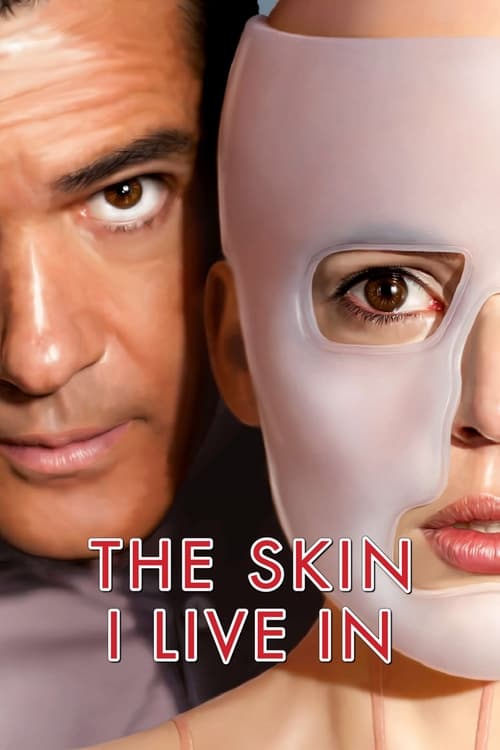
The Skin I Live In
2011 · Pedro Almodóvar
For when you're craving something dark, elegant, and genuinely disturbing — a puzzle-box thriller for a night when you want to be unsettled rather than comforted. Definitely the challenging end of the shelf.
What it's about
A brilliant, immaculately composed plastic surgeon has invented a synthetic skin that can withstand almost anything — and in his gated villa outside Toledo, he keeps a mysterious woman under constant observation as his living experiment. What connects them is the film's slowly detonating secret, and the less you know going in, the better. It's a story about obsession, revenge, and who gets to decide what a body is.
The experience
A horror film without a single jump scare — cool, precise, and increasingly suffocating, it works by making beautiful surfaces feel wrong. It gets under your skin in the most literal sense and leaves you rattled for days.
Performances
Antonio Banderas, reuniting with Almodóvar after two decades, is chilling precisely because he never raises his voice — all courtliness over a void. Elena Anaya matches him with a physically fearless, enigmatic performance that carries the film's biggest demands.
The craft
Almodóvar shoots pulp material like an operating theater: saturated colors frozen into clinical stillness, gorgeous production design (down to the flesh-toned bodysuit that became the film's emblem), and a score that keeps the dread humming. The controlled surfaces are the point — melodrama held at scalpel's distance.
Why it matters
One of the most argued-about films of Almodóvar's career, it pushed his cinema into outright horror territory and reignited his partnership with Banderas; its questions about identity and ownership of the body have only grown louder since.
Pedro Almodóvar called it 'a horror story without screams or frights,' and the description holds: adapting Thierry Jonquet's pulp novel Tarantula, he strips his usual warmth down to surgical steel. Antonio Banderas, reuniting with the director after twenty-one years, plays a plastic surgeon of immaculate composure who keeps a woman under observation in his gated Toledo villa; what binds them is the film's slow-detonating secret, and it should be met cold. The lineage runs straight to Georges Franju's Eyes Without a Face and to Vertigo's dream of remaking a person, but the sensibility — the saturated interiors, the Louise Bourgeois sculptures, the flesh-toned bodysuit that became the film's emblem — is pure Almodóvar, melodrama frozen into something clinical and disquieting. Questions of identity, embodiment, and who owns a body have made it a touchstone of queer horror, argued over as fiercely as it is admired. Alberto Iglesias's string score does the screaming the characters won't, circling like something trapped under glass.
A Deleuzian reading
A woman sits on the floor of a bare room in a bodysuit the colour of skin that is not hers.
The full Deleuzian reading of The Skin I Live In →
Reception
It polarized Cannes in 2011 — critics couldn't agree if it was Almodóvar's boldest film or his coldest — but it aged fast into a late-career highlight, winning the BAFTA for Best Film Not in the English Language and climbing 2010s best-of lists ever since.
How The Skin I Live In was received, from release to now →
Influences: the films it descends from and the films it influenced
- Eyes Without a Face (1960) — Almodóvar transplants Franju's exact conceit — a guilt-driven surgeon holding a captive in a gated country estate while grafting a new face — keeping the serene, lyrical calm draped over clinical operating-theater horror.
- Vertigo (1958) — Hitchcock's engine of a man obsessively remaking a woman — hair, clothes, body — into the image of a lost love is what Almodóvar literalizes with a scalpel, turning makeover-as-control into surgery-as-control.
- Frankenstein (1931) — Supplies the maker/creature grammar: a creator who assembles a body from another's flesh, then imprisons and recoils from the sculpted being who turns the desire for mastery back on him.
- Les Diaboliques (1955) — The precision-engineered withheld reveal — information metered out so a late identity twist detonates and retroactively rewrites every prior scene — is the thriller architecture Almodóvar borrows for the Vera/Vicente disclosure.
- Peeping Tom (1960) — Powell fuses clinical apparatus with desiring gaze (camera-as-instrument-of-violation), the same coupling Almodóvar stages through the surveillance monitor on which Robert watches his captive as both patient and object.
- Bad Education (2004) — Rehearses the nested literary adaptation, gender masquerade and Alberto Iglesias's noir-melodrama scoring — the coiled Iglesias strings and Hitchcockian orchestral menace carry directly into the seed.
- That Obscure Object of Desire (1977) — As Buñuel's most direct Spanish heir, Almodóvar inherits the staging of horrifying situations within a meticulously domesticated visual register — the nonchalant framing of the inexplicable that Buñuel deployed for the sack prop — and the central figure of a woman whose body is the site of a possessive male fantasy construction she ultimately refuses.
- Tristana (1970) — Shot around Toledo and built on the Buñuelian captive-in-the-house scenario, with a patriarch-surgeon who remakes a body to his specification and a prisoner who acquires power through the very alteration done to her — Tristana's amputation-as-inversion rewritten as surgery, retaining the cool, clinical framing of the operating and living quarters.
- Under the Skin (2013) — Extends skin-as-worn-disguise and the clinical abduction of bodies into blank, controlled interiors, treating the human surface as a detachable, manufactured shell.
- Stoker (2013) — Carries forward the lacquered bourgeois-villa gothic — a sculpture-filled family estate as pressure chamber — with the same slow-drip withheld twist and eroticized menace.
- The Neon Demon (2016) — Stages body-horror as high melodrama inside saturated, designer interiors, using color-drenched production design (as Almodóvar's saturated villa does) to aestheticize violation of the flesh.
- The Handmaiden (2016) — Restructures a literary source (as Almodóvar reworks Jonquet's novel) around captivity, eros and a withheld reveal that inverts victim and master.
- Titane (2021) — Pushes the seed's forced re-identification through the flesh — a body surgically and violently remade into another gender/identity against its will — into the next generation of art-house body horror.
- The Substance (2024) — Builds body-horror melodrama around a surgically manufactured second self and the horror of an engineered new body, inheriting Almodóvar's clinical-glamour framing of flesh as designed object.
- Goodnight Mommy (2014) — Confines its dread to an isolated modernist villa and withholds an identity twist about the person behind the altered face, echoing the seed's captivity-plus-reveal machinery.
- The Ugly Stepsister (2025) — Its clinical surgical remaking of a body toward another's aesthetic ideal supplies the beauty-as-cold-violence and medical-procedure horror the film applies to the stepsister's self-modification.
- Tie Me Up! Tie Me Down! (1990) — Banderas already plays the captor who imprisons a woman expecting captivity to ripen into love — the Stockholm-syndrome dynamic and the actor's tender-menacing register are reprised here two decades later.
- Matador (1986) — Early Almodóvar–Banderas collaboration that welds eros to death and ritualized bodily violence, establishing the actor's charged, guilt-ridden physicality the seed exploits.
- Talk to Her (2002) — Almodóvar's prior study of a caretaker ministering obsessively to a silenced, immobile body in an antiseptic domestic-clinical space — the same ethics of tending-as-possession.
- Dead Ringers (1988) — Centers a surgeon whose instruments reshape flesh, shot with cold clinical elegance and a body-as-destiny logic, privileging controlled tone over surgical gore exactly as Cronenberg does.
- The Face of Another (1966) — Descendant of the surgical-identity lineage: a surgeon fabricating a new face and skin as an experiment in imposed selfhood, explicitly extending the Franju–Teshigahara conceit of the constructed face as prison.
- Helter Skelter (2012) — Cosmetic surgery reframed as horror inside saturated melodrama — the female body engineered as a manufactured beautiful object — is the exact contemporaneous craft parallel.
Similar films
- Talk to Her (2002) — influence & lineage
- Bad Education (2004) — influence & lineage
- Eyes Without a Face (1960) — influence & lineage
- The Neon Demon (2016) — influence & lineage
- Tie Me Up! Tie Me Down! (1990) — influence & lineage
- Pain and Glory (2019) — shared sensibility
- Biutiful (2010) — shared sensibility
- Under the Skin (2014) — shared sensibility
All the films related to The Skin I Live In →