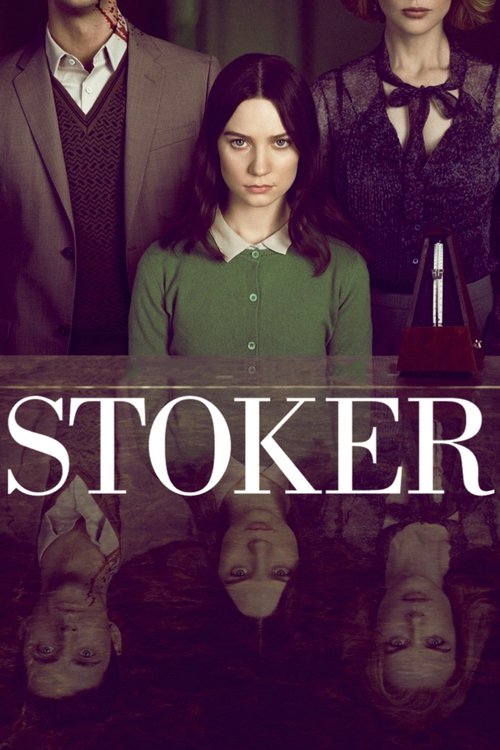
Stoker
2013 · Park Chan-wook
For when you want elegant menace over cheap thrills — a film to sip slowly and chew on afterward. Reach for it when you're in the mood for something beautiful, perverse, and deliberately paced; skip it if you need momentum tonight.
What it's about
On her eighteenth birthday, India Stoker's father dies suddenly, and an uncle she never knew existed moves into the family's isolated house. Charlie is handsome, attentive, and wrong in some way India can't name; he charms her brittle, needy mother while India — friendless, watchful, unnervingly perceptive — studies him. What she discovers about Charlie starts to reveal something about herself.
The experience
A hothouse slow burn: hushed, sensuous, and coiled, where a piano duet or a shared glass of wine carries more menace than any chase. It's less about what happens than about the mounting, transgressive charge between three people in one house — unsettling in a way that lingers.
Performances
Mia Wasikowska plays India almost entirely through stillness and stares, and makes it riveting; Matthew Goode's Charlie is charm with something hollow behind the eyes; Nicole Kidman gives the fragile, jealous mother real wounded glamour.
The craft
Park Chan-wook's first English-language film is composed within an inch of its life — every match cut, sound bridge, and camera move loaded with meaning, with sound design that puts you inside India's hypersensitive hearing, where a cracking egg or a spider's footsteps roar. It's a Gothic told through style, and it rewards good speakers as much as a good screen.
Why it matters
It announced that one of Korean cinema's great stylists could carry his full visual language into Hollywood intact, and it's become a touchstone for the modern American Gothic revival.
Snapshot
Stoker is Park Chan-wook's first English-language feature: a hothouse Gothic in which an eighteen-year-old girl, India Stoker, loses her father in a car fire and gains an uncle she never knew she had. Charlie moves into the family house, seduces India's brittle mother Evelyn, and begins removing obstacles. India — hypersensitive, unfriended, watchful — works out what he is, and in the working-out discovers what she is. The film is less a thriller about detection than a coming-of-age story in which maturity means accepting an inheritance of appetite.
It is a deliberate rewriting of Hitchcock's Shadow of a Doubt (1943), down to the name Uncle Charlie and the niece who shares a preternatural bond with him. Where Hitchcock's Charlie is a murderer who contaminates a bright American family, Park's Charlie is a catalyst who reveals what was already latent. The film's surname promises vampirism and never delivers it literally; the Bram Stoker echo is a lure, and the bloodline in question is ordinary human predation passed down like eye color.
Made for Fox Searchlight under Scott Free, premiered at Sundance in January 2013, released in the US that March, it performed modestly in specialty release and divided critics sharply between those who found it a masterclass in controlled style and those who found it an exquisite hollow object. Its afterlife has been strong: it functions now as the hinge between Park's Korean revenge films and The Handmaiden (2016).
Industry & production
The screenplay was written by Wentworth Miller, then best known as an actor on Prison Break, who circulated it under the pen name Ted Foulke to keep his acting profile from prejudicing the read. It landed on the 2010 Black List, the industry's annual survey of admired unproduced scripts — a route that, in the post-2008 specialty market, had become one of the few reliable ways for an original non-franchise script to reach production. Ridley Scott, Tony Scott and Michael Costigan produced through Scott Free; Fox Searchlight financed and distributed. The film reached theaters roughly six months after Tony Scott's death in August 2012, and carries a dedication to him.
Casting shifted during development; Colin Firth was reported as attached to Charlie before departing, with Matthew Goode taking the role opposite Mia Wasikowska and Nicole Kidman. Dermot Mulroney plays the dead father in flashback, Jacki Weaver the doomed aunt, Alden Ehrenreich and Lucas Till the schoolboys.
Production was based in and around Nashville, Tennessee — a Southern setting rendered as an unplaceable, seasonless estate rather than a documented region. Park directed largely through an interpreter, a working method that has been widely discussed in accounts of the shoot and that arguably reinforced the film's style: a director who cannot improvise verbally with actors will storyboard, block and pre-visualise with unusual rigor. The record is thin on the exact contractual terms of Park's authority in post; what is visible on screen is a film that shows no obvious signs of studio smoothing, which is itself notable for a Searchlight release of this period.
This was one node in a striking historical convergence: within roughly a year, the three directors most identified with Korea's post-1999 boom all made English-language features — Kim Jee-woon's The Last Stand (2013), Bong Joon-ho's Snowpiercer (2013), and Stoker. The results were commercially inconsistent, and all three returned to Korean production afterward.
Technology
Stoker is a photochemically originated film finished digitally — 35mm capture, digital intermediate grade — and it belongs to the last cohort of American specialty features for which that was the unremarkable default rather than a stated aesthetic choice. The DI is doing heavy work: the palette is pushed toward mustard, moss and bruise, with skin held pale and cool against it, so that the house reads as a preserved specimen.
The film's most-copied technical gesture is a set of digital morph transitions that Park uses as narrative connective tissue rather than as spectacle. Evelyn's brushed hair dissolves into wind-combed field grass; a spider's progress up a stocking becomes a graphic rhyme with a hand on a piano; the annual birthday shoeboxes stack through time. These are compositing effects deployed with the logic of a 1960s optical-printer transition — invisible technology used to make an old-fashioned rhetorical figure.
The opening title sequence integrates credits into the photographed world — lettering caught in grass and flowers, disturbed by movement — a design lineage running back through Saul Bass, and consistent with Park's habit of treating titles as part of the film's argument rather than a wrapper around it.
Worth noting as context: two years earlier Park had co-directed Night Fishing (2011) shot entirely on iPhone 4. He is not a purist about capture; the 35mm here is a texture decision, not a creed.
Technique
Cinematography
Chung Chung-hoon, Park's cinematographer since Oldboy (2003), shoots Stoker as a study in constrained perception. The camera moves constantly but rarely dramatically — slow lateral tracks, creeping push-ins, and a recurring device of reframing that reveals a watcher already inside the shot. Compositions favour hard verticals: banisters, doorframes, window mullions, the piano's music stand, all of which cage India before she learns to move through them.
The film's signature is the perceptual insert. India's hearing and sight are established in an opening monologue as abnormally acute, and the camera obeys her: extreme close-ups of a cracking eggshell, a spider, a pencil's shavings, a metronome, a whispering blade of grass. These are not merely stylish — they are the film's only reliable narration, since India speaks so little.
Light is sourced with theatrical frankness: table lamps and windows blaze while the surrounding rooms fall away, so the house reads as a series of lit islands in darkness. The exteriors, by contrast, are flat and overcast — a world with nothing to hide because nothing lives there.
Editing
Nicolas De Toth cuts the film — a departure from Park's long partnership with the Korean editors of his Vengeance films. The dominant figure is the graphic match, used to collapse time and to insist on continuity between bodies. The most famous is the hair-to-grass dissolve; the most structurally important is the film's opening, which is a flash-forward to its own final minutes, so that the entire narrative is retrospectively an explanation of an image already seen.
Elsewhere the cutting is patient to the point of provocation, then suddenly elliptical. Charlie's backstory arrives late, compressed into a montage of letters and childhood memory, dumping decades of withheld exposition in a rush. The most discussed sequence intercuts India's shower with her memory of a boy's strangulation — an edit that does not depict arousal so much as construct it from adjacency, and which remains the film's clearest statement of method: meaning made in the cut, not in the shot.
Mise-en-scène / staging
Thérèse DePrez's production design and the costumes by Kurt Swanson and Bart Mueller build a house that is a museum of arrested taste — dark wood, wallpaper, taxidermy, a wine cellar, a chest freezer. India's wardrobe is period-indeterminate schoolgirl formality: blouses, cardigans, and the saddle shoes she has received every birthday since childhood. The shoes are the film's central object; when the eighteenth box holds a key instead, the costume system itself announces the plot turn.
Staging repeatedly places three bodies in unstable triangles — mother, daughter, uncle around a dinner table, a piano, a staircase — with the geometry doing the work of dialogue. Park stages sexual threat and family courtesy in the same register, at the same volume, which is the source of the film's peculiar unease.
Sound
Sound is where Stoker is least conventional. The mix privileges India's hearing to a degree that borders on the fantastical: a distant conversation is audible over close ambience; a cracked egg is louder than a raised voice; a spider is audible at all. This is subjective audio used as characterization rather than as horror punctuation, and it is the strongest formal claim the film makes about its heroine's difference.
Clint Mansell's score works in nervous strings and low pulses, but the film's musical center is a piano duet composed for it by Philip Glass. The scene — Charlie joining India at the keyboard, the piece accelerating into an unmistakable seduction, India fleeing when it ends — is the film's set piece, and one of the rare instances of a contemporary art-music commission being fully load-bearing rather than decorative. Source music sharpens the irony: Nancy Sinatra and Lee Hazlewood's "Summer Wine" and an original Emily Wells song carry the film out.
Performance
Mia Wasikowska plays India as a study in withheld reaction — minimal blinking, a flat vocal line, a stillness that reads as either damage or predation depending on what the film has just shown. The performance's arc is physical rather than expressive: posture straightens, gaze becomes direct, the body finally occupies space.
Matthew Goode plays Charlie almost entirely on a smile held a beat too long, a courtly manner delivered with the slight over-precision of someone who learned social behavior from observation rather than practice — appropriate for a man institutionalized since childhood.
Nicole Kidman gives the film its one operatic register, playing Evelyn as a woman of exhausted glamour, and delivers a late monologue of maternal cruelty that is the picture's most quoted passage. Jacki Weaver, in limited screen time, supplies the only warmth, which is precisely why she is disposed of.
Narrative & dramatic mode
The mode is fairy tale under Gothic dressing. The mechanics are those of a mystery — who is Charlie, what happened to the housekeeper, what is in the freezer — but the film treats these as foregone, releasing information at intervals dictated by India's readiness rather than by suspense. Park is not withholding for the reveal; he is withholding to dramatize a girl's acquisition of knowledge.
Voice-over bookends the film, and it is unreliable in an unusual way: not lying, but speaking from the far end of a transformation the audience has not yet watched. The closing narration's fatalism — that we no more choose our natures than a flower chooses its color — reframes everything preceding it as an origin myth rather than a moral test. There is no redemptive off-ramp built into the structure; the only question is when India will stop resisting.
Dramatically the triangle is a displaced family romance: the father is removed before the film begins, and the uncle occupies both the paternal and the erotic vacancy, with the mother as rival rather than protector. The film's most transgressive move is to make the daughter's victory over the mother simultaneously her succession to the uncle.
Genre & cycle
Stoker sits at the junction of three cycles. It is Southern Gothic in setting and furniture — the decaying estate, the buried family crime, the sexual charge under manners — though it treats the South as an aesthetic rather than a place. It is a Hitchcock riff arriving in the middle of a broader Hitchcock revival that also produced Hitchcock (2012) and The Girl (2012), a moment when the director was being re-litigated as both master and predator.
Most durably, it belongs to the cycle of arthouse-financed films about girls whose maturation is indistinguishable from becoming dangerous — Black Swan (2010) and Hanna (2011) before it, Raw (2016) and Thoroughbreds (2017) after. That strand ran alongside the specialty-label "elevated horror" boom, and Stoker is one of its more formally extreme entries precisely because it refuses supernatural machinery.
Authorship & method
Stoker is a director's film built on someone else's script — a spec by a first-time screenwriter, considerably reshaped by a director with an established grammar. Park's method here is the one visible across his work: rigorous pre-visualisation, a preference for figures of rhyme over psychological explanation, and a willingness to let a sequence stop the narrative to complete a formal idea.
The core collaboration is with Chung Chung-hoon, whose decade with Park had already established the vocabulary of gliding lateral camera, hard graphic composition and saturated-then-drained color that Stoker transplants to America. Chung's subsequent Hollywood career — much of it in mainstream horror — makes Stoker legible as his calling card.
Nicolas De Toth's editing supplies a different rhythm than Park's Korean collaborators: less percussive, more dissolve-driven. Clint Mansell's score aligns Park with the American art-horror sound of the period, while the Philip Glass commission is the more distinctive credit and the one that most clearly marks the film as an auteur object rather than a genre assignment. DePrez's design and Kurt and Bart's costumes carry over the Black Swan team's talent for making psychological states into wardrobe.
Wentworth Miller's authorial contribution should not be understated — the Shadow of a Doubt armature, the shoe motif and the fatalist ending are structural, not decorative. His subsequent screenwriting record is slight, and the film remains his principal credit in that role.
Movement / national cinema
Park belongs to the generation that made Korean cinema an international force after the late-1990s liberalization and the screen-quota era, alongside Bong Joon-ho and Kim Jee-woon. His Sympathy for Mr. Vengeance (2002), Oldboy (2003) and Lady Vengeance (2005) established the register for which that cinema became known abroad: extreme violence held inside baroque formal control, and moral schemes that refuse catharsis.
Stoker is best read as a document of that cinema's export phase — the moment when festival prestige converted into Hollywood offers, and when the question became whether an idiom formed under specific national conditions survives translation. The consensus is that Park's survived better than most, partly because his style was never realist and therefore had less to lose in relocation. What did not travel was the political substrate: the Korean films' preoccupation with historical guilt, class and institutional failure has no equivalent here, leaving a purer, thinner exercise.
A domestic ancestry is also legible. The poisonous intruder installed inside a bourgeois household is the founding situation of Kim Ki-young's The Housemaid (1960), a touchstone for Korean domestic thrillers generally, and Stoker's architecture of stairs, cellars and sexual contagion sits comfortably in that line.
Era / period
The film is a specimen of the early-2010s American specialty ecosystem: studio-owned art labels — Searchlight, Focus, Sony Classics — financing mid-budget auteur pictures for platform release, with the Black List and Sundance functioning as the discovery and legitimation pipeline. That model was already under pressure from the collapse of DVD revenue and would contract further; Stoker's modest commercial performance is typical of the squeeze.
It also belongs to a brief window of studio confidence in importing festival auteurs for English-language debuts. The mixed commercial outcomes of that 2012–14 experiment helped push the next round of such collaborations toward streaming and prestige television — a path Park himself took with the six-part The Little Drummer Girl (2018).
Themes
Inheritance is the master theme, framed biologically rather than morally. The film's proposition is that violence is a family trait like height, and that the drama of adolescence is discovering which traits you got. The father's stated principle — that doing something small and bad prevents something larger — is offered as a parenting strategy and revealed as containment protocol.
Predation is literalised through hunting. India was taught to shoot by her father; Charlie completes the education; the final act converts the lesson into practice. The rifle, the belt and the pencil form an escalating series of instruments that are all, in the end, the same instrument.
Sexuality and violence are not merely adjacent but interchangeable, and the film has been read both as a bracing account of adolescent female desire and as an aestheticized evasion of the same. The shower sequence is the crux of that disagreement and will likely remain so.
Finally, gentility as concealment: the house, the manners, the dinner service and the polished piano exist to make an ordinary murder look like a family with taste. Park's decorative excess is not indulgence but argument — beauty here is what a crime looks like from the outside.
Reception, canon & influence
Critical response on release was genuinely split. Admirers treated it as a demonstration of near-total directorial control — the transitions, the sound design and the piano duet were singled out almost universally, including by detractors. The dissenting case was consistent too: that the film's surface is so dominant that its psychology becomes schematic, that the Southern setting is a mood board, and that a story about a girl's interiority is told almost entirely from outside her. Wasikowska's performance was praised widely; Kidman's was the more debated, read alternately as calibrated brittleness and as camp. Commercially it was a modest specialty performer rather than a breakout, and it collected no significant awards.
Its backward debts are explicit and acknowledged. Shadow of a Doubt supplies the premise and the name; Psycho and Rebecca supply the architecture of the haunted-by-the-living house; Val Lewton's suggestion-over-display and the domestic Gothic of du Maurier and the Brontës supply the tone. Within Park's own filmography, Thirst (2009) is the immediate precursor — appetite as inheritance, desire as infection — and Stoker can be described as Thirst with the vampirism removed and the metaphor left standing.
Forward, its clearest legacy is internal: The Handmaiden (2016) reworks nearly every Stoker element — the sequestered heiress, the manipulative interloper uncle, the erotically charged period costume, the house as psychological diagram — with the political and historical weight the American film lacked. It is not an exaggeration to say Stoker was the laboratory for Park's most acclaimed film, and the perceptual-subjectivity experiments here resurface in the sensory play of Decision to Leave (2022).
More diffusely, Stoker became a reference image for a decade of art-horror about girlhood and for a certain style of high-gloss Gothic in music video and streaming prestige drama. Its influence circulated at least as much through image culture — the belt, the spider, the shoes, the duet — as through the industry. That may be the fairest summary of its standing: a film whose individual sequences are more widely known than the film itself, and which is now valued less as a self-contained achievement than as the point where one of contemporary cinema's major stylists tested his grammar in a foreign language and found that it held.
A Deleuzian reading
A spider climbs the inside of India Stoker's stocking, and she does not brush it off.
The full Deleuzian reading of Stoker →
Reception
Landed at Sundance 2013 to a shrug — critics called it gorgeous but chilly, and it barely made a dent at the box office. A decade of Letterboxd devotion later, it's routinely reclaimed as Park Chan-wook's underrated English-language gem rather than his awkward Hollywood detour.
How Stoker was received, from release to now →
How to watch Stoker: what to notice on a first viewing
- Listen for a cracked eggshell mixed louder than a raised voice. The mix obeys India's ears rather than the room's acoustics. A conversation two floors away carries over the ambience beside her. A spider is audible. Park takes her opening claim about her senses literally. You are put inside a girl who takes in everything and can do nothing with any of it.
- Notice the banisters and doorframes standing between you and India. Chung Chung-hoon builds compositions on hard verticals. Stair rails, window mullions, the piano's music stand. The camera moves in slow lateral tracks and creeping push-ins that never turn urgent. She is boxed in by the furniture of her own house before anything happens to her.
- Look at India's shoes and the box they came in. The same saddle shoes arrive in the same wrapped box on every birthday of her life. She wears them everywhere, with blouses and cardigans that belong to no particular decade. The film sets up an object you can count on, which is the only way it can later surprise you with one.
- Count how often three people arrange into a triangle. Mother, daughter and uncle at the dinner table, at the piano, on the staircase. Park keeps finding three-point geometry and letting the distances between bodies carry what nobody says out loud. The blocking tells you who is winning the house. Almost none of it is spoken.
- Watch how rarely Wasikowska blinks or raises her voice. She plays India on a flat vocal line and a withheld face. Goode plays Charlie on a smile held a beat too long and a courtesy that is slightly too precise, like manners learned by watching. Two people are managing their faces at each other for the whole film. India's change is posture, not expression.
The whole guide to watching Stoker, with the keys for a rewatch →
Influences: the films it descends from and the films it influenced
- Shadow of a Doubt (1943) — Supplies the literal armature Wentworth Miller rewrites — the charming Uncle Charlie who arrives after a death, the niece who shares his name and telepathic 'twinning,' and Hitchcock's device of introducing the two in rhymed supine poses on separate beds, which Park converts into the film's parallel-cutting logic and the dinner-table scene where the uncle's worldview leaks out as monologue.
- Rebecca (1940) — Origin of Stoker's costume-as-plot method — the wardrobe and its contents used as forensic evidence of an absent woman, the closet entered as an erotic archive — plus the housekeeper who knows what the house is hiding, transposed to Mrs. McGarrick and to the belt/shoe-box succession of gifts.
- Psycho (1960) — Gives Park the vertical house as psychological cross-section (basement freezer below, mother's bedroom above) and the Hitchcock/Bass graphic-match grammar — drain to eye — that Stoker escalates into its signature transitions of hairbrush bristles dissolving into wind-blown grass and hair into wheat.
- Cat People (1942) — Val Lewton's suggestion-over-display economy: the predator is withheld from frame and rendered instead through motivated practical light and off-screen sound, the method behind Stoker's refusal to show the killings' impact and its reliance on shadow, reflection and audio cue to carry violence.
- The Night of the Hunter (1955) — The template for Southern Gothic staged as expressionist tableau from a child's sightline — Stanley Cortez's hard-edged source lighting and low-angle predator framings — and for the seductive adult male whose courtship of the household is filmed as a hunt.
- The Innocents (1961) — Freddie Francis's wide-lens deep-focus compositions that isolate a repressed young woman inside an over-large estate, married to sound bridges that carry whispers and birdsong across cuts — the direct precedent for Stoker's subjective-hearing design, where India's hyperacusis (eggshell, spider, metronome) is edited as if the world were mixed from inside her skull.
- Repulsion (1965) — Establishes the acoustic-subjectivity contract Stoker inherits: amplified ticking, dripping and cracking used as the sole index of a young woman's dissociation, with the domestic interior warped into an externalized psyche rather than explained by dialogue.
- Don't Look Now (1973) — The associative-intercutting and premonition school Stoker's opening flash-forward and its pencil-sharpening/strangulation cross-cut both derive from — Roeg and Graeme Clifford's practice of cutting on graphic rhyme and color motif so that editing, not exposition, announces fate.
- Candyman (1992) — The precedent for commissioning Philip Glass to score domestic Gothic horror: arpeggiated keyboard cycling used as a seduction figure rather than a fear cue, which is exactly the register of Glass's four-hands piano 'Duet' written for Stoker's central consummation-by-music scene.
- Thirst (2009) — Park and Chung Chung-hoon's immediate rehearsal — appetite as inherited condition, desire transmitted by an older infector, and the saturated-then-drained palette plus gliding lateral camera around a house of confined family — with Stoker essentially the same architecture with the vampirism deleted and the metaphor left standing.
- Oldboy (2003) — Park transposes Oldboy's core formal devices into American Gothic: a house that functions as a psychological prison (confined-cell mise-en-scène logic applied to a domestic interior), a piano leitmotif that surfaces repressed character psychology, and a Sophoclean family tragedy in which a blood revelation transforms the meaning of every preceding scene.
- Lady Vengeance (2005) — Park's first English-language film with Chung Chung-hoon transposes Lady Vengeance's theatrical staging and clinical dispassion into a Hollywood production context; the performance-of-social-propriety-concealing-violence motif recurs structurally in the Nicole Kidman arc.
- The Handmaiden (2016) — Reworks every Stoker element with historical weight added: sequestered heiress, manipulative uncle-interloper, the estate as floor-plan diagram of power, and costume laced and unlaced as the actual mechanism of plot — Stoker was the English-language laboratory for this film's grammar.
- Decision to Leave (2022) — Extends Stoker's perceptual-insert vocabulary into a full system — the observer spliced bodily into the scene being watched, eyeline cuts that substitute one character's sensorium for another's, and phone audio treated as physical proximity — the mature form of the subjective-hearing experiments run here.
- Last Night in Soho (2021) — Chung Chung-hoon carrying the Stoker toolkit forward: motivated neon and lamp practicals as the sole color source, mirror-and-reflection blocking that swaps two women within a single unbroken move, and a young woman's haunting staged as a perception problem rather than an apparition.
- Thoroughbreds (2017) — Builds a film out of Stoker's withheld-reaction performance rule and triangular blocking — long lateral tracks through an estate holding two girls and a third body in stable geometric composition, affect deliberately absent from the face so that percussion and camera movement carry the emotional information.
- It (2017) — Chung's clearest rehearsal for It's warm-vs-cold color scheme and coming-of-age menace, using precise color temperature shifts to mark a child's crossing into fear.
- Wonka (2023) — Chung's obsessively symmetrical framing and graphic match-cut transitions — a compositional rigor rare in family cinema — is the discipline Wonka inherits from his prior collaboration.
- Heretic (2024) — Chung Chung-hoon renders a menacing domestic interior through controlled depth staging and low, motivated light that makes a home feel predatory — the domestic-dread cinematography he reprises for Heretic.
- Black Swan (2010) — Shares the literal crew — Clint Mansell's score, Therese DePrez's production design, Kurt and Bart's costumes — and the method those credits encode: wardrobe and set dressing charted as a progression of psychological states, so a girl's transformation is legible in fabric and color before it is in behavior.
- We Need to Talk About Kevin (2011) — Contemporaneous demonstration of the same non-chronological, motif-cued cutting Stoker adopts — associative matches on color and texture and a sound mix that reads as memory rather than continuity — applied to the same premise of a family raising a predator it declines to name.
- Crimson Peak (2015) — Parallel revival of the du Maurier house-as-diagram — a breathing manor filmed in vertical strata with the horror sealed in basement and attic — and of color-coded costume in which the newcomer's wardrobe is gradually overwritten by the family's, the same succession-by-clothing Stoker runs on India.
- Raw (2016) — Same central figure treated as a body problem: coming-of-age filmed as the surfacing of a hereditary appetite, with the older blood-relative functioning as tutor rather than antagonist and consummation staged as a first kill that the film frames as an arrival, not a fall.
- A Single Man (2009) — Builds its subjectivity out of selectively amplified diegetic detail — the eggshell crack, the hairbrush through hair — the same isolate-and-magnify sound design Ford uses on the pencil sharpener and telephone to mark George's hyperacute attention.
Similar films
- The Handmaiden (2016) — influence & lineage
- Crimson Peak (2015) — influence & lineage
- Decision to Leave (2022) — influence & lineage
- Thirst (2009) — influence & lineage
- Shadow of a Doubt (1943) — influence & lineage
- Burning (2018) — shared sensibility
- Bram Stoker's Dracula (1992) — shared sensibility
- Hereditary (2018) — shared sensibility