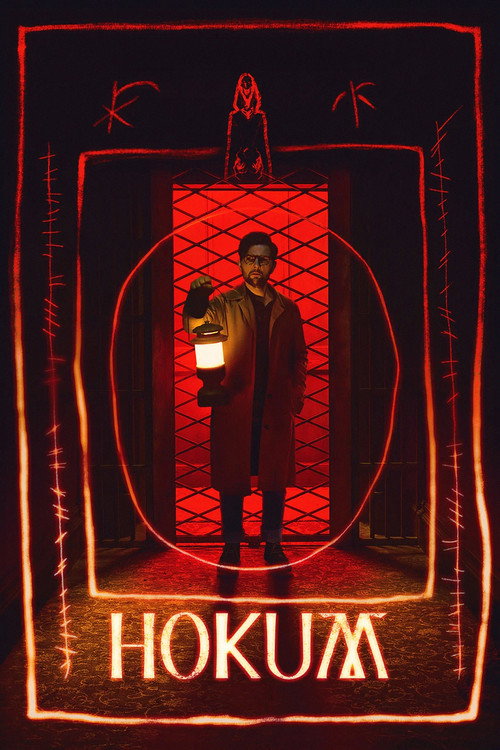
Hokum
2026 · Damian McCarthy
For when you're craving a real, patient scare — lights off, phone away, the kind of horror you let seep in rather than jump at. A challenge in atmosphere, not gore.
What it's about
A novelist named Ohm Bauman, drinking too much and carrying his parents' ashes, checks into a remote inn to lay them to rest. The locals talk of a witch bound to the honeymoon suite, and the stories get under his skin — visions start bleeding into his nights, and when someone vanishes, the line between the inn's legend and his own buried past stops holding. It's a gothic ghost story about a storyteller trapped inside one.
The experience
Slow-creeping and clammy, built on silences, odd objects, and the awful feeling that something in the room is watching. It unsettles more than it jolts, and the grief underneath the scares gives the dread a sad, human weight.
The craft
Damian McCarthy builds fear out of production design and framing — cursed rooms, handmade totems, corridors and an old elevator that feel wrong before anything happens in them. The title itself is a wink: 'hokum' is old showbiz slang for the cheap thrill, and the film knowingly runs that machine at full craft. Good speakers matter; the sound does half the haunting.
Why it matters
It extends McCarthy's rapid rise from micro-budget cult favorite to one of the most distinctive voices in Irish and folk-inflected horror, with each film more self-aware than the last.
Snapshot
Hokum is Damian McCarthy's third feature, arriving after the micro-budget Caveat (2020) and the festival breakout Oddity (2024), and it appears — on the evidence of its premise — to be the most self-aware film he has made. A novelist named Ohm Bauman takes his parents' ashes to a remote inn, becomes absorbed in local talk of a witch attached to the honeymoon suite, and is pulled apart by visions and by someone's disappearance. The title is the tell. "Hokum" is American show-business slang, in currency since the vaudeville era, for contrived sensational or sentimental material engineered to work a crowd — the cheap effect, the ghost story told for the pleasure of telling it. Naming a horror film Hokum is a filmmaker declaring, in advance, that he knows exactly what machine he is operating, and inviting the audience to watch the gears while still flinching.
A caution that governs everything below: as of this writing the public record on Hokum is thin. Cast and department credits, budget, financing structure, and critical response are not established well enough to state as fact, and nothing here should be read as reporting on them. What can be done responsibly — and what this dossier does — is to situate the film precisely within McCarthy's demonstrated method, the Irish horror economy that produced him, and the long generic tradition of the haunted inn and the accused witch, while marking clearly where description ends and inference begins.
Industry & production
McCarthy's career is a case study in the contemporary micro-budget horror ladder. Caveat was made for a sum small enough that the film's constraints are legible in every frame: essentially one house, a handful of actors, almost no exterior coverage, and effects built by hand rather than bought. It found its audience through Shudder, the AMC Networks horror subscription service that since the late 2010s has functioned as the genre's principal distributor of last resort and first opportunity — the place where a first feature with no stars can reach a self-selected audience that is disproportionately willing to forgive roughness in exchange for a genuinely good scare.
Oddity executed the next rung cleanly. It premiered at SXSW in 2024, took the Midnighters audience award, and received a theatrical release through IFC Films before moving to Shudder — the now-standard IFC/Shudder pipeline in which a modest theatrical window buys critical legitimacy and the streaming tail pays the bill. Irish features at this scale typically depend on Screen Ireland development and production funding together with the Section 481 tax credit, and Oddity carried Screen Ireland backing; that public-support layer is the structural reason a filmmaker without industry pedigree can make two features in Ireland before anyone in Los Angeles has heard his name.
Hokum should be understood as the film made from that accumulated credit. The premise — one inn, one guest, one legend — retains the single-location discipline that has defined McCarthy's work, which suggests either that the budget is still modest or, more interestingly, that the containment is now a choice rather than a constraint. That distinction matters: a filmmaker who keeps working in one building after he could afford not to is making an argument about form.
Technology
McCarthy's films are technologically unremarkable by design and sophisticated in one narrow respect. They are shot digitally, in low light, and they depend on the fact that modern large-sensor cameras can hold detail in near-darkness without the noise floor that would have made such images unusable on film or on early digital. That capability is the precondition for his central visual gambit: a frame dark enough that the eye searches it, but clean enough that when something is there, you can see it, and when nothing is there, you cannot tell yourself the camera simply failed to record it. The scare depends on the image being trustworthy.
Against this, his effects practice is aggressively pre-digital. The wind-up rabbit with the drum in Caveat and the life-size wooden man in Oddity are physical objects, built, lit, and placed. McCarthy's signature property is a thing that sits in the room with the actor and is therefore subject to the same light, the same lens distortion, and the same photographic grain as the performer — which is precisely why it reads as present in a way that composited imagery does not. In the mid-2020s, as generative tools began saturating the lower end of production, this handmade quality acquired a market value it did not previously have: the visible fact of a real object became a selling point. A film called Hokum, about the manufacture of a scary story, is well positioned to exploit that irony.
Technique
Cinematography
The governing unit of McCarthy's style is the static, wide, deep-focus frame held past the point of comfort. He composes with large areas of dead space — a hallway behind a seated figure, the black rectangle of an open doorway, the gap beside a bed — and then declines to cut away from them. The audience is left to police the frame themselves, which converts passive viewing into active dread; the camera has offered you everything, so anything you miss is your own fault. Doorways, thresholds, and the edges of the frame do the work that a moving camera does in more conventional horror. When movement comes, it is slow, motivated, and usually a slight push that tightens the trap rather than a swooping gesture.
McCarthy has not worked with a single recurring cinematographer across his features, and the department credits on Hokum are not something the record supports naming here. The consistency across the films therefore appears to originate with the director's own storyboarding and blocking rather than with a fixed collaborator's eye — a pattern common among writer-directors who came up designing their own effects.
Editing
Cutting is where McCarthy is most distinctive and most disciplined. Mainstream horror grammar delivers a scare through the cut: the reverse angle, the sudden insert, the smash to a face. McCarthy's best-known set piece in Oddity does the opposite — the horror occurs inside a single continuous shot, in the same space the audience has been staring at, with no editorial permission to look away. Withholding the cut is a claim about honesty: an edit can hide the seam where the trick was assembled, and a held shot cannot. The rhythm of his films is accordingly patient, occasionally to the point of slackness in expository stretches, and then merciless in the set pieces. Given a plot built on a story told aloud, Hokum's editorial problem will be the relation between the telling and the seeing — how, and whether, to cut between a mouth describing a witch and any image of one.
Mise-en-scène / staging
An inn is an almost ideal McCarthy space: a building of numbered doors, corridors, a public room where stories get told, and a private room that is the story's subject. The honeymoon suite as the locus of haunting is a strong choice, loading a single room with romance, consummation, and the idea of a threshold crossed once and permanently. His staging habit is to establish a room's geography with unusual clarity — where the bed is, where the door is, what you can see from the chair — so that a later violation of that geography registers as a fact rather than a confusion. The urn of ashes is, in this scheme, a classic McCarthy object: portable, ritually charged, and available to be moved by something other than its owner.
Sound
The soundtrack does the work the camera refuses to do. Offscreen sound — a knock, a drag, a breath in a room the frame is not showing — is McCarthy's principal method for populating the dark space he has just handed the audience. Scoring in his films is sparse and largely textural, closer to sustained tone and low percussion than to melody, and it tends to withdraw entirely at the moment of greatest tension, leaving room acoustics and foley exposed. In a film concerned with hokum, the folklore sequences invite a further sound strategy: the voice of the teller carried over images, so that the audience cannot separate what the inn contains from what they have been told it contains.
Performance
McCarthy works in a restrained Irish and British naturalist register — actors who underplay, who behave reasonably for far longer than a horror protagonist normally does, and whose eventual breakdown is therefore legible as a real event. Oddity built its effect on a controlled dual performance from Carolyn Bracken and on Tadhg Murphy's capacity to be quietly wrong in a scene. A grieving novelist in a strange inn is a role that requires the actor to be interesting while doing almost nothing, alone, for long takes; the casting of Hokum's lead is the single decision most likely to determine whether the film's patience reads as tension or as delay. The record does not yet establish who carries it.
Narrative & dramatic mode
The premise is a frame tale: a man arrives, is told a story, and the story begins to metabolize him. This is the oldest architecture in supernatural fiction, running from the fireside narrators of the Victorian ghost story through the portmanteau films of the mid-twentieth century. It gives the film a built-in engine of ambiguity, since every supernatural claim arrives secondhand and can be discounted by both protagonist and viewer until it cannot.
Layered on top is a mystery-thriller spine — the disappearance — which supplies forward momentum that pure haunting narratives often lack, and a psychological confession structure, since the visions are explicitly tied to "dark corners of his past." That triple construction is the film's chief risk and chief opportunity. Run well, the three lines converge: the witch story is the vehicle, the disappearance is the pressure, and the past is the content. Run badly, the supernatural material becomes a decorative wrapper around a guilt narrative, and the ghost is revealed as metaphor — a resolution the genre has overused since the mid-2010s and which a film titled Hokum would seem designed to comment on rather than commit.
Making the protagonist a novelist is a deliberate escalation. He is professionally in the business of taking other people's material and selling it, which makes him structurally complicit in the very thing the title names.
Genre & cycle
Hokum sits at the intersection of two durable cycles. The first is the haunted-lodging film, where the transient occupies a space with a history he did not earn: Psycho's motel, the Overlook in The Shining, 1408, Vacancy, and — closest in tone and scale — Ti West's The Innkeepers (2011), which likewise concerns underemployed people at a failing inn, a ghost story maintained as much by repetition as by evidence, and long stretches of nothing punctuated by a static-frame scare.
The second is the witch film, which has run hot since Robert Eggers's The Witch (2015) and includes Hagazussa (2017), the Suspiria remake (2018), and a great deal of folk-horror adjacent work; its ancestry reaches back through Häxan (1922) and Day of Wrath (1943) to the historical fact that "witch" was, overwhelmingly, an accusation made against inconvenient women. A witch attached to a honeymoon suite is a specific and promising variant: it locates the accusation in marriage.
Within Irish production, Hokum belongs to a genuine 2020s wave — The Hole in the Ground (2019), You Are Not My Mother (2021), Unwelcome (2022), Fréwaka (2024) — characterized by folkloric material, rural isolation, and modest budgets deployed with unusual craft discipline.
Authorship & method
McCarthy is a writer-director who also functions as a designer, and the through-line of his authorship is the object: a cursed or animate thing, physically built, around which a set piece is constructed. He writes his own screenplays, works in confined locations, and appears to conceive scares as staging problems rather than as editorial ones. His route into features ran through self-financed short work rather than an industry apprenticeship, and the resulting habit — solving problems with carpentry and blocking instead of money — has survived his increase in resources.
On collaborators, honesty is required. McCarthy has not maintained a fixed core team across his features in the way that, say, Eggers has, and the department credits for Hokum — cinematographer, editor, composer, production designer — are not reliably established in the public record available here. Naming them would be invention. What can be said is that the screenplay is McCarthy's own, consistent with both prior features, and that the authorial signature in his work has been located in writing, design, and staging rather than distributed across a stable crew.
Movement / national cinema
Irish gothic is a literary tradition before it is a cinematic one — Maturin, Le Fanu, Stoker, and the long folkloric collection tradition of the nineteenth and twentieth centuries — and Irish horror cinema arrived late to it, largely because there was no production base to support genre work until the state funding apparatus and Section 481 matured. What emerged in the 2010s and 2020s is a national horror cinema more interested in inherited story, land, and family obligation than in institutional religion, and more comfortable with tonal dryness than its American counterparts. McCarthy is among its most formally rigorous practitioners, and notably among its least ethnographic: his films use Irish settings and Irish actors without foregrounding national folklore as subject. A film about a man consumed by a local legend brings him closer to that folkloric centre than he has previously come.
Era / period
Hokum arrives in a moment when horror is one of the few genres reliably capable of filling cinemas, when a specialist streamer has made careers out of films no studio would finance, and when audiences have grown noticeably impatient with the "trauma allegory" mode that dominated the previous decade. There is a countercurrent running toward unembarrassed craft — films that want to frighten you rather than to be interpreted. A title that translates roughly as nonsense designed to thrill a crowd, attached to a director whose reputation rests on two or three genuinely startling set pieces, reads as a positioning statement in that argument.
Reception, canon & influence
No settled critical record exists for Hokum, and anyone claiming one is guessing. The relevant precedent is Oddity, which was received as a genuine craft surprise — praised for the discipline of its scares and for achieving a physical, hand-built horror at a scale where most films settle for noise — and which converted McCarthy from a Shudder curiosity into a filmmaker whose next project carries expectation.
Backward, the lines of influence are legible. The tale-within-a-tale and the scholarly protagonist undone by a local story descend from M. R. James and the Ealing portmanteau Dead of Night (1945). The patience, the failing lodging house, and the static-frame scare come through Ti West. The withheld cut and the flatly presented impossible image recall Kiyoshi Kurosawa's Cure (1997) and Pulse (2001) and the found-footage-adjacent realism of Lake Mungo (2008) and Ghostwatch (1992). The grief-object nexus — an urn, a keepsake, a thing that will not stay put — runs through The Changeling (1980) and Dark Water (2002).
Forward, it is far too early to assess legacy. What can be observed is that McCarthy's grammar has already begun to propagate in a specific and measurable way: his best set pieces circulate as standalone clips, and the locked-off wide shot in which the horror occurs without a cut has become a recognizable move among low-budget genre filmmakers who understand that in an era of infinitely manipulable images, the most frightening thing a camera can do is refuse to blink.
A Deleuzian reading
A black rectangle where a door stands open, behind a man sitting in a chair.
The full Deleuzian reading of Hokum →
Reception
Premiered at SXSW in March 2026 to loud midnight-crowd buzz, then became one of the year's indie-horror success stories in its May theatrical run — reportedly grossing around $25M on a $5M budget — turning years of 'trust me, watch Caveat and Oddity' evangelism into a mainstream moment.
How Hokum was received, from release to now →
Influences: the films it descends from and the films it influenced
- Dead of Night (1945) — The Ealing portmanteau's device of guests at a lodging swapping tales that keep returning the film to one room supplies Hokum's frame-tale architecture — the outer story as containment vessel rather than mere wrapper, with the inn itself as the structure's hinge.
- Night of the Demon (1957) — Tourneur's M. R. James adaptation builds its dread on a charged object passed hand to hand — the runic parchment that will not stay where it is put — and on a credentialed sceptic dismantled by testimony he refuses to credit; both are Hokum's load-bearing mechanisms.
- Whistle and I'll Come to You (1968) — Miller solves his central scare as a blocking and carpentry problem, not an editorial one: a found object, a single guest bedroom, and animate bedding staged inside a held frame with the camera declining to cut in — McCarthy's exact method for a set piece.
- The Innocents (1961) — Freddie Francis's deep-focus wide compositions park the apparition at the far edge of an unbroken frame and make the audience do the finding, establishing the negative-space grammar Hokum uses instead of a cut-to-reveal.
- The Changeling (1980) — Medak's grief-object nexus — the ball that returns, the wheelchair, the keepsake dredged up from the house — is the template for a mourning artefact treated as a physical prop with its own volition rather than as symbol.
- Ghostwatch (1992) — The figure planted, unremarked and unpunctuated, in the background of a live-feed frame — no score sting, no push-in — pioneers the flatly presented impossible image and the secondhand-testimony register Hokum's narration adopts.
- Cure (1997) — Kurosawa's withheld cut: atrocity and the uncanny occur in a locked-off long shot that refuses to intervene, move, or shorten, so duration does the work coverage would otherwise do — the single most direct grammatical debt in McCarthy's set pieces.
- Session 9 (2001) — An early 24p digital shoot inside one decaying building, using available low light rather than fighting it, with recorded voices carrying the story from offscreen — the economic and acoustic model for single-location digital horror at this budget.
- Dark Water (2002) — Nakata welds the failing lodging — water ingress, a building actively decaying around its tenants — to a keepsake that keeps returning, making architecture and object a single haunting apparatus.
- Lake Mungo (2008) — Its unreliable secondhand testimony delivered in flat, underplayed naturalist performance — and its scare located inside an existing image rather than staged for the camera — is the realist register Hokum's narration and casting work in.
- The Innkeepers (2011) — West's failing hotel on its last weekend, shot in patient locked-off frames where long stretches of nothing accrue charge and the scare arrives as an offscreen sound before any image, is the immediate template for Hokum's haunted-inn tempo.
- Caveat (2020) — McCarthy's own first feature establishes the authorial method: a hand-built animate prop — the drumming rabbit — around which an entire confined-location set piece is engineered, the designer's solution standing in for a budget.
- Talk to Me (2022) — The embalmed hand is a built, tactile charged object whose possession scenes are staged as continuous room events that circulate as standalone clips — the contemporary proof of McCarthy's bet that a designed prop plus sustained blocking beats digital augmentation.
- Skinamarink (2022) — Ball pushes negative-space dread to its limit: static low-light digital frames aimed at corners, ceilings and doorways where nothing is happening yet, with offscreen sound carrying the entire event — the same wager that an unblinking camera on empty space out-frightens a reveal.
- Stopmotion (2023) — Morgan is a writer-director who is first a fabricator, and the film's terror is literally handmade — puppets built from meat and wire, shot as objects in real space — the same location of authorship in design and craft rather than in a stable crew or coverage.
- Longlegs (2024) — Perkins composes in boxy static wides that hide the threat at the frame's edge or half out of it and hold the shot past comfort, refusing the cut that would confirm what the viewer thinks they saw — the same negative-space-plus-withheld-cut contract.
- Fréwaka (2024) — Clarke works the same Irish low-budget craft economy: one confined dwelling, folk testimony treated as unverifiable secondhand report, and dread built from a superstitious object and offscreen space rather than from effects spend.
Similar films
- Oddity (2024) — influence & lineage
- Longlegs (2024) — influence & lineage
- The Innocents (1961) — influence & lineage
- Late Night with the Devil (2024) — shared sensibility
- The Wailing (2016) — shared sensibility
- A Tale of Two Sisters (2003) — shared sensibility
- The Ritual (2017) — shared sensibility
- Bring Her Back (2025) — shared sensibility