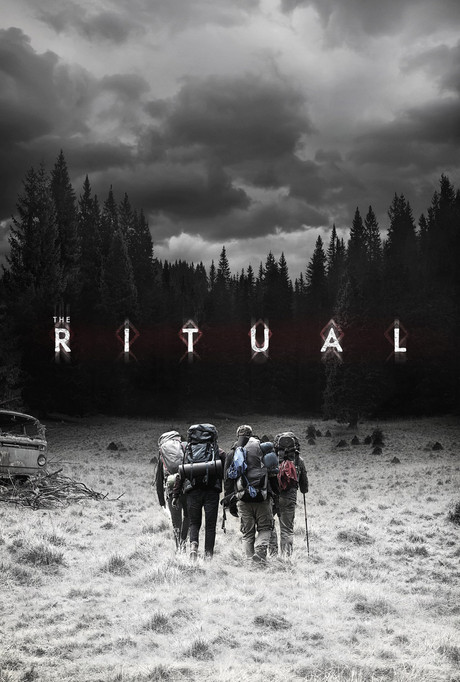
The Ritual
2017 · David Bruckner
For a night when you want atmospheric, thinking-person's horror — creeping unease over jump scares. Ideal when you're in the mood to be slowly unsettled and left staring at the dark.
What it's about
Four London friends — softened by middle age and strained by an unspeakable loss — hike into the remote forests of northern Sweden to honor a fifth friend who was killed in a robbery. A shortcut off the trail takes them into an ancient wood where something is watching, and old guilt starts to weigh as heavily as their packs. What began as a memorial trip becomes a fight against both the thing in the trees and the shame one of them carries.
The experience
Slow-burning dread that gets under your skin — creaking pines, rune-carved trees, nightmares that bleed into waking. It's as much about grief and male friendship curdling under pressure as it is about the monster, and when the creature finally shows itself, the payoff is genuinely awe-inspiring rather than cheap.
Performances
Rafe Spall anchors the film as the guilt-ridden survivor, letting shame and self-loathing seep through every decision.
The craft
David Bruckner directs Adam Nevill's novel with disciplined restraint — glimpses, sounds and silhouettes for most of the runtime, and a creature design, rooted in Norse myth, that's earned a reputation as one of the great modern movie monsters. The forest photography is vast and oppressive at once; watch it with the lights off and good sound.
Why it matters
A standard-bearer of the 2010s folk-horror revival that built a devoted following on streaming and lifted Bruckner into the front rank of horror directors.
Horror · Folk horror · Creature feature · Backwoods & survival. Grieving friends take a shortcut through ancient Nordic woods; slow-burn folk dread, rune-carved trees and a monster worth the wait.
Snapshot
The Ritual is a British folk-horror survival film that folds a chamber drama of male grief and guilt into the exoskeleton of a monster movie. Four London friends—middle-aged, softening, estranged by the demands of adult life—set out on a memorial hiking trip through northern Sweden after a fifth is murdered in a convenience-store robbery that one of them survives by hiding. A wrong turn off the trail delivers them into an ancient wood governed by something older than Christianity, and the film proceeds to strip them down, physically and psychologically, until the survivor must confront both a literal deity and the specific shame he has been carrying. Directed by David Bruckner from a screenplay by Joe Barton, adapting Adam Nevill's 2011 novel, the picture is notable for its disciplined restraint, its Nordic mythological underpinning, and a creature design withheld until the final act. It arrived as a Netflix acquisition, which shaped both its exposure and the comparative thinness of its theatrical box-office record.
Industry & production
The Ritual was produced by Andy Serkis and Jonathan Cavendish's The Imaginarium Studios in partnership with Entertainment One (eOne), the company that also handled distribution in the United Kingdom. It marked one of The Imaginarium's early forays into producing genre features distinct from its performance-capture technology business. The film was shot largely in Romania, with the Carpathian forests and mountains standing in for the Swedish wilderness of the story—a common cost-and-logistics substitution in mid-budget European genre production, and one that supplies the film's dense, disorienting old-growth locations.
Internationally, The Ritual was acquired by Netflix, which released it on the platform in February 2018 following a festival launch. It premiered at the Toronto International Film Festival in September 2017, in the Midnight Madness strand that has long served as a proving ground for horror titles seeking distribution and critical momentum. The Netflix pickup is the central industrial fact of the film's life: it gave the picture a very large potential audience and a durable streaming afterlife, but it also means the reliable public financial record is thin. Netflix does not disclose viewership or revenue in the manner of theatrical grosses, and any specific box-office figures for the film's limited theatrical exposure should be treated cautiously; I will not invent them here.
Technology
The Ritual is a digitally photographed feature that leans on conventional but capably deployed contemporary tools rather than any signature technological innovation. Its most interesting technical dimension is its creature realization, which combines practical elements with digital augmentation—a hybrid approach standard to 2010s horror, in which a physical presence on set anchors performances and lighting while computer-generated work completes and conceals the design. The film's strategy is deliberately anti-spectacle: the entity is glimpsed in fragments—an impossible silhouette between trees, a shape too tall and wrongly jointed—before any full reveal, so the technology serves concealment as much as display. Given The Imaginarium's identity as a performance-capture house, it is tempting to assume capture technology drove the creature, but I would not assert that as established fact without confirmation; the visible result reads as a mix of practical build and digital finishing.
Technique
Cinematography
The cinematography, by Andrew Shulkind, is built around the forest as an antagonist. The camera favors the oppressive verticality of tall conifers, framing the men as small figures dwarfed by trunks that crowd out the sky, and it repeatedly loses the horizon so that the audience shares the characters' inability to orient. Natural, overcast Nordic-substitute light gives the daylight scenes a flat, colorless melancholy, while the night and interior sequences—an abandoned cabin, a derelict dwelling—use pooled, motivated sources that leave the frame's edges to darkness where the threat lives. The film's visual grammar withholds: the entity is staged at the limits of legibility, often out of focus or at the frame's periphery, trusting suggestion over exposure.
Editing
The cutting sustains a slow-burn architecture, allowing the group's bickering and grief to breathe before the horror accelerates. A recurring structural device is the intrusion of a traumatic flashback to the convenience-store killing, which the film returns to in fragments, withholding the full memory until it can pay off as the survivor's central wound. The editing also handles the film's dream and hallucination passages—characters wake in impossible places, kneel in postures they did not adopt—by cutting to disorient, blurring the boundary between what the forest imposes and what the mind confesses.
Mise-en-scène / staging
Production and location design supply The Ritual's folk-horror iconography: crude effigies lashed together from branches and antlers, runic markings carved into bark, a decapitated animal strung up as a totem, and a wooden dwelling whose attic conceals a shrine. These objects accumulate as evidence of an old, organized worship, and the staging treats them as clues in a mystery even as they function as dread. The abandoned cabin sequence is a set-piece of escalating wrongness, its interior arranged so that discovery feels like trespass into a rite already underway.
Sound
The score is by Ben Lovett, a frequent Bruckner collaborator, and it works largely in low, textural registers—drones and swells that thicken the air rather than announce shocks. Sound design is the film's most consistent instrument of terror: the forest is rendered as an acoustic space of cracking branches, distant lowing and animal-adjacent cries that never resolve into a nameable source, and sudden absences of sound that precede the creature's approach. The entity is frequently heard—a groan, a shudder of displaced trees—before it is seen.
Performance
Rafe Spall carries the film as Luke, the survivor whose guilt over failing to act during the robbery is the emotional engine. His performance modulates from irritable everyman to hollowed-out penitent, and the film's climax depends on his capacity to make a refusal—a refusal to kneel—read as both survival and self-forgiveness. The supporting quartet, including Arsher Ali, Robert James-Collier, and Sam Troughton, sketch a believable frayed friendship, with the men's resentments and evasions supplying the human friction that makes the supernatural pressure land.
Narrative & dramatic mode
The Ritual operates in the survival-horror mode braided with a grief drama. Its dramatic engine is guilt: the inciting robbery establishes Luke's failure of nerve, and the forest becomes a mechanism for externalizing and testing that shame. The film uses the classic dwindling-group structure—friends picked off, tensions boiling as the situation deteriorates—but subordinates it to an interior arc in which the true antagonist is the protagonist's inability to forgive himself. The creature and its cult literalize this: the entity's power is bound up with visions that force each man to confront his private failure, and worship of it promises a false immortality that is really a surrender. The resolution is deliberately un-triumphant in the conventional sense; survival is figured as the act of refusing to bow.
Genre & cycle
The film sits squarely within the 2010s revival of folk horror, the cycle preoccupied with pagan survivals, rural rites, and outsiders swallowed by landscapes that operate under older laws. It shares DNA with the lineage that runs from The Wicker Man (1973) through the era's arthouse-inflected examples, and it is frequently discussed alongside contemporaneous titles that pushed folk horror back into critical view. Simultaneously it belongs to the "trip gone wrong in the wilderness" subgenre—men in nature, out of their depth—and to the creature-feature tradition, which it approaches with unusual patience. Its distinctiveness within the cycle is its grafting of a specifically Norse mythology onto folk-horror's usually British or generically pagan frame.
Authorship & method
David Bruckner came to The Ritual from a background in horror anthologies and shorts that prized craft and restraint: he directed segments in V/H/S (2012) and Southbound (2015) and co-directed the feature The Signal (2007). The Ritual was a significant step up in scale and his first solo-directed feature of this kind, and it established the tonal signature—slow-build dread, grief as subtext, sparing use of the monster—that he carried into The Night House (2020) and his studio remake of Hellraiser (2022). His method here is one of withholding, trusting atmosphere and performance to sustain tension long before any payoff.
The screenplay is by Joe Barton, adapting Adam Nevill's novel; the adaptation notably compresses and alters the book's structure, particularly its back half. Cinematographer Andrew Shulkind executes the forest-as-antagonist visual scheme. Composer Ben Lovett, a recurring Bruckner partner whose collaboration extends across the director's work, supplies the film's textural dread. The editing sustains the flashback architecture central to the script. Taken together, the authorship reads as a tight director-led unit in which recurring collaborators—especially Lovett—reinforce a consistent Bruckner sensibility.
Movement / national cinema
The Ritual is a British production drawing on a distinctly British horror tradition—folk horror is arguably the national cinema's most exportable native genre—while its story reaches into Scandinavian myth and its physical production relocated to Romania. This tri-national character (British authorship and financing, Nordic setting, Eastern European locations) is typical of contemporary mid-budget European genre filmmaking, where creative nationality and shooting geography rarely coincide. It should be read within the modern British horror revival and the broader transnational folk-horror wave rather than as the product of any single national movement.
Era / period
The film is a product of the mid-2010s horror renaissance, a period in which streaming platforms and specialty distributors underwrote a wave of atmosphere-forward, theme-driven horror often labeled—sometimes reductively—"elevated horror." Its 2017 festival debut and 2018 Netflix release place it at the moment when streaming acquisition was reshaping how genre films reached audiences, trading theatrical prestige and box-office visibility for scale and permanence on-platform. The Ritual is very much of this juncture: a film whose form reflects the era's appetite for slow dread and psychological subtext, and whose distribution reflects the era's structural shift toward streaming.
Themes
Guilt and cowardice are the film's central concerns: Luke's failure during the robbery is the wound that the forest reopens and demands he answer for. Around this sit intertwined themes of male friendship in decline—the way shared history curdles into resentment when men stop being honest with one another—and of grief unprocessed. The mythological apparatus dramatizes a temptation: the cult offers relief from suffering through worship and false immortality, and the film treats the refusal of that offer, the refusal to kneel to one's shame, as the only authentic form of survival. Nature is figured as indifferent and ancient, a domain governed by laws that predate and disregard the men's modern selves, and the horror derives partly from that cosmic smallness.
Reception, canon & influence
Critically, The Ritual was received as a well-crafted, atmospheric entry in the folk-horror revival, with particular praise directed at its creature design's restraint, its Nordic mythological conceit, and Rafe Spall's central performance; the most common reservation concerned a final act that some found tipped too far from ambiguity toward explicit confrontation. It became one of the more visible horror titles in Netflix's catalog in this period, and its streaming availability gave it a broad, sustained audience beyond what its modest theatrical footprint would suggest. I will not attach specific critical percentages or viewership figures, as reliable public numbers for a Netflix title are limited.
Looking backward, the film's influences are legible: the pagan-survival lineage of The Wicker Man, the wilderness-survival horror tradition, and specifically the source novel by Adam Nevill, whose book supplied the myth and the guilt-driven structure. Its Norse framing distinguishes it from the more common British-pagan register of the cycle. Looking forward, its clearest legacy is as a stepping stone in David Bruckner's career—its success helped position him for The Night House and Hellraiser—and as a frequently cited touchstone in discussions of 2010s folk horror and forest-set survival horror. Whether it exerted direct stylistic influence on later films is harder to establish, and I would characterize its forward legacy more as a durable, well-regarded reference point within the streaming-era horror canon than as the origin of a distinct new movement.
Reception
It slipped out quietly — a UK theatrical run, then a Netflix drop in the US in early 2018 — and has steadily climbed via word-of-mouth ever since, a fixture of every 'best horror actually on Netflix' list and a key beneficiary of the late-2010s folk-horror wave.
How The Ritual was received, from release to now →
How to watch The Ritual: what to notice on a first viewing
- Watch the camera lose the horizon among the trees. Shulkind frames the men as small figures dwarfed by tall conifers that crowd out the sky, repeatedly denying any clear sense of direction. You share the characters' disorientation because the frame itself refuses to give you a horizon to hold onto.
- Listen for a groan or cracking branch before anything appears. Lovett's score works in low drones and swells, and the forest is built as an acoustic space of distant, unresolved cries that precede any visible threat. Your ears get the warning well before your eyes do, and the film trusts that gap to do the scaring.
- Watch for effigies made of branches and antlers in the forest. Runic markings carved into bark and a decapitated animal strung as a totem accumulate as evidence of an old, organized worship the men keep stumbling into. Each object is a clue and a warning at once, and the film lets you piece together the danger before anyone explains it.
- Notice a flashback interrupt the present without warning. The film returns in fragments to a memory from before the trip, cutting in without warning. The broken-up memory tells you a wound is driving this man before the film explains it.
- Watch Luke's irritability curdle into something quieter. Spall plays Luke as an ordinary irritable everyman who grows quieter and more inward as the trip wears on and the group frays. The shift in his manner tells you he is carrying something heavier than exhaustion.
The whole guide to watching The Ritual, with the keys for a rewatch →
Influences: the films it descends from and the films it influenced
- The Wicker Man (1973) — Supplies the pagan-survival architecture and the 'refusal to kneel' climax in which a lone outsider is delivered to a pre-Christian belief system, capped by a hand-built effigy as ritual payoff — the exact template the film's staging cites.
- Deliverance (1972) — Provides the core narrative engine: a bonded group of city men whose wilderness trip strips male friendship down to guilt and blame as the landscape turns actively predatory.
- The Blair Witch Project (1999) — Establishes forest-as-antagonist geography where disorientation itself is the horror, and stick-figure effigies glimpsed among the trees signal an unseen presence long before any reveal.
- The Descent (2005) — British survival-horror blueprint of a tight-knit group picked off after a grief prologue, with the creature withheld — heard and half-glimpsed before it is ever shown fully.
- The Evil Dead (1981) — Codifies the animate, malevolent woodland where trees and terrain function as an active antagonist rather than passive setting.
- Don't Look Now (1973) — Model for the fragmented, associative flashback editing that fuses a death the protagonist feels responsible for into present-tense dread — the guilt-externalized cutting architecture.
- Antichrist (2009) — Turns the forest into an externalized psychological space where a grieving character's guilt manifests as environmental menace — 'nature is Satan's church.'
- Picnic at Hanging Rock (1975) — Landscape that silently consumes people while sustaining ambiguity about a mythic force rather than explaining it — the restraint the film's first two acts emulate.
- The Thing (1982) — Benchmark for creature-design restraint and rationed reveal, keeping the monster mostly unseen so paranoia within the isolated group carries the dread.
- Midsommar (2019) — Extends the same folk-horror grammar: a grief-stricken protagonist, communal pagan rite with hand-crafted effigies, and a climax turning on submission to a belief system.
- In the Earth (2021) — Forest-set folk horror where the woodland harbors a pagan nature-entity and characters are progressively unmade by the landscape itself.
- The Night House (2020) — Bruckner's next film carries the identical method — grief as subtext, an unseen presence, slow-build withholding — sustained by recurring collaborator Ben Lovett's textural dread score.
- Hellraiser (2022) — Bruckner reapplies his restraint-and-reveal calibration and disciplined creature design, honed on The Ritual's forest god, to studio-scale monsters.
- Gaia (2021) — Forest survival-horror with a fungal nature-deity and hybrid creature design, making the worshipped wilderness itself the antagonist.
- The Witch (2015) — Sibling in the 'elevated' folk-horror wave that plants an ancient malevolent entity in the woods and trusts texture and restraint over gore.
- Apostle (2018) — Streaming-era folk horror in which outsiders are drawn into a pagan cult worshipping an old-god deity that demands blood — the Netflix-cycle pairing to The Ritual.
- Kill List (2011) — Male-dread British horror that detonates into a folk-horror cult reveal, masked figures and ritual sacrifice deployed as the final structural turn.
- The Empty Man (2020) — Post-Ritual American folk-adjacent horror built on a heard-before-seen entity and a ritual cult, favoring slow atmospheric dread over jump scares.
Similar films
- Midsommar (2019) — influence & lineage · same viewing thread
- Kill List (2011) — influence & lineage · same viewing thread
- The Blair Witch Project (1999) — influence & lineage
- The Wicker Man (1973) — influence & lineage
- The Descent (2005) — influence & lineage · same viewing thread
- Men (2022) — same viewing thread
- The Witch (2016) — same viewing thread
- The Cabin in the Woods (2012) — same viewing thread
All the films related to The Ritual →
Watch it with: curated runs of related films
- Folk Horror's New Harvest — A run of modern folk horror in which grieving or rootless outsiders step onto old land (a Swedish commune, a Puritan forest edge, an Icelandic farm, an English village) and find the pagan past still hungry; they rhyme on ritual, landscape and the dread of belonging.
- Out Past the Last Gas Station — A run of films about people who go somewhere remote (woods, caves, a quarry lake, a backwoods club, an island, the frontier) and find that the usual rules stop applying out there. Watched near each other, they show the 'city folk take a wrong turn' story played as dread, as Western, as revenge and as a joke on itself.