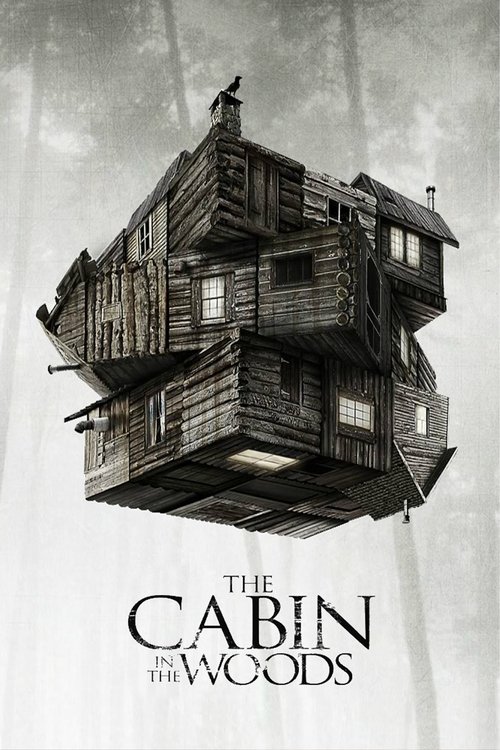
The Cabin in the Woods
2012 · Drew Goddard
For a movie night with friends who love horror but love laughing at horror even more — a crowd-pleaser that rewards yelling at the screen. Comfort food for genre fans, a wild ride for everyone else.
What it's about
Five college friends — a jock, a stoner, a scholar, a party girl, and the good girl — drive out to a remote cabin for a weekend of drinking and fooling around. What they don't know is that their getaway is being watched, and steered, by people with clipboards and a schedule to keep. The woods hold real horrors, but the deeper unease comes from realizing someone arranged all of this on purpose.
The experience
It plays two registers at once: genuinely gory, jump-out-of-your-seat horror and a running, increasingly gleeful joke about why horror movies work the way they do. The last half hour escalates into pure delirious mayhem, and you'll come out grinning and slightly wrecked.
Performances
Fran Kranz steals it as Marty, the stoner whose paranoia keeps turning out to be the sanest read of the situation, while Richard Jenkins and Bradley Whitford are drily hilarious as bored office workers whose job happens to be nightmarish.
The craft
Drew Goddard and Joss Whedon's script is a machine of setups and payoffs, where nearly every throwaway line and background prop comes back around. The film cuts between fluorescent office banality and moonlit forest dread with total tonal control, and the creature-effects blowout in the finale is a practical-and-digital candy store best seen big and loud.
Why it matters
It became the definitive movie-about-horror-movies of its era, the reference point for any film that wants to love the genre and interrogate it in the same breath, and it launched Goddard as a director.
Horror · Horror comedy & camp · Backwoods & survival · Creature feature. Five friends, a cabin and men with clipboards: a gory, gleeful horror comedy that grows into a gonzo creature-effects blowout.
Snapshot
The Cabin in the Woods is a meta-horror film that dismantles the American "dead teenager" picture from the inside, staging the familiar journey of five college friends to an isolated cabin as an engineered ritual overseen by white-collar technicians in a subterranean control facility. Written by Joss Whedon and Drew Goddard and directed by Goddard in his feature debut, the film is at once a functioning horror movie and an essay about why horror movies are shaped the way they are. Its central conceit — that the archetypal victims (the Whore, the Athlete, the Scholar, the Fool, the Virgin) are being deliberately herded toward stereotyped deaths to appease slumbering "Ancient Ones" beneath the earth — recasts genre convention as literal cosmic obligation, and the audience's appetite for punishment as the sustaining force of an old, cruel order. Produced in 2009 but stranded for years by studio turmoil, it reached theaters in April 2012 and quickly became a touchstone of the reflexive-horror conversation.
Industry & production
The film was produced by Whedon's Mutant Enemy banner in partnership with Metro-Goldwyn-Mayer, and shot in 2009 in and around Vancouver, British Columbia — a standard runaway-production base for genre work of the period. Its release history is inseparable from MGM's protracted financial crisis. Originally slated for a 2010 opening, the picture was repeatedly delayed as the studio slid toward bankruptcy and restructuring, and at one point a post-production 3-D conversion was floated as a commercial hedge before being abandoned. The completed film sat unreleased for roughly three years. Lionsgate ultimately acquired distribution rights, and the film premiered at South by Southwest in March 2012 before opening theatrically in April.
The delay produced one of the film's more famous industry ironies: Chris Hemsworth shot his role before he was cast as Marvel's Thor, but by the time Cabin was released he was an established franchise lead, so a film made with an unknown ensemble arrived carrying a marquee name. The budget was modest by studio-genre standards; precise figures for cost and gross vary across trade reporting and I won't assert specific numbers, but the film was understood as a mid-budget genre release that performed respectably rather than as a blockbuster.
Technology
Technologically the film is notable less for innovation than for the sheer breadth of horror iconography it had to physically realize. Goddard and Whist favored practical creature and gore effects wherever possible — the climactic "system purge," in which the facility's entire menagerie of nightmares is unleashed, required a large inventory of monster designs, prosthetics, and creature suits — supplemented by digital work for the more impossible imagery (the vast Ancient hand at the finale, environmental destruction, matte extensions of the control complex). The abandoned 3-D conversion is the clearest technological footnote: the film was conceived, shot, and finished as a 2-D work, and the studio's late interest in stereoscopic post-conversion belonged to the commercial anxieties of the early-2010s 3-D boom rather than to any authorial intention.
Technique
Cinematography
Peter Deming shot the film, and his presence is significant. Deming is best known for his long association with David Lynch (Lost Highway, Mulholland Drive) and for genre credits including Evil Dead II and the Scream sequels — a résumé that spans both art-horror unease and slasher mechanics, precisely the two registers Cabin wants to hold at once. The visual grammar is deliberately bifurcated: the cabin and forest are shot in the warm, slightly overripe naturalism of the teen-horror tradition, while the control facility is rendered in cool, fluorescent, procedural flatness — the look of an office, an operations center, a place of dull competence. This contrast is the film's thesis expressed in light: the horror above is a product manufactured by the banality below.
Editing
Lisa Lassek, a frequent Whedon collaborator (she cut Serenity), edited the film, and the editing carries much of its argument. The picture cross-cuts continually between the victims' escalating ordeal and the technicians watching it on monitors, so that nearly every "scare" is doubled by a shot of professionals betting, joking, or troubleshooting. The cut becomes an instrument of irony: a moment that would play straight in a conventional slasher is immediately reframed as spectacle-for-hire. Lassek also manages the tonal whiplash — comedy, dread, and pathos often occupying adjacent shots — and the accelerating rhythm of the final-act purge, where the film abandons suspense for cathartic overload.
Mise-en-scène / staging
Martin Whist's production design is the film's most concentrated achievement. Two spaces dominate: the cabin, dressed with the calculated clichés of the subgenre (creepy cellar, cursed objects, one-way mirror), and the control facility, whose signature image is a grid of glass elevator cells each holding a different monster — a literalized taxonomy of horror. The elevator wall is essentially an index of the genre made physical, and the "purge" that empties it is a self-aware demolition of the entire iconographic tradition. The cellar sequence, in which the teens unknowingly "choose" their own tormentors by handling the artifacts, is staged as a menu — agency presented as a trap.
Sound
David Julyan composed the score. Julyan's background — Christopher Nolan's early features (Memento, Insomnia, The Prestige) and, crucially, Neil Marshall's The Descent — makes him a fitting choice for a film that oscillates between cerebral gamesmanship and visceral fright. The score largely honors horror convention (the film needs its scares to land as scares for the deconstruction to matter), while the sound design polices the boundary between the two worlds: the muffled, mediated quality of the victims' terror as heard through the facility's monitors underscores the technicians' — and by extension the audience's — insulation from the suffering they consume.
Performance
The ensemble is calibrated to the archetypes it critiques. Kristen Connolly (Dana, the Virgin/Final Girl), Fran Kranz (Marty, the Fool/stoner, and the film's inadvertent truth-teller), Hemsworth (Curt, the Athlete), Anna Hutchison (Jules, the Whore), and Jesse Williams (Holden, the Scholar) play figures who begin as recognizable types and are shown, pointedly, to be more than the roles imposed on them — the chemical manipulation by the facility is what forces them into type. Kranz's Marty, whose drug use ironically inoculates him against the control system, anchors the film's sympathy. The counterweight is the pair of technicians, Richard Jenkins and Bradley Whitford, who play cosmic horror as workplace comedy — weary, funny, morally anesthetized bureaucrats — a performance choice that is itself the film's sharpest idea. Sigourney Weaver's late cameo as the Director makes explicit the film's chain of command up to the audience.
Narrative & dramatic mode
The film runs on structural irony: the viewer is let in on the machinery early, so the pleasure is not "what will happen" but watching the victims move helplessly through a plot we can see being authored. It is a dramatic mode of nested spectatorship — we watch people watch people die — that implicates the audience in the transaction. The screenplay withholds one turn (the full cosmic rationale) for its final act, escalating from parody of the cabin picture into apocalyptic Lovecraftian revelation, and ends not with survival-as-restoration but with a refusal: the surviving pair decline to complete the sacrifice, and the world is left to end. The tragicomic nihilism of that ending is the logical endpoint of the film's argument about ritual, complicity, and the cost of the stories we demand.
Genre & cycle
Cabin is a self-aware slasher/creature hybrid that belongs to the meta-horror lineage inaugurated in the mainstream by Wes Craven and Kevin Williamson's Scream (1996) and by Craven's earlier New Nightmare. Where Scream made characters genre-literate, Cabin makes the genre's rules diegetically real — the clichés are not just known, they are enforced. It arrives at the tail end of the 2000s "torture porn" cycle (the Saw and Hostel films), and functions in part as a rebuke to it: an attempt to reclaim horror's play and moral seriousness from what Whedon publicly characterized as a culture of sadism-as-spectacle. It simultaneously sits within the "cabin" tradition running from The Evil Dead through countless imitators.
Authorship & method
The film is a genuine two-author work. Whedon and Goddard had collaborated on Buffy the Vampire Slayer and Angel, and the script is often reported to have been written very quickly (the widely repeated account is a matter of days), an anecdote that fits its confident, argument-driven design; where such origin stories are apocryphal I'd flag that this one comes from the filmmakers' own interviews rather than documentary record. Goddard, who had also written for Lost and scripted Cloverfield, directs with an emphasis on tonal control and structural clarity rather than stylistic flourish — appropriate for a film whose "style" is the exposure of style. The key collaborators reinforce the project's split personality: Deming (art-horror and slasher pedigree), Lassek (Whedon's editorial voice), Julyan (Nolan-and-Descent gravity), and Whist (the taxonomic sets). It is very much an authored film in the sense that its formal choices all serve a single controlling idea.
Movement / national cinema
The film is a product of American studio genre filmmaking, physically made within the Canadian (Vancouver) production ecosystem that absorbed much US genre work in the period. It does not belong to a formal movement, but it is a representative artifact of a distinctly early-21st-century, post-Scream, internet-literate mode of American horror — self-referential, fan-fluent, and conversant with the entire history of the form as a shared vocabulary. Its Lovecraftian frame also connects it to a longstanding strain of American weird fiction, refracted through pop-cultural rather than literary channels.
Era / period
Though released in 2012, the film is thoroughly a work of the years around 2009–2012: made in the shadow of the torture-porn cycle, of the 3-D revival, and of a maturing culture of genre self-commentary native to the DVD-commentary and message-board era. Its portrait of monitored, mediated cruelty — a control room consuming other people's suffering as content — reads, in hindsight, as unusually prescient about a surveillance-and-streaming culture that had not yet fully arrived. The MGM-collapse delay means the film also functions as an accidental time capsule of the pre-Marvel-superstardom moment for several of its cast.
Themes
The film's governing theme is complicity: horror as ritual sacrifice, and the audience as the deity that must be appeased. It reads genre convention as social contract — the archetypes must die in the prescribed ways or the world (the story) ends — and asks what it means to require that. Subsidiary themes include the bureaucratization of cruelty (evil administered by bored professionals), free will versus determinism (the victims are chemically forced into their roles, complicating the moralized "punishment" of the slasher), the loss of innocence, and generational judgment: an ancient order demanding the ritual death of the young to sustain itself. The film's nihilistic ending reframes these into a final provocation — if the price of the world is the endless, patterned sacrifice of youth, perhaps the refusal to pay is the only ethical move left.
Reception, canon & influence
Critically the film was received as a clever, well-made, and unusually intelligent entry in a often-disparaged genre; reviewers repeatedly singled out its wit, its structural audacity, and the Jenkins/Whitford double act, while some found its final-act escalation and thesis-driven design more admirable than frightening. It has since accrued a durable reputation as a canonical meta-horror text, frequently taught and cited alongside Scream in discussions of genre reflexivity.
Influences on the film (backward): the Sam Raimi Evil Dead films and the broader cabin-slasher tradition (Friday the 13th and its progeny); the meta-slasher of Craven and Williamson (Scream, New Nightmare); H. P. Lovecraft's cosmic-horror mythos of buried elder gods; the reality-television and surveillance-spectacle premise of works like The Truman Show and Series 7/The Running Man lineage; Japanese horror imagery (the vengeful long-haired ghost among the monster gallery); and Whedon and Goddard's own Buffy mode of genre-literate storytelling.
Legacy (forward): the film became a reference point for a wave of subsequent self-aware, deconstructive horror and horror-comedy, and its "control room manipulating the victims" architecture and its taxonomy-of-monsters spectacle have been widely echoed and parodied. It helped legitimize the idea that a horror film could be simultaneously a scary movie and a rigorous critique of scary movies, and it is regularly invoked in critical writing on reflexive genre cinema of the 2010s. Its precise causal influence on any single later film is hard to document cleanly, but its place in the meta-horror canon — and its status as a favorite object of academic and fan analysis — is secure.
A Deleuzian reading
Two men in short sleeves stand at a wall of monitors, running a betting pool.
The full Deleuzian reading of The Cabin in the Woods →
Reception
Shot in 2009 then shelved for three years by MGM's bankruptcy, it finally landed in April 2012 to rave reviews but modest box office — and has since climbed from cult curiosity to consensus modern-horror essential.
How The Cabin in the Woods was received, from release to now →
How to watch The Cabin in the Woods: what to notice on a first viewing
- Watch for the cut back to two men at monitors. Lassek cuts to a control room of technicians who talk shop while the teens head for the cabin. Two tones, one tense and one casual, run side by side.
- Notice the cabin's warm glow against the facility's cold fluorescent light. Deming shoots the cabin in overripe warmth and the control room in flat fluorescence, all film long. Two looks sit side by side, one lush and one clinical.
- Watch how the technicians react while people are in danger. Jenkins and Whitford stay bored, funny, and procedural through the worst moments on their screens. Their calm sets a second register of humor against the scares.
- Listen for how screams sound muffled through the monitor speakers. Whenever sound crosses from the cabin to the control room, it gets flattened and distant. The muffled sound puts a distance between the two places.
The whole guide to watching The Cabin in the Woods, with the keys for a rewatch →
Influences: the films it descends from and the films it influenced
- The Evil Dead (1981) — Establishes the template Cabin literally re-stages — five youths at an isolated cabin who unleash the horror by reading an incantation from a found book, which Goddard reproduces as the Latin diary that raises the Buckner clan.
- Friday the 13th (1980) — Codifies the disposable-teen body count at a remote site; Cabin's Whore/Athlete/Scholar/Fool/Virgin scheme is a point-by-point anatomization of this archetype-slaughter machine.
- Halloween (1978) — Fixes the slasher's moral calculus — the chaste survive, the sexual die — which Cabin literalizes as a ritual requirement the technicians must engineer (drug the 'whore,' spare the 'virgin').
- The Texas Chain Saw Massacre (1974) — Supplies the feral backwoods murder-family iconography that the redneck-zombie Buckner clan is modeled on, down to the rusted rural-decay production design.
- Scream (1996) — Introduces characters who articulate horror's 'rules' as diegetic knowledge; Cabin escalates the reflexive move by relocating that rulebook into an entire engineering bureaucracy that enforces it.
- Wes Craven's New Nightmare (1994) — Frames the monster as a contained authored artifact that breaks its own narrative frame — the meta-authorship premise Cabin systematizes as monsters kept in glass cells until released.
- The Truman Show (1998) — Provides the control-room architecture — technicians orchestrating an unwitting subject's world through cameras, cues and environmental triggers — that becomes the film's split-screen upstairs/downstairs structure.
- Series 7: The Contenders (2001) — Models death-as-produced-reality-television, the bureaucratized, sanctioned, ratings-driven spectacle of killing that underwrites Cabin's office-drone framing of atrocity.
- The Wicker Man (1973) — Establishes communal ritual sacrifice to appease a god as engineered liturgy, where the victim's death is a required, orchestrated offering — Cabin's entire causal engine.
- In the Mouth of Madness (1994) — Supplies the Lovecraftian conceit that the Old Ones' awakening depends on human enactment and belief, giving Cabin its cosmic-horror stakes beneath the slasher surface.
- Hellraiser (1987) — The Cenobite design and summoned-pain-god iconography are directly echoed in 'Fornicus, Lord of Bondage and Pain,' one of the taxonomy's marquee monsters.
- Cube (1997) — Pioneers the anonymous institutional apparatus that engineers a lethal test environment for subjects who never see their controllers — Cabin's faceless 'Facility' bureaucracy.
- The Final Girls (2015) — Extends the from-inside-the-machine reflexivity, with characters consciously manipulating slasher 'rules' as levers to survive, the mechanic Cabin dramatized from the control room.
- Get Out (2017) — Carries forward Cabin's proof that horror can be a rigorous thesis, staging a hidden orchestrating order (the Order/auction) that engineers its victims through ritualized procedure.
- Ready or Not (2019) — Reprises the appease-the-old-god engine, a family compelled to complete a ritual blood-sacrifice on schedule or face collective doom, matching Cabin's if-the-ritual-fails cosmology.
- The Menu (2022) — Inherits the complicity thesis and the unseen-staff staging a lethal ritual experience that indicts its own genre's consumers, echoing Cabin's turn of the audience into implicated spectators.
- Companion (2025) — Deploys unseen operators manipulating victims through technology while the audience holds dramatic irony over the characters — the control-room puppeteers that Companion's app-controllers echo.
- Abigail (2024) — An ensemble that is being watched and arranged by an unseen controller, with the genre rules revealed partway through, anticipates Abigail's discovery that the 'kidnapping' was a set-up hunt all along.
- Tucker & Dale vs. Evil (2010) — Runs the same 2010-12 deconstructive-horror-comedy current, inverting the backwoods-slasher's archetype assumptions to expose how the genre pre-assigns guilt to its victims.
- The Martian (2015) — Goddard's writer-director work formalizes the structural device central to his Martian screenplay: an institutional ensemble observing screens and managing systems reacts to a protagonist's survival scenario in real time, creating a dual-narrative geometry of watcher and watched.
- Project Hail Mary (2026) — Goddard's signature of rigorously engineered genre architecture delivered with quippy levity — the precise screenwriting voice he carries from here into PHM.
- Evil Dead (2013) — A contemporaneous reckoning with the exact cabin-in-the-woods template, dismantling the same five-kids-and-a-book-in-the-basement architecture Álvarez plays straight.
- Scream (2022) — Diagrams and critiques horror's 'rules' from inside the machine, extending the reflexive-slasher commentary tradition Williamson launched with the original Scream script.
- Barbarian (2022) — Companion in horror-comedy satire that overtly builds and then dismantles the audience's expectation machine, pairing a bright surface with a monstrous below-ground apparatus.
- Scream VI (2023) — Goddard and Whedon's rule-cataloguing deconstruction of horror machinery is the parallel meta-genre-museum impulse that Scream VI's self-referential shrine-building shares.
Similar films
- The Final Girls (2015) — influence & lineage · same viewing thread
- Scream (1996) — influence & lineage
- The Texas Chain Saw Massacre (1974) — influence & lineage
- Ready or Not (2019) — influence & lineage · same viewing thread
- Tucker and Dale vs. Evil (2010) — same viewing thread
- The Ritual (2017) — same viewing thread
- Teenage Sex and Death at Camp Miasma (2026) — same viewing thread
- Scream 4 (2011) — same viewing thread
All the films related to The Cabin in the Woods →
Watch it with: curated runs of related films
- Horror That's In on the Joke — A run of horror comedies that know the rules — the slasher's final girl, the cabin in the woods, the zombie survival list, the deadly family tradition — and have a blast bending them, so watching them together turns each one's genre jokes into a running conversation.
- Out Past the Last Gas Station — A run of films about people who go somewhere remote (woods, caves, a quarry lake, a backwoods club, an island, the frontier) and find that the usual rules stop applying out there. Watched near each other, they show the 'city folk take a wrong turn' story played as dread, as Western, as revenge and as a joke on itself.