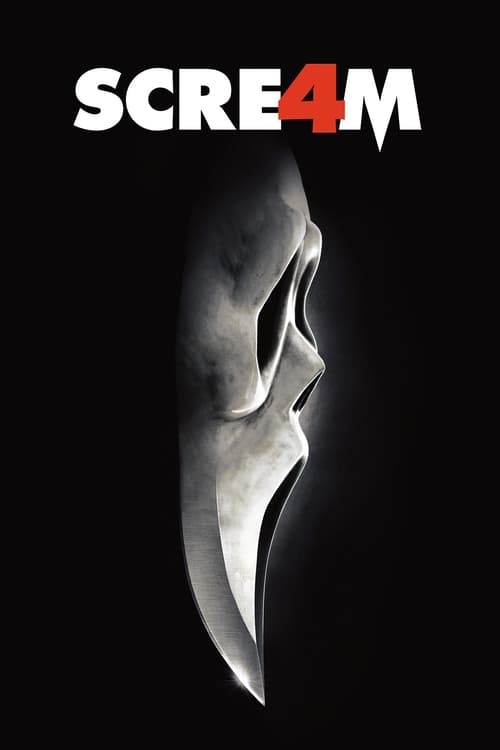
Scream 4
2011 · Wes Craven
For a fun, jumpy movie night with friends who like yelling theories at the screen — a comfort-horror pick that's scary enough to work but self-aware enough to laugh with. Best if you know the original, fine if you don't.
What it's about
Fifteen years after the Woodsboro murders, survivor Sidney Prescott comes home on a book tour, promoting her memoir about moving past trauma. Her timing is terrible: a new Ghostface starts carving through a fresh generation of teenagers, including Sidney's cousin Jill, while the old guard — Sheriff Dewey and reporter Gale — get pulled back into the hunt. It's a whodunit slasher where the killer's rules have been updated for the age of remakes, viral fame, and filming everything.
The experience
Fast, bloody, and mordantly funny — it winks at horror-sequel conventions while still delivering genuine jolts and a guessing game about the killer's identity. The tone is playful but with a nasty satirical edge about fame-hunger.
Performances
Neve Campbell brings weathered steel to Sidney, and Emma Roberts is a standout among the new cast, playing sweetness with something sharper underneath.
The craft
Wes Craven, in his final film, directs the set pieces with veteran precision — the opening sequence alone is a nesting-doll joke about sequels that doubles as a thesis statement. Kevin Williamson's script keeps the franchise's signature move: characters who know the rules of horror movies and die by them anyway.
Why it matters
Craven's swan song turned out to be prophetic — its satire of remake culture and kill-your-way-to-fame ambition anticipated the influencer era, and it laid the groundwork for the franchise's later revival and the wider legacy-sequel boom in horror.
Horror · Slasher · Teen horror · Horror comedy & camp. A whodunit slasher that winks at sequels and remakes while still landing real jolts — scary-fun, mordant, built for yelling theories.
Snapshot
Scream 4 is the fourth installment in the slasher franchise that Wes Craven and screenwriter Kevin Williamson launched in 1996, arriving eleven years after Scream 3 (2000) and functioning as both a sequel and a self-aware commentary on the remake-and-reboot economy that had come to dominate American horror by the late 2000s. Sidney Prescott (Neve Campbell), now a self-help author, returns to Woodsboro on the anniversary of the original murders, and a new Ghostface begins killing a fresh generation of teenagers — chief among them Sidney's cousin, Jill Roberts (Emma Roberts). The film's governing idea, announced in its marketing tagline "New decade. New rules," is that the slasher's meta-conversation had itself been overtaken by a culture of viral fame, livestreaming, and remake nostalgia. It is a knowing legacy sequel produced before the term entered common industry usage, and it holds a distinct place in Craven's filmography as the last feature he directed before his death in 2015.
Industry & production
Scream 4 was produced and distributed by Dimension Films under the Weinstein Company, the label that had shepherded the entire franchise from Miramax's Dimension arm. The project revived a series that had been dormant for a decade, and its development is notable for a publicized screenwriting struggle. Kevin Williamson — who wrote the first two films but not Scream 3 — returned to script Scream 4 and reportedly conceived it as the opening of a new trilogy. During production, however, Williamson's availability and creative differences led to rewrites credited in trade reporting to Ehren Kruger, the writer of Scream 3, producing friction that was widely covered at the time. The precise division of authorship between the two writers is one area where the public record is genuinely muddy; Williamson retains sole screenplay credit, but accounts of reshoots and revised third acts circulated during and after release.
Principal photography took place largely in Michigan in 2010 — in and around Ann Arbor, Northville, Plymouth, and Dearborn — taking advantage of the state's film tax incentives, which had drawn a wave of productions to the region in that period. The budget was reported in the range of $40 million. Commercially, the film underperformed relative to the franchise's earlier peaks: domestic returns were modest (reported in the high-$30-million range) with worldwide totals reported around the $95–100 million mark. I flag these figures as widely reported rather than independently verified here; the consensus, in any case, is that the film opened below the studio's expectations, which effectively foreclosed the planned trilogy despite the movie's later reputational recovery among fans.
Technology
Scream 4 was shot on 35mm film — the franchise had always been a photochemical enterprise, and Craven and cinematographer Peter Deming continued that practice here rather than moving to the digital capture that was becoming standard for studio horror at the turn of the decade. If there is a technological "subject" to the film, it is diegetic rather than production-based: the screenplay is preoccupied with consumer technology as an instrument of both murder and celebrity. Characters livestream from head-mounted webcams, the killer uses smartphones and voice-changing apps, and a running motif concerns the idea that survival can be monetized through recorded footage and internet notoriety. The film thus registers, at the level of plot, the shift from the 1996 original's landline-and-answering-machine texture to a 2011 world of always-on cameras — a self-conscious updating of the franchise's signature "the call is coming from inside" premise for the streaming age.
Technique
Cinematography
Peter Deming, who had photographed Scream 2 (1997) and Scream 3 (2000), returned for the fourth film, giving the sequel a visual continuity with the middle entries of the series. Deming — also a longtime David Lynch collaborator (Lost Highway, Mulholland Drive) — brings a clean, glossy studio-horror surface to the material: bright suburban interiors, controlled Steadicam mobility, and staged reveals built around doorways, windows, and reflective surfaces where Ghostface can appear and vanish. The look is deliberately more polished and saturated than the grainier 1996 original, consistent with the film's argument that it is a "remake" operating under new production values.
Editing
The film was edited by Peter McNulty. The cutting is organized around the franchise's characteristic rhythm of misdirection: extended stalk-and-suspense sequences that withhold the killer, punctuated by sudden attacks, and set-pieces engineered to make the audience second-guess who is present and who is on the phone. The film's most discussed structural gambit is its opening, which stacks several fake-outs — scenes revealed to be footage from the in-universe Stab movies — before the "real" narrative begins. This nested-prologue construction is fundamentally an editorial and structural joke about sequels and openings, and it depends on precise timing to land.
Mise-en-scène / staging
Craven stages Scream 4 in the franchise's established suburban register: Woodsboro houses, a high school, a hospital, and a climactic party set-piece. The production design leans on recognizable slasher iconography — the Ghostface mask and robe, the black-handled hunting knife — while updating the teen milieu with laptops, webcams, and a "Cinema Club" of horror-obsessed students. Staging repeatedly exploits domestic geography (garages, kitchens, upstairs bedrooms) as spaces of entrapment, and Craven continues to use the frame's negative space and off-screen sound to place Ghostface at the edge of perception before an attack.
Sound
Marco Beltrami, who scored every entry in the series, returned to compose Scream 4, maintaining the franchise's musical identity — its blend of orchestral suspense, percussive stingers, and the recurring dramatic material associated with Sidney and with Ghostface's attacks. Sound design remains central to the series' suspense grammar: the modulated telephone voice (again performed by Roger L. Jackson, the franchise's constant vocal presence as Ghostface) is the film's defining aural signature, and the shift of that voice from landline to mobile devices is itself a thematic point.
Performance
The film reunites the franchise's central trio — Neve Campbell as Sidney Prescott, Courteney Cox as Gale Weathers, and David Arquette as Dewey Riley, now Woodsboro's sheriff — and pairs them with a younger ensemble including Emma Roberts, Hayden Panettiere (as horror-savvy Kirby Reed), Rory Culkin, Nico Tortorella, Erik Knudsen, and Marielle Jaffe. Campbell's Sidney anchors the film as a survivor-turned-author, a performance built on wariness and hard-won composure. The most consequential performance is Roberts's Jill, whose late-film turn requires a shift from ingénue to antagonist. The layered opening also functions as a showcase of brief starring turns from actors including Anna Paquin, Kristen Bell, Aimee Teegarden, and Britt Robertson.
Narrative & dramatic mode
Scream 4 operates in the franchise's signature mode: the meta-slasher, a whodunit murder-mystery that simultaneously narrates and critiques the rules of the genre it inhabits. The dramatic engine is the whodunit — the audience is invited to suspect nearly every character until a two-killer reveal — layered over a satirical essay on horror remakes. Where the 1996 film's "rules" speech dissected the classic slasher, Scream 4 stages its exposition around the rules of the remake and the reboot: that anything can happen, that legacy characters are expendable, that the new version must escalate the original. The film's ultimate twist repurposes the survivor archetype itself: the killer's motive is not trauma or revenge in the earlier films' mold but the pursuit of fame — the desire to become the celebrated "final girl" of a media spectacle. This makes the film's mystery structure inseparable from its cultural argument.
Genre & cycle
The film belongs to the post-Scream self-reflexive slasher, a cycle that Craven and Williamson themselves inaugurated. Its immediate generic context, however, is the late-2000s horror-remake boom: the Platinum Dunes and studio reimaginings of The Texas Chain Saw Massacre, Friday the 13th, Halloween, and — pointedly — A Nightmare on Elm Street (2010), a remake of Craven's own 1984 film. Scream 4 positions itself as a commentary on that cycle, folding the remake wave into its plot through the fictional Stab series, which has by this point spawned numerous sequels within the story world. The film thus sits at a hinge: it is a sequel about the exhaustion of sequels and remakes, and in retrospect it prefigures the "legacy sequel" or "requel" cycle that would define studio horror and franchise filmmaking in the following decade.
Authorship & method
Scream 4 is a Wes Craven film in the fullest sense of his late career: a genre veteran returning to the property that had revitalized his reputation in the mid-1990s and applying his long-honed command of suspense staging and audience misdirection. Craven's method throughout the series balanced sincere scares with irony, and Scream 4 extends that dual register. The authorship is genuinely collaborative and, in this case, contested: Kevin Williamson's screenplay supplies the franchise's characteristic dialogue and its meta-architecture, while reported rewrites (associated with Ehren Kruger) complicate any clean attribution of the final structure. The key collaborators form a continuity spine across the series — cinematographer Peter Deming (returning from the second and third films), composer Marco Beltrami (all four films), and vocal performer Roger L. Jackson (all four films) — with editor Peter McNulty shaping the film's suspense rhythm. That this proved to be Craven's final directorial credit lends the film an unintended valedictory weight in his body of work.
Movement / national cinema
The film is a product of mainstream American studio horror — specifically the Dimension/Weinstein franchise machine — rather than any art-cinema movement. Its most meaningful "movement" affiliation is to the reflexive, genre-literate American horror lineage that Scream itself defined: films that treat their audience as fluent in horror convention and build suspense partly through that fluency. Its Michigan production also situates it within the brief early-2010s wave of runaway domestic productions drawn to state tax incentives, a phenomenon of film-industry geography more than of aesthetic school.
Era / period
Scream 4 is deeply of its moment — 2011, at the threshold of the smartphone-and-social-media era and near the tail end of the horror-remake boom. Its anxieties are period-specific: viral fame, the collapse of privacy, the monetization of trauma, and a media environment in which being filmed is indistinguishable from being famous. The franchise's evolution across time is itself the film's subject, as it explicitly contrasts the 1996 world of the original murders with the recording-saturated 2011 of its new killings. In this sense the film is a useful cultural artifact of the early social-media period, catching the anxieties of that transition at the exact moment they were becoming ambient.
Themes
The dominant theme is fame as a new form of horror — the idea that in a viral culture, notoriety is a motive that can rival any of the genre's older engines of revenge or madness. Adjacent to this is the theme of the remake and the reboot: the film is an extended meditation on repetition, on how culture recycles its own traumas as entertainment, and on the impossibility of a "clean" original in a franchise world. Trauma and its commodification form a third strand — Sidney has literally authored a book about her survival, and the killer's scheme is to appropriate the survivor's story for personal celebrity. Finally, the film continues the series' abiding interest in spectatorship and complicity: the Stab films within the story implicate the audience's own appetite for stylized violence.
Reception, canon & influence
Critical reception at release was mixed to moderately positive. A substantial body of critics welcomed the film as a smarter, more energetic return to form than Scream 3, praising Williamson's meta-commentary and the reunion of the original cast; others found the franchise's self-awareness had itself grown tired, and judged the satire of remake culture less fresh than the 1996 film's genre deconstruction had been. Commercially, as noted, it fell short of the studio's hopes, which ended the planned Williamson trilogy.
The influences on the film run backward through Craven and Williamson's own 1996 Scream and its sequels, through the classic slasher canon those films cataloged (Halloween, Friday the 13th, and Craven's own A Nightmare on Elm Street), and through the specific late-2000s remake cycle it satirizes. Its influence forward has grown more visible with time. Scream 4 is frequently reassessed as an underrated entry and, more importantly, as an early and prescient example of the legacy sequel — a film that stages the return of aging franchise heroes alongside a new generation, and interrogates that very move, years before the "requel" became a dominant studio strategy. The franchise itself was eventually revived with a fifth film (2022), which openly borrowed Scream 4's vocabulary of remakes and requels and elevated its concepts into the new films' central conceit. As Wes Craven's final work, Scream 4 also carries a retrospective significance in horror history as the closing statement of one of the genre's defining directors.
A Deleuzian reading
A phone rings in a bright kitchen and a girl picks it up.
The full Deleuzian reading of Scream 4 →
Reception
Shrugged off in 2011 as a diminished-returns legacy sequel and a box-office disappointment, it's since been reclaimed as prescient — its satire of fame-hunger and the remake era landed years before the discourse caught up, and its stock rose further as Wes Craven's final film.
How Scream 4 was received, from release to now →
How to watch Scream 4: what to notice on a first viewing
- Count how many times the opening starts over before the story begins. A phone rings and a girl answers, exactly as you expect. Then the camera finds two girls on a couch who were watching it. Then that happens again. Craven stacks the fake-outs, each one footage from the in-world Stab movies. The film makes you wrong three times before it starts. That is the instruction manual for everything after it.
- Look for the Stab movies playing inside this world. Woodsboro has a franchise made about its own murders. The Cinema Club watches them, the teenagers know the town's history as sequels, and Sidney is back on a book tour selling her survival. There is no longer an outside to the movies here. Coming home means walking back into the product made from it.
- Listen for the Ghostface voice coming out of cell phones. Roger L. Jackson has voiced the caller since 1996 and the modulation is unchanged. What changed is the hardware. The voice used to come from a landline in a specific house. Now it travels with everyone. The old threat worked because the caller was inside the house. Move it to a phone in a pocket and inside is everywhere.
- Watch the doorways, windows, and reflections behind whoever is talking. Peter Deming shoots clean, bright, saturated studio horror on 35mm and Craven keeps loading the empty parts of the frame. Ghostface arrives at the edge of what you were already looking at. Craven puts the threat where your attention is not, so the suspense is built out of the parts of the shot you skipped.
- Listen for the scene where someone states the rules aloud. The 1996 film had a rules speech about slashers. This one runs its version on remakes: anything can happen, the legacy characters are expendable, the new one has to go further than the old one. The chain you are holding has moved up a level. You are not just following the mystery now. You are following a genre talking about itself.
The whole guide to watching Scream 4, with the keys for a rewatch →
Influences: the films it descends from and the films it influenced
- Psycho (1960) — Establishes the technique of murdering the apparent star/protagonist in an early set-piece to destabilize the audience's sense of who is safe — the bait-and-switch that Scream's celebrity-cameo prologues (and Scream 4's nested Stab-within-Stab opening) systematize.
- Peeping Tom (1960) — Introduces the murderer who films his own killings and implicates the camera/viewer in the act — the direct formal precursor to Charlie and Jill's plan to record the murders on webcams as both alibi and instrument of fame.
- Black Christmas (1974) — Codifies the anonymous threatening phone caller who is already inside the house, the telephone-as-stalking-device grammar that Ghostface's modulated calls inherit wholesale.
- Halloween (1978) — Supplies the roaming subjective killer-POV prologue and the babysitter-suburb geography of entrapment that Scream's opening-kill staging and Woodsboro layout replicate.
- Friday the 13th (1980) — Provides the hidden-culprit whodunit reveal and the survivor/insider-as-killer twist — the structural DNA of Scream 4's two-killer misdirection and Jill's final unmasking.
- Wes Craven's New Nightmare (1994) — Craven's own metafictional experiment — a horror franchise folding back on its production and legacy — is the true precursor to Scream's genre self-awareness and to Scream 4's remake/requel commentary.
- Scream (1996) — The direct parent: originates the rules-reciting self-aware whodunit slasher, Roger L. Jackson's modulated Ghostface voice, and Beltrami's stinger-driven score, all of which Scream 4 continues via the same collaborators.
- Scream 2 (1997) — Builds the meta 'rules of the sequel' architecture and, with Peter Deming's later-series photography, the visual continuity spine that Scream 4 recycles onto the vocabulary of remakes and requels.
- The Cabin in the Woods (2012) — Explicitly catalogs and deconstructs horror archetypes as a governing ruleset, elevating Scream's meta-commentary from character banter into the film's structural engine.
- Unfriended (2014) — Literalizes Scream 4's livestreaming/webcam motif by staging the entire slasher through laptop screens and video calls, making the recording technology the very frame of the murders.
- Happy Death Day (2017) — Continues the genre-savvy comedy-slasher register with a masked campus killer and a college-mystery whodunit, the tonal balance of irony-plus-scares that Craven and Williamson perfected.
- Halloween (2018) — Executes the legacy-sequel template Scream 4 prototyped — the aging final girl returning to confront decades-old trauma alongside a new generation — as its entire premise.
- Spree (2020) — Fulfills Scream 4's prophetic 'murder for fame' motive by having its killer livestream the killings to gain followers, making Jill's fame-through-recorded-violence scheme the whole plot.
- Scream (2022) — Directly borrows Scream 4's 'requel' vocabulary and elevates it into the film's central conceit, reusing the aging-hero-plus-new-cast structure and legacy-sequel critique as the sequel's organizing idea.
- Bodies Bodies Bodies (2022) — Transposes the phone-driven, fame-obsessed whodunit slasher into a fully social-media-native cast, extending Scream 4's 'fame-as-horror' and livestreaming anxieties into Gen-Z group paranoia.
- Behind the Mask: The Rise of Leslie Vernon (2006) — Extends Williamson's meta-taxonomy by having its slasher lecture, on camera, about cardio, false-scare beats, and final-girl selection — the analytic self-commentary that Scream 4's opening film-buff scenes mirror.
- You're Next (2011) — A same-year self-aware suburban-siege slasher whose resourceful final girl and inside-job killer conspiracy run the exact home-invasion-whodunit machinery Scream 4 deploys.
Similar films
- Scream (2022) — influence & lineage · same viewing thread
- The Cabin in the Woods (2012) — influence & lineage · same viewing thread
- Scream (1996) — influence & lineage
- Scream 2 (1997) — influence & lineage
- Halloween (1978) — influence & lineage
- Friday the 13th (1980) — influence & lineage
- Scream VI (2023) — same viewing thread
- The Final Girls (2015) — same viewing thread
All the films related to Scream 4 →
Watch it with: curated runs of related films
- Horror That's In on the Joke — A run of horror comedies that know the rules — the slasher's final girl, the cabin in the woods, the zombie survival list, the deadly family tradition — and have a blast bending them, so watching them together turns each one's genre jokes into a running conversation.
- Slashers That Know the Rules — A run of body-count films that know their own genre: requels, camp-slasher love letters, Ti West's X trilogy and outright parodies, all reworking the masked killer, the final girl and the cursed summer camp, so each one sharpens the jokes and scares in the next.