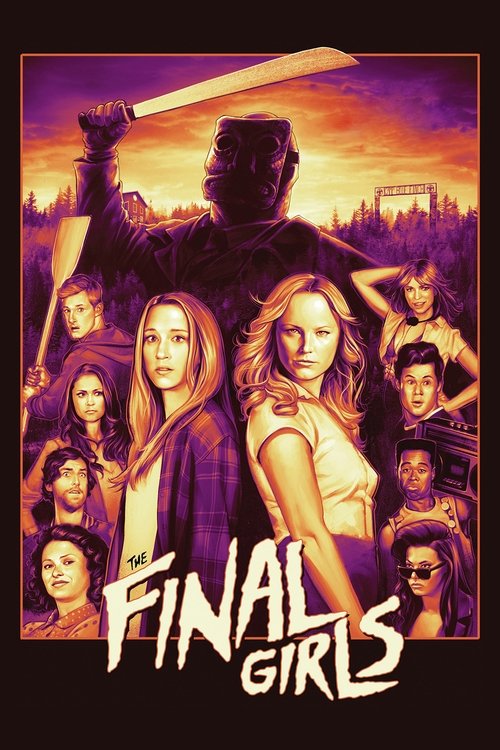
The Final Girls
2015 · Todd Strauss-Schulson
For a night when you want horror-adjacent fun without real dread — and maybe a good cry you didn't see coming. A perfect group watch that works even for friends who hate scary movies.
What it's about
Max is still grieving her mother, a working actress best remembered for a small role in a cheesy 1980s summer-camp slasher. Dragged to a revival screening three years after her mom's death, Max and her friends escape a theatre fire by slipping through the screen — and land inside the movie itself, where Max comes face to face with her mother's doomed character and a masked killer who runs on slasher-movie rules.
The experience
Funnier and far more tender than the premise suggests: it plays the slasher clichés for big laughs, then blindsides you with a mother-daughter story that can genuinely make you cry. Bright, fast and warm-hearted, with scares that stay on the playful side.
Performances
Taissa Farmiga grounds the comedy with real grief as Max, and Malin Åkerman does lovely double duty as both the lost mother and the sweet, naive counsellor character she once played — their scenes together give the film its unexpected emotional weight.
The craft
Todd Strauss-Schulson directs the movie-within-a-movie with real visual wit: swooping camera moves, candy-colored lighting and clever gags built from film grammar itself — flashbacks, slow motion and title cards become things the characters can physically stumble into. The craft is in how a parody keeps looking this inventive.
Why it matters
A festival favorite that became a cult touchstone for affectionate, emotionally sincere horror comedy, regularly cited among the best of the meta-slasher wave that followed the genre's 90s self-awareness.
Snapshot
The Final Girls is a meta-horror comedy that puts a grief story inside a slasher film. Max Cartwright (Taissa Farmiga) is a teenager whose mother, Amanda (Malin Åkerman), was a working actress best known for a small role in a 1980s summer-camp slasher called Camp Bloodbath. Amanda dies in a car crash. Three years later Max reluctantly goes to a revival screening, a fire breaks out in the theatre, and she and her friends escape through the screen into the movie itself. There she meets her mother again, or rather her mother's character, Nancy: a shy, guitar-playing camp counsellor who is fated to die early. The film uses the rules of the slasher (the sexually punished teenager, the masked killer, the virginal survivor) as both a comic puzzle and a melodramatic trap. Its real subject is a daughter who has to watch her mother die a second time, and who tries to rewrite the script so that she won't.
The film premiered at SXSW in 2015 and had only a small release. It sits in the line of self-aware slashers that runs from Scream (1996) through The Cabin in the Woods (2012). It stands apart in that line for its sincerity. It is less interested in deconstructing the genre than in asking what we feel for its stock characters, and for the actors who played them.
Industry & production
The Final Girls is a mid-2010s independent genre film, made at modest scale and sold through the specialty and home-video channels of a major studio. It was produced by Groundswell Productions, the company of producer Michael London, and distributed in the United States by Stage 6 Films, Sony's label for acquired and lower-budget titles. Its world premiere was in SXSW's Midnighters section in March 2015, and it also played genre festivals. In October 2015 it was released in a small number of theatres and on video-on-demand at the same time, a standard pattern for genre films of that size. Reliable public figures for the budget and theatrical gross are thin. Its commercial life was mostly on home video and streaming, where it found the audience it now has.
The screenplay by M.A. Fortin and Joshua John Miller had circulated for years before production. Miller is the son of actor and playwright Jason Miller, who played Father Karras in The Exorcist (1973). He has spoken publicly about the script coming partly out of losing his father and then meeting him again on screen. That autobiographical root explains why the film's emotional register is so unusual for a slasher comedy. Miller was himself a child actor in 1980s genre and youth films, including Near Dark (1987) and River's Edge (1986). The production shot in Louisiana, which was a busy hub at the time because of the state's film tax incentives. The ensemble mixed television-comedy talent (Adam DeVine, Thomas Middleditch, Alia Shawkat) with young genre and teen-drama actors (Farmiga, Nina Dobrev, Alexander Ludwig). The casting had a commercial logic, but it also does real work inside the story: the 2015 characters play as sketch-comedy improvisers, and the 1986 characters play as broad types.
Technology
The film was shot digitally, as most independent productions of its period were. Much of its visual wit comes from making a digital image imitate, or stylise, the look of a 1980s film. The film-within-the-film is never presented as a literal pastiche of 16mm or 35mm stock, with grain, scratches and gate weave, in the way the Grindhouse (2007) segments were. Instead it is a heightened, saturated, sun-drenched world that suggests how a remembered 1980s movie feels rather than how it looked. The key technical conceit is that the movie is a closed system with physical laws. Its opening titles exist as objects in space. A flashback turns the characters' world into black and white. The film's running time works as a loop that resets at around 92 minutes. These are achieved with fairly economical digital effects, grading and compositing. In each case the technique is tied to a joke about how films are physically made and watched: titles, flashbacks, reels, running time.
Technique
Cinematography
Elie Smolkin's cinematography divides the film into two visual regimes. The framing story in the present day, covering Max's grief and the revival screening, is shot in a cooler, plainer register. The Camp Bloodbath world is warm, high-key and saturated, with blooming sunlight and crayon-bright costumes and props. The difference explains itself: the movie-world looks the way a beloved VHS memory looks to its fans. The camera is also given some showpieces. The best known is a slow-motion circling move around the group as the killer, Billy Murphy, closes in. It turns a slasher set-piece into something like a music-video tableau, choreographed and absurd, and exhilarating as well. The black-and-white flashback sequence stages the past in an old-movie register, and the comedy comes from the characters' colour clothing and skin being drained once they physically walk into it.
Editing
Debbie Berman's editing has to manage tones that change from scene to scene: broad comedy, slasher suspense, and unguarded melodrama. The structure depends on repetition and reset. Scenes and lines from Camp Bloodbath recur as the characters learn the film's loop. The comedy relies on the audience recognising a scripted beat a second time, while the modern characters scramble to interrupt it. Berman makes the transitions between registers abrupt without making them incoherent. The film's most effective cuts are the ones that pull it out of a gag and into an emotional moment between Max and Nancy, and they work because they are never prepared with a cue. Berman later moved into large-scale studio editing, including Spider-Man: Homecoming (2017) and Black Panther (2018, co-edited).
Mise-en-scène / staging
The production design treats the 1980s summer camp as an iconographic set: cabins, a lake, a campfire, camp-counsellor costumes, and a killer whose mask and machete are a composite of slasher conventions rather than a copy of any one franchise. Billy Murphy most obviously recalls the Friday the 13th series in setting and backstory, with touches of Sleepaway Camp (1983) and The Burning (1981). Much of the staging is a comedy of frames. Characters from 2015 stand at the edge of shots in which the film's characters carry on reciting their dialogue. The 1986 counsellors move with stylised, poster-like confidence, and the modern teenagers move with naturalistic hesitancy. The film's mythology is literalised in its set pieces. When the rule that sexual activity summons the killer is understood, it becomes a tactical device. In one sequence characters try to engineer a striptease to lure Billy into a trap, and the staging of that scene turns the genre's voyeurism into a plan everyone is uncomfortably aware of.
Sound
Gregory James Jenkins's score moves between synthesizer cues pastiching 1980s horror scoring and the scale of a sincere emotional score. It avoids simply parodying the genre's sound. The key sound element is Kim Carnes's "Bette Davis Eyes" (1981). It is playing in the car before the opening crash, it is a shared song between mother and daughter, and it returns in the movie-world in the film's most direct reunion of the two. Using a period pop song both as a memory cue and as a diegetic object inside a film from the same period is the clearest instance of the film's double time-frame. Other 1980s pop is used to similar effect, more for comedy.
Performance
The acting runs on two levels, and the film's success depends on keeping them distinct. Taissa Farmiga plays Max naturalistically and with restraint, keeping the grief contained and only occasionally letting it break through. Malin Åkerman has the most demanding part. She plays Amanda in the brief framing scenes as a tired, loving working actress. Then she plays Nancy, a character who does not know she is a character, whose dialogue is scripted and whose personality is a stock type: the shy virgin with the clipboard and the guitar. The film's emotional climax depends on Åkerman letting Nancy become, slightly, more than her role, so that she seems to choose. Around them, Adam DeVine plays Kurt, the 1986 film's oafish lothario, as a broad caricature. Angela Trimbur plays Tina, the film's sexually forward counsellor, with an aggressively comic physicality. Thomas Middleditch plays Duncan, the modern horror fan who explains the rules, and his performance borrows directly from Jamie Kennedy's Randy in Scream. Alia Shawkat and Nina Dobrev play the modern friends, whose subplot (an ex-best-friend reconciliation) is lightly sketched.
Narrative & dramatic mode
The film is a hybrid of three modes. The first is the "trapped inside a film" fantasy, whose ancestors include Sherlock Jr. (1924), The Purple Rose of Cairo (1985), Last Action Hero (1993) and Pleasantville (1998). The second is the slasher-survival narrative. The third is the melodrama of grief and second chances. The plot is set up like a puzzle. The characters must learn the film's rules (it loops, the killer is triggered by sex, a final girl must kill him), and the jokes come from their efforts to game a story that has already been written.
The dramatic engine underneath is a variation on the fantasy of reunion with the dead. Max cannot save her mother. She can try to save her mother's character, and so keep alive the version of Amanda that survives on film. The film is clear about the cost of that substitution. Nancy cannot leave the movie, and the climax depends on her accepting the role assigned to her so that Max can survive. That reverses the usual shape of the slasher, in which the final girl survives alone. Here the final girl survives because of a mother's sacrifice. The coda puts Max in the sequel, Camp Bloodbath 2, facing the killer again. It is a nod to the franchise logic of the 1980s and an acknowledgement that the past can be revisited but not finished.
Genre & cycle
The Final Girls belongs to the cycle of postmodern or self-aware slashers inaugurated in mainstream form by Wes Craven's Scream (1996), and anticipated in Craven's own Wes Craven's New Nightmare (1994). The cycle continued through Behind the Mask: The Rise of Leslie Vernon (2006), Tucker & Dale vs. Evil (2010) and The Cabin in the Woods (2012). By 2015 the cycle was crowded, and the novelty of characters knowing the rules had worn thin. The film's contribution is to move from knowingness to affection. Scream's characters know the rules as a defensive literacy. Cabin in the Woods makes the rules a sacrificial system run by a bureaucracy. The Final Girls treats them as a world its characters must physically live in, and finds sympathy for the stock types (the slut, the jock, the virgin) the genre consumes.
Its title draws on Carol J. Clover's term "the final girl," from her essay "Her Body, Himself" (1987) and her book Men, Women, and Chain Saws (1992). The term had long since passed from academic film studies into fan discourse. The film uses it with full self-awareness: Duncan explains the concept within the story, and the plot depends on the right character occupying that role. It is also part of the broader 2010s wave of 1980s nostalgia in American popular culture, which saw the period's horror and adventure films become a shared language of reference.
Authorship & method
Todd Strauss-Schulson came from commercials, music videos and comedy. His first feature was A Very Harold & Kumar 3D Christmas (2011), a stoner comedy whose 3D gags already showed his interest in the formal apparatus of film as a source of jokes. The Final Girls develops that interest in more emotional terms. His next feature, Isn't It Romantic (2019), is a structural cousin. It traps a heroine inside the conventions of the romantic comedy and makes genre-awareness both its comedy and its resolution. Taken together, the two films suggest a director drawn to protagonists who wake up inside a genre and must negotiate its rules. The record is too short to make larger claims about his authorship.
The screenwriters, M.A. Fortin and Joshua John Miller, have the strongest claim to the film's emotional design, rooted in Miller's experience of his father's screen presence after his death. The pair later wrote and created the television series Queen of the South (2016–21). Elie Smolkin (cinematography), Debbie Berman (editing) and Gregory James Jenkins (music) together give the film its double register of nostalgic pastiche and present-day feeling. The available record does not document the division of creative labour among them in detail.
Movement / national cinema
The film belongs to American independent genre production of the 2010s. In this period, festival programming (SXSW Midnighters, Fantastic Fest and similar), day-and-date VOD release, and studio specialty labels created a durable market for mid-budget horror comedy. It is not part of a formal movement. It does share an ecosystem with the American horror films that circulated through the same channels in the early 2010s, and with the wider comedy world (sketch, improv, cable comedy) from which much of its cast came. Its comic texture of improvised riffs and deadpan meta-commentary owes as much to that comedy scene as to horror traditions.
Era / period
The film has two eras. Its setting looks back to 1986, the high point of the slasher franchises after Halloween (1978) and Friday the 13th (1980), when sequels, home video and summer-camp settings made the slasher a mass-market product. Its sensibility belongs to 2015, a moment of 1980s nostalgia in American culture that would soon peak with Stranger Things (2016), and in which 1980s horror had passed through VHS cult culture and repertory screenings into a shared language. The revival screening that opens the film, a fan audience at a double feature, is a document of that period's repertory and cult culture. In it, older films are re-watched ironically and affectionately, and the actors who appeared in them become objects of fan devotion and some condescension. Amanda's career as a "scream queen" remembered for a single disposable role is a wry comment on how the period's culture remembers the performers of the 1980s.
Themes
Grief and the screen afterlife of the dead. The film's central idea is that cinema preserves the dead in a looping present. A mother's on-screen image is both a comfort and a cruelty to the child who survives her, because it keeps the person but not the self. The film turns Max's grieving into a narrative in which she can finally say what she could not say before the crash, and in which the loss is repeated, this time with consent.
The ethics of the stock character. The slasher depends on characters designed to die. The film's most interesting move is to grant these types some interiority. Nancy is more than "the shy one." Tina's sexual brashness is played for comedy but not contempt. The genre's treatment of women's bodies as triggers for violence becomes a plot device the characters can name and use, which puts its moral logic on display.
Mothers and daughters. The final girl is usually a solitary figure. Here she becomes the product of a mother-daughter bond. Max inherits her survival from Nancy's choice. The film's resolution reads the final girl less as a figure of individual endurance than as one of inheritance.
Genre literacy as survival. As in Scream, knowing the rules is a resource. The film is ambivalent about that knowledge. Duncan's expertise is useful and comic, but the climax depends on an emotional action rather than a clever rule-hack.
Nostalgia. The film loves the 1980s slasher, but it does not pretend the period was innocent. Its affection is for the idea of a shared film world rather than for the films' values.
Reception, canon & influence
Critical reception. On release the film was generally well reviewed by critics and genre press. Many praised it for its unexpectedly emotional core, Åkerman's and Farmiga's performances, and its visual inventiveness on a small budget. The more reserved reviews found its comedy uneven and its modern-day supporting characters thinly sketched. Some also judged its slasher mechanics too tame, given that horror sits alongside comedy here, a common complaint about the hybrid. It had little commercial impact on release. Its reputation has grown since, mainly through home video, streaming and fan recommendation. It is now frequently cited in lists of overlooked horror comedies and meta-slashers, and has a modest but durable cult reputation.
Influences on the film (backward). The most direct models are the Friday the 13th series and the early-1980s summer-camp slashers (Sleepaway Camp, The Burning), from which Camp Bloodbath is assembled. The self-aware slasher line, Scream above all, supplies Duncan's rule-explaining role and the film's habit of naming conventions. Its premise descends from the "into the film" fantasy: Buster Keaton's Sherlock Jr., Woody Allen's The Purple Rose of Cairo (a film about a character stepping out of a movie, here inverted), and Last Action Hero (a boy enters an action film and discovers its rules). Pleasantville's use of black-and-white and colour as a physical property of a fictional world is a clear antecedent for the flashback sequence. The Cabin in the Woods is the immediate predecessor that made the slasher's archetypes the explicit subject of a mainstream genre film. Carol Clover's scholarship supplies the title and the central concept.
Legacy (forward). It is hard to establish direct lines of influence for a film of this size, and the record is limited. Still, The Final Girls belongs to a stream of later comedic and self-aware slashers that share its central moves. Happy Death Day (2017) uses a looping-time conceit inside a slasher. Freaky (2020) mixes slasher, comedy and identity-swap fantasy. Most closely, Totally Killer (2023) sends a daughter back to a 1980s slasher scenario to meet her teenage mother, and many reviewers compared it to The Final Girls. Strauss-Schulson's Isn't It Romantic applies the same trapped-in-genre structure to the romantic comedy. Within the history of the meta-slasher, the film is now usually valued as the cycle's most sentimental instance: a film that shows genre self-awareness can be a means of feeling as well as irony, and that the stock characters of the 1980s slasher, and the actors who played them, can be mourned as well as mocked.
Influences: the films it descends from and the films it influenced
- Sherlock Jr. (1924) — Keaton's projectionist walks into the screen and gets thrown around by the film's cuts. This is the first time a character is trapped inside a film's mechanics, which The Final Girls updates as characters bumping into the edge of the frame and getting caught in flashback transitions.
- The Purple Rose of Cairo (1985) — Allen's film lets a fictional character step out of a movie and keeps the screen boundary as a physical, comic barrier. The Final Girls turns this around: the audience members go into the film, and the stock characters have to be taught that they are fictional.
- Last Action Hero (1993) — A viewer is pulled into a genre film through a magic ticket, sees its conventions as physical laws, and has to explain those rules to the characters. Duncan's rule-explaining role inside Camp Bloodbath follows this outsider-who-knows-the-genre setup.
- Pleasantville (1998) — Ross treats black-and-white versus colour as a physical property of a fictional world that the visitors can change. The Final Girls uses the same idea for its black-and-white flashback, where the characters can see and touch the change in visual regime.
- Friday the 13th (1980) — This is the template for Camp Bloodbath: the lakeside summer camp, the machete killer punishing sex and drinking, and Harry Manfredini's breathy, minimal score. The Final Girls copies these closely enough that they work as the rules of its world.
- The Burning (1981) — Billy the killer's backstory, a disfigured camp-prank victim who returns with a bladed tool, comes from The Burning's Cropsy, including the campfire story that frames him as a legend.
- Sleepaway Camp (1983) — Camp Bloodbath takes its period texture from Sleepaway Camp's low-budget look: flat daylight cabin interiors, bullying counselors, and overacted camp archetypes. The Final Girls plays this both as affectionate parody and as a period record.
- Scream (1996) — Kevin Williamson's script has a horror-fan character recite the genre's rules and puts the characters' survival on knowing them. Duncan copies Randy's role directly, and the plot keeps testing whether naming a convention protects you from it.
- Wes Craven's New Nightmare (1994) — New Nightmare makes the real actress who played a scream queen the subject of the film, and ties her real-life motherhood to the fiction she once acted in. The Final Girls builds its grief plot on the same overlap between a dead actress-mother and her slasher role.
- Behind the Mask: The Rise of Leslie Vernon (2006) — Glosserman's film switches between two visual regimes, mockumentary for the slasher's 'behind the scenes' and glossy 80s slasher grammar for the kills. The Final Girls uses a similar switch between present-day and in-film registers to show which genre rules are in force.
- The Cabin in the Woods (2012) — Goddard and Whedon made the slasher's stock archetypes (virgin, whore, fool, jock) the explicit machinery of a mainstream film. The Final Girls takes that taxonomy and has its characters knowingly play into or against their assigned roles to survive.
- The Slumber Party Massacre (1982) — Builds its plot on a group of women who survive by rejecting the sole-survivor rule, the collective final girl, and it deadpans the eighties slasher's shower-and-stalk setpieces while still staging them.
- Happy Death Day (2017) — Landon puts a reset loop inside a slasher and uses each repeat to teach the heroine the killer's rules. The Final Girls has a similar device: when the in-film runtime ends, the story restarts as a looping trap.
- Isn't It Romantic (2019) — Strauss-Schulson uses the same structure again: a heroine wakes up inside a genre she disdains (the rom-com), its conventions act as physical law, and she escapes by using those conventions rather than mocking them.
- Freaky (2020) — Freaky depends on actors playing two registers at once, a body-swap performance inside slasher-comedy, much as Farmiga plays both Nancy the scripted camp counselor and the mother the heroine is grieving.
- Fear Street Part Two: 1978 (2021) — Janiak rebuilds the Friday-the-13th summer-camp slasher as a knowing period pastiche, with a nested frame story and period needle-drops. It follows The Final Girls' approach of treating the camp slasher as a set of loving reconstructions.
- Totally Killer (2023) — Like The Final Girls, Totally Killer sends a daughter into a 1980s slasher to meet her mother as a teenager, gets comedy from period mismatch, and makes protecting the mother the emotional climax.
- Tucker & Dale vs Evil (2010) — Both films stage kills as slapstick by making the characters misread what genre they are in. Both also find sympathy for stock slasher figures, building the comedy from a mismatch between how people act and the genre that surrounds them.
- Fear Street: 1978 (2021) — An affectionate meta-reconstruction of a fictional 80s camp slasher that treats the camp as a navigable genre map — the same pastiche-as-love-letter reconstruction Janiak performs on the idiom.
Similar films
- Scream (1996) — influence & lineage
- The Cabin in the Woods (2012) — influence & lineage
- Freaky (2020) — influence & lineage
- Friday the 13th (1980) — influence & lineage
- Teenage Sex and Death at Camp Miasma (2026) — shared sensibility
- Final Destination Bloodlines (2025) — shared sensibility
- Scream 4 (2011) — shared sensibility
- The Slumber Party Massacre (1982) — shared sensibility