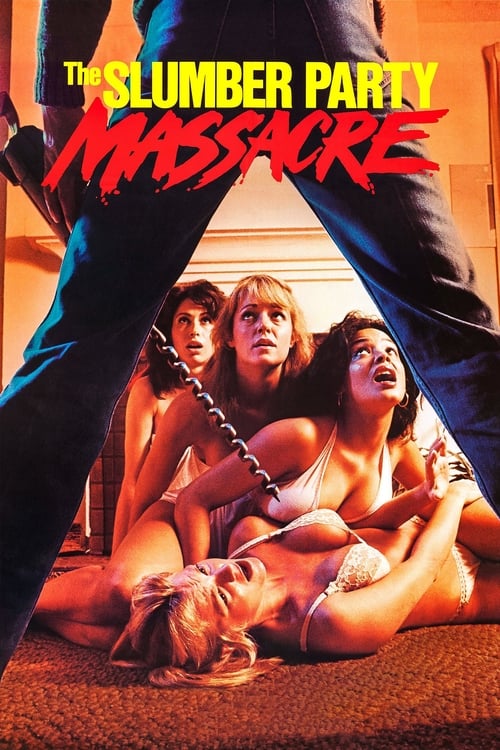
The Slumber Party Massacre
1982 · Amy Holden Jones
Ideal slumber-party viewing, fittingly: when you want a quick, fun, gory crowd-pleaser that's smarter than it first appears. Pure comfort horror with a satirical aftertaste.
What it's about
High-schooler Trish hosts a slumber party for her basketball teammates while her parents are away, with the snubbed new girl next door watching from across the street. An escaped mass murderer armed with an oversized power drill crashes the night, and the sleepover becomes a siege.
The experience
Fast, funny, and sharp — it plays the slasher formula completely straight on the surface while quietly winking at it, so you get real jump scares and sly jokes in the same 77 minutes. The girls banter like actual friends, which makes the mayhem land harder.
The craft
Written by novelist and feminist activist Rita Mae Brown and directed by Amy Holden Jones, it's a rare slasher of its era made by women — and it shows in how the camera treats its characters and how pointedly absurd the killer's drill becomes. Lean, economical Corman-school filmmaking with not a wasted minute.
Why it matters
A landmark of women-directed horror from a cycle that almost never allowed it, it spawned a franchise and became a key text in debates about what the slasher genre says about and to women.
Snapshot
The Slumber Party Massacre is a low-budget American slasher film. It was made under Roger Corman's sponsorship, released at the height of the early-1980s slasher boom, and runs a lean 77 minutes or so. On the surface it follows the formula exactly. An escaped mass murderer, Russ Thorn (Michael Villella), carrying an oversized portable power drill, besieges a suburban house where high-school senior Trish (Michelle Michaels) is hosting a sleepover for her basketball teammates. Valerie (Robin Stille), the new girl next door, was snubbed and not invited. She watches from across the yard with her younger sister Courtney (Jennifer Meyers) and becomes the decisive survivor.
What makes the film unusual, and why it has lasted, is who made it. It was written by the novelist and feminist activist Rita Mae Brown and directed by Amy Holden Jones, two women working in a genre that critics of the period widely attacked as misogynist spectacle. Brown's script was conceived as a parody of the slasher form. The finished film keeps the genre's required elements (the locker-room shower, the stalking point of view, the escalating body count) but runs them through a deadpan, self-aware sensibility. The drill is staged so plainly as a phallic surrogate that it reads as commentary. The film was dismissed or ignored as exploitation on release. It has since been reappraised as one of the slasher cycle's most interesting internal critiques, and it started a three-film franchise in which every entry was directed by a woman.
Industry & production
The film came out of the Corman ecosystem, the training ground that in the 1970s and early 1980s turned editors, assistants and trailer cutters into feature directors on minimal budgets. Before directing, Amy Holden Jones worked in post-production. She is credited as editor on Allan Arkush and Joe Dante's Corman comedy Hollywood Boulevard (1976), and she has often been described as having worked as an assistant to Martin Scorsese in the mid-1970s.
The production story Jones has told in interviews is well established in the film's lore. She picked up Rita Mae Brown's script, then circulating under the title Sleepless Nights. Using borrowed equipment and leftover short-end film stock, she shot a few minutes of the opening scenes as a demonstration reel and showed it to Corman, who agreed to finance the feature. Jones has also said that around the same time she was offered the editing job on Steven Spielberg's E.T. the Extra-Terrestrial (1982) and chose to direct her own film instead. The account comes mainly from Jones herself, but it has been repeated consistently for decades.
Jones is credited as producer alongside Aaron Lipstadt, another Corman alumnus who later directed Android (1982). Distribution went through Corman's company, then operating as New World Pictures. Figures in the low hundreds of thousands of dollars are often cited for the budget, but no audited number exists in the public record and any precise figure should be treated with caution. Like many slashers of its moment, the film was cheap to make and easy to sell to drive-ins, grindhouses and the growing home-video market.
The production shot in and around Los Angeles. Its suburban settings are ordinary houses, a high-school gym and locker room, and quiet residential streets. Those were economical choices, and the genre had already made them meaningful: since Halloween (1978), the threatened middle-class home had become the slasher's natural stage.
Technology
Nothing here is technically innovative, and the film should not be oversold on that point. It was shot on 35mm with the modest lighting and grip resources of a Corman production. Jones's demo reel was reportedly shot on short ends, which shows how close to the margin the project began. The score relies heavily on synthesizer, typical of horror after John Carpenter's self-composed Halloween score, when electronic keyboards gave low-budget productions an affordable, atmospheric sound.
The film's most important "technology" is a prop: the killer's power drill, fitted with an absurdly long bit. As a weapon it follows the slasher's fondness for domestic or workshop tools (the kitchen knife of Halloween, the chainsaw of The Texas Chain Saw Massacre, 1974). Its exaggerated length is the film's central visual joke and critique. It is easy to see on screen, impossible to mistake, and it carries the film's argument.
Technique
Cinematography
The cinematographer was Stephen Posey. The camerawork follows the slasher grammar Carpenter had standardized. There are prowling handheld or Steadicam-style moves, and subjective shots apparently from the killer's point of view, framed through windows or around corners. Night exteriors are lit to keep the suburban house glowing against the dark. One notable departure is that the killer is seen clearly, unmasked and in daylight, from early in the film. Michael Myers was half-glimpsed and Jason was still offscreen in the first Friday the 13th, but Russ Thorn is simply a man in a denim jacket, and the camera lets him be seen. This removes the supernatural mystique the cycle increasingly attached to its killers. The threat becomes ordinary, recognizable and male rather than mythic.
The frame repeatedly sets up observers and observed. Valerie and Courtney watch the party house, the girls watch the boys spying on them, and the killer watches everyone. As a result, the film's voyeuristic camerawork tends to show the act of looking as well as perform it.
Editing
Jones's background as an editor is visible in the film's economy. It moves quickly, cuts most stalking sequences tightly, and wastes little time on exposition, a virtue the 77-minute running time demanded. Scare beats depend on cross-cutting between the party house, Valerie's house next door, and victims who wander outside or arrive from elsewhere. The comic beats are timed for deadpan effect, such as a cut that holds on a character doing something banal next to something grotesque. The record is thin on who exactly is credited as the film's editor and how much of the cutting Jones supervised herself. Her editorial training is a reasonable context for the film's pacing, but specific attributions should not be overstated.
Mise-en-scène / staging
The staging pushes slasher conventions to the point where they become visible. The opening day includes the obligatory locker-room shower scene, shot with the leering frankness the exploitation market expected. Commentators have read its very flatness and length as Jones meeting a commercial requirement while declining to invest it with much erotic charge. The sleepover itself is mostly pajamas, beer, gossip, pizza and phone calls.
The best-remembered staging choices are the jokes. In one, the girls discover the pizza delivery boy dead in the doorway, and after a beat they eat the pizza anyway. In another, the bodies pile up while the survivors argue and dither. The climactic image is the most cited. Valerie, armed with a machete, chops the long drill bit short as the killer advances, then finishes him off; he ends up in the backyard swimming pool. Critics have described the castration symbolism as so overt it reads as authorial commentary, the parody Brown intended surfacing in the film's single most important image.
Sound
The score is credited to Ralph Jones. It is mostly synthesizer stingers and pulsing cues in the post-Halloween manner, plus diegetic pop music from the party. The drill's whine is the most distinctive sound in the film. It announces the killer offscreen, and the sound design uses it as a signature, much as the chainsaw's roar works in The Texas Chain Saw Massacre. Telephones, heard and answered, carry suspense, as they had since Black Christmas (1974) and When a Stranger Calls (1979).
Performance
The cast is young and mostly inexperienced, typical of exploitation casting. Robin Stille's Valerie is the film's center: reserved, slightly outside the group, watchful. She is the figure who will act decisively. Michelle Michaels plays Trish, the hostess, as a conventional popular girl. Michael Villella plays Russ Thorn with flat, almost bored menace. He speaks few lines, and one of them, delivered to his victims, has been widely quoted as a crude statement of the killer's sexual pathology; the film treats it as almost pathetic. Brinke Stevens, later a fixture of 1980s low-budget horror, appears early as a victim. The adult supporting roles are Pamela Roylance as the girls' basketball coach and Rigg Kennedy as a fussy neighbor. They are played with a slight comic exaggeration that helps the film's tonal double game. Performances drift between straight horror and gentle absurdity, sometimes awkwardly. That unevenness is part of the film's texture and part of the long debate over how much of its satire is deliberate.
Narrative & dramatic mode
The structure is the classic slasher siege in three movements:
1. The day. Exposition at school and in the neighborhood establishes the girls, the boys who will spy on them, the snubbed neighbor Valerie, and the news report of Thorn's escape. Thorn kills almost at once, at the school and around it. 2. The night. The party settles in while Thorn closes on the house and picks off peripheral figures: neighbors, the delivery boy, the boys, the coach who arrives to check on things. 3. The siege and the turn. The survivors are trapped in the house. Valerie and Courtney cross from observers to participants, and Valerie confronts the killer.
The film's dramatic mode is double-voiced. It works as a functional thriller, with suspense built in standard ways. It also works as a running commentary on the form, through deadpan reactions, obvious symbolism, and characters who behave just stupidly enough to make the conventions show. Brown's original script leaned harder into parody. The finished film seems to have been pulled toward straight horror for commercial reasons, which produces the tonal ambiguity viewers still argue over. It is neither a full spoof like Student Bodies (1981) nor a straight-faced stalker film. It sits uneasily, and productively, between the two.
A notable dramaturgical choice is that the "Final Girl" is spread across several characters. Valerie, the outsider, does the decisive work, but Trish and Courtney survive alongside her. The emphasis falls on collective survival rather than a single traumatized heroine.
Genre & cycle
The film belongs squarely to the first great wave of the American slasher. That wave began with Halloween (1978) and turned into a commercial formula with Friday the 13th (1980). It produced a glut of holiday-, institution- and occasion-themed imitators: Prom Night, Terror Train, My Bloody Valentine, Graduation Day, Happy Birthday to Me, Hell Night and many others in 1980–82. Its title follows the cycle's "X Massacre" naming habit, borrowed from The Texas Chain Saw Massacre. The drill weapon inevitably recalls Abel Ferrara's The Driller Killer (1979), though the two films have little else in common.
Within that cycle, The Slumber Party Massacre is one of the earliest examples of a slasher commenting on its own formula from inside. Student Bodies had already spoofed the genre openly in 1981. Jones and Brown's film is more interesting because it keeps the commercial form intact while ironizing it. This anticipates in miniature the self-reflexive turn the genre would take much later with Scream (1996).
Authorship & method
Amy Holden Jones (director, producer). This was Jones's directing debut. She followed it with the Corman-produced romantic drama Love Letters (1983), starring Jamie Lee Curtis, which was much better received critically, and later directed Maid to Order (1987) and The Rich Man's Wife (1996). Her most commercially significant later work was as a screenwriter. Her credits include Mystic Pizza (1988), Beethoven (1992), Indecent Proposal (1993) and The Getaway (1994 remake). Jones has generally been candid that she took on a slasher because it was a viable way into directing, and that she had to accommodate the market's requirements while shaping the material her own way. The Slumber Party Massacre reflects that pragmatic, editor's-eye craft.
Rita Mae Brown (writer). Brown was best known as the author of the landmark lesbian coming-of-age novel Rubyfruit Jungle (1973) and as a prominent figure in second-wave and lesbian feminist activism. She wrote the script as a parody of the slasher, and she has been described as unhappy with how far the produced film moved toward straight exploitation. Her authorship gives the film much of its later critical interest: a feminist novelist's satirical blueprint pressed into the shape of a commercial horror product.
Stephen Posey (cinematographer). Posey's photography follows the genre's standard visual grammar competently and efficiently. He later shot other low-budget genre features in the 1980s.
Ralph Jones (composer). He supplied a synthesizer-driven score in the post-Carpenter idiom.
Editing. The film's editor credit and the extent of Jones's own hand in the cutting are not well documented in accessible sources. Her editorial background is the more useful context.
Roger Corman (backer). Corman's method shaped the film decisively: give an untested filmmaker a chance in exchange for a fast, cheap, commercially conventional product with the expected exploitation elements. His operation's openness to women behind the camera is part of the context. Stephanie Rothman had directed for him in the 1960s and 1970s, and the later Slumber Party sequels, all made under Corman's companies, were also directed by women.
Movement / national cinema
The film belongs to American independent exploitation cinema, specifically the New World/Corman branch. That tradition worked alongside the studio system, catered to drive-in, grindhouse and later video audiences, and served as an informal film school. It is not tied to any aesthetic movement in the art-cinema sense. Its importance lies in genre history and in the history of women working within commercial genre production, a field where women directors were then very rare.
Era / period
The film was made at the peak of the slasher boom in 1981–82. Critical and public backlash against the cycle was intense. Gene Siskel and Roger Ebert famously attacked slasher films on television around 1980 as hateful toward women, and the industry was facing ratings pressure over graphic violence. The film is also a product of the early Reagan era's suburban imaginary of tract houses, teenage consumerism and fragile domestic security, and of the moment just before home video transformed how such films reached audiences. Over the following decade it found much of its life on VHS and cable.
It also reflects the cultural reach of second-wave feminism: a feminist novelist could be commissioned, however incongruously, to write a slasher, and the period's arguments about pornography, violence and the male gaze were in the air the film breathes.
Themes
- The phallic weapon made literal. The drill's absurd length turns the slasher's buried sexual logic into overt imagery, where the killer's violence stands in for sexual aggression. The killer's crude spoken rationale and Valerie's literal cutting-down of the bit complete the critique. Whether audiences took it as satire or as a straightforward thrill, the symbolism leaves little room for misreading.
- Looking and being looked at. The film is full of watchers: the boys spying on the party, Valerie and Courtney observing from next door, the killer's subjective camera. It stages the genre's voyeurism openly, and for many later critics it uses that voyeurism to make the audience conscious of its own gaze.
- Female community and its fractures. The girls' friendships, cliques and exclusions, especially the snub of Valerie, are drawn with more attention than the cycle usually gave its victims. Survival comes from the excluded girl crossing the social line, and the ending emphasizes women surviving together.
- The incompetence of men. Boyfriends, neighbors and would-be rescuers are largely ineffectual, comic or quickly killed. The film quietly denies the male rescuer role.
- The banality of the threat. An unmasked, ordinary killer and a matter-of-fact news report place violence against women in everyday suburban reality rather than in myth.
- Dark comedy as distance. The pizza scene and similar beats keep the horror at an ironic distance. They invite viewers to watch the conventions working as conventions.
Reception, canon & influence
Contemporary reception. On release the film was mostly lumped in with the slasher glut and dismissed by mainstream critics as one more exploitation item. The cycle as a whole was then drawing sustained hostility for its treatment of women. The film did well enough commercially for a low-budget release to justify sequels, though no reliable box-office figures are widely documented. It found a lasting audience on home video and late-night television.
Influences on the film (backward).
- John Carpenter's Halloween (1978) supplied the template: the suburban setting, the escaped killer, the stalking point of view, the synth score and the young female victims.
- Friday the 13th (1980) and its imitators established the formula of serial kills in a confined setting.
- The Texas Chain Saw Massacre (1974) provided the power-tool weapon and the "Massacre" title convention.
- Black Christmas (1974) and When a Stranger Calls (1979) contributed the house siege and telephone suspense.
- The Driller Killer (1979) is an evident nominal reference for the weapon.
- Brown's satirical intent connects the film to the parody impulse already visible in Student Bodies (1981), though the film's mode is far more ambivalent.
Legacy (forward).
- Franchise. Slumber Party Massacre II (1987, dir. Deborah Brock) and Slumber Party Massacre III (1990, dir. Sally Mattison) followed, both made under Corman's later companies. That gave the series a rare distinction: every entry was directed by a woman. The loosely related Corman-produced Sorority House Massacre (1986, dir. Carol Frank) shares the same production ecology. In 2021 a remake directed by Danishka Esterhazy, written by Suzanne Keilly, premiered on Syfy. It made the original's satirical inversion explicit and turned many of the 1982 film's gendered conventions back on themselves.
- Feminist criticism. From the late 1980s onward, as feminist film scholarship began reading the slasher more closely, the film became a recurring reference point. Carol J. Clover's Men, Women, and Chain Saws (1992) defined the "Final Girl" and argued for the genre's complex gender dynamics, and this work set up the framework through which films like The Slumber Party Massacre were reread as more self-aware than their reputations suggested. The film appears frequently in later scholarship and criticism on women horror directors, on the female gaze in horror, and on parody in the slasher.
- Cult and canon. Home-video reissues, including special editions from labels specializing in cult horror, and repertory and festival screenings have given the film a firm cult standing. It now regularly appears on lists of essential slashers and of horror films directed by women. Discussion often frames it as an early, under-recognized ancestor of the self-reflexive slasher that Scream (1996) later made mainstream, and of the twenty-first-century wave of women-directed horror that revisits the genre's gender politics.
The film's critical position remains two-sided. Some viewers see a subversive feminist satire smuggled inside an exploitation film. Others see a conventional slasher whose satire was largely domesticated by commercial pressures, with the shower scene and stalking camera intact. The most defensible reading holds both at once. Its interest lies in that tension between Brown's parody and the market's demands, worked out by a first-time director who knew exactly which conventions she was required to deliver, and how to make the audience see them.
Influences: the films it descends from and the films it influenced
- Halloween (1978) — Gives the film its basic grammar: subjective prowling shots from the killer's view through suburban windows, a minimal repeating synth score, and teenage girls stalked one by one through ordinary houses on one ordinary night.
- Black Christmas (1974) — Sets up the all-female household under siege, with a killer roaming inside the house unseen by the women, and the outside world (police, boyfriends, neighbours) failing to notice or help. Jones's siege structure follows this pattern.
- The Texas Chain Saw Massacre (1974) — Introduces the motorised power tool as a slasher weapon whose engine noise works as sound design, which the drill's whine updates. It also supplies the 'Massacre' title convention.
- The Driller Killer (1979) — The direct source for the portable electric drill as a killing tool and visual signature. Jones's film moves it out of Ferrara's grungy New York and into a bright Californian suburb.
- When a Stranger Calls (1979) — Its opening act builds a template for domestic suspense around the phone line and the unseen intruder. Slumber Party Massacre uses that template for its long setpieces of girls alone in houses, cut off from help.
- Psycho (1960) — The source of the voyeuristic shower scene and the framing of the female body before the attack. Jones stages the obligatory locker-room shower openly, so that the audience is made aware of its own look.
- Peeping Tom (1960) — Its reflexive linking of camera, gaze and phallic weapon is the critical tradition behind Rita Mae Brown's satirical idea: a drill, framed at crotch level, standing in for the male look.
- Friday the 13th (1980) — Fixes the commercial body-count rhythm of isolated young people killed at regular intervals in one bounded location. Corman demanded this structure, and Jones kept to it while editing for maximum speed.
- Sorority House Massacre (1986) — Another woman-directed Corman production in the same low-budget ecology. It reuses the template of an all-female house invaded and the house-siege staging almost exactly.
- Slumber Party Massacre II (1987) — Takes the drill's phallic joke to its logical end: the weapon becomes a drill-tipped electric guitar played by a rockabilly killer. This turns the 1982 film's buried satire into open, surreal camp.
- Slumber Party Massacre III (1990) — Keeps the franchise's woman-directed lineage and its drill signature going, and gives the killer a motive of male sexual inadequacy. This makes literal the castration subtext that Brown's script had left implicit.
- Scream (1996) — Brings into the mainstream the self-aware slasher, in which characters' knowledge of genre convention runs alongside real suspense, a dual register that Slumber Party Massacre had already tried in deadpan form.
- Jennifer's Body (2009) — A woman director and woman writer working with the genre's sexualised conventions from the inside. It inherits the strategy of handing the audience the expected exploitation beats while making them visibly aware of the looking.
- The Final Girls (2015) — Builds its plot on a group of women who survive by rejecting the sole-survivor rule, the collective final girl, and it deadpans the eighties slasher's shower-and-stalk setpieces while still staging them.
- Slumber Party Massacre (2021) — A direct remake that flips the 1982 shower and pillow-fight setpieces into male-body voyeurism and turns the slumber party into a deliberate trap. It makes Brown's original satirical inversion the film's explicit structure.
- Bodies Bodies Bodies (2022) — Updates the collective female house-siege to a single night of gallows comedy. It keeps the deadpan tone, in which the young women's banter carries on right next to the dead bodies.
- Student Bodies (1981) — An outright slasher spoof released the year before. Its open joking marks the far end of the parody range; Brown's script plays the same conventions deadpan instead, so the satire sits inside a straight genre film.
- The House on Sorority Row (1983) — A boom-year companion that also puts a group of young women in one house and divides the 'final girl' role across several survivors, rather than giving it to a single heroine as Halloween did.
Similar films
- The Final Girls (2015) — influence & lineage
- Scream (1996) — influence & lineage
- Halloween (1978) — influence & lineage
- The Texas Chain Saw Massacre (1974) — influence & lineage
- Jennifer's Body (2009) — influence & lineage
- Black Christmas (1974) — influence & lineage
- Friday the 13th (1980) — influence & lineage
- The Texas Chainsaw Massacre Part 2 (1986) — shared sensibility