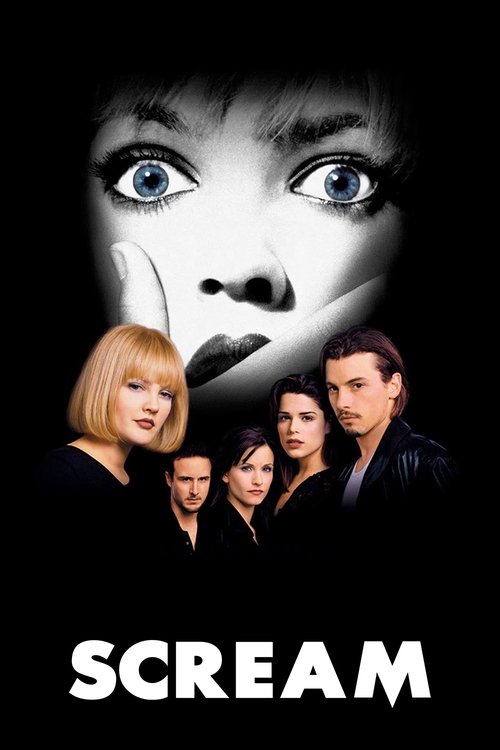
Scream
1996 · Wes Craven
For when you're craving a real scare with a wink — the ideal group horror night, Halloween pick, or gateway film for someone who claims they don't like slashers.
What it's about
A year after her mother's murder, a California teenager becomes the target of a masked killer who stalks her and her friends — and who plays a deadly game built on the rules of scary movies. It's a slasher and a whodunit at once: everyone in this small town has seen the horror classics, including, apparently, the killer.
The experience
Genuinely scary and genuinely funny in the same breath — the characters joke about horror-movie rules even as those rules tighten around them, and the whodunit keeps you second-guessing everyone. The opening stretch alone is one of the most nerve-shredding sequences in the genre.
Performances
Neve Campbell grounds the mayhem as a heroine with real grief and grit, and Drew Barrymore's brief early appearance is legendary — a movie star used as a weapon against your expectations.
The craft
Kevin Williamson's whip-smart script gave horror characters genre-literacy for the first time, and Wes Craven's veteran command of suspense keeps the self-awareness from ever defusing the fear. The phone-call set pieces are masterclasses in sustained dread — watch it with the lights off and the sound up.
Why it matters
It single-handedly resurrected the slasher film in the late '90s, launched a wave of self-aware teen horror, and gave the genre its last great masked icon in Ghostface.
By 1996 the slasher film was a corpse, and Wes Craven — who had helped invent it with A Nightmare on Elm Street — performed the autopsy and the resurrection in one gesture. Kevin Williamson's script gave us teenagers who had seen every horror movie their killer had, who recite the genre's rules even as those rules close around them. The trick could have curdled into smugness; Craven's decades of craft keep it lethal. The opening sequence alone — a house, a phone, a movie-star cameo weaponized against audience expectation — is a master class in sustained dread, and it announced that self-awareness would sharpen fear rather than defuse it. Ghostface, with his Munch-derived mask and his fallibility (he trips, he gets hit, he bleeds), became the last great slasher icon. The film single-handedly revived teen horror, spawned a wave of imitators it had already pre-emptively mocked, and made meta-commentary a permanent register of the genre. Craven, the former humanities professor, had spent his career interrogating why we watch; here he built the question into the murder weapon.
A Deleuzian reading
A phone rings in a big empty house, and a famous face picks it up.
The full Deleuzian reading of Scream →
Reception
It opened quietly in December 1996 against Christmas blockbusters, then word-of-mouth turned it into a sleeper smash that single-handedly resurrected the slasher genre. Thirty years on it's gone from 'clever hit' to unassailable canon — the meta-horror urtext everything since gets measured against.
How Scream was received, from release to now →
Influences: the films it descends from and the films it influenced
- Halloween (1978) — Establishes the babysitter-in-suburbia slasher grammar Scream runs on — the roving subjective stalk-cam, the unstoppable masked shape, the resourceful final girl — and Craven literally puts the film on a TV screen so the killer's rules can be recited over it.
- Black Christmas (1974) — Originates the anonymous obscene phone caller who is already inside the house and the sorority-siege POV kills, the tonal source for Ghostface's telephone game of intimacy and threat.
- A Nightmare on Elm Street (1984) — Craven's own teen-horror mechanics — the killer stalking high-schoolers, the blurring of on-screen fiction and threat — are the authorial foundation he then turns inside out here.
- Targets (1968) — Mass-market inheritor of Targets' central insight that the horror genre's own history can be its subject matter, with characters watching genre films on screens while the killer moves through the same room.
- Gremlins 2: The New Batch (1990) — Builds a franchise on characters reciting and litigating genre rules aloud — the Brain Gremlin's function, generalized into a whole screenplay's dialogue mode.
- The Lost Boys (1987) — Randy Meeks is the Frog brothers professionalized: a character whose function is to state the genre's rules aloud so the film can honor or violate them on cue, making fandom itself the diegetic survival skill.
- The Cabin in the Woods (2012) — Systematizes Scream's rules-of-the-genre conceit into an entire apparatus, dramatizing 'why we watch' by making the audience's demand for ritual teen sacrifice the literal plot.
- Final Destination (2000) — Supplied the immediate post-Scream template: a self-aware, rules-based teen-slasher ensemble picked off one by one in sequence.
- Scream 4 (2011) — The direct parent: originates the rules-reciting self-aware whodunit slasher, Roger L. Jackson's modulated Ghostface voice, and Beltrami's stinger-driven score, all of which Scream 4 continues via the same collaborators.
- Five Nights at Freddy's (2023) — Cements Matthew Lillard's slasher-icon persona, which FNAF fan-casts as an intertextual signal — the actor's genre history doing narrative work the same way Craven mined his cast's associations.
- Ready or Not (2019) — Codifies the rules-articulating, self-aware horror-comedy rhythm where characters name the game's logic aloud — the comic-horror editing cadence Radio Silence would later inherit outright.
- Fear Street: 1994 (2021) — Provides the self-aware mall/bookstore cold-open in which a masked killer stalks a victim through consumer-lit aisles while the film winks at slasher conventions — Fear Street: 1994 replicates this reflexive prologue almost beat-for-beat, down to the ironic pop needle-drop under a stabbing.
- Fear Street: 1978 (2021) — Marco Beltrami's breakout stinger-and-strings slasher scoring idiom is the direct collaborator debt behind the Beltrami-led Fear Street score's genre voice.
- Fear Street: 1666 (2021) — Twofold debt: the meta-slasher self-awareness that treats slasher history as quotable text (the trilogy's organizing thesis), plus Marco Beltrami's scoring lineage, whose associated team the film hires for its music.
- Scream (2022) — Provides the literal blueprint the film restages — the phone-stalked prologue, the 'rules of horror' seminar scene, and the third-act house-party siege are reconstructed beat-for-beat as structural scaffolding.
- Scream VI (2023) — The rules-based meta-structure, the star-killed cold open, and the two-killer twist are literally the source code every sequel including this one negotiates.
- Scream 2 (1997) — Supplies the working template Scream 2 must both honor and violate — the pre-title celebrity-victim prologue built on the phone call, Beltrami's prepared-string stingers, and the whodunit contract in which every suspect gets an alibi scene the edit deliberately clips short.
- Teenage Sex and Death at Camp Miasma (2026) — Characters who recite the subgenre's rules from inside it, and a pre-title two-hander phone call sustained long enough to function as a self-contained short — the meta-slasher's opening move.
- When a Stranger Calls (1979) — Its 20-minute babysitter-terrorized-by-phone prologue ('the call is coming from inside the house') is the direct structural template for Scream's Casey Becker opening set piece — a self-contained short-film of escalating phone dread before the main title.
- Psycho (1960) — Pioneers slaughtering the marquee star in the first reel to detonate audience expectation — the move Scream reprises by killing top-billed Drew Barrymore in the cold open (the subverted cameo).
- Peeping Tom (1960) — The urtext of horror-about-spectatorship, indicting the viewer's complicity in watching violence — the intellectual seed of Scream's 'why we watch' thesis and Stu/Billy's movie-fed motive.
- Friday the 13th (1980) — Codifies the whodunit-killer and the moral 'rules' (sex/drink/drugs = death) plus mask iconography that Randy explicitly recites to camera, making the genre's own conventions Scream's diegetic text.
- Wes Craven's New Nightmare (1994) — Craven's immediate prototype: a horror film in which characters know they're in a horror franchise, directly seeding Scream's self-referential, meta-genre architecture two years later.
- Student Bodies (1981) — An early self-aware slasher parody that on-screen tallies the body count and mocks the genre's clichés, an ancestor of Scream's rules-quoting, fourth-wall-adjacent commentary.
- I Know What You Did Last Summer (1997) — Kevin Williamson's follow-up screenplay reuses the same photogenic-teens-stalked-by-a-secret-avenger formula, the commercial engine of the teen-slasher revival Scream ignited.
- The Faculty (1998) — Williamson again writes genre-literate teens who name-check the very movies they're trapped in, extending Scream's device of characters weaponizing pop-culture knowledge to survive.
- Urban Legend (1998) — A direct imitator built on Scream's premise of murders staged to genre 'rules' (here folklore), complete with the whodunit reveal and self-aware film-student characters.
- Halloween H20 (1998) — Ghost-scripted with Williamson's involvement, it revives a dormant slasher icon with wry self-aware teens — the franchise-resurrection playbook Scream made bankable.
- Scary Movie (2000) — The spoof franchise Scream directly spawned (its working title was 'Scream'), parodying Ghostface's mask, phone calls and opening kill beat-for-beat.
- Behind the Mask: The Rise of Leslie Vernon (2006) — Pushes Scream's meta-slasher logic further by having a killer explicitly lecture on the mechanics — cardio, the fixed final girl, staged 'random' clues — of executing a slasher setpiece.
Similar films
- Halloween (1978) — influence & lineage
- A Nightmare on Elm Street (1984) — influence & lineage
- Black Christmas (1974) — influence & lineage
- The Cabin in the Woods (2012) — influence & lineage
- Scream 4 (2011) — shared sensibility
- Scream (2022) — shared sensibility
- Scream 2 (1997) — shared sensibility
- Scream VI (2023) — shared sensibility