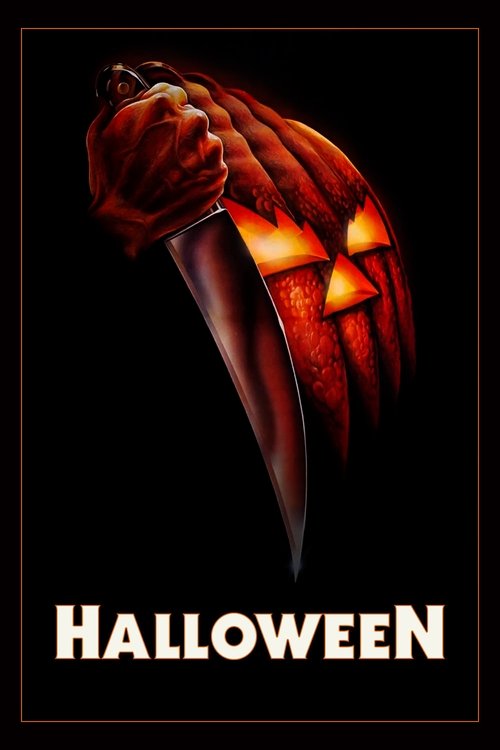
Halloween
1978 · John Carpenter
When you're craving a real scare — the classic October-night pick, lights off, preferably with someone to grab. It's tense rather than gross, so it's the horror film to show someone who thinks they hate horror.
What it's about
Fifteen years after murdering his sister on Halloween night, Michael Myers escapes a mental hospital and comes home to small-town Haddonfield, Illinois, where he fixes on Laurie Strode, a bookish teenager with a babysitting job on Halloween. As kids trick-or-treat and the streets empty, his psychiatrist races to town convinced he's chasing something purely evil.
The experience
Lean, patient, and genuinely frightening — most of the film is quiet suburban streets, a masked figure glimpsed at the edge of the frame, and that piano theme tightening around you. It scares by suggestion and stalking dread rather than gore.
Performances
Jamie Lee Curtis, in her film debut, makes Laurie the template for every resourceful horror heroine since, and Donald Pleasence gives the doom-saying psychiatrist a conviction that sells the whole premise.
The craft
John Carpenter directed, co-wrote, and composed the relentless score himself; the gliding widescreen camera keeps putting you in the killer's point of view or leaving him lurking in the background of an ordinary shot. Shot in three weeks on a tiny budget, it's a masterclass in doing everything with almost nothing — watch it in the dark with the sound up.
Why it matters
It became one of the most profitable independent films ever made and effectively invented the modern slasher, spawning a franchise and an entire decade of imitators. Its babysitter-in-peril grammar is now the genre's native language.
Snapshot
Halloween is the film that crystallized the American slasher into a coherent, replicable form and, in doing so, rewired the economics of independent horror for a generation. Shot in twenty-one days in the spring of 1978 on a budget that has been variously reported in the low-to-mid six figures, it went on to become one of the most profitable independent films of its era. Its premise is austere to the point of fable: a child, Michael Myers, murders his older sister on Halloween night in 1963; fifteen years later he escapes incarceration and returns to the fictional town of Haddonfield, Illinois, to stalk a teenage babysitter, Laurie Strode (Jamie Lee Curtis, in her screen debut), while his psychiatrist, Dr. Sam Loomis (Donald Pleasence), pursues him with the conviction that he is pursuing pure evil. What distinguishes the film is not narrative complexity but the rigor of its construction — a horror picture assembled with the formal discipline of a thriller and the patient dread of an art film. It is, simultaneously, a genre landmark, a masterclass in low-budget filmmaking, and a work whose influence so saturated subsequent horror that its originality is easy to underestimate in hindsight.
Industry & production
Halloween originated with producer Irwin Yablans and financier Moustapha Akkad, who approached the young John Carpenter — then known primarily for the science-fiction comedy Dark Star (1974) and the action thriller Assault on Precinct 13 (1976) — with the idea of a film about a babysitter stalked by a killer. Yablans is credited with the conceptual hook of setting the action on Halloween night, which supplied both a marketable title and a structuring conceit. Carpenter and his then-partner Debra Hill wrote the screenplay quickly; Hill, who had grown up in Haddonfield-adjacent suburban experience, is generally credited with shaping the texture of the teenage girls' dialogue and domestic detail, while Carpenter built the architecture of suspense.
The production was defined by scarcity. The shoot took place largely in South Pasadena, California, standing in for autumnal Illinois — a substitution that required dressing the locations with purchased and reused fall leaves, since California in spring offered none. The budget's smallness drove nearly every creative decision: a limited cast, a handful of locations, minimal special effects, and a near-total reliance on staging and editing rather than gore. Carpenter famously took a reduced fee in exchange for a share of the profits, a gamble that paid off substantially given the film's eventual returns. The film was released by the small distributor Compass International. Crucially, the deferred-payment, profit-participation model — and the demonstration that a horror film could be made cheaply and earn enormously — became part of the film's industrial legacy, encouraging a wave of independent slasher production into the early 1980s.
Technology
Halloween is closely associated with the Panaglide, a camera-stabilization system functionally comparable to the Steadicam, which was still a relatively new tool in 1978. The film's celebrated opening — an extended, near-unbroken subjective shot in which the camera becomes the eyes of the six-year-old Michael as he moves through the house, climbs the stairs, and commits the first murder — exploits this fluid, gliding mobility to bind the viewer to the killer's point of view. The technology made possible a kind of smooth, prowling movement that handheld work could not achieve and that dolly track could not reach into the cramped spaces of a suburban home.
The film was shot anamorphic, in the 2.35:1 widescreen frame, an unusual and ambitious choice for a low-budget horror picture. Carpenter and cinematographer Dean Cundey used the wide canvas to hide and reveal — leaving expanses of dark, empty frame in which a shape might or might not be lurking. Beyond these elements the production was technologically modest by necessity, relying on available light supplemented economically and on practical locations rather than constructed sets.
Technique
Cinematography
Dean Cundey's photography is the film's most enduring technical achievement and the foundation of his long collaboration with Carpenter. Working in anamorphic widescreen, Cundey composed for negative space, repeatedly placing Michael — or the suggestion of him — at the edges and in the soft-focus background of the frame, so that the audience scans the image with the same uneasy vigilance the characters lack. The figure of "the Shape," as Michael is billed in the credits, is often present before the viewer consciously registers him. Cundey's lighting favors deep shadow and the cool blues of suburban dusk, with the autumnal daylight scenes lit naturalistically so that the eventual descent into night feels like a tightening. The widescreen frame, rare for the budget tier, gives the suburban geography a horizontal sweep that makes the empty sidewalks and lawns feel exposed.
Editing
The film's editing — credited to Tommy Lee Wallace and Charles Bornstein — is patient and withholding, prioritizing duration over shock. Carpenter's suspense depends on letting shots run, on the agony of waiting, rather than on rapid cutting. When violence arrives it is often brief and abrupt, the cut doing the work that explicit effects might otherwise do. The film's structure builds slowly across its first two acts, with the killings concentrated in the final movement, so that accumulated dread rather than incident sustains the running time.
Mise-en-scène / staging
The staging is the film's intellectual core. Carpenter treats the ordinary suburban house — its doorways, hallways, windows, and yards — as a field of sightlines, and the horror emerges from what is placed where within the frame rather than from what is shown in close-up. Michael appears and disappears at thresholds; he stands motionless in daylight across a road, glimpsed and then gone. The white-painted mask — famously a modified Captain Kirk / William Shatner mask, its features sanded and reworked into blankness — turns the killer into an expressionless surface onto which the audience projects menace. The decision to keep Michael a "shape" rather than a psychologically legible character is fundamentally a staging decision: he is composed into the environment as an architectural fact.
Sound
Carpenter composed and performed the film's score himself, and it is among the most recognizable in the genre — a spare, insistent piano figure in an unusual meter (often described as 5/4), built on minimal means but maximally effective at signaling threat. Carpenter has spoken of the importance of music in rescuing the film: early test screenings reportedly played poorly without the score, and the music supplied the dread that the restrained imagery implied. Beyond the main theme, the sound design exploits silence and ambient quiet — the hum of a suburban evening — so that small sounds register as alarms. The score's synthesizer textures align the film with a broader late-1970s movement toward electronic film music.
Performance
Donald Pleasence anchors the film with a performance pitched at near-operatic conviction; his Loomis speaks of Michael in the language of metaphysical evil, and Pleasence's gravity lends the film's supernatural undertow its credibility. Jamie Lee Curtis, in her first film role, grounds Laurie Strode in a watchful, bookish ordinariness that makes her competence in the finale earned rather than generic. As the daughter of Psycho's Janet Leigh, Curtis carried an inherited resonance into the genre, and the role launched her as horror's defining lead of the era. The supporting performances by P.J. Soles and Nancy Loomis establish the contrast of carefree, sexually confident peers against Laurie's reserve — a contrast the film's structure pointedly exploits.
Narrative & dramatic mode
Halloween operates in a mode of pure suspense in the Hitchcockian sense — the audience is granted knowledge the characters lack and is made to wait for the collision. Its dramatic engine is not mystery (we know who and what Michael is from the first scene) but dread and inevitability. The screenplay is remarkably lean, almost devoid of subplot, sustained by rhythm rather than plot mechanics. The film resists explanation: Loomis's diagnoses gesture at psychology but ultimately frame Michael as unmotivated, irreducible evil — "the boogeyman," in the film's own terms. The ambiguous ending, in which Michael's body is gone after an apparently fatal fall and his breathing is heard over images of empty houses, refuses closure and renders the threat as ambient and unkillable.
Genre & cycle
The film stands at the headwaters of the American slasher cycle. While it had clear antecedents — Hitchcock's Psycho (1960), the proto-slasher Black Christmas (1974), and the Italian giallo tradition of Mario Bava and Dario Argento — Halloween codified the conventions that the cycle would repeat for a decade: the masked, silent, seemingly unstoppable killer; the subjective camera aligned with his stalking; the holiday or anniversary structure; the group of teenagers picked off in sequence; and the resourceful surviving heroine later theorized as the "final girl." It is important to note that the film is far less explicit than its imitators; the moralized association — frequently overstated by later critics — between sexual activity and death is present more by structural accident than by design, and Carpenter has disputed the schematic reading. Nonetheless, the cycle that followed (Friday the 13th, A Nightmare on Elm Street, and countless others) treated Halloween as a template.
Authorship & method
Halloween is a foundational text for understanding Carpenter as an auteur in the classical-Hollywood mold he openly revered. His method fuses the economy of Howard Hawks with the suspense architecture of Hitchcock; his use of widescreen, his composer's instinct for the cue, and his preference for the unkillable, near-mythic antagonist all recur across his subsequent work (The Fog, Escape from New York, The Thing). The film is inseparable from its key collaborators: Debra Hill as co-writer and producer, whose contribution to the script's domestic realism is well documented; Dean Cundey, whose anamorphic eye defined the look; and the editing team of Tommy Lee Wallace (also the production designer responsible for refining the mask) and Charles Bornstein. Carpenter's authorship is unusually total here — director, co-writer, and composer — making Halloween one of the purest expressions of his sensibility, achieved precisely because the budget left no room for studio interference.
Movement / national cinema
The film belongs to the wave of American independent and genre filmmaking that flourished in the late 1970s in the wake of the New Hollywood's loosening of studio control and the rise of regional, low-budget production. It is part of a cohort of horror films by directors of Carpenter's generation — Tobe Hooper, Wes Craven, George Romero, David Cronenberg in Canada — who used the genre's marginality as creative freedom. Stylistically it draws as much on European art-horror (the giallo's stalking camera, Argento's chromatic dread) as on American sources, synthesizing them into a distinctly American suburban idiom. It is not a "movement" film in any manifesto sense, but it is a defining artifact of the independent-horror moment.
Era / period
Released in 1978, Halloween sits at the threshold between the grimy, transgressive horror of the early-to-mid 1970s and the commercialized, formula-driven slasher boom of the early 1980s. Its suburban setting reflects a specifically post-1960s American anxiety — the violation of safe, middle-class domestic space, the babysitter's home as the last refuge under siege. The film registers a cultural moment in which the optimism of suburban normalcy had curdled into unease, and in which evil is figured not as an external monster but as something that emerges from within the ordinary American street and cannot be explained away.
Themes
The film's governing theme is the intrusion of irrational evil into ordinary life. Michael is explicitly stripped of motive; Loomis's speeches insist on his inhuman emptiness, and the film's refusal to psychologize him is its central thematic statement. Related concerns include the fragility of domestic safety, the vulnerability and resilience of adolescence, and vision itself — the film is preoccupied with watching, looking, and the failure to see what is in plain sight, a thematic that its sightline-driven staging literalizes. The much-debated theme of punished sexuality is, as noted, more a feature of the cycle than a demonstrable authorial intent, though the film's structure does set Laurie's watchfulness against her peers' distraction. Above all, the ending's open void universalizes the threat: evil here is not defeated but merely deferred.
Reception, canon & influence
Critical reception at release was mixed before becoming strongly positive; the film initially struck some reviewers as a simple exploitation picture, but influential critics — Roger Ebert among the most prominent — championed it, and its reputation grew rapidly as its commercial success became undeniable. It is now firmly canonized, frequently cited among the most important horror films ever made and, in 2006, selected for preservation in the United States National Film Registry by the Library of Congress as a culturally significant work.
The influences on the film are well established: Psycho (whose casting of Curtis the film consciously echoes, and whose shower-scene logic of domestic violation it extends), Bob Clark's Black Christmas (the babysitter under siege, the killer's POV), and the Italian giallo's stalking aesthetics. Carpenter's debt to Hawks and Hitchcock is structural and acknowledged.
The influence of the film is immense and arguably disproportionate to any other horror film of its decade. It launched a franchise spanning numerous sequels, reboots, and reimaginings across more than four decades. It established the commercial template that made the slasher the dominant horror mode of the early 1980s, directly shaping Friday the 13th (1980) and its successors. It gave Jamie Lee Curtis a career and the genre its "scream queen." Its score became a template for synthesizer-based horror music. And its formal lessons — suspense through staging and sound rather than gore, the killer composed into negative space, the patient withholding of violence — have been studied and imitated continuously. Perhaps the film's deepest legacy is paradoxical: its imitators so thoroughly absorbed its surface conventions while discarding its restraint that Halloween's own austerity now reads as the work of a master standing apart from the cycle he set in motion.
A Deleuzian reading
You see him before you mean to.
The full Deleuzian reading of Halloween →
Reception
Dismissed by many critics on release in 1978, it was rescued almost immediately by champions like Roger Ebert and the Village Voice, and within a few years was being taught as a model of pure suspense filmmaking — the low-budget indie that became the horror canon's cornerstone.
How Halloween was received, from release to now →
Influences: the films it descends from and the films it influenced
- Psycho (1960) — Carpenter consciously cast Jamie Lee Curtis as Janet Leigh's daughter and transposed the shower scene's logic — the ordinary domestic interior as the site of sudden bodily violation — onto the suburban house.
- Peeping Tom (1960) — Originated the sustained first-person killer-POV camera that fuses the lens with the murderer's gaze and implicates the viewer, the exact device Carpenter extends in the opening continuous-take Myers murder.
- Black Christmas (1974) — Supplied the template directly: a roaming subjective killer-POV prowling a domestic interior and babysitters/young women picked off inside the home where they should be safe.
- The Texas Chain Saw Massacre (1974) — Demonstrated that terror could be built almost entirely through implication and staging rather than on-screen gore — the restraint Carpenter adopts in withholding the kill's graphic detail.
- Deep Red (1975) — Codified the giallo's gliding stalking camera and fetishized POV that conceals the killer's identity, the stalking aesthetic Carpenter borrows for Myers's patient pursuit.
- A Bay of Blood (1971) — Established the proto-slasher set-piece architecture of isolated victims dispatched one by one in discrete staged sequences that Halloween systematizes.
- Rio Bravo (1959) — The Hawksian economy of professional ensemble staging that Carpenter openly revered and quotes — he later named characters and even his pseudonyms after Hawks's work and modeled his cutting economy on it.
- Targets (1968) — Located motiveless, irrational evil in banal suburban-American space via an expressionless everyman killer — the affectless 'shape' of violence Carpenter abstracts into Michael Myers.
- Frenzy (1972) — Carpenter directly inherits Frenzy's early-killer-disclosure irony structure: Myers is identified for the audience in the opening sequence, converting all subsequent suspense from whodunit mystery into the dramatic irony of the audience knowing while characters do not—Hitchcock's engine running at slasher scale.
- Jaws (1975) — Carpenter's piano ostinato for Michael Myers—a repeating figure built on a minimal interval, rhythmically relentless, functioning as a threat-announcement signal before any visual disclosure of the killer—directly imitates the structural logic of Williams' two-note bass motif, using rhythmic minimalism to prime the audience's nervous system for violence rather than to score violence itself.
- Eyes Without a Face (1960) — Carpenter has cited Franju directly: Michael Myers's blank white mask evacuates killer interiority the same way Christiane's porcelain mask does, converting violence into pure expressionless surface rather than affect; the mask's function is not disguise but ontological — it replaces the face with an absence, which is precisely Franju's device.
- Carrie (1976) — Inherits De Palma's roving subjective/voyeuristic camera and suspense architecture built on the audience seeing the threat before the victim, applied to the bullied-outsider-turned-killer logic inverted.
- Friday the 13th (1980) — Mechanically copied the commercial template — holiday-date title, subjective POV kills, sequential teen victims, lone final survivor — while discarding Carpenter's restraint for explicit gore.
- A Nightmare on Elm Street (1984) — Extends the suburban-bedroom slasher and the unkillable, near-mythic antagonist menacing teenagers in the homes their parents believe are safe.
- Scream (1996) — Self-consciously codifies the 'rules' Halloween established and quotes its babysitter-under-siege and killer-POV grammar back to a knowing audience.
- It Follows (2014) — Explicit formal homage: anamorphic suburban widescreen with a slow figure planted at the frame's edge in negative space, scored with a Carpenter-style analog synth pulse.
- My Bloody Valentine (1981) — Inherits the holiday-branding hook and the methodical POV-stalking-to-set-piece structure that Halloween made the genre's commercial formula.
- The Strangers (2008) — Revives Carpenter's austerity directly — masked, motiveless intruders held silently in deep-focus background negative space rather than revealed in gore.
- Halloween (2018) — Reactivates Carpenter's own widescreen threshold-staging and synth scoring (Carpenter co-composing) as a deliberate stylistic return to the 1978 formal grammar.
- Alien (1979) — Carpenter's slow-burn editing rhythm — long stretches of normalcy punctuated by bursts of violence — and the implacable, partially-glimpsed killer whose opacity amplifies dread were the immediate genre precedent Scott refined into Alien's even more attenuated tempo and creature staging.
- The Thing (1982) — Carpenter and Dean Cundey's development of deep-focus anamorphic compositions that hold multiple figures in simultaneous sharp resolution originated here; those same formal principles are transported directly into The Thing's paranoid wide-frame multi-character staging where visibility is itself the threat.
- Bright Future (2003) — Carpenter's synthesizer-drone non-diegetic scoring — ambient tonal dread operating below narrative event, generating unease independently of image content — is the direct sonic model for Kurosawa's ambient-menace sound practice.
- The Invisible Man (2020) — Carpenter's use of wide-angle lenses to expand peripheral threat zones in ordinary domestic interiors — making every room's edge a potential concealment site — is the direct formal precedent for Whannell and Duscio's negative-space-pan vocabulary.
- The Silence of the Lambs (1991) — Codified the stalking killer-POV shot and the resourceful imperiled woman who flips hunted into hunter — the 'final girl' that Starling matures into a professional.
- The Fog (1980) — Same authorial signature pushed further: Dean Cundey's anamorphic eye, Carpenter's own synth cue-driven score, and antagonists composed into Panavision negative space.
- Dressed to Kill (1980) — Parallel application of Steadicam killer-POV long takes and stalking subjectivity, the slasher current De Palma's giallo-inflected attacks run alongside.
Similar films
- The Texas Chain Saw Massacre (1974) — influence & lineage · same viewing thread
- Black Christmas (1974) — influence & lineage · same viewing thread
- Scream (1996) — influence & lineage
- A Nightmare on Elm Street (1984) — influence & lineage
- Psycho (1960) — influence & lineage
- Night of the Living Dead (1968) — same viewing thread
- Carrie (1976) — shared sensibility
- Trick 'r Treat (2007) — shared sensibility
All the films related to Halloween →
Watch it with: curated runs of related films
- Nowhere Left to Hide — Watch these when you want pure primal terror — ordinary people cornered by something relentless, from open water to a silent farmhouse to a stairwell in Barcelona.