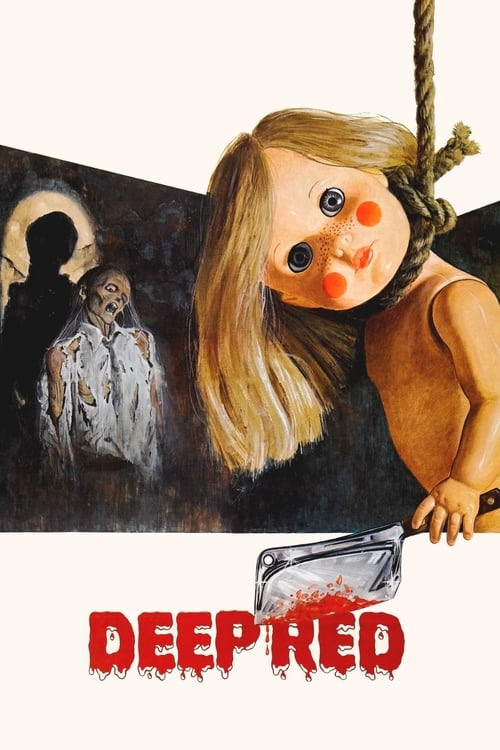
Deep Red
1975 · Dario Argento
For when you want horror with style to spare — a whodunit you can puzzle over and a scare you can savor rather than merely survive. More delirious fun than pure dread, but not for the squeamish.
What it's about
An English jazz pianist living in Rome witnesses his neighbor — a psychic — brutally murdered, and becomes obsessed with a detail he glimpsed at the scene but can't quite recall. Teaming up with a fearless young reporter, he starts playing amateur detective, and the trail leads into a buried history of madness and violence that someone will kill to keep hidden.
The experience
Lurid, operatic, and strangely playful — long stretches of prowling, needling suspense broken by murder scenes staged like set pieces, while the leads trade screwball banter in between. It keeps you scanning every frame for the thing you missed, and the music alone will raise your pulse.
Performances
David Hemmings makes obsession magnetic as the pianist who can't stop looking, and Daria Nicolodi gives the film a jolt of comic energy as the reporter who refuses to be sidelined — their sparring is half the pleasure.
The craft
Argento's camera is the star: swooping tracking shots, extreme close-ups of dolls and marbles, architecture that seems in on the crime. Goblin's pulsing prog-rock score became a template horror still borrows from. This one genuinely rewards a big screen and loud speakers — it's built as spectacle.
Why it matters
The high-water mark of the giallo, the Italian thriller tradition that fed directly into the American slasher film, and the film that cemented Argento's reputation as horror's great stylist.
The giallo — the Italian thriller of black gloves, amateur sleuths, and murder staged as spectacle — reached its delirious high-water mark here. Dario Argento casts David Hemmings, forever the photographer of Blow-Up, as a jazz pianist who witnesses a killing and becomes obsessed with a detail he saw but cannot recall: the whole film pivots on the unreliability of looking. Around that clever premise Argento constructs some of the most flamboyant camerawork of the 1970s — prowling tracking shots, extreme close-ups of marbles and dolls' eyes, architecture that seems complicit in the violence — while Goblin's prog-rock score, their first for the director, invented a sonic template horror is still borrowing from. Daria Nicolodi, sparring with Hemmings as a fearless reporter, gives the film an unexpected screwball charge. Halloween, Dressed to Kill, and a generation of slashers descend from it, but none matched its baroque confidence. Argento reportedly shot the killer's hands himself — his own black gloves, in nearly every murder.
A Deleuzian reading
A camera moves slowly across a tabletop.
The full Deleuzian reading of Deep Red →
Reception
A smash in Italy in 1975, but Americans first met it as a hacked-down export cut retitled 'The Hatchet Murders' and mostly shrugged; decades of restorations later, it's routinely called the greatest giallo ever made.
How Deep Red was received, from release to now →
Influences: the films it descends from and the films it influenced
- The Bird with the Crystal Plumage (1970) — Argento's own debut established the 'witness who saw the crucial detail but can't decode it' amnesiac-clue structure — plus the trapped-witness-behind-glass staging — that Deep Red refines into its central perceptual puzzle.
- Blow-Up (1966) — Supplies the core conceit of an artist-protagonist who visually witnessed a murder but misreads his own evidence, and Argento literally casts Antonioni's David Hemmings as the same kind of perceptually unreliable investigator.
- Blood and Black Lace (1964) — Codified the giallo's faceless black-gloved killer and murder-as-baroque-set-piece, with color-gelled expressionist lighting Argento inherits wholesale for his kill sequences.
- The Girl Who Knew Too Much (1963) — The first giallo; its amateur outsider who witnesses a murder and turns detective is the exact narrative template Deep Red's musician-sleuth inhabits.
- Psycho (1960) — The shower-scene grammar of fragmented extreme close-ups cut against a violent set-piece, and withholding the killer's identity through misdirected point-of-view, are the tools Deep Red weaponizes.
- Peeping Tom (1960) — Pioneers the killer's-eye subjective camera that makes the audience complicit in murder-as-spectacle — the voyeuristic POV Argento's prowling camera extends.
- Les Diaboliques (1955) — Models the twist-thriller architecture where the solution is planted in plain sight for a second viewing — the direct forerunner of Deep Red's 'the killer's face was on screen all along' mirror gambit.
- Repulsion (1965) — Uses subjective sound and extreme close-ups to externalize a disturbed psyche and turn an apartment into a mind — the unreliable-perception device Deep Red builds its haunted-house set-pieces around.
- Suspiria (1977) — Argento extends Deep Red's Goblin collaboration and complicit-architecture staging into full expressionist color, making the set itself the antagonist that stalks its victims.
- Halloween (1978) — Carpenter's self-composed pulsing score and gliding killer-POV Steadicam directly extend Deep Red's Goblin-driven momentum and prowling subjective camera.
- Dressed to Kill (1980) — Lifts Deep Red's set-piece grammar — a wordless, music-driven stalking sequence built from subjective tracking and slow motion, with a black-gloved, disguised killer whose identity is concealed by staging.
- Blow Out (1981) — Extends the Blow-Up lineage Deep Red channels: a technician who captures recorded evidence of a crime and cannot get anyone to perceive what he perceives.
- Friday the 13th (1980) — Its roving first-person killer POV and each death staged as a gory prosthetic showpiece codify for the American slasher exactly what Argento's Italian set-pieces pioneered.
- Santa Sangre (1989) — The giallo blueprint — black-gloved killings keyed to a buried childhood trauma and a misremembered primal scene — carried into the project by co-writer/producer Claudio Argento, who disciplined Jodorowsky's imagery into a tracking-the-killer thriller.
- Dawn of the Dead (1978) — Establishes the Argento–Goblin prog-rock scoring partnership and prowling first-person camera that Argento brought to the Italian co-production.
- Perfect Blue (1998) — The giallo grammar Kon quotes directly: the black-gloved killer's subjective POV, stylized primary-color murder set pieces, and the amateur sleuth misreading a crucial glimpsed detail.
- Saw (2004) — Giallo template for ornamental cruelty and stylized murder set-pieces built around insert close-ups of gleaming mechanisms and a driving score fused to the kill.
- Suspiria (2018) — Codifies the giallo grammar of the snap zoom and the propulsive rock-band score (Goblin) that 2018 deliberately answers by commissioning Thom Yorke's anti-Goblin song cycle.
- Last Night in Soho (2021) — Giallo built on a mirror-concealed clue and reflective surfaces that hide the killer in plain sight, feeding Soho's mirror-reflection staging and its frame-precise mirror-match cuts.
- MaXXXine (2024) — Supplies the subjective first-person killer POV gliding over fetish objects married to a pulsing analog synth score, a template for MaXXXine's stalking sequences and Bates's synth cues.
- A Bay of Blood (1971) — Its inventory of elaborate, gore-showcase murder set-pieces staged as the film's real spectacle is the same craft Deep Red practices and the slasher later plagiarizes.
- Tenebrae (1982) — Its celebrated crane/Steadicam shot prowling across and over a building's entire facade radicalizes Deep Red's prowling-tracking-shot voyeurism into pure autonomous camera movement.
- Opera (1987) — Pushes Deep Red's fetish for the extreme close-up of the eye and 'forced to watch' murder-as-spectacle to its literal extreme, with needles pinning the witness's eyes open.
- Final Destination Bloodlines (2025) — Supplies the giallo tradition of baroque, pre-choreographed murder set pieces staged as suspense puzzles, where the camera surveys a space cataloging every object that will later become an instrument of death.
- Black Christmas (1974) — Contemporaneous giallo refining the roving killer-POV and pairing murder with a nursery-song motif, the same marriage of childlike sound to violence Zittrer's prepared score explores.
Similar films
- The Bird with the Crystal Plumage (1970) — influence & lineage · same viewing thread · often watched together
- Blood and Black Lace (1964) — influence & lineage · same viewing thread
- Dressed to Kill (1980) — influence & lineage · same viewing thread
- Suspiria (1977) — influence & lineage
- Peeping Tom (1960) — influence & lineage
- Blow-Up (1966) — influence & lineage
- Psycho (1960) — influence & lineage
- Hannibal (2001) — same viewing thread
All the films related to Deep Red →
Watch it with: curated runs of related films
- The Killer You Can't Look Away From — A run of murder mysteries where obsession — the witness's, the investigator's, the killer's own — curdles into pure style, from the gloved-hand giallo that invented the look to the modern heirs still working the vein.