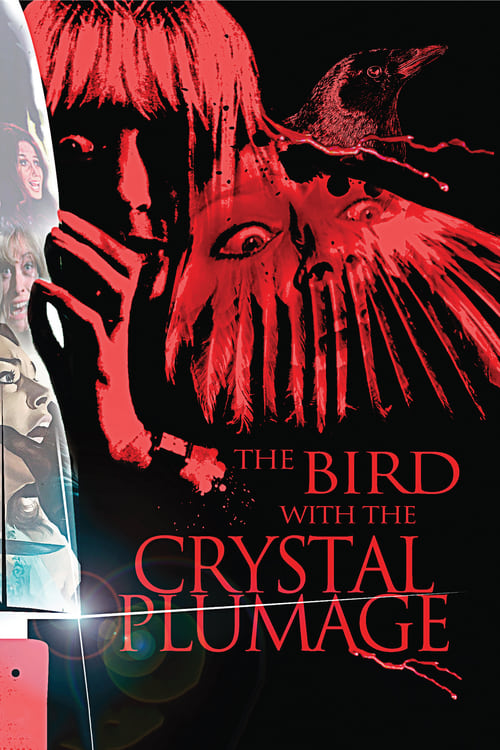
The Bird with the Crystal Plumage
1970 · Dario Argento
When you want a stylish, twisty murder mystery with an edge of the uncanny — more nerve-jangling than a cozy whodunit, less punishing than hard horror. Great for a late night when you feel like playing detective.
What it's about
An American writer living in Rome witnesses an attempted murder through the glass doors of an art gallery — and finds himself trapped, unable to intervene, unable afterward to fully reconstruct what he saw. Convinced his memory holds the key to a string of killings terrorizing the city, he launches his own investigation, even as the black-gloved killer turns attention toward him and his girlfriend.
The experience
Sleek, stylish, and needling — a whodunit that keeps making you doubt your own eyes along with the hero's. It's tense rather than gory, with an insinuating score that gets under your skin, and the central puzzle genuinely pays off.
The craft
Dario Argento's debut announces a whole visual signature at once: Vittorio Storaro's glassy, architectural cinematography turns Rome into a maze of frames and reflections, and Ennio Morricone contributes an eerie, lullaby-like score. The famous gallery scene — a witness sealed behind glass, watching violence he can't reach — is one of the great suspense set pieces, built entirely on staging and sightlines.
Why it matters
A surprise international hit that launched Argento's career and codified the giallo — the Italian black-gloved-killer thriller — whose visual grammar fed directly into the American slasher film.
Snapshot
The Bird with the Crystal Plumage (L'uccello dalle piume di cristallo) is the debut feature of Dario Argento, a twenty-nine-year-old former film critic for the Rome newspaper Paese Sera who had, by 1970, already accumulated a substantial screenwriting résumé — most visibly as one of the writers, with Bernardo Bertolucci, of the story for Sergio Leone's Once Upon a Time in the West (1968). The film takes a plot skeleton loosely derived from Fredric Brown's 1949 novel The Screaming Mimi and rebuilds it as an exercise in perceptual doubt: an American writer, Sam Dalmas (Tony Musante), stranded between two plate-glass doors in a Roman art gallery, watches a struggle between a woman in white and a black-clad figure, and cannot afterward reconstruct what he saw. The remainder of the film is the slow correction of that misreading.
Its importance is disproportionate to its modest scale. Argento had wanted to direct rather than continue writing, and the film's commercial success in Italy — it was among the more profitable domestic releases of its season — effectively created a production cycle. Within roughly three years, dozens of Italian thrillers appeared bearing its marks: the animal in the title, the black-gloved killer, the foreign protagonist, the amateur investigation, the flamboyant murder set-piece. The giallo as a film form did not begin here — Mario Bava's The Girl Who Knew Too Much (1963) and Blood and Black Lace (1964) precede it, and the yellow-jacketed Mondadori crime paperbacks that gave the genre its name go back to 1929 — but Bird is the film that made the giallo an industrial proposition and fixed its grammar. Nearly everything Argento would spend the next two decades elaborating, and much of what Brian De Palma and John Carpenter would later absorb, is present here in first draft.
Industry & production
The film was produced by Salvatore Argento — the director's father, a working producer — through Seda Spettacoli, with West German co-production participation via Constantin Film, a routine arrangement in an Italian industry that by 1970 ran heavily on co-financing with German and Spanish partners. This was standard practice for genre production of the period, and it shaped the film materially: the international cast, the dubbed multi-language soundtrack, the presumption of export.
Casting followed the era's export logic. Tony Musante, an American actor known from The Incident (1967), takes the lead; Suzy Kendall, British, plays his girlfriend Giulia; Enrico Maria Salerno, an Italian character actor of standing, plays Inspector Morosini. Eva Renzi, German, plays Monica Ranieri. A cast assembled across four nationalities was not an aesthetic choice but a distribution one — each country's market wanted a familiar face — and Italian production had long since adapted to it by shooting without usable direct sound and post-synchronising every version separately. Musante and Argento reportedly clashed during the shoot, an account that has circulated widely in interviews and genre histories; the details are anecdotal and should be treated as such.
The production was shot in Rome, largely on location, with interiors at studios in the city. Argento's inexperience as a director was a live concern for the financiers, and the presence of Vittorio Storaro as cinematographer — himself only a few features into his career, having shot Bertolucci's The Conformist in the same period — provided technical ballast. The budget was modest by any standard; the film's visual ambition is an argument for what composition and framing can accomplish without money.
Its domestic success was substantial and immediate, and its export performance strong enough that Argento was able to make two further "animal trilogy" films in quick succession — The Cat o' Nine Tails (1971) and Four Flies on Grey Velvet (1971). Precise grosses for Italian genre releases of this period are inconsistently recorded in accessible sources, and specific figures should be regarded as unreliable.
Technology
Bird was shot on 35mm in Techniscope, the two-perforation anamorphic-substitute process developed by Technicolor Italia. Techniscope exposed a half-height frame using standard spherical lenses and was optically converted to anamorphic 2.35:1 prints in the lab. Its economics were the point: half the negative stock per foot of screen time, no expensive anamorphic glass, and the ability to shoot with ordinary lenses in cramped locations. The Italian industry adopted it heavily through the 1960s — the Leone westerns used it — and its characteristic grain structure, a consequence of blowing up a small negative area, is part of the texture of Italian genre cinema of the era.
The consequence for Bird is specific. A 2.35:1 frame is a poor container for a single standing figure and an excellent one for a person dwarfed by architecture, or for two things happening at opposite edges of the image with dead space between them. Argento and Storaro build the film's central conceit around exactly that: the gallery sequence works because the widescreen frame can hold the trapped Dalmas at one side and the tableau he is failing to interpret at the other, with a wall of glass between them.
Optical effects are minimal and traditional — no process work of any ambition. The film's technical distinction lies in camera mobility and in the sound post-production, not in any novel apparatus. As with all Italian production of the era, the soundtrack was constructed entirely in post: dialogue, effects, and Ennio Morricone's score assembled onto a track with no location audio underneath it.
Technique
Cinematography
Storaro's work here predates the theoretical elaboration of color and light he would later become known for, but the compositional intelligence is fully formed. The governing strategy is obstruction. The camera is repeatedly placed so that something intervenes between viewer and subject: glass, grilles, doorframes, foreground objects, the edge of the frame itself. The gallery sequence is the thesis statement — Dalmas sealed between two sliding glass panels, lit like a specimen, watching a scene he can see perfectly and understand not at all. The image is transparent and the meaning is opaque.
Subjective camera is used more sparingly than the film's reputation suggests, and more precisely. The killer's point of view appears, but Argento does not run the whole film from behind the gloves; the killer's-eye shots are punctuation, and much of the menace is generated instead by camera positions that belong to nobody — a slow track along a corridor, a high angle in a courtyard — which unsettle precisely because they cannot be assigned.
The film moves between two lighting registers. Daytime Rome is flat, white, tourist-bright, almost documentary. The murder sequences are staged in constricted, hard-shadowed spaces, with saturated color used locally rather than as a scheme — the yellow jacket in the stairwell, red against white. Argento would push color to expressionist extremes with Luciano Tovoli on Suspiria (1977); here the palette remains largely naturalistic, which makes the eruptions register harder.
Editing
Franco Fraticelli cut the film, beginning a collaboration that ran across most of Argento's subsequent work. The editing operates on two clocks. Investigative passages are cut conventionally and move at a brisk, almost procedural pace. The set-pieces slow down and fragment: close-ups of hands, blades, fabric, eyes, cut against each other with the geography deliberately withheld, so that the viewer must assemble a space that the film refuses to establish.
The film's structural signature is the repeated flashback to the gallery attack. The same footage returns, but each return is recut — new fragments, a different emphasis, an altered duration — as Dalmas edges toward what he actually saw. The editing thereby carries the film's argument: the image is stable, the reading of it is not. The final revision, which reassigns aggressor and victim, is achieved not by new information but by re-cutting the same event. It is a device of considerable formal confidence for a first feature, and Argento would return to it repeatedly, most elaborately in Deep Red (1975).
Mise-en-scène / staging
The film's spaces are its argument. Argento stages violence in architecture that traps: a stairwell, an elevator shaft, a hallway, a room whose exits are visible but unreachable. The gallery — a white modernist box, sterile and over-lit, with an enormous abstract sculpture of spiked forms presiding over it — is the film's emblem. Art objects recur throughout as instruments of threat: the painting that eventually explains the killer's psychology, the sculpture, the antique dealer's crowded shop.
Set decoration works ironically. Rome appears not as historical spectacle but as a modern city of apartment blocks, offices, and rented rooms; the film almost entirely avoids the monuments. Argento choreographs long takes through these spaces with an eye to the corner not yet turned, so that the frame itself becomes a source of anxiety — the widescreen composition keeps promising that something is just outside it.
The pursuit sequence involving a yellow-jacketed hired killer, staged around a convention center and a bus terminal, is the film's best demonstration of staging as suspense: no music for much of it, geography deliberately confusing, and a resolution that depends on a mistake of identification, which is the film's subject in miniature.
Sound
Ennio Morricone's score is central and unlike his western work. The principal theme is a lullaby — a wordless female voice, Edda Dell'Orso, over a small, cool arrangement — set against dissonant, semi-improvised passages of scraped strings, prepared piano, muttering voices, and unresolved percussion, closer to the free-improvisation work Morricone was doing at the time with the collective Gruppo di Improvvisazione Nuova Consonanza than to conventional thriller scoring. The juxtaposition is the point: the innocence of the lullaby and the abrasion of the atonal passages describe the film's split between surface and pathology. Argento was reportedly not entirely satisfied with the score, and by Deep Red had moved to Goblin's rock-based scoring — but the Morricone gialli remain a distinct and influential body of work.
Beyond the score, the sound design exploits the fact that everything is post-synchronised. Voices sit slightly outside the space they occupy; breathing, a whispered voice on a telephone, and the killer's raspy vocalizations are placed with an artificiality that reads, in this context, as dread rather than sloppiness. The killer's phone call is delivered as pure voice with no body attached — the film's method in one gesture.
Performance
Musante plays Dalmas with a flat, slightly irritable American affect that keeps the character at arm's length; he is curious rather than heroic, and the performance resists the easy sympathy an amateur-detective role invites. Suzy Kendall's Giulia is given less to do than the structure implies, though her extended solo sequence — alone in the apartment, aware of the intrusion — is the film's most sustained passage of conventional suspense and she carries it.
Enrico Maria Salerno's Morosini supplies the film's dry comic register, playing the police procedure as bureaucratic tedium against Dalmas's amateur enthusiasm. Eva Renzi's Monica Ranieri, constrained by the plot's requirement that she be misread, performs the necessary double register. Reine Pietragrua, Umberto Raho, and Mario Adorf (as the reclusive painter Berto Consalvi) fill out a gallery of eccentrics — Adorf's cat-eating recluse is a comic grotesque that sits oddly alongside the film's severity, and the tonal mixture is one of the giallo's persistent, characteristic instabilities. Performance in dubbed Italian genre cinema is a composite artifact: what a viewer registers as acting is a negotiation between body and an unrelated voice, and Bird should be assessed with that in mind.
Narrative & dramatic mode
The film is a detective story whose detective is unreliable and whose crime is a perceptual error. Argento takes the classical mystery contract — a witness, clues, a sequence of murders, a revelation — and relocates its difficulty from the withholding of information to the misreading of it. Dalmas sees everything; he simply arranges it wrongly. The line "something was wrong with what I saw" (paraphrased from the film's premise) organizes the whole structure.
Dramatically, this produces a curious flatness in the middle stretch: the investigation is episodic, a series of visits to informants, stammering witnesses, and antique dealers, with the momentum supplied by murder sequences rather than by escalating deduction. The film is not much interested in the mechanics of detection. Its energy is concentrated in three modes — the perceptual puzzle, the set-piece, and the tonal comedy of Roman bureaucracy and eccentricity — held together loosely.
The resolution deploys a psychoanalytic explanation of the killer's pathology delivered by an expert in a late scene, a convention inherited from Psycho (1960) and standard in the giallo thereafter. Its function is less explanatory than formal: it licenses the retrospective re-reading of the film's images. Argento's plotting is frequently, and fairly, described as subordinate to his set-pieces; the accusation is accurate but somewhat beside the point, since the plot exists chiefly as an armature for a sustained argument about the unreliability of vision.
Genre & cycle
Bird stands at the hinge of the giallo's transition from Bava's isolated experiments to a full production cycle. Bava's Blood and Black Lace had already established the masked, gloved, faceless killer and the murder-as-aesthetic-composition; what Bird adds is the foreign protagonist as audience surrogate, the perceptual-recall structure, the amateur investigation, and — commercially decisive — the animal title.
The consequences were immediate and industrial. The Italian film industry of the period operated on rapid cycle imitation, and within three years the market carried dozens of animal-titled thrillers by directors including Sergio Martino (The Strange Vice of Mrs Wardh, 1971; Your Vice Is a Locked Room and Only I Have the Key, 1972), Umberto Lenzi, Luciano Ercoli, and Duccio Tessari. Argento's own two follow-ups completed the informal "animal trilogy." Bava himself responded to the cycle with A Bay of Blood (1971), which pushed toward the body-count structure the American slasher would later formalize.
The giallo also sits at the junction of the German krimi — the Edgar Wallace adaptations that Constantin and Rialto had been producing through the 1960s, several featuring Klaus Kinski, whose plots turn on masked killers and inheritance schemes — and the Hitchcockian suspense thriller. Bird's German co-production financing is not incidental to this lineage.
Authorship & method
Argento arrived at directing from criticism and screenwriting, and the film shows a critic's self-consciousness about the medium's mechanics. His method, evident from this first feature, is set-piece-first: the sequence is conceived as a discrete formal object and the narrative built to arrive at it. He operated camera himself on occasion and famously performed the killer's gloved hands in his own films, a practice reportedly beginning here — a small fact that says something real about his relation to the material.
Vittorio Storaro's contribution is architectural: the widescreen compositions, the use of glass and obstruction, the discipline of the daylight scenes. Storaro left after this film for the Bertolucci collaboration that would define his career, and Argento's subsequent cinematographers — Erico Menczer, Luigi Kuveiller, Luciano Tovoli — took the work in more chromatically extreme directions.
Ennio Morricone scored all three animal-trilogy films. His giallo work constitutes a distinct strand in an enormous filmography, characterized by the collision of lyrical female vocalize with atonal experiment.
Franco Fraticelli's editing became one of the most durable elements of Argento's authorship, running from Bird through Opera (1987). The rhythmic signature of an Argento set-piece — fragmentation, withheld geography, sudden acceleration — is as much Fraticelli's as Argento's.
Argento wrote the screenplay alone. The relation to Fredric Brown's The Screaming Mimi is acknowledged in later scholarship and criticism but was not credited on the film; the borrowing is structural rather than literal, and Brown's novel had already been adapted in Hollywood as Screaming Mimi (1958).
Movement / national cinema
The film belongs to Italian genre cinema at its industrial peak — the filone system, in which a commercially successful film generated an immediate stream of variations from a shared pool of technicians, actors, and financiers. Cinecittà and its satellite production apparatus supported peplum, spaghetti western, poliziottesco, and giallo cycles in overlapping succession, and Bird was made inside that machinery, not against it.
Two national inheritances converge in it. From Italian cinema comes the post-synchronised soundtrack, the co-production casting, the technical fluency of a craft base trained on high-volume production, and Bava's precedent. From outside comes Hitchcock — the innocent witness, the wrong-man structure, the eroticized violence of Psycho — and the German krimi.
It is worth registering that the film emerged in the same national moment as Italian political cinema and the late art-film generation: Bertolucci's The Conformist, Petri's Investigation of a Citizen Above Suspicion, and Fellini's late work all belong to 1970 or adjacent years, and they shared crews. Storaro shot both Bird and The Conformist in the same period. The conventional division between Italian art cinema and Italian genre cinema is more porous than it appears.
Era / period
1970 in Italy was a moment of political violence and institutional distrust — the Piazza Fontana bombing of December 1969 opened the anni di piombo, and the poliziottesco cycle would shortly make that anxiety explicit. Bird is not a political film, and reading it as coded commentary would overreach. But its atmosphere — a city where violence is anonymous and the police are procedurally competent and interpretively useless — is legible against that background.
The film is also a document of a specific modernity: Rome as a city of glass, concrete, and international transience, its protagonist a foreign professional passing through. The permissiveness of the period is present in the film's treatment of sexuality and violence, which is franker than what would have passed a few years earlier and considerably more restrained than the giallo cycle would become by 1972.
Themes
The unreliability of vision. The film's central and organizing theme. Dalmas is a professional writer — a maker of narratives — who cannot correctly narrate a thing he watched from ten feet away. The gallery's glass is the image of the problem: perfect transparency, total incomprehension.
Art and violence. Paintings, sculptures, and galleries recur as the sites and instruments of harm. The killer's pathology is triggered by a painting, and the film's murders are themselves composed like artworks. The self-implication is deliberate: Argento's set-pieces are beautiful, and the film knows this is a problem.
Trap and enclosure. Nearly every significant sequence involves confinement — the glass vestibule, the elevator, the apartment, the sculpture that finally pins its victim. The film's spatial imagination is uniformly claustrophobic even in a widescreen frame.
The foreigner. Dalmas's outsider status makes him both a clear-eyed observer and a systematically incompetent reader of local signs. His displacement is the mechanism of his error.
Gendered violence and its inversion. The giallo's reliance on stylized violence against women is a well-documented and legitimate critical problem, and Bird is fully implicated in it. The film complicates the pattern with a late reversal concerning the identity and psychology of the killer — an inversion which criticism has read both as a genuine destabilisation of the genre's assumptions and as a further pathologising move. Both readings have merit and the film does not settle between them.
Reception, canon & influence
Contemporary Italian reviews were mixed but the commercial reception was decisive, and the film's international distribution was wide. Anglophone criticism of the period largely treated it as a stylish but disreputable genre item; serious critical attention to Argento in English came later, developing substantially from the 1980s onward through horror-focused scholarship and the work of critics such as Kim Newman and Maitland McDonagh, whose Broken Mirrors/Broken Minds (1991) remains the foundational English-language study. In current assessment the film is generally regarded as one of Argento's strongest and most disciplined works — less baroque than Deep Red or Suspiria, but tighter.
Backward. The debts are traceable. Hitchcock supplies the witness-protagonist, the wrong-man structure, and — via Psycho — the shocking murder and the terminal psychiatric explanation; Rear Window (1954) supplies the frame-within-a-frame of the trapped observer. Bava supplies the gloved killer, the aestheticized murder, and the giallo's visual vocabulary. Fredric Brown's The Screaming Mimi supplies the plot skeleton. The German krimi supplies the cycle's commercial logic and some of its financing. Antonioni's Blow-Up (1966) — a film about a witness who cannot resolve what his own image contains — is a plausible and frequently drawn comparison, though direct influence is not documented and the resemblance may be conceptual convergence.
Forward. The film's legacy is unusually broad. It fixed the giallo template that dozens of Italian films followed through the mid-1970s, and it launched Argento's career, making possible Deep Red and Suspiria. Its influence on the American horror film is well established: the killer's-eye camera, the stalking of a woman alone in a domestic space, and the elaborate rather than perfunctory murder set-piece all pass through the giallo into the slasher cycle that Halloween (1978) and Friday the 13th (1980) consolidated — Bava's A Bay of Blood is the more direct conduit for the body-count structure, but Bird established the visual grammar. Brian De Palma's thrillers of the 1970s and 1980s, especially Dressed to Kill (1980) and Blow Out (1981), work in close dialogue with the same set of concerns — the misread perception, the elaborate suspense construction, the Hitchcock inheritance processed through excess. Later filmmakers have engaged the tradition directly and self-consciously: Peter Strickland's Berberian Sound Studio (2012) and In Fabric (2018), Hélène Cattet and Bruno Forzani's Amer (2009) and The Strange Colour of Your Body's Tears (2013), and Nicolas Winding Refn's color-and-architecture work all draw on the vocabulary Bird codified.
Its most durable contribution may be the simplest: the proposition that a thriller can be organized around the act of looking rather than the act of knowing, and that the gap between seeing and understanding is itself sufficient material for a film.
A Deleuzian reading
A man is standing between two sheets of plate glass in a white gallery at night, lit from above like something for sale.
The full Deleuzian reading of The Bird with the Crystal Plumage →
Reception
A surprise smash in 1970 — a debut so successful it single-handedly ignited the Italian giallo boom of the early '70s — and it's never really fallen out of favour: today it's canonized as the film that codified the genre's whole grammar.
How The Bird with the Crystal Plumage was received, from release to now →
How to watch The Bird with the Crystal Plumage: what to notice on a first viewing
- Watch for glass or grilles placed between you and the action. Argento keeps sealing the camera behind panes, grilles, and doorframes, clearest in the opening gallery attack, where Dalmas watches a struggle through plate glass he cannot enter. You see everything as clearly as the hero does, and still misread it exactly as he does.
- Listen for the wordless lullaby breaking into scraped, dissonant strings. Morricone sets a cool female vocal against scraping strings, prepared piano, and muttering voices. The two registers never blend; innocence and abrasion sit side by side through the score. The music keeps announcing the film's split between a calm surface and something sick underneath it.
- Notice attacks happening where the exits are visible but unreachable. Stairwells, an elevator shaft, a hallway: Argento stages violence in spaces that look open but trap the person inside them. The film's spaces argue that seeing a way out is not the same as having one.
- Track how little of historic Rome you actually see. The city appears as apartment blocks, offices, and rented rooms. Argento almost entirely avoids the monuments a tourist's Rome would show. This Rome is a modern, anonymous machine for living in, not a postcard.
- Notice camera positions that seem to belong to no one. A slow track down a corridor, a high angle over a courtyard: these shots do not belong to anyone's point of view in the story. Menace here comes from vision itself, unattached to any person you can name.
The whole guide to watching The Bird with the Crystal Plumage, with the keys for a rewatch →
Influences: the films it descends from and the films it influenced
- The Girl Who Knew Too Much (1963) — Establishes the giallo's founding device Argento rebuilds wholesale: a foreigner in Rome glimpses a knifing through a partial aperture, is disbelieved by police, and the film's engine becomes the re-litigation of that incompletely-seen image rather than a deduction chain.
- Blood and Black Lace (1964) — Supplies the faceless black-gloved killer and, more importantly, the murder conceived as a discrete designed object staged in fashion-trade interiors of mannequins, glass and mirrors — the set-piece-first construction Argento adopts as method.
- Rear Window (1954) — The observer sealed behind glass who can see the crime but not reach it; Argento literalises it by trapping Sam between the gallery's two plate-glass doors so the assault plays as a lit proscenium he is framed by and locked out of.
- Psycho (1960) — Donates two structural beats verbatim — the shock murder of a lone woman in a private interior treated as the film's formal centerpiece, and the terminal psychiatric lecture that retroactively assigns the killer a split identity.
- Peeping Tom (1960) — The unowned prowling camera that fuses apparatus and blade so the spectator's look does the killing; Argento's unassigned camera — gliding through rooms with no character to anchor it — descends directly from this refusal to attribute POV.
- Blow-Up (1966) — The witness who must re-scan their own recorded image to recover the detail perception withheld, staged across depopulated modernist architecture — the conceptual template for Argento's recut flashback and his unmonumental Rome of white galleries and empty courtyards.
- Screaming Mimi (1958) — The uncredited Fredric Brown skeleton Argento reuses: a woman whose psychosis is detonated by an artwork depicting her own assault, and the resulting misassignment of the killer's identity/gender to the wrong body in the witness's memory.
- Der Frosch mit der Maske (1959) — Founds the Edgar Wallace krimi's industrial formula — masked killer, rotating suspect pool, German co-production money and post-dubbed multinational casts — which supplied both the financing model and the commercial logic Argento's film converted into the giallo cycle.
- The Strange Vice of Mrs. Wardh (1971) — The immediate template copy — Gastaldi's whodunit organized around a woman's contested perception, the J&B-and-black-gloves iconography, and the animal/object title formula lifted straight from Argento's ornithological titling as a marketing signature.
- Deep Red (1975) — Argento's own refinement of the recut-flashback gag: again a foreign witness saw the solution in reel one, but the withheld element is now a face-in-a-mirror hidden among paintings, re-screened identically so the audience's failure is provably their own.
- Suspiria (1977) — Pushes the set-piece-first method to its limit — narrative reduced to connective tissue between designed murders — and escalates architecture-as-trap from the gallery vestibule to the Tanz Akademie's impossible corridors, with Tovoli's saturated three-strip chroma replacing Storaro's daylight restraint.
- Halloween (1978) — Inherits the unassigned gliding camera and the stalking of a woman alone in a domestic interior, and adds Argento's use of the anamorphic 2.35 frame as a hiding place — the killer parked in dead space at the edge of the composition, unremarked by the cut.
- Dressed to Kill (1980) — Rebuilds Bird's modernist gallery as a wordless museum labyrinth of pursued looking, then pairs the gloved razor killer of unstable gender identity with a closing psychiatric explanation — Hitchcock's structure processed through Argento's excess rather than direct from the source.
- Blow Out (1981) — Relocates the withheld-evidence device from image to soundtrack: the witness owns a recording of the crime and must re-process it to hear what he missed, making explicit the post-synchronised sound-construction that Argento's dubbed, Morricone-scored Rome only implied.
- Amer (2009) — Distils the codified grammar into near-wordless form — macro close-ups of gloved hands and eyes, amplified leather creak and lock-tumbler foley, and needle-dropped period Italian cues used as structural units rather than accompaniment.
- Berberian Sound Studio (2012) — Makes Argento's production conditions the subject: post-synchronised dubbing, looping sessions and the multinational cast's split of body from voice become the horror mechanism, the giallo reverse-engineered from its foley stage outward.
- Body Double (1984) — Giallo template of the trapped witness who half-sees a killing through glass, plus the eroticized, fetishistically staged murder choreography De Palma adopts for the drill sequence.
- Scream VI (2023) — Giallo's gloved unseen assailant and its planted false-identity misdirection are the plotting DNA behind the whodunit reveal and the two-killer switcheroo the franchise runs.
- The Conformist (1970) — Storaro's same-year sister experiment in architecture-as-psychology: wide 2.35 compositions where colonnade, glass and marble interpose between camera and figure, the obstructed-framing discipline he tested on Argento before taking it to Bertolucci permanently.
- A Bay of Blood (1971) — Takes Argento's elaborated murder set-piece, discards the investigation around it, and serializes the kill into a repeatable body-count structure — the mechanism by which Bird's visual grammar reaches the American slasher.
Similar films
- Deep Red (1975) — influence & lineage · same viewing thread · often watched together
- Blood and Black Lace (1964) — influence & lineage · same viewing thread
- Dressed to Kill (1980) — influence & lineage · same viewing thread
- Suspiria (1977) — influence & lineage
- Blow-Up (1966) — influence & lineage
- Psycho (1960) — influence & lineage
- Rear Window (1954) — influence & lineage
- Investigation of a Citizen Above Suspicion (1970) — shared sensibility
All the films related to The Bird with the Crystal Plumage →
Watch it with: curated runs of related films
- The Killer You Can't Look Away From — A run of murder mysteries where obsession — the witness's, the investigator's, the killer's own — curdles into pure style, from the gloved-hand giallo that invented the look to the modern heirs still working the vein.