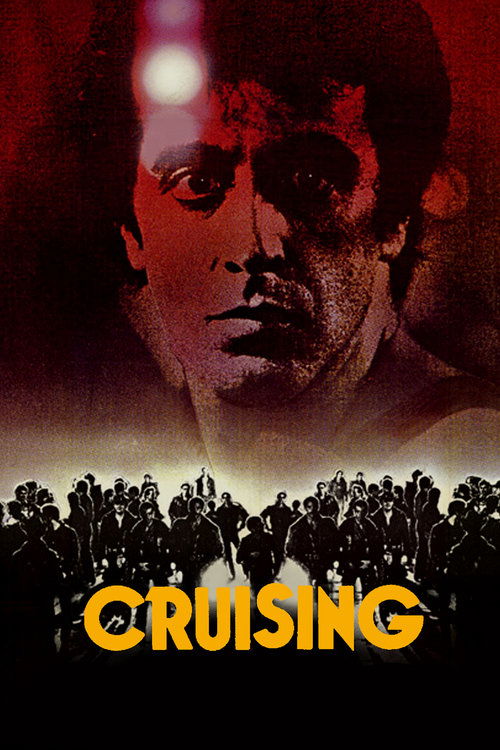
Cruising
1980 · William Friedkin
For when you want a confrontational, argument-starting thriller rather than a tidy whodunit — a film to wrestle with, not relax into. Decidedly a challenge watch.
What it's about
A serial killer is preying on gay men in New York's underground leather bars, and a young patrolman is sent undercover into the scene to draw him out. As Steve Burns goes deeper into the after-hours world of the West Village — its clubs, codes, and rituals — the line between the role he's playing and the man he is starts to blur, and the investigation becomes as much about him as about the killer.
The experience
Grim, clammy, and deliberately disorienting — Friedkin shoots the night world with documentary rawness and withholds the reassurances a normal police thriller provides. It leaves you unsettled and unsure of what you've seen, which is clearly the point.
Performances
Al Pacino plays Burns almost entirely from the inside — guarded, increasingly unreadable — a riskier and stranger performance than the showboating he's known for.
The craft
Friedkin shot in real Meatpacking District bars with real patrons as extras, giving the film a texture no set could fake, and his editing grows more fractured as Burns loses his bearings. The sound design and punk-scored club scenes still feel transgressive. It's grimy in a way only location-shot late-seventies New York can be.
Why it matters
Protested during production and at release, it became the flashpoint in the fight over Hollywood's images of gay men — and decades later was reclaimed by some as a rare, unvarnished record of a vanished subculture.
Snapshot
Cruising is William Friedkin's police thriller about a young New York patrolman, Steve Burns (Al Pacino), sent undercover into the leather bars of the West Village and the Meatpacking District to draw out a killer who is murdering gay men. It is loosely adapted from Gerald Walker's 1970 novel. It was probably the most fiercely contested American studio film of its year. Gay activists protested during the 1979 shoot, and again when it opened in early 1980. Most critics dismissed it, it drew nominations at the first Golden Raspberry Awards, and for years it served as a standard example in arguments about Hollywood's hostile images of gay men.
Its reputation has since split, not reversed. Some read it as a lurid, homophobic exploitation of a subculture at a moment of real violence against gay men. Others read it as one of the period's most unsettling studies of identity, desire and policing. Its fractured, deliberately unresolved structure and its documentary record of a pre-AIDS sexual culture both matter to that second reading. In the atlas the film sits where several lines meet: the procedural realism of the New Hollywood, the psychosexual serial-killer thriller descended from Psycho, and the history of queer representation and protest.
Industry & production
The film began as a property that had circulated for years. Producer Philip D'Antoni, who had made The French Connection (1971) with Friedkin, held an early interest in Walker's novel. Friedkin was not drawn to it at first. The project was revived at the end of the decade by Jerry Weintraub, and Friedkin was persuaded to write and direct. Friedkin has said that what changed his mind was a set of real cases. Arthur Bell's reporting in The Village Voice on unsolved killings of gay men in Manhattan was one. Another was his own unexpected connection to Paul Bateson, a radiology technician who had appeared in The Exorcist (1973) and was later convicted of murdering a journalist. Friedkin has recounted that Bateson was suspected in further killings. Those accounts come largely from Friedkin's own retellings, and their details should be treated with the caution owed to a famously self-mythologizing raconteur.
The film was produced through Lorimar and distributed by United Artists. Friedkin shot on location in New York in the summer of 1979, using real bars and their regular patrons as extras. That was the source of both the film's texture and its controversy. When the script leaked, Bell used his Voice column to urge readers to disrupt the shoot. Protesters gathered at locations with whistles, noise, mirrors and lights, and much of the location dialogue had to be re-recorded afterward. Former NYPD detective Randy Jurgensen, who had worked undercover in this world, served as an advisor and appears in the film.
The MPAA's first verdict was reportedly an X rating, and Friedkin made substantial cuts to reach an R. He has given various figures for how much footage was removed; the oft-repeated "forty minutes" belongs to the film's legend and has not been documented. At United Artists' insistence a written disclaimer opens the film, stating that it is not intended as an indictment of the homosexual world and depicts only one small segment of it. It opened in February 1980 to protests, with some theaters declining to show it. It was not the commercial event the Friedkin–Pacino pairing had promised.
Technology
Cruising is a conventional 35mm studio picture. What stands out technically is how it puts standard tools to unusual uses, not any new equipment.
- Flash frames. Friedkin carried over the near-subliminal insert he had used in The Exorcist. In the first murder, single frames of explicit gay pornography are cut into the stabbing. They register as a shock more than as an image.
- Post-sync sound. The protests made heavy re-recording (ADR) necessary. That loosened the bond between voice and body, and the film turned the loosening into a theme (see Sound).
- Low-light location shooting. The film was shot in real, dimly lit clubs with crowds of non-professional extras, which pushed the stocks and lighting of the time toward grain, darkness and partial visibility.
Friedkin later supervised a re-timed home-video version for Warner (2007) that altered the color and some effects. Viewers should know that versions in circulation differ.
Technique
Cinematography
James A. Contner shot the film. The camera language belongs to the New York realism Friedkin helped define with The French Connection, now turned toward a nocturnal world closed to most viewers. Exteriors are wet, empty, sodium-lit streets and the edges of piers and parks. Interiors are crowds of leather, denim and bare skin under colored practical light. The camera often sits in the crowd, cutting off faces and bodies. That denies the viewer an orienting overview and puts them in the position of Burns, who is both looking and being looked at. The parks and alleys where the killer strikes are filmed with exposed stillness, in contrast to the press of the club scenes.
Editing
Bud Smith, who also cut The Exorcist and Sorcerer (1977), edited the film. Its editing is famous for withholding. The murders are built from fragments, and the cutting often refuses to fix who did what. Several different actors and bodies are used for "the killer" across the film. The main suspect, Stuart Richards (Richard Cox), is identified and arrested, but a later killing implies that the violence is not limited to him. Flash frames, abrupt jumps between Burns's undercover life and his apartment with his girlfriend Nancy (Karen Allen), and the elliptical final movement all keep the viewer from getting the closure the procedural form promises.
Mise-en-scène / staging
The clubs are staged as rituals with codes the newcomer has to learn. One example is a scene in which a clerk explains the handkerchief code to Burns. There are colored-hankie signals, dress codes and "theme nights", including a bar that requires police uniforms, which blurs the line between cop and costume. Friedkin's crowds are dense and in constant motion, and the staging stresses mirroring: men dressed alike, Burns imitating them, the killer imitating Burns. Bruce Weintraub's production design sets this world against flat police offices and the bare domestic space Burns shares with Nancy. The coda deliberately unsettles that domestic space: Nancy tries on the leather gear Burns has left in their apartment while he looks at himself in a mirror.
Sound
Sound is central to the film. Jack Nitzsche wrote the score, and the club scenes are driven by a hard rock and punk soundtrack that includes contributions from the Germs, Willy DeVille and John Hiatt, among others. That was an unusual choice, since a disco sound would have been more realistic for these bars, and it gives the film an aggressive, abrasive tone. The killer speaks in a recurring voice-and-rhyme pattern ("Who's here? I'm here. You're here."). His dialogue is linked to the voice of a dead, disapproving father whom the killer imagines. Because voices were re-recorded and some performances may have been dubbed across bodies, the voice behaves less like a character's property than like something passed from man to man. That is the film's most formally radical element, and the record of its production suggests it was partly accidental.
Performance
Pacino plays Burns with blankness and opacity, playing against the explosive persona of Dog Day Afternoon (1975) and Serpico (1973). That fits a character who agrees to become someone else and never says what it costs him. Paul Sorvino plays Captain Edelson, the commander who sends Burns in, as an affable functionary whose responsibility the film keeps in view. Richard Cox's Stuart Richards is a tense, lonely portrait of repression. Don Scardino plays Ted, Burns's neighbor, a would-be playwright and the film's warmest gay character, and his fate is key to the ending. The supporting cast includes Joe Spinell as a predatory patrolman, Powers Boothe, Ed O'Neill and James Remar. Many club patrons appear as themselves, a mix of documentary and professional performance that adds to the film's uneasy authenticity.
Narrative & dramatic mode
Structurally Cruising is a police procedural: a body in the river, an undercover assignment, surveillance, a suspect, an interrogation, an arrest. Underneath it is a psychological thriller of identity transfer, and that second structure steadily eats away at the first. The film opens and closes on the Hudson, and the final movement suggests rather than states that violence has kept going, and may have moved into Burns himself. A late killing goes unexplained. Burns's guilt is never confirmed, and the film's last images present his reflection and Nancy's fascination with his clothes as open questions. Robin Wood placed the film among the "incoherent texts" of 1970s Hollywood, films whose contradictions show cultural tensions their makers could not resolve. That is still one of the most useful frames for it. The ambiguity can be read as evasion, as provocation, or as the film's real subject.
Genre & cycle
The film belongs to several overlapping cycles:
- New York police realism, which Friedkin himself helped found with The French Connection, alongside Serpico and Prince of the City (1981).
- The psychosexual thriller of the late 1970s, including Looking for Mr. Goodbar (1977), and in 1980 alone Brian De Palma's Dressed to Kill and Gordon Willis's Windows. Both of those also drew protests over their depiction of sexuality and gender.
- The serial-killer film before the profiler era, which descends from Psycho's fixation on a dead parent and overlaps with the Italian giallo's black-gloved killers and fetishized violence.
- The undercover thriller, in which immersion threatens to become conversion.
Its closest structural relative is Klute (1971), another film in which an investigator enters a sexual underworld and finds his own investment in it.
Authorship & method
Friedkin wrote the screenplay himself. The film fits his recurring concerns: the thin line between policeman and criminal (The French Connection's Popeye Doyle), evil that cannot be fully explained (The Exorcist), obsessive immersion (Sorcerer), and moral ambiguity in law enforcement, which he would push further in To Live and Die in L.A. (1985). He had directed The Boys in the Band (1970), an early studio film about gay men's lives, so Cruising was not his first time on this ground. His method of street casting, real locations, advisors drawn from police work, and a mix of fact and fiction comes straight from his documentary origins.
Key collaborators:
- James A. Contner (cinematography): textured, low-light New York nights.
- Bud Smith (editing): a long-standing Friedkin collaborator, responsible for the fragmentary, unresolved assembly.
- Jack Nitzsche (music): an abrasive score and a punk-inflected selection of songs.
- Bruce Weintraub (production design): the clubs, apartments and precinct spaces.
- Jerry Weintraub (producer).
- Gerald Walker (source novelist).
- Randy Jurgensen (technical advisor and actor).
Movement / national cinema
Cruising belongs to the late New Hollywood. Directors whose authority came from early-1970s hits now used studio money for personal, often transgressive projects, just as the economic and cultural ground under that model was shifting. It also belongs to the New York school of location-based filmmaking, which documented the city's decay and margins in the 1970s. Its unusual documentary value comes from filming, at length, spaces of gay male leather culture that were about to be changed by the AIDS epidemic and by the city's transformation.
Era / period
The film stands right at the turn from the 1970s to the 1980s. Gay liberation had made a visible, organized community able to protest a studio production effectively. The Cruising campaign became a landmark in media activism, a model for later protests over Basic Instinct (1992) and other films. Violence against gay men was real and often under-investigated, which explains both why the film's premise felt urgent and why activists feared its effect. The film was released months before the first reports of what became AIDS, so it became, unintentionally, a record of a world just before catastrophe. Its arrival in the same season as Dressed to Kill and Windows placed it in a broader debate about gender, sexuality and violence in American thrillers at the start of the Reagan era.
Themes
- Identity as costume and contagion. Burns adopts the dress, the codes and the gaze of the world he is watching. The film asks whether identity is something you perform until it becomes you.
- Policing and complicity. Police officers harass and exploit club patrons, a uniform-themed bar mimics the police, and a commander sends a young officer in as bait. The police and the subculture shadow each other.
- Repressed desire and paternal law. The killer's dead father's voice suggests violence born of internalized shame, which Friedkin pointedly does not confine to one man.
- Voyeurism. The audience, like Burns, is a tourist in a world it is meant to find strange, and the film makes that position uncomfortable.
- Indeterminacy. Who killed whom is left open. Many viewers read that as the film's central statement and many others as its central evasion.
Reception, canon & influence
Critical reception. At release, protests and reviews largely moved together. Many critics found it sensational, murky and confused. Gay critics and activists condemned it as equating gay sexuality with death and pathology. It was among the films nominated at the first Golden Raspberry Awards. Vito Russo's The Celluloid Closet treated it as a central example of Hollywood homophobia, and that framing shaped its reputation for two decades. Some contemporary critics defended its atmosphere and daring, but they were a minority.
Influences on the film (backward).
- Psycho's Oedipal killer and divided identity.
- Klute's investigator in a sexual underworld.
- The giallo's ritualized, fetishistic murder.
- Friedkin's own French Connection procedural realism.
- Looking for Mr. Goodbar and Taxi Driver (1976) for the urban-night psychology of the late 1970s.
- Walker's novel, Bell's journalism, and the real unsolved cases that Friedkin claimed as sources.
Legacy (forward). The film's reputation began to rise in the 2000s. A restored Warner release in 2007 was accompanied by Friedkin's commentary and new critical interest. Wood's "incoherent text" reading, queer critical revaluation, and a growing interest in the film as an archive of pre-AIDS leather culture all fed the reassessment. Rather than being simply rehabilitated, it is now often programmed and discussed as productively contested.
Its rumored cut footage inspired Interior. Leather Bar. (2013) by James Franco and Travis Mathews, a hybrid work that imagines reconstructing the lost minutes and questions the anxieties around them. Later queer genre cinema has engaged with the film's territory of cruising, desire and murder, most often Alain Guiraudie's Stranger by the Lake (2013) and Yann Gonzalez's Knife+Heart (2018). The protest movement around it shaped later struggles over representation. Its ambiguous undercover cop prefigured the identity-dissolving thrillers of the following decades, including Friedkin's own To Live and Die in L.A.
How much it directly influenced later filmmakers, beyond these explicit engagements, is less well documented. It is safer to call Cruising a reference point and a lightning rod than a widely imitated model.
Influences: the films it descends from and the films it influenced
- Psycho (1960) — The killer's voice is literally a dead parent's voice. Hitchcock blended Virginia Gregg, Jeanette Nolan and Paul Jasmin into Mother, and Friedkin likewise gives the dead father a disembodied voice ('You know what you have to do') that drives the murders.
- Klute (1971) — Gordon Willis's underlit New York interiors and the investigator who enters a sexual subculture to read its codes laid down the template that Contner's low-light club photography and Burns's undercover descent follow.
- The French Connection (1971) — Friedkin's documentary-style procedure carries straight over: street casting, real cops as advisors and actors (Eddie Egan and Sonny Grosso, then Randy Jurgensen), and handheld camera on live New York locations.
- The Exorcist (1973) — Cruising's subliminal flash-frame inserts (gay-porn frames cut into the first murder) come straight from the subliminal Pazuzu flashes that Friedkin and his editors developed for The Exorcist.
- The Bird with the Crystal Plumage (1970) — The giallo's gloved, faceless killer, ritualized knife murders filmed as fetish set-pieces, and a killer whose identity keeps sliding shape Cruising's staging of each killing as a sexualized ceremony.
- Taxi Driver (1976) — Its subjective New York nightscape and protagonist who mirrors himself in surfaces (the 'You talkin' to me' mirror) foreshadow Burns's mirror and double staging and his slide into the violence he is watching.
- Looking for Mr. Goodbar (1977) — It cuts between pick-up bar sequences and sudden fantasy and flash inserts before ending on a strobe-lit murder, the same disco and bar-cruising-to-death structure and strobe cutting Cruising uses.
- The Boys in the Band (1970) — Friedkin's first studio portrait of gay men taught him to stage a closed social world through ensemble performers who come from that milieu, a method he expanded to the real leather bar patrons in Cruising.
- To Live and Die in L.A. (1985) — Friedkin pushes the identity transfer from cop to criminal further. Vukovich takes on Chance's lawlessness after Chance dies, an explicit inheritance that grows out of the ending of Cruising, where Burns looks into the mirror and may now be the killer.
- Tightrope (1984) — Clint Eastwood's cop stalks a killer through New Orleans's bondage and sex-worker scene and finds his own desires mirrored in the murderer, which is Cruising's procedural identity transfer moved into a mainstream star vehicle.
- Manhunter (1986) — Will Graham's method of becoming the killer to catch him turns Burns's undercover identity dissolution into investigative technique, and it is shot as coldly stylized nocturnal procedure.
- Basic Instinct (1992) — A cop who is drawn into a sexual subculture, a suspect who has an identical double, and an ending that refuses to say who the killer is all extend Cruising's unresolved, contested-text design into the 1990s erotic thriller.
- Interior. Leather Bar. (2013) — It reconstructs the rumored forty lost minutes using non-professional and semi-professional performers and a documentary-fiction blur, taking up Friedkin's own mix of fact and staging as its subject.
- Stranger by the Lake (2013) — Its cruising ground becomes a ritual space where desire and murder share the same gestures, and long, patient real-location takes turn the cruising codes into suspense mechanics.
- Knife+Heart (2018) — It openly quotes Cruising's masked leather killer and gay-porn milieu, crossing them with giallo color and flashback inserts, so the film's ritual murders become self-aware queer genre pastiche.
- Bad Lieutenant (1992) — Ferrara's guerrilla New York nights and his cop-as-transgressor, shot handheld in real clubs and streets with non-actors around the lead, extend Cruising's low-light urban realism and its rotted law-enforcement center.
- Body Double (1984) — A protagonist goes undercover inside the porn industry, and its doubled bodies and voyeuristic identity substitution stretch Cruising's mirroring and identity-transfer devices into a self-reflexive form.
- Pillion (2025) — Friedkin's immersive, costume-and-code-accurate ethnography of the leather subculture prefigures Lighton's research-led insider depiction of the gay-biker community.
- Dressed to Kill (1980) — Released the same summer, it reworks Psycho's split-identity killer through doubles and mirrors, deceptive sexual cruising set-pieces and a razor killer in disguise, matching Cruising's mirroring-doubles staging.
Similar films
- Dressed to Kill (1980) — influence & lineage
- Basic Instinct (1992) — influence & lineage
- The French Connection (1971) — influence & lineage
- Body Double (1984) — influence & lineage
- Taxi Driver (1976) — influence & lineage
- Bad Lieutenant (1992) — influence & lineage
- Serpico (1973) — shared sensibility
- Maniac (1980) — shared sensibility