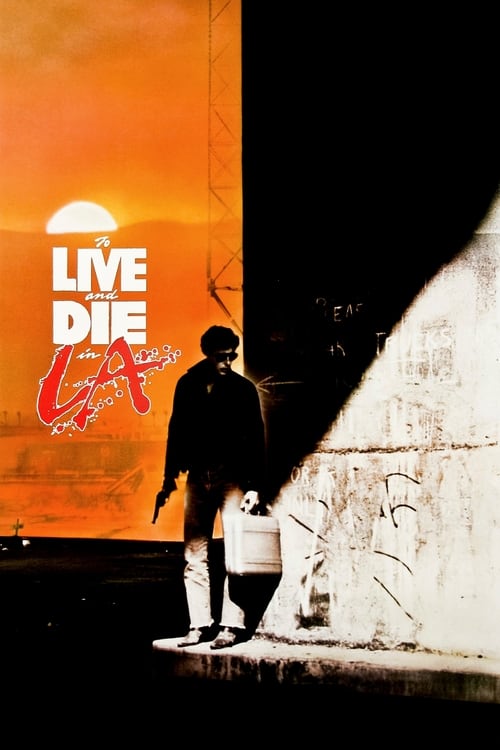
To Live and Die in L.A.
1985 · William Friedkin
For when you're craving a hard-edged 80s crime fix with real bite — style to burn, zero hand-holding, and an ending-of-innocence nastiness that lingers. Choose it when you want your thriller dangerous, not cozy.
What it's about
When his longtime partner is killed days before retirement, a reckless Secret Service agent makes taking down the counterfeiter responsible his personal crusade — and starts breaking every rule, and then every law, to do it. It's a cop-versus-criminal chase through a hard, sun-bleached Los Angeles of money printers, fences, and double-crosses, where the line between hunter and hunted keeps dissolving.
The experience
Fast, mean, and electric — an amoral thriller that keeps pulling the rug out, capped by a freeway chase that will have you gripping the couch. It leaves a bitter aftertaste on purpose: nobody here is clean, and the film never pretends otherwise.
Performances
William Petersen plays Chance as pure adrenaline with a badge, all swagger and self-destruction, while a young Willem Dafoe is mesmerizing as the counterfeiter — cool, artistic, and genuinely unnerving.
The craft
Friedkin shoots the counterfeiting process like a documentary and the city like a neon fever, with Robby Müller's photography turning L.A. smog and sodium light into something gorgeous and toxic. The wrong-way freeway chase is one of the great practical car sequences ever filmed, and Wang Chung's synth score seals the film's chrome-and-sunset mood. Loud speakers strongly recommended.
Why it matters
Unevenly received in 1985, it has hardened into a defining film of 'neon noir' — the glossy, morally corroded 80s crime style — and stands as Friedkin's ferocious answer to his own 70s cop classics.
Snapshot
To Live and Die in L.A. is William Friedkin's hard-lacquered neo-noir about a U.S. Secret Service agent whose pursuit of a counterfeiter curdles into a study of moral contagion. Adapted from a novel by Gerald Petievich—himself a former Secret Service agent—it pairs Friedkin's documentary instinct for procedural texture with a glossy, neon-saturated 1980s surface, yielding one of the decade's defining American crime films. Released in the shadow of the director's 1970s triumphs, it was received unevenly in its moment but has since hardened into a touchstone of "neon noir": admired for Robby Müller's photography, a celebrated wrong-way freeway chase that consciously answers the director's own French Connection, a synth score by the British band Wang Chung, and a structural audacity—the abrupt mid-action killing of its ostensible hero—that few studio thrillers of the era dared. It also functions as an origin point for two major careers, marking Willem Dafoe's first leading antagonist and William Petersen's screen breakout.
Industry & production
The film was produced for release through MGM/United Artists in 1985, arriving when Friedkin's commercial standing had eroded badly. After the box-office failure of Sorcerer (1977), the controversy and disappointment of Cruising (1980), and the flop comedy Deal of the Century (1983), he was no longer the bankable figure of The French Connection (1971) and The Exorcist (1973). To Live and Die in L.A. was, in effect, a comeback bid: a comparatively economical genre picture mounted with a cast of relative unknowns rather than stars, which freed Friedkin to take stylistic and narrative risks a star vehicle would have resisted. The screenplay was written by Friedkin with Petievich, whose insider knowledge supplied the film's procedural spine—the workings of the Secret Service's counterfeiting brief, the texture of informants and sting operations. The precise budget and box-office returns are not something I can state with confidence, and I will not invent figures; contemporary accounts generally characterize the film as a modest commercial performer that found its larger audience later on cable and home video. Friedkin's casting strategy—drawing Petersen and John Pankow from the theater, and elevating the then little-known Dafoe—was itself a production statement, prioritizing fresh, unbranded faces to keep the world abrasive and unglamorous.
Technology
Technically the film sits at the hinge between New Hollywood realism and the high-gloss image-making of the MTV era. It was shot photochemically on 35mm in and around Los Angeles, exploiting practical neon, industrial sodium-vapor light, and the bleached flatness of the city's freeways and rail yards. The most discussed technical achievement is its centerpiece car chase, executed with real vehicles and stunt drivers on actual roadway—staged so that the protagonists flee against oncoming freeway traffic. Friedkin, who had made the French Connection chase a benchmark of in-camera danger, again favored physical execution and long-lens compression over optical trickery, and the sequence's terror derives from the legibility of genuine speed and proximity rather than from effects. The counterfeiting passages similarly trade on process verisimilitude: the film walks through the offset-printing fabrication of currency in near-instructional detail, a docudramatic impulse consistent with Friedkin's background and Petievich's expertise. As always with such sequences, the production was careful to present a dramatized account rather than a literal manual.
Technique
Cinematography
The photography is by Robby Müller, the Dutch cinematographer best known for his work with Wim Wenders and, later, Jim Jarmusch. His contribution is decisive: Müller renders Los Angeles as a landscape of synthetic color—oranges, teals, and acidic neons pooled against concrete and dusk skies—and finds a cold lyricism in industrial nowhere-spaces. The palette is deliberately artificial, the image of a city that is itself a counterfeit, all surface and signage. Müller's framing alternates between wide, sun-flattened exteriors and claustrophobic interiors lit by practical sources, and his command of magic-hour and night exterior light gives the film a painterly sheen that never tips into prettiness. This is among the most influential American cinematographic works of the decade, frequently cited as foundational to the later "neon noir" look.
Editing
The cutting—credited to Bud Smith, a longtime Friedkin collaborator, working with M. Scott Smith—drives the film's two registers: a propulsive, percussive rhythm in the action and sting sequences, and a cooler, more clinical assembly in the procedural passages. The freeway chase is the editorial showpiece, sustaining spatial coherence and escalating panic across a long, complex sequence without surrendering geography. The film's editorial logic is also where its narrative shocks land: the cutting refuses to telegraph the protagonist's fate, so that the violence, when it arrives, ruptures rather than resolves.
Mise-en-scène / staging
Friedkin stages the film in a Los Angeles stripped of glamour—rail yards, drainage channels, anonymous freeways, sterile offices, and a strip-club-and-warehouse demimonde. The recklessness of the lead is established physically: an early base jump off a bridge functions as character exposition through staging rather than dialogue. The counterfeiter Masters is repeatedly framed as an artist—painting, then destroying his own canvases—visually rhyming forgery with creation and implicating the film's own image-making in the theme of fabrication. Production design favors hard surfaces, mirrored and reflective interiors, and a general coldness that keeps the human figures isolated within their environments.
Sound
The sound world is dominated by the score and songs of Wang Chung, the British new-wave duo, who supplied a full synthesizer score in addition to the title song. The choice is era-defining and divisive: the pulsing, processed synths bind the film to its mid-1980s moment and lend the action a music-video propulsion, while the colder ambient cues underscore the narrative's emotional vacancy. Friedkin integrates the music aggressively, letting it shape sequence rhythm rather than merely accompany it—an approach that aligns the film with the period's convergence of cinema and pop-music aesthetics.
Performance
The acting is pitched toward hardness and opacity. William Petersen plays Richard Chance as a coiled adrenaline addict whose machismo is presented critically rather than celebrated—charisma without a moral center. Willem Dafoe, in a breakout antagonist role, gives Eric Masters a serpentine, aestheticized menace, cool and self-possessed where Chance is volatile. John Pankow's Vukovich provides the film's conscience and, ultimately, its grim arc of corruption; Dean Stockwell appears as a slippery defense attorney, John Turturro as a courier, and Darlanne Fluegel and Debra Feuer in the orbit of women used and discarded by the men's schemes. The ensemble's relative anonymity at the time reinforces the film's unsentimental, almost behavioral mode of performance.
Narrative & dramatic mode
The dramatic mode is hard-boiled procedural tragedy. Outwardly it follows the revenge plot promised by the synopsis—Chance vowing to bring down Masters after a partner's murder—but the film systematically dismantles the moral architecture of the revenge thriller. Its most famous gambit is structural: the protagonist is killed, abruptly and ingloriously, well before a conventional climax, shot in the face during what should have been the hero's triumph. The narrative then continues without him, transferring its center of gravity to Vukovich, who inherits not justice but Chance's ruthlessness. The closing movement—Vukovich coldly claiming the dead man's informant—completes a circuit of moral contamination: the methods used to fight the criminal world consume the men who use them. It is a downbeat, deterministic structure closer to film noir's tragic fatalism than to the redemptive arc of the 1980s action film it superficially resembles.
Genre & cycle
The film belongs to the neo-noir crime cycle, updating the moral ambiguity and doomed protagonists of classic noir into the synthetic surfaces of Reagan-era Los Angeles. It sits within a 1980s wave of stylish, morally corroded crime pictures and is frequently grouped with the work of Michael Mann as a progenitor of the decade's "cop and criminal as mirror images" subgenre. Against the period's ascendant heroic-cop blockbusters, it reads as a deliberate counter-statement: the procedural authenticity of the 1970s policier married to a glossy surface, but with the genre's reassurances withheld. Its forgery plot also places it in a lineage of films preoccupied with authenticity and the fake—money, art, and image all standing in for one another.
Authorship & method
The film is unmistakably Friedkin's, extending the obsessions of his major work: the porous boundary between law and lawlessness explored in The French Connection and Cruising; the fascination with procedure and craft; and the conviction that a great chase is a moral as well as kinetic event. His method here fuses documentary verisimilitude—drawn from Petievich's firsthand knowledge—with a self-conscious embrace of contemporary style, a combination that distinguishes the film from both his gritty 1970s pictures and the slicker thrillers around it. The key collaborators are essential to the result: writer-source Gerald Petievich, whose Secret Service experience grounds the world; cinematographer Robby Müller, whose color and light define its identity; editor Bud Smith, whose long association with Friedkin shaped the film's rhythm; and Wang Chung, whose score fixes its sonic signature. The authorship is thus genuinely shared between Friedkin's structural daring and a set of collaborators whose individual signatures—Müller's especially—are legible in the finished work.
Movement / national cinema
As American studio cinema, the film is a late, mutated product of New Hollywood: a director formed in the auteur-driven early 1970s working within, and partly against, the commercial idiom of the mid-1980s. Notably, its visual character is shaped by a European sensibility—Müller, steeped in the New German Cinema of Wenders, brings a continental eye to American genre material, an instance of cross-pollination that complicates any purely national reading. The film can be situated at the intersection of the American crime tradition and an imported art-cinema attentiveness to light, landscape, and surface.
Era / period
The film is acutely of 1985. Its synth score, neon palette, fashion, and music-video editorial energy root it in the mid-decade convergence of cinema and pop culture, while its cynicism—about money, institutions, and masculine self-image—reads as a darker undercurrent beneath the era's surface confidence. The counterfeiting premise resonates with a moment preoccupied by money and image; the film's vision of Los Angeles as a beautiful fake captures a period anxiety about authenticity. It is simultaneously a quintessential 1980s artifact and a critique of the decade's values.
Themes
Its governing theme is authenticity and its counterfeits—currency, art, identity, and law all revealed as forgeries or performances. Masters the counterfeiter is doubled with Masters the painter, and both are doubled with the filmmaker, so that the act of fabrication becomes the film's central metaphor. A second theme is moral contagion: the proposition that the pursuit of criminals deforms the pursuer, dramatized through the transfer of Chance's ruthlessness to Vukovich. Allied to this is a critique of reckless masculinity—Chance's thrill-seeking presented as pathology rather than heroism—and a pervasive fatalism in which institutions offer no redemption and the cycle of corruption simply continues past any individual death.
Reception, canon & influence
Critical reception in 1985 was mixed-to-favorable and somewhat polarized: admirers singled out the cinematography, the chase, and the film's nerve, while detractors found its style cold or its synth-driven surface dated even on arrival. Over time its standing has risen markedly; it is now widely regarded as one of Friedkin's strongest post-1970s works and a key American neo-noir, sustained by home-video and cult rediscovery. Backward, the film draws on the obsessive-cop procedural of The French Connection, the fatalism of classic film noir, and the morally cool crime cinema of figures like John Boorman's Point Blank (1967), filtered through Petievich's documentary authenticity; its chase is explicitly in dialogue with Friedkin's own earlier masterpiece. Forward, its influence is substantial. Its neon-and-synth visual grammar—Müller's contribution above all—prefigures decades of stylized crime cinema, and it is frequently named as an ancestor of the contemporary "neon noir," with Nicolas Winding Refn's Drive (2011) among the works most often traced to its example; its sensibility also rhymes with Michael Mann's evolving aesthetic. The film launched William Petersen, who moved directly into Mann's Manhunter (1986) and a long screen and television career, and established Willem Dafoe as a major character actor. Its structural shock—the killing of the protagonist mid-narrative—remains a reference point for genre subversion. The full extent of its industrial influence is difficult to quantify and I will not overstate it, but its aesthetic legacy in particular is broadly acknowledged.
A Deleuzian reading
Watch Eric Masters finish a painting and then set it on fire.
The full Deleuzian reading of To Live and Die in L.A. →
Reception
A modest performer with mixed reviews in 1985 — many critics shrugged it off as Friedkin chasing his own French Connection glory in pastel Miami Vice clothing — it's since been reappraised as one of the great '80s crime films and arguably peak late Friedkin.
How To Live and Die in L.A. was received, from release to now →
Influences: the films it descends from and the films it influenced
- The French Connection (1971) — Friedkin's own obsessive-cop procedural and documentary-grade street verisimilitude — and its landmark elevated-train car chase shot from inside the vehicle — are the template the freeway chase here both quotes and tries to top.
- Point Blank (1967) — Boorman's morally cool, hard-edged crime cinema and fractured, fatalistic treatment of a vengeance-driven criminal underworld supplies the detached amorality and stylized brutality Friedkin filters through Petievich's authenticity.
- Bullitt (1968) — Establishes the modern American car chase as documentary-real, location-shot, low-mounted kinetic spectacle with minimal scoring — the procedural-cool grammar the wrong-way freeway chase escalates.
- The Killing (1956) — Kubrick's heist-noir doomed-protagonist structure and clinical fatalism model the classic-noir conviction that the schemer is destined to fail, underwriting the film's tragic-fatalist engine.
- Cruising (1980) — Friedkin's immediately prior study of an undercover man absorbed and corrupted by the world he infiltrates establishes the porous law/lawlessness boundary and moral-contagion theme the agent's descent reprises.
- Psycho (1960) — The structural shock of killing the apparent protagonist mid-narrative — destroying the audience's anchor — is the genre-subversion device Friedkin redeploys with Chance's abrupt death.
- American Gigolo (1980) — Inherits the synth-scored (Wang Chung), high-gloss Los Angeles neo-noir surface and fashion-conscious criminal cool, framing a loner inside reflective sun-and-neon imagery.
- Heat (1995) — Extends the cop-and-criminal mirroring and procedural authenticity into a city-symphony register, inheriting the film's conviction that crime craft and law craft are the same obsessive discipline.
- Drive (2011) — The most frequently traced heir: its neon-noir palette, synth-pop song integration over violence, and laconic doomed-driver fatalism are a direct stylistic descent from Müller's neon-and-synth grammar.
- Collateral (2004) — Carries forward the nocturnal-L.A.-as-character, pop-scored neon crime aesthetic and the documentary-real treatment of professional violence pioneered in this film's portrait of the city.
- The Counselor (2013) — Inherits the bleak counterfeit-world moral-contagion thesis — that everyone touching the criminal economy is corrupted and doomed — and the refusal of redemptive resolution for its transgressors.
- Nightcrawler (2014) — Extends the neon-soaked nocturnal-L.A. portrait and the study of reckless, amoral masculine ambition curdling into predation, descending from this film's authenticity-and-counterfeit theme.
- Sicario (2015) — Carries the moral-contagion procedural — a federal operative compromised by the lawless methods of the world being policed — and the conviction that the chase/operation is a moral event, into modern border crime cinema.
- Good Time (2017) — Descends via its propulsive synth score (Oneohtrix Point Never), neon-grimy nocturnal palette and breathless doomed-criminal momentum — the synth-and-neon fatalism updated for a new generation.
- Uncut Gems (2019) — Extends the tragic-fatalist structure of a compulsive risk-taker whose hustle guarantees his destruction, with the abrupt protagonist-death shock the film made a genre reference point.
- Crime 101 (2026) — The direct transmission line — Friedkin's use of the freeway itself as a shooting environment rather than a connective device, plus Robby Müller's sun-flattened industrial-flats palette and Wang Chung's synth pulse as procedural metronome, is Crime 101's structural template.
- Thief (1981) — Mann's synth-scored (Tangerine Dream), neon-wet-pavement nocturnal crime aesthetic with a procedurally obsessive professional runs in parallel, sharing the synth-and-surface grammar Müller crystallizes here.
- Manhunter (1986) — Direct continuation: it casts William Petersen straight out of this film and extends the same cool, designed, synth-scored procedural surface into the obsessive-investigator thriller.
- To Catch a Thief / Body Heat lineage placeholder (1981) — Kasdan's contemporaneous neo-noir revival shares the project of reviving classic-noir fatalism and doomed transgression within glossy, eroticized 1980s surfaces rather than 1940s monochrome.
- Miami Vice (series pilot) (1984) — The TV-defining fusion of pop/synth music cues, designed neon color palettes and undercover-cop moral ambiguity is the exact contemporaneous aesthetic ecosystem the film's neon-and-synth surface belongs to.
- The Driver (1978) — Shares the architectural nocturnal-L.A. nightscape and a virtuoso practical car chase staged for spatial legibility in the Bullitt/Hill lineage.
- Body Heat (1981) — Companion 1980s neo-noir built on a saturated, sun-baked color palette and synth-and-sax atmosphere, treating heat and light as the genre's new expressive medium rather than shadow.
- Deep Cover (1992) — Pioneers the saturated neon crime-noir palette and the cop-who-crosses-every-line premise, pushing procedural realism into stylized color the way Bazelli later does.
Similar films
- The French Connection (1971) — influence & lineage · same viewing thread
- Drive (2011) — influence & lineage · same viewing thread
- Heat (1995) — influence & lineage
- Point Blank (1967) — influence & lineage
- Collateral (2004) — influence & lineage
- Kiss Me Deadly (1955) — shared sensibility
- Ronin (1998) — shared sensibility
- Sorcerer (1977) — shared sensibility
All the films related to To Live and Die in L.A. →
Watch it with: curated runs of related films
- Undercover and Underworld — A run of cops, criminals, and the moles planted between them — watch these back-to-back for how loyalty curdles into betrayal across one corrupt city after another, from the Boston docks to Hong Kong to Marseille-by-way-of-New-York.