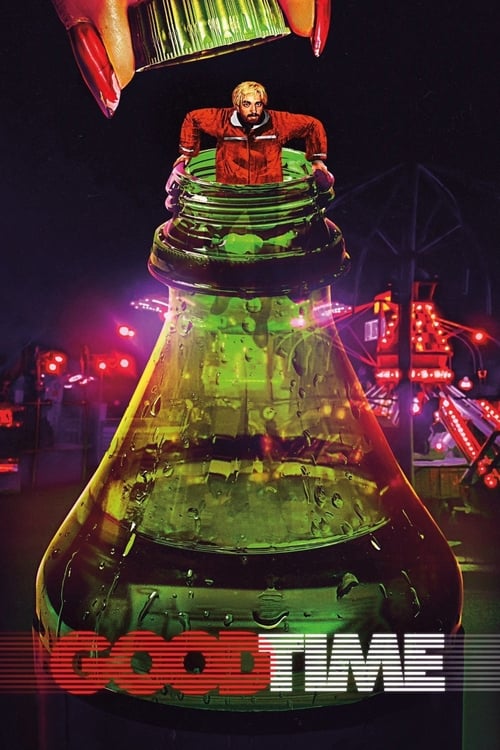
Good Time
2017 · Benny Safdie
For when you want your pulse up — a white-knuckle ride you take in one gulp, not a comfort watch. Reach for it when you're wired, awake at midnight, and want a movie that matches that energy.
What it's about
A bank robbery goes wrong and Connie Nikas's intellectually disabled younger brother Nick ends up behind bars. Over one long New York night, Connie hurls himself through the city's underworld — hospitals, strangers' apartments, an amusement park after dark — improvising scheme after scheme to get Nick out. Every fix he attempts drags someone new into the wreckage.
The experience
Relentless is the word: the film moves at a sprint from the opening minutes and barely lets you exhale, with a throbbing electronic score and tight, sweaty close-ups that make you feel complicit in every bad decision. It's stressful in a way few thrillers are, and weirdly exhilarating because of it.
Performances
Robert Pattinson is astonishing as Connie — feral, fast-talking, thinking three cons ahead while everything collapses — a performance that redefined his career. Benny Safdie is quietly devastating as Nick.
The craft
Shot largely in grainy close-up under neon and sodium light, it turns real New York locations into a fever dream, driven by Oneohtrix Point Never's pulsing synth score. The editing keeps the story in near-real-time, so tension accumulates rather than resets. Loud speakers and a dark room pay off enormously here.
Why it matters
The film announced the Safdie brothers to the world stage at Cannes and set the template for their brand of anxiety-cinema, while proving Pattinson was one of the most adventurous actors of his generation.
Snapshot
Good Time is a nocturnal crime thriller that follows Connie Nikas across a single catastrophic night in New York as he tries to bail his intellectually disabled younger brother, Nick, out of a spiraling disaster of his own making. Though the film is often credited to Benny Safdie alone, it was in fact co-directed by brothers Josh and Benny Safdie — a partnership central to understanding the work — and it marked their arrival, after a decade of regional and vérité filmmaking, into a wider critical consciousness. Premiering in competition at the 2017 Cannes Film Festival and released in the United States by A24, the film became both a formal calling card and the vehicle for Robert Pattinson's decisive reinvention as an actor of auteur cinema. Its reputation rests on three intertwined achievements: a relentless, near-real-time propulsion; a hallucinatory neon palette shot on 35mm by Sean Price Williams; and an abrasive, synthesizer-driven score by Oneohtrix Point Never that won the Cannes Soundtrack Award. Together these make Good Time one of the defining American genre films of the late 2010s and the bridge between the Safdies' scruffy early work and the larger canvas of Uncut Gems (2019).
Industry & production
Good Time was produced through Elara Pictures, the Safdies' own New York–based production banner, in partnership with financiers oriented toward independent genre work, and distributed domestically by A24 — the studio whose late-2010s ascendancy was built precisely on this kind of stylistically aggressive, mid-budget auteur cinema. The film's budget was modest by any studio measure; the Safdies have consistently described their method as low-cost, location-driven, and guerrilla-adjacent, though I would not assign a precise figure without confirmation. Its commercial performance was similarly modest — a specialty release rather than a wide one — but its cultural return vastly exceeded its box office, which is the more relevant metric for a film of this kind.
The most consequential piece of the film's origin is Robert Pattinson's involvement. By his own and the directors' accounts, Pattinson reached out to the Safdies after encountering an image from their earlier film Heaven Knows What (2014), actively seeking to work outside the mainstream apparatus that had formed around him. His attachment as star and, effectively, as a producing catalyst gave the project the visibility and financing that the Safdies' prior films had lacked, while the directors retained near-total creative control. The result is a rare case where a franchise-scale star deliberately subordinated himself to a fiercely independent method — living with the material, altering his voice and physicality, and shooting on real streets among non-professional performers.
Technology
The film was shot photochemically on 35mm — a deliberate, increasingly countercultural choice in a period when digital acquisition had become the industry default. The grain, the specific response of film emulsion to saturated colored light, and the physical constraints of the format are inseparable from the film's texture. The Safdies and cinematographer Sean Price Williams leaned heavily on long lenses and available or practical light sources — sodium-vapor streetlamps, fluorescent hospital corridors, the neon and blacklight of an amusement park — rather than elaborate lighting rigs, which is both an aesthetic and a technological stance: the camera adapts to the city as found. The score's technology matters equally. Daniel Lopatin (Oneohtrix Point Never) built a densely synthetic, analog-and-digital soundscape that behaves less like traditional underscore than like a pressurizing atmosphere, and the sound design integrates it with diegetic chaos so tightly that the boundary between music and environment frequently dissolves.
Technique
Cinematography
Sean Price Williams's cinematography is the film's signature. Working in 35mm, he favors extreme close-ups and long focal lengths that compress space and isolate faces against smeared, out-of-focus backgrounds of colored light. The effect is claustrophobic and subjective — we are pinned to Connie's skin, rarely granted the establishing distance that would let us orient ourselves in the city. Color is expressive to the point of delirium: reds, acid greens, and electric blues bathe the actors, most famously in the Adventureland amusement-park sequence lit in blacklight and neon. The camera is predominantly handheld and restless, tracking bodies through cramped interiors and across streets with a nervous, reactive energy. This is a descendant of vérité practice, but weaponized for genre tension rather than documentary neutrality.
Editing
Cut by Ronald Bronstein and Benny Safdie, the editing is the engine of the film's dread. The rhythm is propulsive and forward-leaning, structured to feel like near-continuous real time even as it elides and compresses; scenes rarely resolve or release tension before the next crisis crowds in. The cutting privileges momentum over clarity, keeping the viewer in the same reactive, improvisatory scramble as Connie, who is always one move ahead of comprehension and one move behind consequence. It is a film essentially without rest — the few quiet beats land as ruptures precisely because the surrounding tempo is so unforgiving.
Mise-en-scène / staging
The staging is grounded in real, unglamorous New York and its adjacent geographies: apartments, a hospital, a bail bondsman's office, a suburban home, an amusement park after hours. Space is used to trap rather than to display. The Safdies stage action in tight, cluttered interiors and stage the city itself as a labyrinth of dead ends. Crucially, the film opens with Nick in a therapy session before erupting into the bank robbery, and it closes by returning Nick to an institutional setting — a framing that quietly reasserts the human stakes the middle of the film buries under adrenaline.
Sound
Sound is arguably the film's most radical dimension. Oneohtrix Point Never's score is wall-to-wall, loud, and deliberately abrasive — dense synthesizer arpeggios and swelling drones that push the audience toward the same overstimulation as the characters. Rather than cueing emotion conventionally, the score functions as sustained pressure. The film's closing track, "The Pure and the Damned," pairs Lopatin's music with a vocal by Iggy Pop, and its melancholy provides the emotional exhalation the score has withheld for two hours. The Cannes Soundtrack Award recognized this contribution specifically.
Performance
Casting mixes professionals with non-professionals, a Safdie hallmark carried over from Heaven Knows What. Robert Pattinson's Connie is the axis: a manipulative, quick, exhausting live-wire whose charisma is inseparable from his destructiveness. Benny Safdie's performance as Nick is tender and unshowy, avoiding sentimentality. Around them, performers including Buddy Duress (as Ray) and Taliah Webster bring an unpolished authenticity, while Jennifer Jason Leigh appears in a smaller role. The texture of the ensemble — the sense that these faces belong to the world being filmed rather than to a casting office — is essential to the film's realism.
Narrative & dramatic mode
The film's structure is a single-night odyssey: a ticking-clock, picaresque descent in which one botched decision generates the next. After the bank robbery goes wrong and Nick is arrested, Connie's attempts to free him metastasize — a hospital mix-up leads him to spring the wrong man, and each subsequent improvisation drags new bystanders into ruin. Dramatically, the film operates in an anti-heroic register: Connie is the protagonist and the disaster, and the narrative refuses to redeem him. Its irony is moral rather than plot-mechanical — Connie frames every betrayal as love and every act of "help" leaves someone worse off. The near-real-time momentum keeps the audience complicit, rooting for a man whose every success is a catastrophe for someone with less power than he has.
Genre & cycle
Good Time belongs to the "one crazy night" crime thriller and, more broadly, to the tradition of the New York night film about small-time criminals in over their heads. It participates in a late-2010s revival of stylized "neon noir" — genre cinema that treats the nocturnal city as an expressionist canvas. But the Safdies inflect these conventions with a documentary grit that resists the slickness typical of the neon mode. The film is a heist-gone-wrong story stripped of the heist's cool competence: there is no master plan, only panic. This positions it against the polished procedural end of crime cinema and squarely within the strand that treats crime as desperation and improvisation.
Authorship & method
The authorship is fundamentally collaborative. Josh and Benny Safdie co-directed; the screenplay is credited to Josh Safdie and Ronald Bronstein, who is also the film's co-editor — making Bronstein a triple presence across writing, structure, and rhythm. Sean Price Williams's cinematography and Daniel Lopatin's score are not decorative additions but co-authoring forces, each responsible for a defining sensory register. The Safdie method, developed across Daddy Longlegs (2009) and Heaven Knows What, is location-first and immersion-based: extensive research into real milieus, casting from within those worlds, long shoots on real streets, and a tolerance for chaos as a generative principle. Pattinson's months of immersion and physical transformation are extensions of this ethos. The through-line is a refusal to separate the fictional from the actual texture of the city.
Movement / national cinema
The film sits within American independent cinema, specifically a New York regional lineage that runs from John Cassavetes through the gritty 1970s studio-adjacent realism of Sidney Lumet and the vérité crime pictures of that decade. The Safdies emerged adjacent to — but distinct from — the "mumblecore" milieu of the late 2000s; where that movement was talky and low-stakes, the brothers pushed toward genre propulsion and formal aggression. Good Time is a quintessentially New York film, engaged with the city's outer-borough and underclass geographies rather than its iconic skyline, continuing a native tradition of filmmaking that treats the city as an actor.
Era / period
Made and set in the mid-2010s, the film is contemporary in its milieu — the world of cheap apartments, bail bondsmen, hospital bureaucracies, and casual surveillance — but its sensibility is consciously retrospective, drawing on 1970s New Hollywood crime cinema and on the synthesizer scores associated with early-1980s genre film. This deliberate anachronism, a present-day story rendered through the grain of an earlier cinema, is part of its identity. It arrived at a moment when A24 and a cohort of American auteurs were reasserting the viability of the mid-budget, director-driven feature against a franchise-dominated industry, and it stands as one of that movement's exemplary texts.
Themes
At its core the film is about brotherhood and the violence of misguided love: Connie's devotion to Nick is genuine and ruinous, the engine of every disaster. Disability is central — Nick's intellectual disability frames the film and indicts Connie, whose "protection" repeatedly endangers him. Class and power run underneath everything: Connie, a poor white man, moves through the night exploiting people with even less standing than he has — often people of color, an immigrant security guard, a teenage girl — and the film has been widely read as a critique of white manipulation and privilege, of how Connie weaponizes the presumption of his own innocence. The carceral system, institutionalization, and the thin membrane between care and captivity thread through the framing sequences. And beneath the adrenaline is a study of exhaustion — the sense that this life is a treadmill of crisis with no exit.
Reception, canon & influence
Critical reception was strong and, for Robert Pattinson, transformative: his performance was widely singled out as the moment his post-Twilight reinvention as a serious actor became undeniable, and the film's Cannes competition slot conferred art-cinema legitimacy on filmmakers previously known to a narrower audience. Oneohtrix Point Never's score drew particular praise and the Cannes Soundtrack Award.
Its influences run backward to the 1970s New York crime film — Sidney Lumet's Dog Day Afternoon is the most frequently cited touchstone, with its botched robbery and pressure-cooker realism — as well as to Cassavetes's raw performance style, Scorsese's Mean Streets-era street cinema, and the synthesizer-scored genre films of John Carpenter and Tangerine Dream that echo through Lopatin's work. The vérité impulse the Safdies absorbed from documentary and from their own earlier films is equally foundational.
Forward, the film's legacy is substantial. It established the Safdies as major American filmmakers and led directly to Uncut Gems, which extended the same anxiety-machine aesthetic to a larger scale and star (Adam Sandler). More broadly, Good Time helped legitimize a wave of high-tension, neon-and-synth independent thrillers and reinforced A24's identity as the home of stylistically distinct auteur genre cinema. It is now widely treated as a modern reference point for immersive, pressure-driven crime filmmaking and for the possibility of a franchise star's radical reinvention through independent work. Where the historical record remains thin — precise budget and grosses — I have declined to specify rather than risk inventing figures; the film's importance was never a matter of its ledger.
A Deleuzian reading
A man wheels a sedated, bandaged body out of a hospital under fluorescent light, certain it's his brother.
The full Deleuzian reading of Good Time →
Reception
Premiered in competition at Cannes 2017 to rave reviews but only a modest box office run — since then it's snowballed into a defining film of the 2010s, the moment the Safdies broke out and Robert Pattinson's 'actually one of the best actors alive' reappraisal became consensus.
How Good Time was received, from release to now →
How to watch Good Time: what to notice on a first viewing
- Watch how close the camera stays on Connie's face. Sean Price Williams shoots long lenses and extreme close-ups, isolating Pattinson's face against smeared, out-of-focus city lights. You are pinned to one man's skin, never given the distance to get your bearings in the city.
- Notice the colors bathing every scene: acid green, electric blue, red. The Safdies push saturated neon and blacklight until color stops just lighting the scene and becomes the scene's feeling. The palette works on your nerves directly, the way a mood works on a body.
- Listen for the synth score that never resolves or lets up. Oneohtrix Point Never's score stays wall-to-wall and abrasive, refusing the usual cues that tell you when to relax. The music keeps your body at the same pitch of overstimulation as Connie's.
- Watch the cramped, real interiors Connie moves through all night. The Safdies stage apartments, a hospital, a bail office, and a suburban house as tight, cluttered, unglamorous spaces that trap rather than display. The city itself becomes a maze with no room to think, matching Connie's own lack of a plan.
- Watch how rarely Connie's hands or mouth stop moving. Pattinson plays Connie as a live-wire who talks fast and touches everyone; Benny Safdie's Nick, by contrast, stays still and unshowy. The contrast in stillness tells you who is actually in control and who is being used.
The whole guide to watching Good Time, with the keys for a rewatch →
Influences: the films it descends from and the films it influenced
- Dog Day Afternoon (1975) — The template of a botched small-time robbery mutating into a sweaty, real-time siege sustains its tension through escalating logistical failure rather than plot twists — the exact pressure-cooker structure Good Time runs across a single night.
- Mean Streets (1973) — Restless handheld cameras chasing petty street criminals through a specific New York neighborhood, with music and momentum standing in for narrative architecture, model the Safdies' verité street-level propulsion.
- The Panic in Needle Park (1971) — Unglamorized, scoreless location shooting of the NYC drug underworld with naturalistic near-documentary performance is the exact deglamorized realism the Safdies rehearsed in Heaven Knows What and carried into Good Time.
- A Woman Under the Influence (1974) — Cassavetes' actor-first method — letting raw, uncomfortably sustained performance override plot and dictate the film's rhythm — underwrites the Safdies' tolerance of chaos as a generative principle and Pattinson's immersive transformation.
- Thief (1981) — Tangerine Dream's pulsing analog-synth score draped over rain-slick neon nightscapes establishes the synth-scored nocturnal-crime tone that Lopatin's Oneohtrix work directly echoes.
- Assault on Precinct 13 (1976) — Carpenter's minimalist, self-composed synthesizer pulse driving genre tension is a foundational reference for Lopatin's relentless, wall-to-wall electronic score.
- After Hours (1985) — The one-crazy-night odyssey in which a protagonist's every attempted fix compounds the disaster gives Good Time its escalating single-night structural engine.
- The Warriors (1979) — A single-night journey across a stylized, hostile nocturnal New York, borough by borough, prefigures Good Time's geographic single-night odyssey through the city's outer edges.
- Drive (2011) — Its neon-drenched, synth-scored art-house recasting of pulp crime — pairing a heartthrob's minimalist reinvention with pop-electronic scoring — is the immediate stylistic precedent for the neon-and-synth indie thriller wave Good Time crowned.
- Spring Breakers (2012) — Korine's neon-saturated, synth-scored (Cliff Martinez) reframing of crime as a sensory fever dream, casting a teen-idol against type, is a direct sibling-precursor to Pattinson's grimy reinvention here.
- Daddy Longlegs (2009) — The Safdies' own location-first, immersion-based method — real streets, chaos tolerance, family texture — is first fully worked out here and carried forward as their signature craft.
- Heaven Knows What (2014) — Casting from within a real milieu (a former addict playing herself) and shooting long on actual streets is the immediate methodological ancestor Good Time inherits wholesale, minus only the nonprofessional lead.
- Uncut Gems (2019) — It scales up the identical anxiety-machine aesthetic — overlapping-dialogue chaos, Lopatin's suffocating synth score, real-time escalation — onto a bigger canvas and a franchise star (Sandler) reinventing himself exactly as Pattinson did.
- Beau Is Afraid (2023) — Its escalating single-protagonist anxiety-odyssey — an ordinary journey deforming into a compounding nightmare of misfortune — extends the Safdie panic-machine structure into surreal maximalism.
- The Smashing Machine (2025) — Source of the unbearable-intimacy framing — long-lens handheld pressed flush against faces under available/neon light — that Safdie reuses but slows from sprint to dirge.
- Marty Supreme (2025) — Establishes the Lopatin electronic score as relentless propulsive pulse and the Bronstein co-write/co-edit as the structural through-line Josh carries into his solo work.
- The Drama (2026) — A protagonist whose self-serving self-presentation drives escalating chaos, keeping the audience trapped in his mortifying momentum.
- Primetime (2026) — Sean Price Williams's grainy, close telephoto photography and Pattinson's buried, prosthetic character work set the post-Safdie grime look and star-transformation mode that critics read in Primetime (an inference, not a stated influence).
- Zola (2020) — A single wild descent into a nocturnal underworld, propelled by relentless momentum and a synth-forward Mica Levi score, it extends the A24 immersive-crime-odyssey mode into a stranger register.
- Queen of Earth (2015) — Shot by the same cinematographer, Sean Price Williams, whose grainy anamorphic close-ups and 16/35mm textural intimacy define the tactile, faces-in-tight visual grammar he brought to Good Time.
- A Hard Day (2014) — The sustained-panic performance structure tracked in observational proximity by a restless camera through a compressed nocturnal timeline — a protagonist whose physical distress is the film's primary register, with architecture consistently converting from refuge to trap.
- Emily the Criminal (2022) — The Safdies established the high-intensity pole of the post-Dardenne American independent crime tradition against which Ford's film defines itself; Emily the Criminal is the dossier's own 'spare alternative' to Safdie maximalism, and the two films together mark the range of the mode.
- The Wrestler (2008) — Shares the super-16 handheld following-shot aesthetic and immersive vérité-naturalism, pinning the camera to a self-destructive protagonist careening through grimy outer-borough texture in real time.
- If I Had Legs I'd Kick You (2025) — Anxiety cinema of unbroken proximity and escalating panic; Josh Safdie's producer role makes this the explicit grammatical parent of the seed's dread.
- Mikey and Nicky (1976) — Descendant that revives the single-desperate-night structure with handheld available-light immediacy, following a doomed low-life whose panicked choices betray the one person loyal to him.
- Victoria (2015) — Extends the city-nocturne crime propulsion: handheld available-light neon, a botched score-driven scheme unraveling across one desperate night, the same tonal slide from lark to catastrophe that Victoria rides.
Similar films
- Uncut Gems (2019) — influence & lineage
- Dog Day Afternoon (1975) — influence & lineage
- After Hours (1985) — influence & lineage
- Mean Streets (1973) — influence & lineage
- The Panic in Needle Park (1971) — influence & lineage
- Thief (1981) — influence & lineage
- Marty Supreme (2025) — shared sensibility
- Insomnia (1997) — shared sensibility