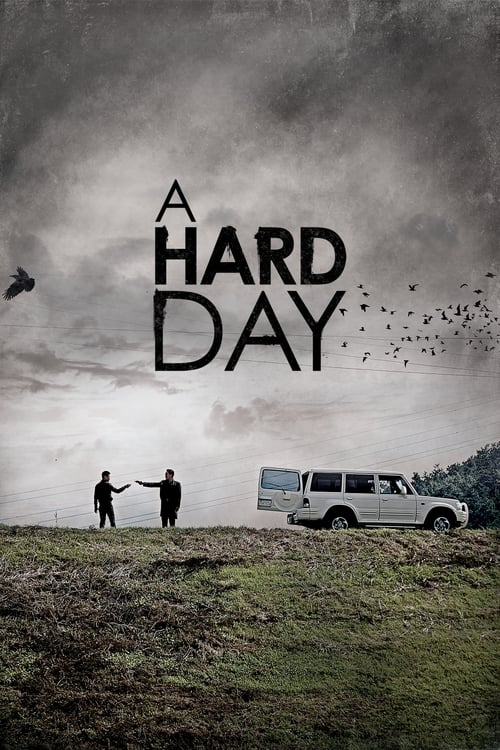
A Hard Day
2014 · Kim Seong-hun
For when you want pure propulsion — a one-sitting, edge-of-the-couch ride that's twisty without being confusing. Great with a crowd; expect involuntary gasps.
What it's about
On the day of his mother's funeral, a corrupt Seoul homicide detective hits a pedestrian with his car — and, panicking, hides the body in the one place no one will look: her coffin. Then a stranger calls, claiming he saw everything. What follows is a cat-and-mouse duel in which every move the detective makes to dig himself out buries him deeper.
The experience
Relentless and blackly funny — a thriller wound so tight it plays like a trap snapping shut in slow motion, with laughs that escape you at the worst possible moments. Once the phone rings, it does not let up.
Performances
Lee Sun-kyun makes the sweating, scheming detective weirdly sympathetic — you root for a man you shouldn't — while Cho Jin-woong is chillingly relaxed as the witness, a heavy who seems to be enjoying himself far too much.
The craft
Kim Seong-hun's direction is a machine of setups and payoffs: every object and lie introduced comes back with interest, and set pieces are staged with clockwork clarity. It's a debut of startling economy — no fat, no wasted scene.
Why it matters
A sleeper hit that traveled from Korea to international festivals and helped cement the global reputation of the Korean thriller as the sharpest genre machinery going. It made Kim Seong-hun a director to watch.
Snapshot
A Hard Day (Korean: 끝까지 간다, lit. "Going to the End") is a feature debut of startling formal economy from director Kim Seong-hun — a machine of escalating dread built from a single corrupt act and the merciless arithmetic of cover-ups. Released in South Korea in May 2014 and screened at the Tribeca Film Festival that same spring, the film centers on Go Geon-su (Lee Sun-kyun), a crooked homicide detective who strikes and kills a pedestrian while driving distracted, then conceals the body inside his mother's coffin during her funeral wake. Almost immediately, a stranger named Park Chang-min (Cho Jin-woong) makes contact, announcing that he saw everything. What follows is a two-hander of relentless invention: each move Go makes to extricate himself tightens the noose, and Park proves to be not merely a blackmailer but something close to an instrument of fate. Working from his own screenplay, Kim constructs the film as a demonstration of pure thriller mechanics — the pleasures here are formal and almost musical, organized around the question of how much worse things can possibly get. The answer, the film insists, is always: considerably worse.
Industry & production
A Hard Day emerged from the upper tier of South Korean commercial genre filmmaking at a moment — roughly 2012–2016 — when that ecosystem was operating at exceptional confidence. The Korean film industry had by the mid-2000s developed a robust production infrastructure anchored by major studio conglomerates capable of financing polished genre work at scale, and the film benefited from this environment; specific production company details are less thoroughly documented in English-language sources than those of some contemporaries, and should be drawn from Korean industry records for precision. What is clear is that the film received wide domestic distribution and that its packaging — a polished mid-budget thriller with commercially legible genre mechanics — was characteristic of the CJ Entertainment-adjacent ecosystem that had by this period become one of the dominant forces in Korean commercial cinema.
Kim Seong-hun had prior experience in television before A Hard Day, and the discipline evident in his construction — the efficient exposition, the clean escalation of complications — is consistent with a director trained in the compressed narrative rhythms of commercial television drama, where pacing and clarity are professional requirements rather than aesthetic preferences. The film was written by Kim himself: the screenplay's elegant cat-and-mouse architecture did not arise from adaptation but from original construction, and its internal consistency reflects a single authorial intelligence governing both structure and incident.
The casting of Lee Sun-kyun was, at the time, a counterintuitive choice. He was considerably better known as a television actor — a face associated with domestic drama series, not action or crime — and his casting against type produces a productive tension. Cho Jin-woong, by contrast, was already established as a character actor of formidable range, recognized for significant work in Nameless Gangster: Rules of the Time (2012) and The Berlin File (2013); casting him as the implacable antagonist was a more legible choice that nonetheless gave him unusual room. His performance became one of the film's most discussed elements internationally and drew major recognition at Korean film awards — reports consistently cite his receipt of the Best Supporting Actor award at the Blue Dragon Film Awards for this role, though precision on specific Korean award records should be verified against authoritative domestic sources.
The film premiered in South Korea in May 2014 and played Tribeca in April 2014, the festival exposure preceding domestic release in some international markets in a manner that suggests confidence in the film's legibility beyond Korean audiences. Domestic box-office performance was solid; specific figures are not reliably reproduced in English-language scholarship and are not reproduced here.
Technology
A Hard Day was shot digitally, in keeping with standard Korean commercial production practice by 2013–2014, when the industry had largely transitioned away from film stock for theatrical features of this budget range. The precise camera package has not been widely publicized in accessible production documentation, though the visual result — cool and somewhat clinical in its daytime sequences, increasingly oppressive in its nocturnal and interior passages — is consistent with the high-dynamic-range latitude of digital cinematography systems standard to Korean commercial productions of the period, such as the ARRI Alexa. The film does not draw attention to its technological substrate; the digital image serves the thriller's demands for spatial clarity and controlled atmosphere rather than expressionist texture for its own sake.
Sound design plays a substantially technical role, particularly in sequences dominated by phone calls and off-screen threat, and the film's deployment of ambient noise, mobile audio compression, and environmental sound betrays careful post-production work. The production design constructs a convincingly quotidian Korean urban-suburban environment — the police station, the funeral home, the mid-range apartment block, the rain-slicked outer road. None of these spaces are stylized; their very normalcy is part of the film's argument about how ordinary the preconditions for catastrophe can be.
Technique
Cinematography
The film's visual approach is disciplined rather than decorative. The opening sequences — Go Geon-su driving at night, distracted and stressed, the accident occurring in a moment of terrible banality — establish an aesthetic of observational proximity, keeping the camera close enough to register the actor's physical state without sacrificing spatial clarity. Wide shots are deployed strategically to establish geography when the film requires the audience to understand blocking; close-ups are reserved for physiological detail — sweat, blinking, the micro-expressions of a man calculating rapidly under pressure.
The extended sequence in which Go maneuvers a body through a funeral home and into a coffin is staged with particular compositional care. The dark comedy of logistics — this is genuinely funny in the manner of the Coen Brothers — requires the audience to track spatial relationships precisely, and the cinematography cooperates, maintaining coherence through potentially confusing action. The choice to keep much of this sequence in medium shot, resisting close-up cutaways that would fragment the action into impressionistic detail, emphasizes the elaborate physical reality of what Go is doing. It refuses to let the scene become abstract, insisting on the specific weight and awkwardness of concealment.
Nocturnal sequences in the film's second half — as Go and Park move toward direct confrontation — shift toward a tighter, more constricted visual vocabulary. Pools of artificial light, architecture that seems to compress, an increasing reluctance to open space up. The visual strategy mirrors the dramatic one: exit routes close as the film proceeds.
Editing
The editing tempo is one of the film's most distinctive formal features. The first act sustains a pace of steady accumulation — sequences are given room to develop their consequences — before the cut rhythm accelerates markedly as Park's presence becomes active and threatening. This modulation of tempo is a classical thriller technique, but it is executed here with precision, and the transitions between frenetic action and moments of terrible stillness are managed without losing momentum. The coffin sequence has a stop-start quality, repeatedly interrupting its own suspense with procedural detail, that is characteristic of a particular strain of Korean crime cinema: refusing pure streamlining, insisting on the specific texture of how things are done, and trusting that texture to generate rather than dissipate tension.
Mise-en-scène / staging
The staging reveals a director who thinks spatially and understands architecture as dramatic material. The funeral home sequence, the car sequences, the apartment — each setting is used to its logical maximum. Characters cannot simply walk away; spaces constrain and direct. The film employs the logic of the closed system: the coffin is the literal instance of the principle governing the entire film — hiding something generates its own inescapable trap — and the staging of this sequence makes the metaphor spatial and physical.
Cho Jin-woong's character is staged throughout in configurations of imbalance: appearing at unexpected angles, positioned in the frame to suggest he occupies more space than is geometrically reasonable, a formal analog to the character's narratively superhuman quality of seeming to know more than he should. The staging of his phone calls in particular — intercut with Lee Sun-kyun's increasingly unraveling performance — has a formal elegance that the film's thriller mechanics make easy to overlook.
Sound
The film is substantially a sound-driven experience in its middle section. The primary dramatic relationship — Go and Park — is conducted almost entirely through mobile phone audio for a significant stretch, and the sound design must therefore carry enormous dramatic weight. Park's voice on the phone, rendered with the slightly compressed, intimate quality of mobile audio against ambient environmental noise, functions as the film's principal source of dread. Cho Jin-woong's delivery — measured, almost amused, infuriatingly calm — would be effective in any medium, but the decision to embed that performance in the specific acoustic texture of a phone call, with all its connotations of private access and inescapability, amplifies the threat considerably.
The film's score operates in the spare, tense register characteristic of Korean crime cinema of the period: functional rather than expressive, present enough to sustain tension without imposing emotional direction. Composer attribution is not consistently reproduced in English-language sources consulted for this account, and specific credit should await more complete production documentation. The film trusts its performances and situations to generate affect, and the score respects that trust.
Performance
Lee Sun-kyun's performance is the film's engine and the source of most of its comedy. He plays Go as a man whose fundamental characteristic is competence under pressure — he is, after all, a detective — and the dark humor arises from watching that competence deployed in the service of increasingly desperate improvisation. Lee's physicality is central: he sweats convincingly, moves with the specific economy of someone trying not to be noticed, and registers fear in a way that remains legible without tipping into caricature. His is a performance of sustained and varied panic, calibrated so that the audience remains in his corner even as his moral failings accumulate and his situation becomes genuinely of his own making.
Cho Jin-woong operates in an entirely different register: still where Lee is frenetic, amused where Lee is desperate, deliberate where Lee improvises. Park Chang-min presents as a figure of almost supernatural knowledge and composure — the film eventually reveals his backstory and motivation, grounding him in recognizable psychology — but Cho's performance sustains the character's uncanny quality even as the narrative demystifies him. The restraint he brings to what could easily have been a scenery-chewing villain role is one of the film's genuine achievements, and that restraint is what makes Park's occasional eruptions of violence so effectively disorienting.
Narrative & dramatic mode
A Hard Day operates in the mode of the escalation thriller: a narrative organized around the principle that each solution to a problem generates a worse problem, and that moral compromise, once begun, cannot be arrested at a manageable threshold. The structure is grimly logical — almost algebraic. Go's original sin (the hit-and-run) is compounded immediately (concealing the body), which creates a new vulnerability (the witness), which requires further compromise, and so on. The plotting is a demonstration of why cover-ups fail, made entertaining through the specificity and inventiveness of each new complication.
The tone is distinctive and somewhat singular: A Hard Day sustains genuine comedic affect throughout — the coffin sequence produces laughter as well as suspense — without ever releasing the underlying moral tension. This is a harder tonal register to manage than pure thriller or pure dark comedy, and Kim navigates it with confidence. The humor is not relief from the stakes but a sharpening of them: the funnier the logistics of concealment become, the more horrifying the underlying situation remains. Go Geon-su does not stop being a man who killed someone and is trying to escape accountability; the comedy never absolves.
The film is structured significantly around dramatic irony: the audience knows things Go does not, and knows things Go believes are hidden that Park already possesses. This creates a particular kind of viewing pleasure — the irony-driven thriller mode, in which suspense arises not primarily from uncertainty about outcome but from the anticipation of revelation. Park knows. The audience knows Park knows. Go does not know Park knows. Kim milks this structure with evident relish and considerable craft.
Genre & cycle
A Hard Day belongs to the specific cycle of Korean crime and thriller filmmaking that consolidated in the mid-2000s and ran through the 2010s. This cycle — sometimes loosely grouped under the umbrella of New Korean Cinema, though that label more precisely designates the late-1990s/early-2000s generational breakthrough — includes Na Hong-jin's The Chaser (2008) and The Yellow Sea (2010), Bong Joon-ho's Mother (2009), Kim Jee-woon's I Saw the Devil (2010), and the procedural tradition extending back to Bong's Memories of Murder (2003). Within this cycle, A Hard Day occupies a particular niche: the single-protagonist escalation thriller, narratively tighter and more mechanically focused than the morally panoramic crime epics that characterize some of its peers.
The film also participates in the global noir tradition of the morally compromised protagonist trapped in an impossible situation — a genre formation with deep roots in Hitchcock and American film noir, rerouted here through specifically Korean institutional settings: the corrupt police force, the bureaucratic apparatus of a Korean funeral home, the specific geography of contemporary Seoul's suburban periphery. The Korean inflection is significant: Go is not an innocent wrong-manned into catastrophe but a guilty party whose corruption predates the film's opening. The genre convention of audience identification with a morally compromised protagonist is used with full awareness of its ethical complexity, and the film never pretends otherwise.
Authorship & method
Kim Seong-hun, who wrote and directed A Hard Day, approaches genre not as a vehicle for personal statement but as a formal problem to be solved — and solved elegantly. The screenplay's internal logic is unusually clean: each complication follows from the previous one with the coherence of a puzzle, and the satisfaction the film generates is partly the satisfaction of watching an architecture hold together under strain. His prior television experience likely cultivated the efficient exposition and compressed pacing that the theatrical feature inherits.
The decision to center the film's most sustained tension in phone calls — essentially a radio-dramatic technique — is confident and distinctive. It transforms a potentially static situation into a source of sustained dread by collapsing geography: Park can reach Go anywhere, and the specific acoustic quality of the calls makes that reach feel intimate and inescapable.
Kim's subsequent feature, Tunnel (2016), confirmed the pattern established here: a formally controlled genre exercise, again featuring a single protagonist in an impossible situation, again building suspense through systematic escalation, again finding dark comedy in the procedural specifics of a crisis. The two films constitute a recognizable authorial approach, if not yet a fully elaborated worldview — a director whose métier is the problem of endurance, of a figure who must keep thinking and moving while everything around him collapses.
In terms of key collaborators, the production lacked — as far as English-language sources document — a prominent recurring partnership of the kind that marks some Korean genre cinema of this period. Specific cinematographic, editorial, and compositional credits are less thoroughly circulated in international scholarship than those for some contemporaries; the film's reputation rests primarily on Kim's directorial construction and the performances of its two leads.
Movement / national cinema
A Hard Day belongs to the moment of mature industrialization in Korean genre cinema — the phase following the New Korean Cinema breakthrough of Park Chan-wook, Bong Joon-ho, and Kim Jee-woon, and preceding the global inflection point represented by Parasite's Palme d'Or in 2019 and Academy Award for Best Picture in 2020. In the 2010s, Korean commercial genre filmmaking had developed the infrastructure and confidence to produce polished, internationally competitive work across a range of thriller sub-genres, and A Hard Day is representative of that maturity: a film that competes comfortably with comparable European and American genre cinema without requiring the cultural-explicatory framing that sometimes attached to earlier Korean art-genre crossover work abroad.
The film contributes to the ongoing critical project in Korean cinema of reckoning with institutional corruption — the police force, the bureaucracy, the class system — as thriller material. Korean crime cinema of this period returns repeatedly to the figure of the corrupt or complicit official, and A Hard Day is notable for making its corrupt detective the identification figure rather than the antagonist of a morally uncomplicated narrative. The institutional critique is embedded in the genre mechanics rather than foregrounded as social commentary: the corruption of the system is simply the given condition in which the story operates, which is itself a more searching indictment than accusatory framing would produce.
Era / period
2014 is a specific moment in South Korean cultural production. Domestic box-office records that year were broken by Ode to My Father with melodrama and The Admiral: Roaring Currents with historical spectacle — event-film formations aimed at mass audiences. A Hard Day occupies a different register from these popular peaks: a mid-budget genre exercise whose ambitions are formal rather than commemorative. It belongs nonetheless to the same moment of intense productivity in Korean commercial cinema, a period when the critical infrastructure for Korean cinema's global reception was becoming established and when international audiences had developed genuine appetite for genre work from Korean directors.
The film appeared two years before the domestic crime procedural drama Signal (2016) would expand the market for Korean police narratives with a genre-inflected, temporally complex sensibility; whether direct production lineages connect these works is unclear, but they share an environment.
Themes
Moral entropy. The film's central dramatic mechanism is also its central theme. The logic of the cover-up — that each step taken to conceal wrongdoing requires further wrongdoing — is staged as a form of entropy: once begun, the process cannot be reversed or stabilized at a comfortable level. Go Geon-su does not face a single choice but a cascade of them, each worse than the last.
Institutional corruption as precondition. Go is corrupt before the film begins — the career pressures and internal affairs investigation alluded to in the opening suggest a man already compromised by the institution he inhabits. The accident is not a fall from innocence but an intensification of already-existing moral failure. The film situates personal corruption within a recognizable institutional environment, implying that the police force as an institution is not merely a setting but a causal condition.
The unknowable witness. Park Chang-min functions thematically as guilt made external — a conscience that Go's internal architecture has apparently failed to generate, now appearing as a hostile presence outside. His seeming omniscience gives the film a faint quality of moral allegory: guilt cannot be outrun because it is always already watching, and it knows exactly what you have done.
The dark comedy of the procedural. The film generates much of its tone from the gap between the enormity of what Go has done and the bureaucratic, logistical specificity of what concealing it requires. The coffin sequence makes literal the film's comic-morbid argument: to escape one's crime requires entering into intimate proximity with death in increasingly absurd ways. The more elaborate the concealment, the more comprehensively the body is involved.
Reception, canon & influence
A Hard Day was warmly received on the international festival circuit following its Tribeca 2014 premiere. Critics noted the film's tonal confidence — the simultaneous management of comedy and thriller tension — and the quality of both central performances. Cho Jin-woong's work as the antagonist attracted particular praise and drew major recognition at Korean film awards, with his Blue Dragon Film Award recognition consistently cited in coverage, though precise records should be verified against authoritative Korean sources. Domestically, the film performed well without becoming a cultural event on the scale of that year's blockbusters. It circulated widely on streaming platforms and developed a substantial international audience in subsequent years as Korean genre cinema attracted more consistent global critical attention.
Backward influences. The film's most evident Korean ancestor is Na Hong-jin's The Chaser (2008), which established the template for the compressed single-protagonist crime escalation thriller in Korean cinema — the ticking timeline, the procedural specificity, the dark comedy of catastrophe, the almost superhuman quality of the antagonist who cannot be shaken. Behind The Chaser lies the Korean crime realist tradition extending through Memories of Murder (2003), itself inflected by the procedural films of the 1980s and 1990s. Internationally, the Coen Brothers' Fargo (1996) and No Country for Old Men (2007) are the most structurally relevant analogs: narratives organized around escalating consequences and the impossibility of outrunning one's crimes, with dark comedy and existential threat coexisting. Hitchcock's influence is diffuse but pervasive — the identification with a morally compromised protagonist, the architecture of suspense built on dramatic irony, the use of setting as a trap. The figure of the pursuer who cannot be outmaneuvered has distant relatives in No Country's Anton Chigurh and in the implacable antagonists of French polar cinema.
Forward influence. A Hard Day is not typically identified as a direct originating influence on subsequent Korean films, in part because it participates in a cycle rather than initiating one. Its significance is more diffuse: it confirmed the viability and international appetite for the Korean crime escalation thriller and expanded the genre's casting range — demonstrating, through Lee Sun-kyun's performance, that television-identified dramatic actors could anchor action-inflected crime cinema. Kim Seong-hun's subsequent Tunnel (2016) confirmed that A Hard Day was the first statement of a sustained formal approach. Lee Sun-kyun's later international recognition came substantially through Bong Joon-ho's Parasite (2019), where he plays another man whose social position rests on a concealed reality; the thematic resonances between the two films, while not causal, are legible in retrospect.
The retrospective weight of the film increased following Lee Sun-kyun's death in December 2023, which prompted renewed critical attention to his career across television and theatrical work. Reappraisal confirmed what the 2014 festival circuit had suggested: that A Hard Day is among the better Korean genre films of its decade, and that Lee Sun-kyun's performance in it — specifically the comedic precision of his panic — was among his finest work, one that demonstrated a range his more celebrated late-career roles tended to underplay.
A Deleuzian reading
A man kneels in a funeral home and tries to fold a dead stranger into his mother's coffin.
The full Deleuzian reading of A Hard Day →
Reception
It premiered in the Directors' Fortnight at Cannes 2014 and became a word-of-mouth hit in Korea; a decade on it's a fixture of 'underrated Korean thriller' lists, with fresh eyes on it after Lee Sun-kyun's post-Parasite fame — and, more somberly, after his death in 2023 sent people back to his best roles.
How A Hard Day was received, from release to now →
Influences: the films it descends from and the films it influenced
- The Chaser (2008) — Established the Korean crime-escalation template A Hard Day inherits directly: a compressed single-protagonist timeline, procedural specificity in staging urban pursuit, and an antagonist whose calm intelligence makes flight impossible — the architecture Kim Seong-hun tightens into a single night.
- Memories of Murder (2003) — Originated the Korean procedural-realist convention of encoding dark comedy within the architecture of investigative failure — the mode where catastrophe and absurdity are staging conventions, not tonal departures, that A Hard Day's opening act inherits wholesale.
- Oldboy (2003) — Established the New Korean Cinema formal convention of closed-system logic: built architecture as an inescapable trap whose coherence tightens with each escape attempt, the structural grammar A Hard Day applies to a police station, a coffin, and a funeral home.
- Fargo (1996) — The structure in which a single bad decision generates an escalating cascade of compounding consequences, with dark comedy and genuine menace operating simultaneously — a protagonist who cannot stop digging, and whose every corrective action worsens his position.
- No Country for Old Men (2007) — The restrained-villain template: an antagonist who controls space through procedural calm, making architecture itself adversarial, whose pursuit cannot be outrun because it follows a logic the protagonist cannot comprehend — the direct grammar of Cho Jin-woong's corrupt detective.
- Rope (1948) — The dramatic-irony architecture of concealing a body within a domestic space while performing normalcy under social surveillance — suspense organized entirely around the gap between audience knowledge and the ignorance of characters sharing the frame with the hidden corpse.
- Psycho (1960) — Establishes the protagonist-as-perpetrator mode in which concealment guilt is externalized in staging — the character who must perform innocence while actively managing evidence, drawing audience identification against moral logic, the precise situation of A Hard Day's first act.
- Les Diaboliques (1955) — The body-disposal thriller template: a hidden corpse becomes the organizing pivot of all subsequent suspense, with architecture systematically turned into a trap that tightens with each attempt to secure the concealment against discovery.
- After Hours (1985) — The single-night urban-nightmare escalation structure — an ordinary man's evening spiraling into dark-comedy catastrophe through compounding misfortune — with the city staged as a closed hostile system that consistently withholds exit, the tonal register A Hard Day inherits for its nocturnal second half.
- Le Samouraï (1967) — The emotionally opaque, procedurally intelligent antagonist whose restraint functions as menace — the restrained-villain performance grammar in which stillness and methodical spatial control communicate threat more effectively than aggression, inherited directly by Cho Jin-woong's performance.
- The Yellow Sea (2010) — Extends the same Korean crime-escalation cycle into a longer nocturnal register, applying the relentless-pursuer structure and procedural action specificity to a protagonist who cannot simultaneously escape institutional and criminal pursuit — the sibling film to A Hard Day's more compressed model.
- Tunnel (2016) — Kim's direct follow-up applies the same closed-system architectural logic — a protagonist trapped within built structure, unable to exit — to a survival-thriller frame, confirming A Hard Day as the first complete statement of his formal approach to escalation-thriller construction.
- Parasite (2019) — Lee Sun-kyun's countertype-casting as a man whose domestic comfort rests on concealed realities carries the same performance grammar developed in A Hard Day — the physical specificity of performing normalcy atop guilt — while Bong extends the closed-system architectural logic into the film's literal underground staging.
- A Bittersweet Life (2005) — Shares the Korean nocturnal thriller's cinematographic grammar — medium-shot observational staging in institutional interiors, artificial light as a spatial threat indicator — and the dual-antagonist structure in which institutional authority and criminal violence converge simultaneously on a single protagonist.
- The Wailing (2016) — Extends New Korean Cinema's tonal-compression method — the sustained management of dark comedy and escalating dread across a single runtime — demonstrating that A Hard Day's genre-register modulation belongs to a broader formal movement rather than individual authorial invention.
- Good Time (2017) — The sustained-panic performance structure tracked in observational proximity by a restless camera through a compressed nocturnal timeline — a protagonist whose physical distress is the film's primary register, with architecture consistently converting from refuge to trap.
- Confession of Murder (2012) — Deploys epistemological uncertainty as a sustained narrative engine — the audience's calibrated partial knowledge generating dramatic irony from the gap between what different characters know — the same structural mechanism that drives Confession of Murder's central conceit.
- Asura: The City of Madness (2016) — Sibling dirty-cop noir where a single corrupt detective spirals through escalating cover-ups, the compromised-protagonist descent-structure Asura runs to its bleakest end.
Similar films
- Memories of Murder (2003) — influence & lineage · same viewing thread
- Oldboy (2003) — influence & lineage · same viewing thread
- The Chaser (2008) — influence & lineage · same viewing thread
- Parasite (2019) — influence & lineage · same viewing thread
- A Bittersweet Life (2005) — influence & lineage
- The Yellow Sea (2010) — influence & lineage
- Memoir of a Murderer (2017) — same viewing thread
- 12.12: The Day (2023) — same viewing thread
All the films related to A Hard Day →
Watch it with: curated runs of related films
- New Korean Cinema — Watch these in a run and you feel one national cinema flip between monster movie, revenge thriller, gothic horror, and slow-burn procedural without ever loosening its grip on class, history, and family.