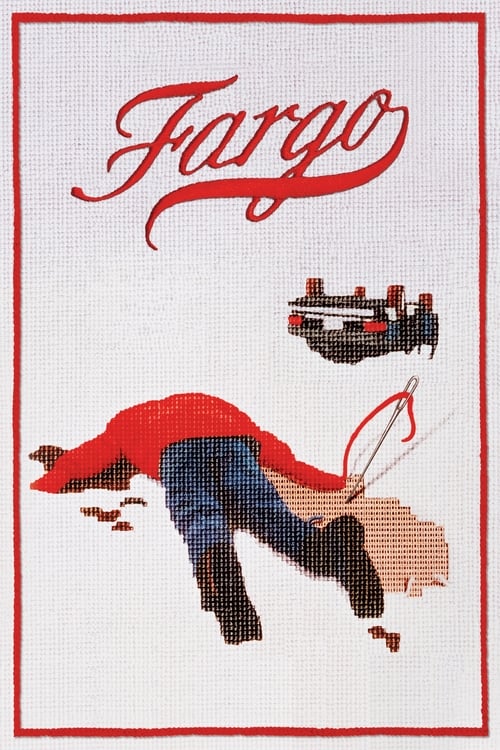
Fargo
1996 · Joel Coen
When you want a crime story with personality — dark enough to thrill, funny enough to delight, and short enough for a weeknight. One of the rare classics that's equally right for a first date or a tenth rewatch.
What it's about
Jerry Lundegaard, a drowning-in-debt Minnesota car salesman, hires two lowlifes to kidnap his own wife so he can skim the ransom from his rich father-in-law. The plan is supposed to be clean and bloodless; it is neither, and soon Marge Gunderson — the unfailingly polite, heavily pregnant police chief of a small town — is calmly working the case through the snow.
The experience
A one-of-a-kind mix: laugh-out-loud funny about its chipper Midwestern manners, then suddenly, genuinely brutal, and somehow warmer than any crime film has a right to be. It's tense and cozy at once — you wince and grin in the same scene.
Performances
Frances McDormand's Marge is one of the most beloved performances of the 1990s — decency and sharp intelligence wrapped in small-town pleasantries. William H. Macy is squirmingly perfect as Jerry, a weak man lying his way deeper into disaster, and Steve Buscemi is unforgettable as the twitchier of the two kidnappers.
The craft
The Coens shoot the snowbound flatlands as a white void that swallows people and their schemes, and the dialogue turns regional politeness — all those 'yah's and 'you betcha's — into both comedy and camouflage. Carter Burwell's mournful score gives the mayhem an unexpectedly grand, folkloric weight.
Why it matters
The film that took the Coen brothers from cult favorites to mainstream American masters, winning Oscars for McDormand and for their screenplay, and setting the template for decades of snowy small-town crime stories on film and TV.
Snapshot
Fargo is the Coen brothers' sixth feature, a crime story set in the snowbound upper Midwest that pairs a botched kidnapping-for-ransom scheme with the patient, almost pastoral detective work of a heavily pregnant small-town police chief. Joel Coen received sole directing credit and Ethan Coen sole producing credit (per their long-standing practice at the time), but the film was, as with all their work, written, directed, and edited jointly. It marked a return to lean, character-driven storytelling after the elaborate studio comedy of The Hudsucker Proxy (1994), and it became the film that broadened the Coens' reputation from cult auteurs to mainstream-recognized American filmmakers. Frances McDormand's Marge Gunderson became one of the most celebrated screen performances of the decade, and the film's blend of bloody violence, regional comedy, and genuine moral seriousness established a tone that critics have struggled to name ever since. The famous opening title card claiming the film is a true story is itself a fiction — a deliberate framing device the Coens later acknowledged as invented.
Industry & production
Fargo was an independently financed production distributed by Gramercy Pictures (the PolyGram/Universal joint venture), made on a modest budget widely reported at roughly $7 million — a figure consistent with the Coens' habit of working economically. Producer Ethan Coen and the brothers' regular producing partner network kept the scale small, and the film was shot largely on location in Minnesota and North Dakota during the winter of 1994–95. A notorious production challenge was the lack of snow that season: the upper Midwest experienced an unusually mild, brown winter, forcing the production to chase snowfall and at points relocate. Reports indicate some shooting moved to North Dakota and even to colder locations to secure the white, featureless landscapes the film required; the production also used artificial snow and carefully chosen overcast skies. The result is a landscape that reads as a near-abstract white void, a deliberate aesthetic the weather nearly denied them.
The film premiered at Cannes in 1996, where Joel Coen won Best Director, and went on to a strong critical run and respectable arthouse box office. At the Academy Awards it won two Oscars — Best Actress for Frances McDormand and Best Original Screenplay for Joel and Ethan Coen — from seven nominations, a level of mainstream recognition the brothers had not previously achieved. The casting drew on the Coens' established repertory: McDormand (Joel Coen's spouse and a frequent collaborator since Blood Simple), Steve Buscemi, John Carroll Lynch, and Peter Stormare, alongside William H. Macy, whose audition for the role of Jerry Lundegaard became part of the film's lore.
Technology
Fargo was shot photochemically on 35mm color film, finished and distributed in the conventional analog manner of mid-1990s American cinema; it predates the digital-intermediate workflows that would become standard in the following decade. There is nothing technologically experimental about the capture format — the film's distinctiveness lies in compositional and lighting choices rather than apparatus. What is notable is the film's exploitation of natural winter light and the photographic problem of rendering a near-monochrome white-on-white world legibly on color stock, which placed unusual demands on exposure and on the cinematographer's judgment about how much detail to retain in snow and overcast sky. The film's editing was cut under the pseudonym "Roderick Jaynes," the fictional British editor the Coens credit for their own editing work — a long-running in-joke rather than a real collaborator.
Technique
Cinematography
Roger Deakins, in his third collaboration with the Coens, photographed Fargo, and it stands among the most discussed of his early career. The defining strategy is the use of the snowbound landscape as a vast negative space: flat gray-white skies meeting flat white ground, with human figures and cars reduced to small dark marks within an almost featureless field. Deakins and the Coens repeatedly place action in wide, static or slow compositions where the environment dwarfs the characters, emphasizing isolation and the indifference of the setting to the human folly unfolding within it. The palette is desaturated and cold, dominated by whites, grays, and muted earth tones, with warmth reserved for interiors. Deakins balances these expansive exteriors against tightly observed, naturalistically lit interiors — diners, offices, the Lundegaard home — that ground the film's comedy in mundane texture. The cinematography is restrained relative to the more baroque camerawork of earlier Coen films; the showmanship is in the framing and the courage to let emptiness carry the image.
Editing
The editing, credited to "Roderick Jaynes" (the Coens themselves), is patient and classical in its rhythm, allowing scenes to breathe and letting comedy and dread accumulate through duration rather than rapid cutting. The film alternates between the crooks' escalating disaster and Marge's methodical investigation, and the cross-cutting deliberately withholds the conventional thriller acceleration — Marge does not even appear until well into the film. The cutting favors held wide shots and lets performances play out, which is essential to the film's tonal control: violence erupts suddenly within otherwise placid framing, and the editing refuses to sensationalize it.
Mise-en-scène / staging
Production design renders a hyper-specific vision of upper-Midwestern life: wood-paneled rec rooms, fluorescent-lit car dealerships, Formica diners, parka-and-earflap-hat winter dress, and the relentless beige-and-brown domesticity of the period and place. The staging frequently isolates characters within these mundane environments, and the Coens compose for awkward social ritual — the strained politeness of Minnesotan conversation becomes a structuring element of the staging. The famous wood chipper, the snow-blanketed parking lots, and the anonymous motels all function as carefully chosen settings in which ordinariness and horror coexist.
Sound
Carter Burwell, the Coens' regular composer, scored the film with a mournful, folk-derived theme based on a Norwegian melody, performed with a gravity that runs counter to the comic surface and lends Marge's world an unexpected tragic dimension. The score is sparing, used to underline the bleakness of landscape and the moral weight of the violence rather than to goose suspense. Equally important is the film's celebrated soundscape of speech: the broad upper-Midwestern accents, the "yah"s, "you betcha"s, and "oh geez"es, are deployed with documentary attentiveness and become both the film's chief comic instrument and a marker of its regional authenticity. Diegetic sound — the crunch of snow, the hum of engines, the drone of the wood chipper — is foregrounded against the quiet.
Performance
The performances are calibrated to a precise regional register that risks caricature and largely avoids it. Frances McDormand's Marge Gunderson is the film's moral center: shrewd, unflappable, decent, and pregnant, she embodies a competence and ordinary goodness set against the venal scheming around her, and McDormand's restraint — the warmth, the deadpan, the genuine intelligence beneath the folksy manner — earned her the Academy Award for Best Actress. William H. Macy's Jerry Lundegaard is a study in flop-sweat desperation, a weak man whose every improvisation digs him deeper, played with a squirming, almost unbearable specificity. Steve Buscemi's twitchy, talkative Carl and Peter Stormare's near-silent, affectless Gaear form a grimly comic criminal pair, their mismatch generating both humor and menace. John Carroll Lynch, as Marge's stamp-painting husband Norm, anchors the film's quiet counter-theme of marital tenderness.
Narrative & dramatic mode
Fargo operates as a crime narrative inverted toward irony and moral observation. Its structure is the inexorable unraveling of a scheme: Jerry's plan is presented as foolproof and proceeds to collapse through accident, panic, and the basic incompetence of everyone involved. The film's dramatic engine is dramatic irony — the audience watches a chain of avoidable catastrophes that the characters cannot see — and its tone hinges on the collision of the banal and the horrific. The investigation plot, when it arrives, is procedural and unhurried; Marge solves the case less through brilliance than through patient attention and common sense. The film withholds the genre's usual catharsis: there is no master criminal, no clean justice, only waste, and Marge's closing reflection ("And for what? For a little bit of money") delivers the film's bewildered moral judgment directly. The mode is finally one of cosmic absurdity tempered by a sincere belief in ordinary decency.
Genre & cycle
The film sits within the American crime film and the broader noir tradition — the doomed scheme, the small man in over his head, the spiraling body count — but it complicates noir by relocating it to a brightly lit, snowbound, almost comic provincial setting rather than the shadowed urban world the genre conventionally inhabits. It belongs equally to the 1990s wave of stylized, ironic, violent American independent crime films, often grouped with the post-Pulp Fiction moment, though Fargo is tonally distinct in its regional specificity and its moral earnestness. It is also a Coen-brothers genre artifact: like Blood Simple and Miller's Crossing, it reworks crime conventions through authorial irony, here fused with a folk-comic regionalism that is largely the brothers' own invention.
Authorship & method
Fargo is a fully collaborative Coen brothers work — co-written, co-directed, and co-edited — despite the divided formal credits. The film exemplifies their method: meticulously written screenplays that are shot close to the page, a controlled visual style developed with a stable team of collaborators, and a sensibility that holds genre pastiche, dark comedy, and a streak of genuine humanism in tension. The Coens drew on their own upbringing in Minnesota for the setting and speech, lending the film a specificity outsiders could not have manufactured. Key collaborators are central to the result: cinematographer Roger Deakins, whose landscape work defines the film's look; composer Carter Burwell, whose elegiac score supplies its emotional undertow; and the Coens themselves as editors under the Roderick Jaynes pseudonym. Frances McDormand functions almost as an authorial collaborator given her long association with the brothers. The screenplay's "true story" claim is a deliberate authorial gesture: the Coens have stated the film is not based on a single real case, and the framing is a fiction designed to shape the viewer's relationship to the events — a characteristically sly move.
Movement / national cinema
Fargo belongs to American independent cinema of the 1990s, the milieu in which the Coens had operated since Blood Simple (1984), working outside the major studios with modest budgets and full creative control. Within that landscape it is a distinctly regionalist American film, drawing its texture from the upper Midwest in a way that few American films had done with such specificity. It does not belong to a formal movement so much as to the Coens' personal authorial cinema, which absorbs classical Hollywood genre, film noir, and a literary irony into a recognizable house style. Its international recognition at Cannes situated it within the broader global art-cinema circuit's embrace of American independents during that decade.
Era / period
The film is a product of the mid-1990s American independent boom, when distributors like Gramercy, Miramax, and others built theatrical markets for stylized, director-driven films and when violent, ironic crime pictures were ascendant in the wake of Pulp Fiction (1994). It reflects that moment's appetite for genre reinvention and tonal mixing. At the same time, its setting is essentially contemporary to its making — a recognizable 1990s Midwest of car dealerships, diners, and modest suburban homes — and the film treats that present-day ordinariness with an almost ethnographic eye, making the period texture part of its subject.
Themes
At its core Fargo is about the disproportion between greed and its consequences — the vast human cost of a scheme over "a little bit of money." It contrasts venality and decency: Jerry's grasping desperation and the crooks' callousness set against Marge's contented, principled ordinariness and her warm marriage to Norm. The film meditates on the banality of evil and the banality of goodness alike, locating both in the most unremarkable people and settings. The snowbound landscape externalizes themes of moral coldness, isolation, and indifference, while the recurring motif of money — pursued, hidden in the snow, never enjoyed — underscores its futility. Marge's bafflement at the violence ("I just don't understand it") articulates the film's stance: a sincere moral incomprehension in the face of pointless cruelty, set against an affirmation of small, decent lives.
Reception, canon & influence
Fargo was met with strong critical acclaim on release and quickly entered the canon of major 1990s American films. Its Cannes Best Director prize, its seven Oscar nominations, and its wins for McDormand and the Coens' screenplay marked the brothers' arrival as recognized American auteurs rather than cult figures. Marge Gunderson has been widely celebrated as one of the great screen characters of the era, and the film is frequently cited in critics' and institutions' lists of the best American films of the decade and of the century's end; it was selected for preservation in the United States National Film Registry, a marker of its institutional canonization.
Influences on the film run backward to film noir and the American crime tradition, to the doomed-heist and small-time-criminal narratives of classical Hollywood, and to the Coens' own earlier crime work, particularly the dread-and-irony of Blood Simple. The regional comedy and speech draw on the brothers' Minnesota background rather than on cinematic precedent.
Its legacy forward is substantial. Fargo helped legitimize a strain of American filmmaking that fuses graphic violence with deadpan comedy and regional specificity, and its influence is visible across subsequent crime cinema and prestige television's appetite for morally serious, tonally mixed regional crime stories. Most directly, it spawned the acclaimed FX anthology series Fargo (created by Noah Hawley, beginning 2014), which extends the film's setting, tone, and moral preoccupations into new stories while explicitly invoking the original, including its "true story" conceit. The film cemented the Marge-type figure — the underestimated, decent, competent investigator — as a durable archetype, and it remains the work most responsible for the popular image of the Coen brothers' sensibility: bleak, funny, violent, and quietly humane.
A Deleuzian reading
Start with the windshield.
The full Deleuzian reading of Fargo →
Reception
No reappraisal needed — it was a sensation on arrival, winning Best Director at Cannes and two Oscars, then got fast-tracked into the National Film Registry in 2006, its very first year of eligibility. Rare case of a film the culture got right immediately and never let go of.
How Fargo was received, from release to now →
Influences: the films it descends from and the films it influenced
- Blood Simple (1984) — The Coens' debut establishes the template Fargo refines — a botched small-time crime spiraling through dramatic irony where the audience knows more than any character, scored by Carter Burwell's first elegiac collaboration.
- The Asphalt Jungle (1950) — Huston's heist-of-doomed-amateurs noir supplies the structural blueprint: ordinary, greedy men whose meticulous plan unravels through human weakness rather than external pursuit.
- The Killing (1956) — Kubrick's fractured-heist film models the cross-cutting that withholds and then accelerates catastrophe, the everyman desperation Macy reprises as flop-sweat panic.
- Double Indemnity (1944) — Wilder's insurance-fraud noir is the direct genre ancestor of Jerry Lundegaard's scheme — greed disproportionate to its payoff, ruin engineered by a respectable nobody.
- In Cold Blood (1967) — Brooks's flat-plains true-crime film pioneers the 'based on a true story' framing and the cold, wide documentary look of Midwestern violence that Fargo ironizes.
- Badlands (1973) — Malick stages banal killing against deadpan affect and vast flat upper-Midwest landscapes, the negative-space-and-horizon compositional grammar Deakins adapts to snow.
- Barton Fink (1991) — The first Coen–Roger Deakins collaboration, where the cinematographer's control of static, precisely framed wide shots and oppressive emptiness is forged before Fargo perfects it.
- The Ladykillers (1955) — Extends the craft of a tidy criminal plan that consumes its own perpetrators through escalating accident, set against an unbudgeable figure of plain decency.
- A New Leaf (1971) — Murder-for-money rendered utterly deadpan against naturalistic regional textures and an ironic score, keeping the violence mundane and the perpetrators politely oblivious in the murder-comedy lineage.
- One False Move (1992) — Perfects the structural move One False Move got to first: a small-town lawman introduced as provincial comedy who turns out to be the film's moral center and its only genuinely competent professional.
- A Simple Plan (1998) — Raimi explicitly works Fargo's seam — snowbound rural greed where a windfall corrodes ordinary people — using the same desaturated white-out landscapes as moral void.
- No Country for Old Men (2007) — The Coens and Deakins extend Fargo's decent-investigator-versus-implacable-violence structure across an arid landscape, retaining the laconic lawman and withheld, off-screen killing.
- Insomnia (2002) — Nolan transposes the snowbound-noir to Alaska, inheriting Fargo's cold pallid light, regional remoteness, and a homicide cop unmoored in a too-bright northern landscape.
- True Detective (2014) — Prestige TV's appetite for morally serious, regionally specific crime — landscape as character, dialect soundscape, tonal gravity — descends directly from Fargo's legitimization of the form.
- Fargo (FX series) (2014) — Hawley's anthology literally extends the film's setting, Norwegian-inflected dialect soundscape, 'true story' conceit, and deadpan-violence tone into serialized form.
- Wind River (2017) — Sheridan builds a snow-negative-space procedural around a quietly competent investigator in frozen wilderness, inheriting Fargo's cold palette and decency-amid-brutality moral frame.
- Three Billboards Outside Ebbing, Missouri (2017) — McDonagh casts McDormand again as a flinty small-town moral center in a tonally mixed regional crime story, drawing directly on her Marge-derived deadpan restraint.
- Hell or High Water (2016) — A regionally exact American crime film fusing economic desperation, dry deadpan comedy, and an underestimated lawman — the Marge archetype relocated to dusty West Texas.
- Mare of Easttown (2021) — The series crystallizes Fargo's durable archetype — the underestimated, decent, dialect-marked local detective — anchoring prestige regional crime in unglamorous female competence.
- In Bruges (2008) — Carter Burwell composed both scores using the same compositional strategy—sparse folk-melodic themes played in ironic counterpoint to violent material rather than underscoring it—producing the sardonic emotional detachment that both films use to hold tragedy and black comedy in suspension.
- Headhunters (2011) — Socioeconomic production design as structural critique: regional affluence rendered as moral vacuum from which criminality logically emerges; Headhunters applies the same principle to Norwegian oil-boom prosperity — the executive's art collection and corporate wardrobe as indictment before a crime occurs.
- Prisoners (2013) — American Gothic suburban uncanny — the provincial landscape as location of incomprehensible violence, with procedural investigation that produces no adequate moral accounting; the winter/rain contrast in palette maps directly.
- Miller's Crossing (1990) — The Coens' patient held-wide-shot editing under the Roderick Jaynes pseudonym, and their genre-pastiche-with-genuine-feeling tone, mature here into the method Fargo deploys.
- Get Shorty (1995) — Crime comedy built on deadpan professionals and ironic reversals, treating violence as banal business — the same flat moral comedy of competence, with Sonnenfeld's Coen-adjacent (he shot their early films) glossy-controlled visual lineage.
- Raising Arizona (1987) — Extends Arizona's affectionate regional-vernacular caricature and its tonal braid of crime, dim-witted criminals, and deadpan warmth, again anchored by Frances McDormand and a Burwell score.
- The Man Who Wasn't There (2001) — Deakins's wide, isolating compositions of ordinary people in flat landscapes, plus the McDormand-led ensemble and the 'mild man's criminal plan goes catastrophically wrong' engine, immediately precede this film in the Coen-Deakins partnership.
- El Infierno (2010) — Sibling in the tonal engine El Infierno runs on — crime staged as absurd regional farce whose comedy curdles into moral tragedy across deadpan wide landscapes.
- Insomnia (1997) — Roger Deakins's whiteout snowscapes remove the horizon and flatten depth so that crime plays out with nowhere to conceal it, paired with a procedural conducted at deadpan workplace tempo — the same bleached-noir grammar arrived at independently.
Similar films
- Miller's Crossing (1990) — influence & lineage · same viewing thread
- Three Billboards Outside Ebbing, Missouri (2017) — influence & lineage · often watched together
- Hell or High Water (2016) — influence & lineage · often watched together
- No Country for Old Men (2007) — influence & lineage
- Barton Fink (1991) — influence & lineage
- GoodFellas (1990) — same viewing thread
- The Sting (1973) — same viewing thread
- Pulp Fiction (1994) — same viewing thread
All the films related to Fargo →
Watch it with: curated runs of related films
- The Great American Crime Film — A run through the seductions and wreckage of American crime — mob epics that span a whole life beside capers that unravel over a weekend, all told with the same eye for how ordinary greed curdles into violence.