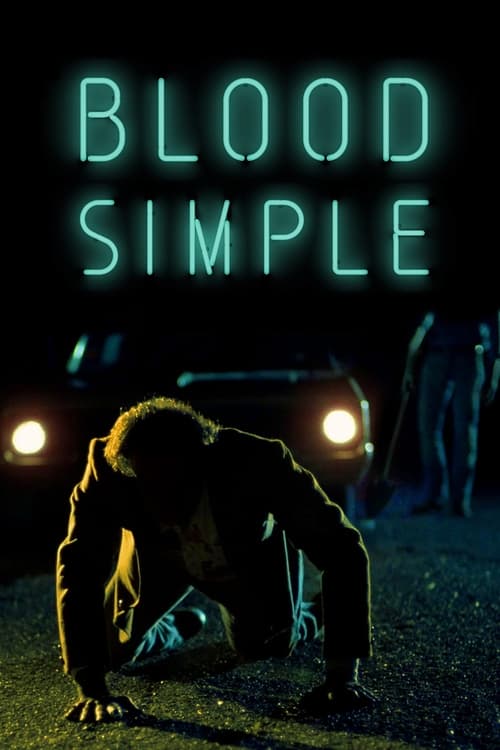
Blood Simple
1985 · Joel Coen
For when you're craving a tight, nasty thriller that trusts you to keep up — 90-odd minutes, no fat, maximum squirm. Great with a group that likes yelling 'no, don't' at the screen.
What it's about
In a dusty Texas town, a bar owner learns his wife is sleeping with one of his bartenders and hires a sleazy private detective to kill them both. The detective has other ideas, and what follows is a chain reaction of double-crosses and dead-wrong assumptions in which every character acts on information that's fatally incomplete — and nobody knows what the audience knows.
The experience
Lean, mean, and blackly funny — the tension comes from watching people make confident, catastrophic decisions based on half the picture. One extended, nearly wordless sequence in the middle is as excruciating as anything in the genre, and the film's deadpan wit keeps flickering through the dread.
Performances
Frances McDormand makes a remarkable film debut as the wife, and M. Emmet Walsh is grotesquely perfect as the detective — sweaty, chuckling, and genuinely menacing, one of the great noir villains.
The craft
The Coen brothers' first feature, and the control is already uncanny: Barry Sonnenfeld's prowling camera, Carter Burwell's spare piano score, and staging that wrings suspense from ceiling fans, car headlights, and light through bullet holes. Every shot is doing narrative work.
Why it matters
It launched the Coen brothers, helped ignite the American independent film boom of the 1980s, and set the template for neo-noir built on irony and lethal misunderstanding.
Snapshot
Blood Simple is the debut feature of Joel and Ethan Coen, a Texas-set noir thriller that announced a ferociously controlled directorial intelligence working in the tradition of Hitchcock and James M. Cain. A bar owner hires a sleazy private detective to murder his wife and her lover; the detective double-crosses him; a chain of lethal misunderstandings ensues, each character acting on fatally incomplete information. The film is less concerned with plot mechanics than with the philosophy of knowledge in extremis: characters are destroyed not by what they know but by what they think they know. Shot by Barry Sonnenfeld, scored by Carter Burwell in his first film assignment, and edited by the pseudonymous "Roderick Jaynes" — a fiction the Coens have elaborated for decades — Blood Simple established the collaborators, the methods, and the thematic obsessions they would develop across the following forty years.
Industry & production
The Coens financed Blood Simple through an unconventional fundraising strategy that has since become a touchstone of independent cinema lore. Unable to secure studio backing for a first feature, they assembled a short promotional reel — essentially a proof-of-concept trailer — to demonstrate their technical competence to private investors, soliciting modest contributions from a network of individuals rather than relying on institutional capital. The approach granted a creative autonomy that studio financing would have foreclosed. The film's budget has been widely estimated in the range of one and a half million dollars, though precise figures were not publicly disclosed.
Frances McDormand, appearing in her first film role, was cast through connections to the New York theater world; she and Joel Coen subsequently married. M. Emmet Walsh, a seasoned character actor, was engaged to play the memorably oleaginous private detective Loren Visser — a role that gave him his most celebrated screen performance. Dan Hedaya and John Getz completed the principal cast.
The film was shot largely in and around Austin, Texas. It premiered at the Toronto International Film Festival in 1984 and won the Grand Jury Prize at the Sundance Film Festival in January 1985 before securing theatrical distribution. Its Sundance triumph helped establish that festival as a launchpad for American independent cinema at a moment when the indie sector was beginning to define itself against Hollywood blockbuster culture.
Technology
Blood Simple was shot on 35mm, with Barry Sonnenfeld — then a young cinematographer working his first feature — employing a range of equipment and rigging choices to achieve the film's distinctive visual register. The camera traverse along the bar top — lifting smoothly over a prone drunk before continuing its track — required a purpose-built mounting system; the shot became one of the more cited technical set-pieces of 1980s independent cinema.
The film predates digital intermediate technology; its color palette and contrast ratios were achieved through photochemical means, with careful management of the relationship between practical light sources and shadow. The low-budget context enforced ingenuity: the strobe effect produced by a ceiling fan interrupting available light was an environmental condition the filmmakers incorporated rather than a controlled studio effect, turning constraint into signature. Carter Burwell's score was recorded using synthesizer and acoustic instruments, establishing the spare, tonally ambiguous practice he would sustain across virtually the entire Coen canon.
Technique
Cinematography
Sonnenfeld's camera in Blood Simple operates as an epistemological instrument: its angles and movements consistently express the perceptual distortions of characters who are terrified, deceived, or operating in the literal dark. Low angles are a persistent signature, making figures loom with an almost Expressionist menace and rendering domestic spaces threatening. Extreme close-ups — a hand, a cigarette, a floor drain — isolate objects with a fetishizing precision that charges them with narrative weight before their significance is apparent.
The film's most discussed compositional effects involve the manipulation of deep space and restricted sight lines: doors left ajar, windows lit from outside, corridors that invite or deny approach. In the climactic sequence, the camera retreats from a window through which a single shaft of light enters via a bullet hole — a brilliant reduction of jeopardy to geometry. Sonnenfeld's work draws on the chiaroscuro traditions of classical Hollywood noir while inflecting them with a more overtly stylized severity closer to the European crime film than to anything produced in the American mainstream.
Editing
The Coens edited Blood Simple themselves under the Roderick Jaynes pseudonym — a fictional English pedant whose biographical details they have embroidered with evident pleasure over the years. The editing is built on a ruthless command of suspense rhythm, alternating sequences of almost unbearable elongation with sudden, violent compression. Dead time is used purposefully: the film allows silences and hesitations to accumulate dread rather than releasing tension through conventional cutting. The structure exploits the audience's superior knowledge against the characters — a form of dramatic irony that depends on meticulous control of information disclosure across cuts. The withholding is never arbitrary; it is calibrated so that the audience perceives, with mounting horror, precisely the gap between character belief and reality.
Mise-en-scène / staging
The Coens' staging in Blood Simple is theatrical in its precision. Blocking is organized around planes of concealment and revelation: characters enter and exit framings, pass behind objects, appear at unexpected edges of the image. The bar setting — with its neon signs, jukebox, and islands of direct light surrounded by shadow — establishes a milieu of shabby Texas commerce that functions simultaneously as naturalistic environment and Expressionist landscape.
The film's climax, staged across a darkened apartment with characters who cannot see each other, achieves a cruel geometry of misidentification. The staging insists that physical proximity and lethal misapprehension can coexist: characters are separated by a single wall and an unbridgeable epistemic gap. The Coens never let the environment become merely decorative; every spatial decision carries dramatic argument.
Sound
Carter Burwell's score is deliberately spare — synthesizer textures and restrained melodic figures that create unease without signposting it. The Coens deploy ambient sound — wind, cicadas, the mechanical tick of a ceiling fan — with the care of filmmakers who understand that near-silence is more disturbing than conventional underscore. Diegetic sound is managed with equal precision: a phone ringing in an empty room, footsteps establishing someone's location before they appear. The film demonstrates an understanding of the ear as a narrative organ equal to the eye — an understanding that would deepen and diversify across subsequent Coen work.
Performance
M. Emmet Walsh's Loren Visser is among the most vivid supporting performances in American independent cinema of the decade. Walsh constructs the character from the outside in — the yellow slicker, the sweating face, the ingratiating drawl — but the performance never reduces Visser to a type; genuine intelligence operates behind the oleaginousness, which makes him more frightening than a straightforwardly menacing villain. Frances McDormand's work is more interior: she plays a woman trapped in overlapping dangers she cannot fully perceive, and the film benefits from her stillness and the way her face registers calculation without ever telegraphing it. John Getz's performance carries important structural weight that is less often remarked upon; his character's confidence and competence are systematically undermined, requiring a naturalistic authority that the film can then erode credibly.
Narrative & dramatic mode
Blood Simple is an exercise in epistemological noir. Its narrative machinery is organized not around the withholding of whodunit information — we see the relevant events with relative transparency — but around the systematic isolation of each character within their own interpretive bubble. Every character acts on a plausible but incorrect reading of the situation; the film's irony is that no single misunderstanding is catastrophic in isolation, but together they produce catastrophe. This is a structural argument about knowledge under pressure: the "blood simple" state of the title, drawn from Dashiell Hammett's Red Harvest (1929), describes the cognitive degradation that extreme violence imposes, the state in which the mind can no longer reliably process reality.
The film is told in conventional linear time but withholds and releases information with surgical timing, ensuring that the audience always perceives the gap between what characters believe and what is actually occurring. This ironic distance is not comic — it is the source of the film's sustained dread. No character achieves the retrospective clarity that genre convention typically grants its survivors; understanding arrives, when it arrives at all, too late to be useful.
Genre & cycle
Blood Simple belongs to the neo-noir revival that gathered momentum across the 1970s and 1980s — a cycle including Roman Polanski's Chinatown (1974) and Lawrence Kasdan's Body Heat (1981). Where Body Heat engaged primarily with the erotic templates of Double Indemnity, Blood Simple is more interested in the procedural mechanics of deception and the genre's epistemological undertow. It strips noir's conventional glamour away, situating its story in unglamorous Texas rather than twilight cities, and refusing to grant its characters the articulate self-awareness that Hollywood noir typically conferred on its protagonists. There is no voiceover rationalizing events into retrospective meaning; there is only action and consequence, misread at every turn.
The film also participates in what critics have sometimes called Texas Gothic — a regional subgenre characterized by rural isolation, punishing heat, and a landscape that seems to enforce moral desolation. This situates Blood Simple alongside Tobe Hooper's The Texas Chain Saw Massacre (1974) in its use of the Texan environment as an agent of menace, though the Coens' film is concerned with psychological rather than physical horror, and with the corrupt institutions of ordinary commerce rather than with the uncanny.
Authorship & method
Blood Simple establishes the collaborative signature that would define Coen Brothers filmmaking across their career. Joel Coen is credited as director; Ethan Coen as producer; both share the screenplay credit. In practice, they have consistently described their working relationship as inseparable: they write together, discuss every shot and editorial decision together, and are present on set together. The singular credit assignments are production conventions rather than descriptions of how the work is actually made.
Barry Sonnenfeld shot three of the Coens' early films — Blood Simple, Raising Arizona (1987), and Miller's Crossing (1990) — before transitioning to a directing career of his own. His contributions to the visual language of the early Coen canon were consequential: the low angles, tracking shots, and the relationship between camera movement and character psychology that he and the Coens developed together on Blood Simple became foundational to their style even after they moved on to other cinematographers.
Carter Burwell's scoring practice, as established here, has been characterized throughout his long Coen collaboration by restraint and tonal ambiguity: his scores tend to undercut or complicate the emotional register of the images rather than amplify them, a disposition that suits the Coens' ironic perspective. The Roderick Jaynes conceit encodes a genuine truth — the Coens regard editing as an authorial act inseparable from direction and writing, and their insistence on controlling the cut has been a consistent feature of their practice. Joel Coen had professional experience as an assistant editor before Blood Simple, a formation legible in the film's precise command of rhythm and duration.
The Coens were in contact with Sam Raimi during this period, and Raimi's Evil Dead (1981) circulated in the independent filmmaking world as a demonstration of what low-budget genre cinema could achieve with directorial conviction; the precise nature of any exchange between the two filmmakers' orbits is less documented than is sometimes suggested, and caution is warranted in specifying its character.
Movement / national cinema
Blood Simple arrived at a pivotal moment in American independent cinema. The early 1980s were seeing the emergence of a coherent alternative to Hollywood production, sustained by the Sundance Film Festival — operating under its current name from 1984 — a growing network of art-house distributors, and a generation of filmmakers trained in film schools or self-taught on low budgets. The film's Grand Jury Prize at Sundance in January 1985 helped define what an American independent feature could look like: technically accomplished, generically literate, and tonally distinctive from studio product.
Blood Simple's relationship to this movement is not one of counter-cinema. The Coens were not rejecting genre but absorbing it with a sophistication that demonstrated how deep formal knowledge of Hollywood tradition could be put in service of a distinctly personal vision. This would become the template — acknowledged or not — for a significant strand of American independent filmmaking across the following two decades. The film implicitly argued that genre literacy and artistic seriousness were not in tension, a position that proved enormously generative for directors who followed.
Era / period
The mid-1980s American cinema context was shaped by the aftermath of the New Hollywood era (roughly 1967–1980) and the commercial consolidation that followed. The blockbuster imperative had tightened its grip on the major studios, and the space for mid-budget adult genre pictures — precisely the kind of film noir had occupied in the 1940s and 1950s — had contracted. Independent cinema expanded partly to fill this vacuum, working at lower budgets and with greater creative latitude.
Blood Simple appeared in the same half-decade as other films that would reshape the independent sector: Jim Jarmusch's Stranger Than Paradise (1984), Spike Lee's She's Gotta Have It (1986), John Sayles's Matewan (1987). These films shared a commitment to working outside studio infrastructure without abandoning formal sophistication. The Coens' decision to engage with genre rather than social realism or avant-garde form was a distinctive positioning that proved distinctively influential; they demonstrated that genre could be a vehicle for precisely the kind of authorial vision that the independent movement claimed to value.
Themes
The film's central preoccupation — the impossibility of reliable knowledge under conditions of extreme stress — extends into a cluster of related concerns. Trust and betrayal are shown to be less moral failures than epistemological ones: characters cannot accurately perceive their situations, and their moral failures follow from their perceptual ones. The institutions and norms that might otherwise mediate human conflict — law, social contract, communication — are either absent or actively perverted. Visser, the private detective, represents a professional apparatus of surveillance and knowledge-gathering that has been entirely corrupted; he is the figure who should know more than anyone, and he uses that knowledge for the worst purposes.
The Texas landscape functions thematically as a space of radical isolation: characters cannot summon help, cannot easily flee, and cannot be certain who else occupies the space they move through. This spatial isolation mirrors the epistemic isolation of the plot. The heat, the darkness, and the dust participate in the film's argument about the environment's indifference to human suffering — a sensibility that the Coens would later pursue more explicitly in No Country for Old Men (2007), their adaptation of Cormac McCarthy's novel, in which the landscape's indifference achieves something approaching philosophical statement.
Money — its pursuit, its inadequacy, the moral distortions it produces — runs through the film as it runs through virtually all Coen work, though here it operates more as an inciting pressure than as a sustained philosophical subject.
Reception, canon & influence
Influences on Blood Simple:
The film's debts are explicit and worn without embarrassment. Dashiell Hammett's Red Harvest (1929) provides the title and the conceptual framework of blood-simple cognitive collapse; James M. Cain's double-indemnity structure — adulterous couple, murder plot, escalating complication — is the narrative template. Alfred Hitchcock's films, particularly Psycho (1960) and Shadow of a Doubt (1943), supply the grammar of suspense through dramatic irony and the moral implication of the audience in the characters' fates. The classical Hollywood noirs — Double Indemnity (Billy Wilder, 1944), Out of the Past (Jacques Tourneur, 1947) — underwrite the genre's visual and moral vocabulary.
From European cinema, the Coens absorbed the precision of the art-film thriller's attention to space and duration — the gap between surface and interior that Michelangelo Antonioni explored, and the rigorous staging grammar of filmmakers such as Fritz Lang, whose influence on American noir was foundational and whose German Expressionist heritage inflects Sonnenfeld's low-angle compositions. Sergio Leone's operatic use of spatial extension and close-up is also legible, particularly in the film's willingness to let shots run past the point conventional Hollywood pacing would terminate them.
Blood Simple's legacy:
Blood Simple's immediate legacy is the Coens' own subsequent career — Miller's Crossing (1990), Barton Fink (1991), Fargo (1996), and No Country for Old Men (2007) develop the themes, techniques, and collaborations first assembled here. Its influence on the neo-noir cycle of the late 1980s and 1990s is diffuse but real: it demonstrated that a genre picture could be formally rigorous, intellectually serious, and commercially viable outside the studio system.
More broadly, Blood Simple helped establish the template for American independent genre cinema — generically fluent, technically precise, tonally idiosyncratic — that would be developed by filmmakers including Steven Soderbergh, the early work of Christopher Nolan, and others whose work inhabits genre without being consumed by it. The film's particular contribution to the thriller is its systematic demonstration that dramatic irony — the gap between what characters know and what audiences know — can be organized with the precision of a musical score, producing a form of sustained dread that operates independently of action or violence.
Critical reception at the time of release was strong, particularly for a debut. The film did not achieve wide theatrical distribution but circulated through the repertory and art-house circuit in ways that generated the reputation that enabled Raising Arizona (1987) to be made with greater resources. It has remained continuously available on home video and streaming formats, and its standing has only grown: it is now recognized as one of the defining American debut features of its decade, a film that arrived, startlingly, in complete command of its form.
A Deleuzian reading
Late in Blood Simple a woman crouches in a dark apartment and fires a pistol through a wall at the man she is sure is her husband.
The full Deleuzian reading of Blood Simple →
Reception
No flop-to-classic story here — it announced the Coen brothers instantly, winning the Grand Jury Prize at the 1985 Sundance (then the US Film Festival) despite modest box office; today it's canonized as one of the all-time great directorial debuts and the origin point of the whole Coen universe.
How Blood Simple was received, from release to now →
Influences: the films it descends from and the films it influenced
- Psycho (1960) — Blood Simple systematizes Hitchcock's technique of conferring superior knowledge on the audience and then weaponizing it: the shower-scene grammar of withholding the decisive blow while the audience knows more than every character on screen becomes the Coens' entire narrative engine, applied not to one sequence but to the film's complete structure.
- Rear Window (1954) — Restricted sight-line architecture as the primary generator of suspense: both films build jeopardy from the geometry of what can and cannot be seen through apertures — windows, peepholes — making the act of looking, and the incompleteness of looking, the central dramatic mechanism rather than plot action.
- Double Indemnity (1944) — Blood Simple inherits the James M. Cain double-cross structure without the retrospective voiceover that frames Wilder's film: adulterous conspiracy, a hired agent who cannot be controlled, and the fatal gap between what each conspirator believes the other will do — the mechanism is the same, the fatalism identical, the Cain source material shared.
- The Postman Always Rings Twice (1946) — The Cain source novel's specific plot mechanics — a married woman, her lover, a murder scheme that survives its first execution only to destroy all parties through incompetence and mutual misreading — are the skeletal structure Blood Simple repurposes, keeping the Texas roadhouse setting and adultery triangle while stripping the legal procedural aftermath.
- Touch of Evil (1958) — Sonnenfeld's low-angle compositions giving Loren Visser a looming, Expressionist menace in confined domestic spaces are legible descendants of Welles's treatment of Hank Quinlan: both cinematographers use extreme low angles to make corruption assume physical mass, making the corrupt man's body itself a spatial threat within the frame.
- Out of the Past (1947) — Tourneur's film gives classical Hollywood noir its most technically rigorous chiaroscuro grammar — hard sources, impenetrable shadow, faces emerging from darkness as partial information — which Sonnenfeld inherits and inflects with greater severity, treating the light/dark threshold as an epistemological boundary rather than mere atmosphere.
- Detour (1945) — Ulmer's ultra-low-budget B-noir proved that production restriction could be converted into fatalistic style: the protagonist as helpless spectator to his own entrapment, the cheap locations turned into an inescapable geography of doom; the Coens' own fundraising-reel financing strategy and their conversion of constraint into signature directly inherit this tradition.
- Chinatown (1974) — The neo-noir revival's central formal lesson: the investigator-figure destroyed by the epistemological limits of his craft, arriving at truth precisely too late to act on it; Blood Simple extends this condition from the detective protagonist to all its characters simultaneously, making epistemological failure the universal condition rather than the tragic fate of one man.
- The Lady from Shanghai (1947) — The Coens build their plotting entirely on the gap between what characters believe they have seen and what actually occurred — the appearance/reality mechanism that Lady from Shanghai encodes visually in its hall of mirrors distributed as procedural logic across an entire film.
- The Postman Always Rings Twice (1981) — A Cain-flavored neo-noir of adultery and botched murder in a sweaty American backwater, extending the naturalistic, fatalistic-betrayal lineage into independent filmmaking.
- The Silent Partner (1978) — Builds every sequence out of information asymmetry — each character acting rationally on a partial account of the same events — and punctuates that clockwork with abrupt, unstylized violence, the Silent Partner engine rebuilt as pure formal exercise.
- Raising Arizona (1987) — Carter Burwell's score continues the sparse acoustic-synthesizer hybrid established in Blood Simple — the same harmonic ambiguity, the same tonal strategy of refusing to tell the audience how to feel — while the Roderick Jaynes editing system is applied to screwball acceleration rather than suspense elongation, demonstrating the portability of the Coen craft system.
- Miller's Crossing (1990) — The Roderick Jaynes pseudonym is carried forward as a sustained authorial fiction; the information-withholding structure — the audience never certain whether Tom Reagan is betraying or protecting — applies Blood Simple's epistemological engine to a genre canvas of greater moral complexity, showing the Coens had generalized their debut's technique into a repeatable formal system.
- Reservoir Dogs (1992) — Tarantino has cited Blood Simple as a direct influence; the staging of confrontation in confined theatrical spaces with characters as precise blocking units, the structural withholding of a central event (what happened inside the vault), and the systematic alignment of audience knowledge against character knowledge all rehearse the Coens' narrative grammar in a different genre register.
- Red Rock West (1993) — Southwest Gothic stranger-in-strange-town neo-noir in which a protagonist is mistaken for a hired killer and cannot escape the role: Dahl extends Blood Simple's Texas-set moral geography and its mechanism of identity-trap — the wrong person becoming the agent of a crime through misrecognition — into a full feature-length variation.
- Fargo (1996) — Carter Burwell's sparse score migrates from Texas to Minnesota with its compositional logic intact; the epistemological structure — a kidnapping scheme that collapses because every participant fatally misreads every other's intentions — is Blood Simple's core narrative engine transposed to Midwest Gothic, with the incompetent criminal replacing the double-crossing detective.
- A Simple Plan (1998) — Raimi transposes Blood Simple's central mechanism — ordinary people destroyed by cascading paranoia over concealed money, each making irreversible decisions based on misread information from the others — to rural Minnesota, demonstrating that the Coen grammar was a portable structural system independent of its original Texas neo-noir genre markers.
- Following (1998) — Nolan's £6,000 debut inherits Blood Simple's proof that budget restriction converted into formal constraint becomes style: the systematic information-withholding across a fractured chronology, the structural revelation that reframes everything the audience believed it understood, and the low-budget-as-aesthetic-choice all descend directly from the Coens' independent financing model and editing grammar.
- No Country for Old Men (2007) — Texas Gothic distilled to formal essence: Roger Deakins' evolution of Sonnenfeld's chiaroscuro grammar, the staging of jeopardy through planes of concealment — Chigurh's boots visible under a door — and the near-total elimination of non-diegetic score across entire sequences all extend Blood Simple's formal innovations to their logical conclusion forty years later.
- Sympathy for Mr. Vengeance (2002) — Parallel pursuit arcs engineered on systematic dramatic irony — each protagonist acts on fatally incomplete information the audience already holds — converting genre mechanics into Greek structural dread rather than thriller suspense.
- Headhunters (2011) — Establishes the tonal template for genre filmmaking where violent consequence is simultaneously horrifying and absurdly funny, with cross-purpose plans compounding catastrophically through misread information — the manure-pit sequence's pitch-black physical comedy is a direct heir of this mode.
- Beasts Clawing at Straws (2020) — Originates the 'bag of money as moral X-ray' MacGuffin architecture: multiple characters pursue the same object in mutual ignorance of each other's knowledge states, so the object itself — not any individual villain — becomes the mechanism of cascading catastrophe.
- O Brother, Where Art Thou? (2000) — The Coens' own debut establishes their authorial method imported wholesale here: Roderick Jaynes pseudonymous editing, deadpan irony, meticulous storyboarding, and the heat-soaked Southern milieu shot by a single controlling DP.
- After Hours (1985) — Produced in the same American independent moment and premiering in the same festival circuit, both films use nocturnal confined geography and cascading misidentification to trap a protagonist in a paranoid spiral where each attempt at escape generates a new layer of entrapment — the dark comedy and the genuine menace are equally inseparable in both.
- Diva (1981) — Both films belong to the early-1980s neo-noir moment that foregrounded cinematographic bravado as an authorial declaration: Beineix's fetishizing close-ups of objects charged with narrative weight and his use of deep focus to organize planes of concealment share Blood Simple's tendency to stylize genre mechanics through visibly mastered craft.
- Nightmare Alley (2021) — Barry Sonnenfeld's off-axis, low-angle compositions establish the American indie neo-noir visual grammar — framing that encodes paranoia through geometric distortion — while the Coens' manipulation narrative, in which each character's deception becomes the precise instrument of their own destruction, is the structural model that del Toro applies to Nightmare Alley at studio scale.
- Barton Fink (1991) — The Coens' first realization of their signature genre-slippage and Carter Burwell-scored slow-building dread, the method matured in Barton Fink's satire-to-horror turn.
- Body Heat (1981) — Parallel New Hollywood revival of Cain-style adultery-and-murder noir, sharing the sweaty Texas heat-as-moral-climate setting and the dramatic-irony architecture of characters acting on partial knowledge.
- The Man Who Wasn't There (2001) — The Coens' debut establishes their Cain-derived neo-noir of a small scheme metastasizing through misread intentions and dumb luck, the authorial DNA this film refines into austerity.
- Bound (1996) — The Coens' precision-plotted, confined neo-noir of double-crosses and mislaid money — the tight cause-and-effect machinery and dark comic bloodletting the Wachowskis openly emulate.
- Repo Man (1984) — A fellow 1984 regional-American indie debut that proves genre-mixing (noir here, punk-scifi there) can be an authored calling-card off tiny money.
- The Evil Dead (1982) — Direct transmission of Raimi's production model — limited-partnership financing raised off a shot-for-shot proof-of-concept short, shared crew — along with the low unmotivated floor-level glide that hops obstacles in a single unbroken move.
Similar films
- Fargo (1996) — influence & lineage
- No Country for Old Men (2007) — influence & lineage
- Reservoir Dogs (1992) — influence & lineage
- Miller's Crossing (1990) — influence & lineage
- Raising Arizona (1987) — influence & lineage
- The Man Who Wasn't There (2001) — shared sensibility
- Barton Fink (1991) — shared sensibility
- L.A. Confidential (1997) — shared sensibility
All the films related to Blood Simple →