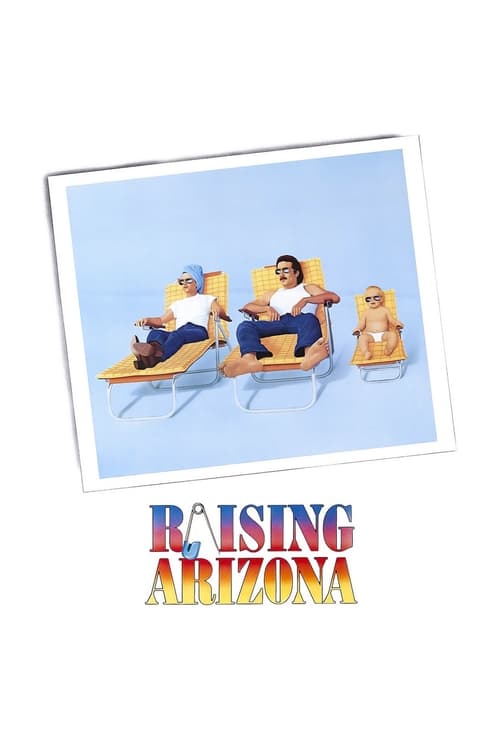
Raising Arizona
1987 · Joel Coen
For when you need to laugh hard at something genuinely weird and smart — great with friends, great when you're worn out and want pure comic energy with a soft heart hiding inside it.
What it's about
Hi is a good-natured repeat convenience-store robber; Ed is the police officer who takes his mugshots. They marry, go straight, and dream of a family — and when they can't have a baby, they help themselves to one of a furniture tycoon's newborn quintuplets, reasoning he has more than he can handle. What follows is a whirlwind of escaped cellmates, a nightmarish bounty hunter, and a couple in way over their heads.
The experience
Fast, loud, and gleefully absurd — it moves like a live-action cartoon, with dialogue so ornate and deadpan you'll want to rewind lines. Underneath the mayhem there's a surprising sweetness about wanting a family and a decent life.
Performances
Nicolas Cage gives one of his defining early performances, all rubber-limbed panic and mournful poetry, and Holly Hunter matches him as Ed — fierce, tiny, and absolutely certain. John Goodman crashes through the film, literally, as an escaped con with opinions.
The craft
The Coen brothers stage slapstick with the precision of a heist film: swooping, low-flying camera runs, whip-fast chases, and a screenplay whose mock-biblical narration is a comic instrument in itself. Carter Burwell's banjo-and-yodel score sets the tone before a single joke lands.
Why it matters
It announced the Coens as comic filmmakers after their grim debut, and its blend of high style, low crime, and heartfelt absurdity shaped a whole strain of American indie comedy that followed.
Snapshot
Raising Arizona is the second feature directed by Joel Coen and co-written and produced with his brother Ethan, arriving in 1987 on the heels of their austere neo-noir debut Blood Simple (1984). Where the debut was a slow, sweating exercise in dread, Raising Arizona is its tonal inverse: a manic, motormouthed comedy pitched at the velocity of a Looney Tunes short and narrated in mock-biblical, Faulknerian cadences. The premise is a fable of working-class longing — recidivist convenience-store robber H.I. "Hi" McDunnough (Nicolas Cage) and ex-police photographer Edwina "Ed" (Holly Hunter), unable to conceive, abduct one of furniture magnate Nathan Arizona's newborn quintuplets — and the film treats this transgression as both a sin to be punished and a yearning to be honored. It is the Coens' first comedy, their first studio-adjacent production (released through 20th Century Fox), and the film that established the elastic, cartoon-physical, camera-as-projectile style that would become a signature. Decades on it is regarded as a defining American comedy of the 1980s and a cornerstone of the Coen filmography.
Industry & production
The Coens emerged from the independent margins. Blood Simple had been financed through limited partnerships Joel and Ethan raised themselves, with Circle Films — the company run by exhibitors Ted and Jim Pedas and Ben Barenholtz — handling distribution and becoming the brothers' early patron. Circle Films financed Raising Arizona as well, granting the Coens a degree of autonomy unusual for filmmakers only one picture into their careers: final cut and freedom from studio interference, with 20th Century Fox attached for distribution. Reported budgets for the film sit in the low-to-mid single-digit millions; precise figures vary across sources, so the exact number should be treated cautiously, but the production was modest by studio standards and clearly profitable, performing solidly in theatrical release and finding a large second life on home video and cable.
The Coens' division of labor was, at this stage, a matter of credit convention rather than reality: Joel was billed as director, Ethan as producer, and both as writers, though by every account the brothers functioned as a single authorial unit on set and in the cutting room. Filming took place in and around Arizona — the Phoenix and Scottsdale area, with desert and suburban-tract locations — lending the picture its blinding sunlight, cinderblock convenience stores, and trailer-park vernacular. The production assembled a creative team that would prove formative: cinematographer Barry Sonnenfeld and composer Carter Burwell, both carried over from Blood Simple, alongside production designer Jane Musky. The casting mixed a rising star (Cage, fresh from Peggy Sue Got Married) with stage-trained performers (Hunter) and character actors who would recur across the Coen universe.
Technology
Raising Arizona was shot photochemically on 35mm in the standard manner of late-1980s American features, but its technical interest lies less in novel equipment than in the aggressive, kinetic deployment of conventional tools. Sonnenfeld and the Coens built much of the film's comic energy out of extreme camera mobility: low mounts skimming inches above the ground, rapid dolly and crane moves, and "ramping" point-of-view rushes. Several of the picture's most celebrated effects derive from rigging the camera to props — most famously the shot that races along the floor and up a ladder toward a screaming Hi — achieved through purpose-built mounts and brisk practical camera operation rather than digital trickery, which did not yet exist as a mainstream option. The film belongs squarely to the pre-digital era; its trcompe l'oeil and physical gags are accomplished in-camera, through staging, lens choice, and editing. This handmade ingenuity is part of what gives the movie its tactile, anything-goes vitality.
Technique
Cinematography
Barry Sonnenfeld's photography is central to the film's identity and arguably its most imitated element. He favors wide-angle lenses held close to faces and objects, which exaggerate perspective and turn ordinary spaces — a nursery, a Short Stop convenience store, a tract house at night — into warped comic arenas. The camera is rarely passive: it swoops, charges, and pounces, often substituting for a character's startled gaze or a predator's approach. The "shaky-cam" rushing shots owe an acknowledged debt to Sam Raimi, the Coens' friend and collaborator (Joel had worked as an assistant editor on Raimi's The Evil Dead, and the Coens co-wrote Raimi's Crimewave); the technique migrates here from horror into slapstick, the same velocity now milking laughs rather than terror. Sonnenfeld also lights for the high-key glare of the Arizona desert, a flat, sunbaked brightness that contrasts pointedly with the inky chiaroscuro of Blood Simple and signals the brothers' deliberate range.
Editing
The film was cut by Michael R. Miller. Its comedy is fundamentally an editing comedy: rapid, percussive, built on collisions of scale and sudden reversals of expectation. The famous diaper-run set piece — Hi's escalating flight from a convenience-store robbery through suburban yards, pursued by police, dogs, and gunfire — is sustained almost entirely through cutting rhythm, a crescendo of escalating absurdity that functions like a silent-comedy chase updated with rock-and-roll tempo. The prologue itself is a feat of compression: a roughly ten-minute montage establishing Hi and Ed's courtship, marriage, and failure to conceive, delivered before the title card even appears, narrated and elided at a pace that tells a whole romance in the time other films spend on a meet-cute.
Mise-en-scène / staging
Jane Musky's production design renders a hyperreal working-class Americana: paneled walls, cheap furniture, Hawaiian shirts, the gleaming consumer cornucopia of "Unpainted Arizona." The staging is overtly comic-strip — symmetrical compositions, exaggerated props, characters framed as types. The film's iconography fuses the mundane (Huggies, pickup trucks, La-Z-Boys) with the mythic, most vividly in Leonard Smalls (Randall "Tex" Cobb), the tattooed bounty-hunter biker — the "Lone Biker of the Apocalypse" — who roars out of the desert trailing fire, a literalized embodiment of Hi's guilt and dread. This collision of the domestic and the apocalyptic is the film's governing visual idea.
Sound
Carter Burwell's score is one of the film's defining pleasures and a sharp left turn from his brooding Blood Simple work. It is built around yodeling, banjo, whistling, and folk motifs — incorporating, among other sources, the melody of the Appalachian murder ballad "Down in the Willow Garden" and a yodeled reworking of Beethoven's "Ode to Joy" — a soundscape that reads as both affectionate and absurd, hillbilly Americana spliced with the European sublime. The result perfectly mirrors the movie's tone: rustic, manic, and unexpectedly tender. Sound design and Hi's voiceover work in concert, the narration's grandiloquent diction playing against the trailer-park reality on screen.
Performance
The performances are calibrated to a heightened, near-vaudevillian register without tipping into shapelessness. Nicolas Cage gives Hi a hangdog sincerity beneath the slapstick — a sweet, dim romantic genuinely trying to be good — while Holly Hunter's Ed is all fierce, brittle want, her maternal hunger so acute it curdles into desperation. John Goodman and William Forsythe, as the escaped Snoats brothers Gale and Evelle, supply blustering, overgrown-toddler menace (Goodman's first major role with the Coens, beginning a long association). Trey Wilson's exasperated Nathan Arizona, Frances McDormand and Sam McMurray as the suffocating suburban couple Dot and Glen, and Cobb's terrifying Smalls round out an ensemble pitched, collectively, somewhere between Preston Sturges and a Chuck Jones cartoon.
Narrative & dramatic mode
The film operates as a tall tale or fable, framed by Hi's first-person narration in a baroque, scripture-inflected idiom that elevates a petty-criminal romance to the register of myth. Its dramatic mode is the moral comedy: a transgression (the abduction) sets in motion a series of escalating punishments and temptations, and the narrative resolves not in tragedy but in a chastened, hopeful renunciation — Hi and Ed return the child and Hi dreams of a future, possibly their own, of family and reconciliation. The structure is picaresque, episodic, propelled by chases and intrusions (the Snoats brothers, the marauding Glen, the avenging Smalls) rather than by a tightly causal plot. Beneath the cartoon surface runs a genuine emotional throughline about longing, inadequacy, and the wish to be better than one is.
Genre & cycle
Raising Arizona is most precisely described as a live-action cartoon, but it draws on several lineages at once: 1930s–40s screwball comedy (rapid patter, working-class romance, comic marriage), the chase comedy descended from silent slapstick, and crime caper. It also participates in a strain of 1980s "regional" or "white-trash" Americana comedy, treating trailer-park and suburban-tract life as both subject and visual texture. Within the Coens' own emerging body of work it inaugurates the comic pole that they would alternate with darker registers throughout their careers, and it stands as an early, influential example of the offbeat American comedy that flourished in the independent and indie-adjacent space of the late 1980s and 1990s.
Authorship & method
The film is a product of the Coen brothers' singular collaborative authorship — co-written, jointly conceived, and shaped in the edit by both, regardless of the period's separated director/producer credits. Their method is marked by tight pre-planning: meticulously storyboarded sequences, precise framing, and dialogue written to a distinctive rhythm and diction. The key collaborators established here would recur for years: cinematographer Barry Sonnenfeld (who shot the Coens' first three features before becoming a director himself, of The Addams Family and Men in Black); composer Carter Burwell (who would score virtually every subsequent Coen film, beginning a decades-long partnership); editor Michael R. Miller; and, among the cast, John Goodman and Frances McDormand (the latter married to Joel Coen and a fixture of their cinema). The screenplay's literary self-consciousness — its mock-heroic narration, its delight in vernacular and high-flown register colliding — is the brothers' authorial fingerprint as much as any visual trait.
Movement / national cinema
The film belongs to American independent cinema's commercial ascent in the 1980s — the moment when figures like the Coens, alongside contemporaries such as Spike Lee, Jim Jarmusch, and Sam Raimi, moved from the margins toward wider distribution while retaining authorial control. It is not affiliated with a formal movement, but it is recognizably part of a postmodern, allusive American filmmaking that recombined genre conventions, classical Hollywood comedy, pop iconography, and regional Americana with knowing irony and evident affection. Its sensibility is deeply native — soaked in the textures of the American Southwest, in Bible-Belt diction, in consumer kitsch — even as its technique borrows freely from cartoon and silent-comedy grammar.
Era / period
Released in 1987 and set in a roughly contemporaneous American present, the film is also a period artifact of Reagan-era consumer culture: its world of big-box stores, disposable diapers, recliners, and self-made furniture tycoons is a sly portrait of 1980s aspiration and abundance. The longing at the film's center — for a baby, for a home, for upward stability — refracts the decade's anxieties about family and class. As a marker in the Coens' chronology it is an early-career work, the film that proved their debut was no fluke and that announced a range no one had anticipated.
Themes
The film's governing theme is the ache for family and belonging — the desire to make a respectable life out of disreputable materials. Closely bound to this is the question of moral worth: Hi's narration is preoccupied with whether he can become good, whether nature or will determines a man's fate, and whether a child can redeem its parents. The film stages a tension between fertility and barrenness, abundance and lack (the wealthy Arizonas have "more than they can handle"; Hi and Ed have nothing). Smalls, the apocalyptic biker, externalizes Hi's guilt and his fear of his own worst nature — a doppelgänger who may be the man Hi would become absent redemption. Running beneath the slapstick is a surprisingly earnest meditation on grace, second chances, and the hope, voiced in Hi's closing dream, that the future might be kinder than the past.
Reception, canon & influence
Critical reception in 1987 was divided. Admirers celebrated the film's invention, velocity, and originality, hailing it as confirmation of a major comic talent; skeptics found its relentless manic energy and stylization exhausting or emotionally thin, a virtuoso exercise more dazzling than felt. (Specific contemporary verdicts varied widely among major reviewers, and the consensus was genuinely mixed rather than uniformly enthusiastic.) Whatever the initial split, the film's reputation has only risen: it is now widely regarded as one of the finest American comedies of its decade and a key early Coen work, a staple of best-comedy lists and a perennial of repertory and home-video life.
The influences on the film run backward through American culture: the screwball comedies of Preston Sturges and Frank Capra; silent-comedy chase construction; the kinetic horror of Sam Raimi; the manic plasticity of Tex Avery and Chuck Jones cartoons; Southern Gothic literature and its grotesques (the film's mock-biblical narration and its menagerie of outsized rural types evoke a Flannery O'Connor sensibility); and the King James cadences of the Bible itself, which saturate Hi's voiceover and the film's apocalyptic imagery.
Looking forward, Raising Arizona's legacy is substantial. It cemented the Coens' status and the template of their comic mode, helped define a "live-action cartoon" aesthetic that countless quirky American comedies would chase, and launched or advanced careers across its team — Sonnenfeld toward directing, Burwell into a landmark composer-director partnership, Goodman and McDormand into the Coen repertory company, and Cage toward the unhinged, sincere-absurd persona that became his trademark. Its rushing wide-angle camerawork became one of the most recognizable and imitated visual gestures in subsequent American comedy. More broadly, the film stands as an early proof that independent-minded auteurs could marry formal audacity to popular comedy, an influence felt across the indie and studio comedy of the following decades.
A Deleuzian reading
The camera tears across the linoleum, hits the foot of a ladder, and climbs it — rung by rung, faster than any hand could carry it — until it shoves its lens into the screaming face of H.I.
The full Deleuzian reading of Raising Arizona →
Reception
Critics were genuinely split in 1987 — Roger Ebert famously panned it as all style and no soul — but its live-action-cartoon energy aged beautifully, and it's now a consensus comedy classic and many people's gateway Coen film.
How Raising Arizona was received, from release to now →
Influences: the films it descends from and the films it influenced
- Blood Simple (1984) — Their own debut established the recurring team and toolkit reused here: Barry Sonnenfeld's deep-focus wide-angle compositions, Carter Burwell's first scores, and the prowling motivated camera that Arizona accelerates into farce.
- Repo Man (1984) — Carries forward the deadpan-absurdist tone and the cartoon-flat generic-product Americana into a fully realized comic vernacular.
- O Brother, Where Art Thou? (2000) — Reprises the picaresque tall-tale structure and the mock-heroic, scripture-and-Homer-inflected narration of small-time crooks on an episodic odyssey through a stylized rural South.
- The Big Lebowski (1998) — The Coens first deploy their signature device here — a laconic voiceover narrator who mythologizes mundane criminal events in a register several tonal notes above the story's actual stakes — plus the Roderick Jaynes comedic edit rhythm that holds shots past their expected conclusion; Lebowski inherits both devices wholesale.
- The Evil Dead (1981) — The low-mounted, ground-skimming 'shaky-cam rush' that hurtles the camera through space is lifted directly from Raimi's kinetic horror POV — the Coens were friends and collaborators of Raimi and adapted his demonic-force gliding camera into comic propulsion.
- Crimewave (1985) — The Coens co-wrote this Raimi feature, working out the 'live-action cartoon' grammar — exaggerated physical violence rendered weightless and comic, grotesque caricature staging — that they then perfected on their own in Arizona.
- Bringing Up Baby (1938) — Supplies the screwball engine — overlapping rapid-fire patter, an escalating chase of accidents, and a put-upon man dragged through chaos by forces of nature — that the Coens transplant onto a baby-snatching plot.
- Sullivan's Travels (1941) — Sturges's collision of high-flown rhetoric with low vernacular, his gallery of comic American grotesques, and his picaresque road structure are the direct model for Hi's mock-heroic narration and the film's social-comedy texture.
- It Happened One Night (1934) — The runaway-couple-on-the-road armature and the Depression-era populist warmth beneath the comic friction give Arizona its screwball spine of two mismatched lovers improvising a life on the lam.
- Seven Chances (1925) — Silent-comedy chase construction — a single pursuit escalating through geometric, ever-multiplying physical obstacles to an absurd crescendo — is the blueprint for the diaper/grocery-store/dog chase set pieces.
- King-Size Canary (1947) — Avery's manic plasticity — bodies and physics that stretch, accelerate, and rebound past any logic — is the cartoon physics the Coens render in live action, from the impossible motorcycle apparition to the bounding chases.
- Badlands (1973) — The naïve outlaw-lovers-on-the-run framed by an ironically literate, self-mythologizing voiceover narration establishes the fable-told-by-a-simple-man register that Hi's mock-biblical narration extends into comedy.
- Wise Blood (1979) — Huston's direct adaptation of Flannery O'Connor models the Southern Gothic menagerie of outsized rural grotesques and the mock-religious cadence that saturate Arizona's narration and its apocalyptic biker imagery.
- The Hudsucker Proxy (1994) — Carries Arizona's 'live-action cartoon' aesthetic to its furthest point — comic-strip flat-on compositions, storyboarded geometric staging, and heightened vaudevillian performance — within the Coens' own filmography.
- Fargo (1996) — Extends Arizona's affectionate regional-vernacular caricature and its tonal braid of crime, dim-witted criminals, and deadpan warmth, again anchored by Frances McDormand and a Burwell score.
- The Addams Family (1991) — Sonnenfeld's directorial debut productizes the wide-angle, briskly tracking comic camera he developed shooting Arizona, carrying that rushing cartoon visual gesture into mainstream studio comedy.
Similar films
- Fargo (1996) — influence & lineage
- O Brother, Where Art Thou? (2000) — influence & lineage
- Hot Fuzz (2007) — influence & lineage
- Bringing Up Baby (1938) — influence & lineage
- The Big Lebowski (1998) — shared sensibility
- Juno (2007) — shared sensibility
- No Country for Old Men (2007) — shared sensibility
- Coyote vs. Acme (2026) — shared sensibility
All the films related to Raising Arizona →