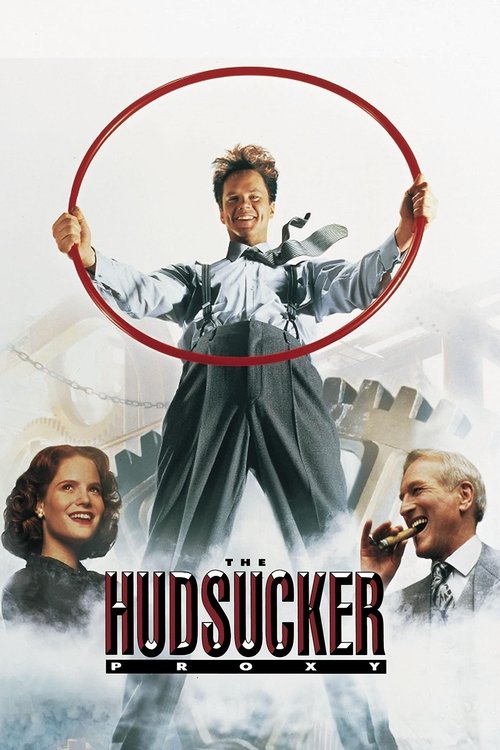
The Hudsucker Proxy
1994 · Joel Coen
For when you want pure stylish escapism — something zippy, gorgeous, and gently absurd that asks nothing of you but delight.
What it's about
A sweet-natured business-school graduate from Indiana lands in the mailroom of a giant 1958 New York corporation on the very day its founder steps out a boardroom window. The scheming board, looking for an idiot to install as president so the stock will crater and they can buy it cheap, picks him — and a fast-talking undercover reporter starts digging into the story. He, meanwhile, has an invention: a simple circle he's sure is going to be big.
The experience
A candy-colored, motor-mouthed screwball fantasy that moves like a wind-up toy — dizzy, quotable, and knowingly artificial. It's funny in a stylized, old-Hollywood way that either sweeps you up or keeps you at arm's length, and it's a lot of fun if you let it.
Performances
Tim Robbins plays guileless without ever being dumb, Paul Newman is deliciously reptilian as the cigar-chomping board villain, and Jennifer Jason Leigh does a full-throttle 1930s fast-talking-dame voice that's a stunt and a marvel at once.
The craft
The Coen brothers built an entire Art Deco universe from scratch — towering sets, whirling clocks, snow-globe New York — and every frame is designed within an inch of its life. The screwball dialogue rhythms and the sheer scale of the production design make it one of the best-looking comedies of its decade; see it big if you can.
Why it matters
A famous box-office flop that nearly derailed the Coens' studio standing, it's since been reclaimed as a cult favorite and a master class in loving pastiche of golden-age Hollywood.
Snapshot
The Hudsucker Proxy is the Coen brothers' most lavish and least typical film of their early period: a big-budget studio fable that resurrects the screwball comedy and the Capra populist parable, then encases them in a hermetic Art Deco diorama. Tim Robbins plays Norville Barnes, a guileless graduate of a Muncie, Indiana business college who arrives in 1958 New York and is plucked from the mailroom of Hudsucker Industries to be installed as company president — not for his promise but for his perceived idiocy. The board, led by Paul Newman's Sidney J. Mussburger, intends a stooge whose blunders will tank the stock so they can buy control cheaply after founder Waring Hudsucker's suicide. The scheme is undone when Norville's doodle of a circle turns out to be the hula hoop. Wrapped around this is a fast-talking newspaper romance with Jennifer Jason Leigh's hard-boiled reporter Amy Archer, and a literal deus ex machina in the form of a guardian angel. Released between Barton Fink (1991) and Fargo (1996), the film was a conspicuous commercial and critical disappointment, and it remains the Coens' most divisive object: to admirers a dazzling formalist machine, to detractors an airless exercise in pastiche.
Industry & production
The film marked the Coens' move into the studio mainstream after a string of acclaimed independent productions. It was their first picture made on a large studio budget — their most expensive to that point by a wide margin — financed through Warner Bros. and the British company Working Title, with the action producer Joel Silver (Die Hard, Lethal Weapon) as a producing partner. The pairing of the Coens, connoisseurs of the offbeat and the morbid, with Silver, the era's premier purveyor of blockbuster spectacle, signaled how far the budget and ambitions had scaled up.
The screenplay was among the Coens' oldest. Written with Sam Raimi — the brothers' longtime friend and collaborator, whose Evil Dead films Joel had cut his teeth editing — the script dated back to the mid-1980s, drafted around the period of Blood Simple and shelved until the filmmakers had the resources and clout to mount it on the necessary scale. Raimi also served as second-unit director, and the film's kinetic camera and slapstick velocity bear his fingerprint alongside the Coens'. Shooting took place largely on soundstages, with the fictional Hudsucker tower realized through miniatures, matte work, and forced-perspective sets at Carolco's North Carolina facilities. The production's cost and its tepid box-office performance made it a cautionary episode in the Coens' careers; the failure arguably pushed them back toward the leaner, character-driven mode that produced Fargo two years later.
Technology
The film is a showcase of pre-digital, optically and physically achieved spectacle, executed at the tail end of the era before computer-generated imagery dominated such effects. Its signature images — the towering Hudsucker Industries skyscraper, the vertiginous falls from its upper floors, the snow-globe stillness of a Manhattan reimagined as a Deco fantasia — were built from scale miniatures, glass and matte paintings, forced perspective, and in-camera trickery. The famous plunges down the side of the building rely on model work and compositing rather than digital simulation, and the sense of an entire metropolis conjured on stages is part of the film's deliberate artifice: this is a New York that never existed, assembled from the iconography of 1930s and 1940s studio pictures rather than from any real city. The choice to render everything by traditional means is itself thematic, reinforcing the film's status as a closed, hand-made world.
Technique
Cinematography
Roger Deakins, in his third collaboration with the Coens after Barton Fink and following The Hudsucker Proxy into a partnership that would define both their careers, shoots the film with a glossy, high-contrast, almost metallic sheen appropriate to its corporate-Deco fantasy. The camera is restless and showy: sweeping cranes up and down the Hudsucker tower, dramatic low angles that monumentalize the architecture, whip-fast moves that keep pace with the dialogue. Deakins lights the boardroom and executive suites in burnished golds and deep shadow, evoking the chiaroscuro of 1940s studio cinematography while keeping the palette cooler and more controlled. The verticality of the imagery — the relentless emphasis on height, on falling, on the long drop — is the film's central visual idea, and Deakins renders it with a precision that makes the building itself the dominant character.
Editing
Edited by Thom Noble, the film cuts with the brisk, percussive rhythm demanded by its screwball model. The newsroom sequences in particular run on rapid-fire montage, overlapping the staccato delivery of the dialogue with snapped-off reaction shots and spinning-headline transitions borrowed wholesale from period newspaper pictures. Elsewhere the editing slows to savor the film's set pieces — the suspended clock, the frozen moment of a fall — exploiting the contrast between frantic comic velocity and arrested, fable-like stillness.
Mise-en-scène / staging
Production designer Dennis Gassner's work is the film's most celebrated element and arguably its true subject. The Hudsucker Industries interiors — the cavernous boardroom, the executive floor, the labyrinthine mailroom, the great clock and its machinery — are conceived as a unified Deco cosmos of geometric grandeur, scaled to dwarf the human figures within it. The design is saturated with circle imagery (clocks, the hula hoop, the doodled "O") and with the vertical logic of corporate hierarchy literalized as physical elevation. Costume designer Richard Hornung dresses the cast in sharp period silhouettes that read as type as much as character. Everything is stylized to the point of abstraction; the film stages its action inside a manifestly artificial world, and that artifice is the point.
Sound
Carter Burwell's score is unusually intertextual, built around appropriations of Aram Khachaturian — the surging Adagio from Spartacus underscores the film's moments of wonder and ascent, while the frenzied Sabre Dance from Gayane drives its comic and chaotic passages. The borrowed Romanticism lends the fable a deliberately overscaled, ironic grandeur, music that is sincere and tongue-in-cheek at once. The sound design foregrounds the mechanical: ticking clocks, pneumatic mail tubes, the whir and clank of the great timepiece that governs the building and the plot.
Performance
The performances are pitched as archetypes rather than psychological portraits. Tim Robbins plays Norville with wide-eyed, dim-bulb sincerity, a Capra naïf updated to near-cartoon. Jennifer Jason Leigh delivers the film's most divisive turn: a deliberate, virtuosic impersonation of the fast-talking 1940s career woman — channeling the clipped cadences of Rosalind Russell in His Girl Friday and the patrician bray of Katharine Hepburn — that some viewers find brilliant and others mannered to the point of alienation. Paul Newman, as the cigar-chewing predator Mussburger, supplies the film's reservoir of star authority and sly menace. Charles Durning's doomed founder, John Mahoney's barking editor, Bruce Campbell's wisecracking reporter, and Bill Cobbs's clock-keeper narrator round out a gallery of stylized types.
Narrative & dramatic mode
The film operates as a fable, explicitly framed as such by Cobbs's omniscient narration and by a circular, deterministic plot in which a falling body, a stopped clock, and a returning angel arrange the resolution. The dramatic mode fuses three classical templates: the Capraesque populist parable of the innocent who triumphs over corrupt power; the Hawksian screwball romance of antagonists who spar their way to love; and the cynical corporate satire of the little man chewed up by the machine. The tone oscillates deliberately between sincerity and irony — the film both believes in its happy ending and winks at the machinery that produces it. Time is the organizing motif: the plot literally hinges on the building's master clock, on a year that turns at midnight, and on a fall that the angel suspends, making the narrative's own contrivance its theme.
Genre & cycle
The Hudsucker Proxy belongs to the cycle of late-twentieth-century homages to Golden Age Hollywood comedy — films that reconstruct the screwball and the newspaper picture not as living forms but as objects of cinephile reverence. Its specific debts are to Frank Capra's populist parables (Mr. Deeds Goes to Town, Mr. Smith Goes to Washington, It's a Wonderful Life), to Preston Sturges's satirical fables of sudden fortune (The Lady Eve, Christmas in July, Sullivan's Travels), and to Howard Hawks's overlapping-dialogue comedies (His Girl Friday, Ball of Fire). Within the Coens' own filmography it sits in their recurring vein of pastiche and period reconstruction, alongside Miller's Crossing and, later, The Man Who Wasn't There and Hail, Caesar! — films that treat a vanished studio idiom as both subject and style.
Authorship & method
The film is a paradigmatic Coen production despite its scale. Joel Coen takes the directing credit and Ethan the producing credit, per their practice of the period, though both are understood to have directed and written jointly with Raimi. Its method exemplifies their signature working relationships: this was the picture that cemented the partnership with cinematographer Roger Deakins, who would shoot most of their subsequent films and become one of the defining lighting cameramen of his generation. Composer Carter Burwell, the Coens' musical collaborator from Blood Simple onward, contributes one of his most overtly intertextual scores. The Coens' authorial preoccupations are all present: the elaborately constructed closed world, the naïf adrift among grotesques, the relish for vintage American vernacular and physiognomy, the cosmic-joke structure in which fate and contrivance are indistinguishable. What distinguishes Hudsucker is the maximalism — the brothers' usual control extended to a scale of design and spectacle they would rarely attempt again.
Movement / national cinema
The film is a product of American independent cinema's graduation into the studio system during the early 1990s, when figures like the Coens, having built reputations on the festival and arthouse circuit, were briefly given major-studio budgets to pursue idiosyncratic visions. It is quintessentially American in its iconography — corporate skyscrapers, mailroom-to-boardroom mythology, the hula hoop as emblem of postwar consumer culture — yet its co-financing through Working Title situates it within the transatlantic production arrangements typical of the period. It belongs to no movement so much as to the Coens' singular authorial enterprise, which stands somewhat apart from both Hollywood and the indie mainstream.
Era / period
Set in 1958 and 1959, the film depicts the late-Eisenhower moment of corporate conformity and consumer abundance — yet it filters that period through the visual and verbal grammar of two decades earlier, so its "1958" is really a dream-amalgam of the 1930s and 1940s. This deliberate anachronism is central to the film's design: it is less a portrait of an era than a collage of cinematic memory. The hula-hoop craze, a genuine phenomenon of 1958, anchors the fantasy to a real artifact of postwar America while the surrounding world remains frankly mythological.
Themes
The film's governing themes are the corruption of innocence by institutional power and its improbable redemption; the indifferent machinery of capital, literalized in the great clock and the falling stock price; and the circle as emblem of time, fate, and the eternal return ("you know, for kids"). The central scam — installing a fool to destroy value so that insiders can profit — is a sardonic anatomy of corporate predation, and Mussburger's calculus reduces human beings to instruments. Against this the film sets a fundamentally Capraesque faith that decency, luck, and a guardian angel can override the system. The reconciliation of cynicism and sentiment — the film's simultaneous belief in and mockery of its own fairy tale — is its deepest and most characteristic theme.
Reception, canon & influence
On release the film was met with a cool, often hostile critical reception and disappointing returns, a notable stumble after the acclaim of Barton Fink. The recurring charge was coldness: critics admired the design while finding the film heartless, a flawless surface with no human pulse beneath it, an exercise in style quoting style. Jennifer Jason Leigh's stylized performance became a particular flashpoint. The commercial failure was significant enough to mark a turning point, after which the Coens recalibrated toward the more intimate, regionally grounded Fargo.
Its influences run backward to the deep well of classical Hollywood: Capra's populism, Sturges's satire, Hawks's verbal velocity, and the Deco monumentalism of 1930s studio design and of architectural fantasists in the lineage of films like Metropolis. Forward, its legacy is more contested. The picture has undergone partial critical reassessment, championed by admirers of its formal audacity and production design as an underrated jewel, while others maintain the original verdict. Its most visible influence lies in the permission it offered for unabashed, large-scale cinephile pastiche, and within the Coens' own work it stands as the grand experiment whose failure clarified their strengths — a film whose reputation, like its narrative, hinges on a long fall and the question of whether something catches it before it lands.
A Deleuzian reading
Norville Barnes goes over the ledge of the Hudsucker tower, forty-some floors of Art Deco dropping away beneath him, and then he stops.
The full Deleuzian reading of The Hudsucker Proxy →
Reception
A notorious flop in 1994 — the Coens' first big-budget studio picture (Joel Silver producing!) grossed under $3 million and got a chilly reception at Cannes — but decades of reappraisal have turned it into the connoisseur's pick for 'most underrated Coen'.
How The Hudsucker Proxy was received, from release to now →
Influences: the films it descends from and the films it influenced
- Metropolis (1927) — Source of the towering Deco-monumentalist boardroom and skyline design — vast vertical sets, miniatures, and forced-perspective architecture dwarfing the human figure that Hudsucker quotes directly in its Hud building interiors.
- Mr. Deeds Goes to Town (1936) — Template for the naïf-from-the-sticks elevated into a corporate power structure he can't comprehend, and the populist fable in which homespun decency outmaneuvers cynical boardroom machiners.
- Meet John Doe (1941) — Direct model for the press-manufactured public hero and the literal suicidal high-ledge climax that fate/contrivance must reverse — Hudsucker's rooftop fall-and-catch is a Capra crisis structure.
- The Lady Eve (1941) — Sturges's satiric screwball method — the fast-talking con artist working an innocent mark, delivered in machine-gun verbal velocity and ironic narratorial framing that Hudsucker's Amy Archer plotline reproduces.
- His Girl Friday (1940) — Overlapping, breakneck Hawksian dialogue rhythm and the hard-boiled fast-talking newsroom reporter archetype that Jennifer Jason Leigh's Katharine Hepburn/Rosalind Russell pastiche is built from.
- Nothing Sacred (1937) — Newspaper-stunt screwball satire whose cynical press-and-publicity machinery and small-town-innocent-meets-big-city structure prefigures the Manufactured-Hero engine of Hudsucker.
- Modern Times (1936) — Comic-mechanical design vocabulary — the worker swallowed by oversized clockwork and assembly-line gigantism — feeding Hudsucker's mailroom machinery and the literal great clock as fate-engine.
- The Apartment (1960) — Production designer Dennis Gassner built the Norville Industries corporate sets explicitly quoting Trauner's forced-perspective geometry from The Apartment; the deliberately theatrical scale distortion of the mailroom and boardroom sequences extends Trauner's institutional-infinity technique into conscious pastiche, and the film's monochrome-adjacent desaturated palette acknowledges the source.
- Hail the Conquering Hero (1944) — A conscious Sturges-Capra pastiche: rapid overlapping dialogue and the overnight manufacture of a naïf's success, lifting Sturges's tonal double-game of affection and irony.
- The Miracle of Morgan's Creek (1944) — Pastiches the Sturges/Hawks rapid-fire dialogue and stylized fast-talking ensemble, keeping the writer-director verbal-comedy method in circulation as explicit homage.
- The Palm Beach Story (1942) — The Coens rebuild the 1940s dialogue meter and the plot-as-patented-invention, then resolve it with an unembarrassed deus ex machina — an angel stopping the clock — which is the twin-brother coda's trick of supplying a manufactured happy ending and letting you see the seams.
- The Hudsucker-era partnership film Fargo (1996) — The recalibration after Hudsucker's failure: same Deakins-Burwell-Coen authorial unit and cosmic-joke fate structure, deliberately stripped of maximalist design toward regional intimacy — Hudsucker's inverse.
- The Big Lebowski (1998) — Continues the Coen mode of genre-pastiche-as-architecture and the passive naïf swept through a contrived plot machine, extending Hudsucker's archetype-pastiche performance style and fable narration.
- O Brother, Where Art Thou? (2000) — Carries forward Hudsucker's intertextual-score method (Burwell weaving pre-existing music) and the relish for vintage American vernacular and period physiognomy within a closed mythic-fable frame.
- The Man Who Wasn't There (2001) — Deakins's monochrome period-Americana lighting matured directly out of the Hudsucker collaboration, applied to the same 1940s/50s closed-world design and deadpan archetype performance.
- The Grand Budapest Hotel (2014) — Inherits the permission Hudsucker offered for unabashed large-scale cinephile pastiche — symmetrical art-direction maximalism, miniatures and forced perspective, fable framing and archetype performance as a self-conscious closed world.
- Hail, Caesar! (2016) — The Coens' return to studio-era maximalist pastiche — recreating classical Hollywood genres as elaborate closed-world set pieces, the most direct revisiting of Hudsucker's quoting-style-with-style method.
- Coyote vs. Acme (2026) — The invention company rendered as deco geometry — symmetrical lobbies, a boardroom staged on the vanishing point, product-development absurdity as the film's engine — the direct architectural model for the Acme corporate campus.
- Barton Fink (1991) — Immediately prior Coen exercise in the elaborately constructed closed world and the naïf-among-grotesques, with period set design as oppressive psychological architecture — the stylistic dry-run for Hudsucker's maximalism.
- Brazil (1985) — Parallel retro-futurist maximalism — anachronistic bureaucratic-industrial design, oversized practical sets and pneumatic machinery as a closed satirical world dwarfing the dreaming clerk.
- The Hudsucker Proxy's design heir Batman (1989) — Anton Furst's Deco-monumentalist Gotham shares Hudsucker's strategy of forced-perspective vertical city design and miniature-driven anachronistic period-future architecture descended from Metropolis.
- Down with Love (2003) — Self-aware reconstruction of late-50s Manhattan screwship — saturated Deco-adjacent production design, battle-of-the-sexes verbal velocity and archetype pastiche set in the same anachronistic 1958 milieu Hudsucker stylizes.
- The Aviator (2004) — Period-corporate American mythos rendered through stylized large-scale design and the rise-and-fall trajectory of an industrialist visionary, sharing Hudsucker's Deco-era spectacle and tycoon-fable architecture.
- The City of Lost Children (1995) — A contemporaneous retro-futurist fantasy built on totalizing stylized production design and clockwork-mechanical set-pieces, sharing the subordination of character to an all-encompassing visual scheme.
- Raising Arizona (1987) — Carries Arizona's 'live-action cartoon' aesthetic to its furthest point — comic-strip flat-on compositions, storyboarded geometric staging, and heightened vaudevillian performance — within the Coens' own filmography.
Similar films
- The Big Lebowski (1998) — influence & lineage · often watched together
- Barton Fink (1991) — influence & lineage
- O Brother, Where Art Thou? (2000) — influence & lineage
- The Man Who Wasn't There (2001) — influence & lineage
- Brazil (1985) — influence & lineage · often watched together
- The King of Comedy (1982) — often watched together
- The Player (1992) — shared sensibility
- The Graduate (1967) — shared sensibility