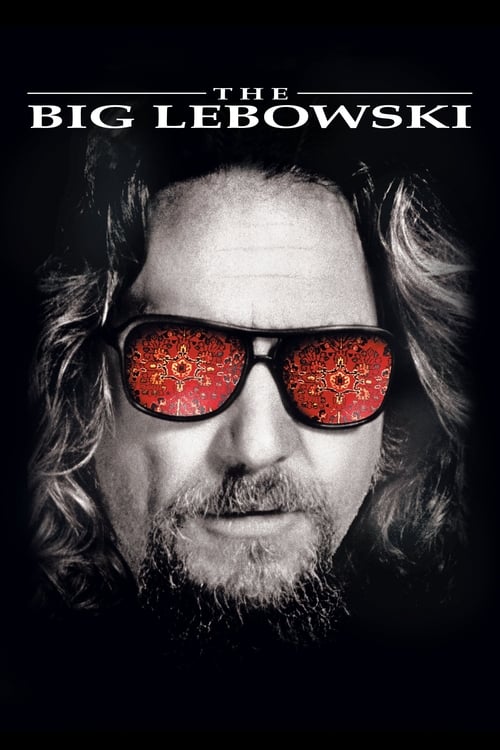
The Big Lebowski
1998 · Joel Coen
When you need a good laugh and zero stress — perfect with friends, a drink in hand, for a night when you want to relax into a movie rather than work at one.
What it's about
Jeffrey 'The Dude' Lebowski, a Los Angeles slacker whose whole life is bowling, White Russians, and his rug, gets mistaken for a millionaire with the same name and dragged into a kidnapping scheme he is spectacularly unqualified to handle. What follows involves nihilists, an adult-film producer, a cowboy narrator, and a lot of money that may or may not exist.
The experience
Loose, shaggy, and endlessly quotable — a stoned detective story where the mystery matters far less than hanging out in it. It's the rare comedy that gets funnier every single rewatch.
Performances
Jeff Bridges IS the Dude — one of the most beloved comic performances in American movies, so lived-in it stopped feeling like acting — and John Goodman's volcanic, rule-obsessed Vietnam vet Walter steals every scene he's in.
The craft
The Coen brothers' script is a machine of running gags and dialogue that loops back on itself, dressed up as a Raymond Chandler mystery and detoured through full-blown musical dream sequences. Every frame of its sun-baked, bowling-alley Los Angeles is deliberate even when the story pretends not to be.
Why it matters
A flop-turned-institution: it landed to shrugs in 1998 and then became one of the defining cult films of its era, complete with festivals, a lifestyle, and a permanent place in the pop-culture vocabulary.
Snapshot
A Los Angeles slacker named Jeffrey "The Dude" Lebowski is mistaken for a wealthy namesake, dragged into a kidnapping scheme, and spends the film doing almost nothing useful about it. Framed by a laconic Western narrator who wanders in from a different genre entirely, The Big Lebowski is simultaneously a Raymond Chandler pastiche, a Vietnam-wound character study, a Busby Berkeley reverie, and a meditation on what it means to persist, mellow and unhurried, at the end of American century. One of the most comprehensively cult films in the post-studio era, it arrived in 1998 to middling returns and polite bewilderment, then spent the next decade becoming a cultural institution.
Industry & production
Joel and Ethan Coen wrote and directed the film following the enormous critical success of Fargo (1996), which won Academy Awards for Best Original Screenplay and Best Actress. Where Fargo was tightly constructed and morally legible, The Big Lebowski was deliberately, cheerfully shaggy — a test of whether the brothers' emerging prestige could purchase them the latitude for a film that refused conventional dramatic momentum. The answer, commercially, was ambivalent: the film did not perform as a mainstream success. It was produced by Working Title Films and distributed by Gramercy Pictures in North America (a PolyGram label) and by PolyGram internationally; PolyGram's subsequent acquisition by Universal meant the film's later catalog life would be managed by Universal.
The Dude's character drew from at least two real sources the Coens openly acknowledged: Jeff Dowd, a film producer and political activist who had been a member of the Seattle Seven and who went by the nickname "The Dude," and Pete Exline, a friend of the Coens who had experienced a rug theft and subsequent, convoluted rug-recovery saga. Both men contributed personality, speech patterns, and biographical texture to what became one of the most fully inhabited slacker figures in American cinema. The production shot primarily on location in Los Angeles, using the city's actual bowling alleys, canyons, bungalows, and mansions as a kind of found geography — the film's LA is not constructed but inhabited, a sprawling civic landscape whose variety mirrors the plot's refusal to cohere.
Technology
Roger Deakins, who had shot Barton Fink, The Hudsucker Proxy, and Fargo for the Coens, once again served as director of photography. The film's most technically distinctive set-pieces are the Dude's dream sequences, which employ overhead crane work and wide-angle lenses to evoke the kaleidoscopic formations of 1930s Busby Berkeley choreography. The "Gutterballs" sequence involves a camera tracking through the interior of a bowling ball — achieved through a combination of miniature work and camera mounting — a literalization of the film's willingness to occupy any perspective, however absurd, in the service of a visual joke.
The widescreen compositions (1.85:1) make sustained use of the lateral space of bowling lanes and the cavernous proportions of the Big Lebowski's mansion, contrasting those registers against the cramped horizontality of the Dude's Venice Beach apartment. No technically novel formats or experimental stocks are prominently documented in published production accounts; the film's visual distinctiveness derives from compositional and choreographic choices rather than photochemical experiment.
Technique
Cinematography
Deakins shoots Los Angeles with an affectionate, slightly hazy warmth that could be the city's actual photochemistry or the Dude's THC-softened perception — the film holds both readings simultaneously. The opening tumbleweed shot is a sustained tracking move through nighttime LA streets, the tumbleweed drifting through traffic and over the Pacific Coast Highway toward the beach, scored to the Sons of the Pioneers' "Tumbling Tumbleweeds." The shot immediately positions the film in an imaginary West, a Hollywood space of myth, before Sam Elliott's narrator speaks a word. Deakins' bowling alley work favors low angles that exaggerate the lanes' depth and the ball's trajectory, framing the game as both mundane ritual and cosmic metaphor. When the Dude is in his element — bathrobe open, White Russian in hand, Creedence on the car radio — the camera is typically at ease, cutting unhurried. When the plot requires him to enter spaces of power (the mansion, Maude's studio, Jackie Treehorn's Malibu home), the compositions become slightly more formal, slightly more oppressive, the camera's sympathy made visible in its relationship to architecture.
Editing
The Coens edit their own films under the pseudonym Roderick Jaynes — a fiction extended here to include an Awards season presence and a filmography. The editing of The Big Lebowski is structured around the Dude's passivity: where a conventional thriller accelerates, this film frequently pauses, repeats, or deflates. The comedic rhythm depends on holding shots past their expected conclusion, on cutaways timed to deflate tension rather than escalate it. The transitions into the dream sequences are abrupt and unapologetic, the film comfortable cutting to a completely different genre register and then cutting back without explanation. The final bowling match, which should narratively deliver some form of resolution, is undercut before it completes — Donny's death arrives as a tonal rupture that the editing refuses to smooth over.
Mise-en-scène / staging
Costume designer Mary Zophres built the Dude's wardrobe as a form of principled refusal — every item (the bathrobe, the cardigan, the Bermuda shorts, the jellies) signals a man who has made a conscious choice not to dress for the economy he inhabits. Walter Sobchak's military surplus gear (the sunglasses, the vest, the cargo shorts) codes him as a man still fighting a war that ended decades ago. The nihilists wear a kind of 1980s German new wave uniform — tight clothes, severe haircuts, an aesthetic borrowed from Kraftwerk videos — that makes them simultaneously menacing and faintly ridiculous. The Big Lebowski's mansion is dressed in the grammar of WASP patrician power: heavy wood, portraits, Persian rugs (the specific absence of which the Dude will spend the film mourning), a studied performance of old money. Maude's studio is pointedly its opposite — white, high-ceilinged, scattered with feminist-inflected work, the set design doing the work of characterizing her as the film's most competent person.
Sound
Carter Burwell composed the film's instrumental score, which is more atmospheric and decorative here than in some other Coen collaborations — the film's sonic personality is dominated by its needle-drop soundtrack, one of the most eclectic and purposeful in 1990s American cinema. Creedence Clearwater Revival's "Lookin' Out My Back Door" accompanies the Dude cruising in his Torino; Bob Dylan's "The Man in Me" opens the first Busby Berkeley dream sequence; Townes Van Zandt, Yma Sumac, The Eagles (memorably despised by the Dude in the film), Henry Mancini, and Moondog all appear. The soundtrack functions as a kind of cultural autobiography for the Dude's generation — late 1960s and 1970s rock as the surviving residue of a particular American idealism. The film is set in 1991 during the Gulf War buildup, and the sonic choices quietly insist on the distance between that culture and its present moment. The sound design in the bowling sequences emphasizes the deep, satisfying thud of ball meeting lane — a sound of pure physical presence in a film full of characters unable to make contact with anything that matters.
Performance
Jeff Bridges synthesized his career's easy naturalism into a performance so thoroughly inhabited that the distinction between actor and character became philosophically interesting to critics and audiences alike. The Dude is not a passive man — he is active in his passivity, deliberate in his refusals, alert in his bemusement. Bridges makes visible the intelligence inside the slackness. John Goodman's Walter Sobchak is a performance of explosive, operatic certainty: a man whose Vietnam-trauma has curdled into an aggressive insistence on rules that only he is following. The comic engine of the film runs largely on the friction between Bridges' adaptive softness and Goodman's rigid conviction. Julianne Moore's Maude deploys a mid-Atlantic accent and a physical fearlessness (her entrance, nude, flying on a studio rig) to construct a character who is, uniquely in the film, entirely in control of her situation. Philip Seymour Hoffman's Brandt is a masterclass in obsequious professional anxiety; John Turturro's Jesus Quintana is an extended, barely-contained cameo of braggadocio; Steve Buscemi's Donny is treated by the film itself as an afterthought, which is the joke, and which becomes something more than a joke by the end.
Narrative & dramatic mode
The Big Lebowski is structured as a deliberate homage to and inversion of the hard-boiled detective novel, specifically Raymond Chandler's The Big Sleep (1939). In Chandler, the detective (Marlowe) is the most active and intelligent person in the story, navigating a labyrinthine plot through force of observation and will. The Coens replace Marlowe with a man who is constitutionally uninterested in detection, who pursues the rug replacement and the kidnapping case with the absolute minimum of initiative, and who, like the reader of The Big Sleep, is frequently unable to follow the plot. The film wears this convolution openly — at one point Walter essentially confesses he cannot keep the threads straight. The resolution is non-resolution: Bunny Lebowski was never kidnapped, the ransom money was embezzled by the Big Lebowski himself, the nihilists get nothing, and the only real loss is the death of Donny Kerabatsos from a heart attack after a parking lot confrontation that was always going to amount to nothing.
The Stranger narration — Sam Elliott as a laconic Western voice-over figure who doesn't entirely understand what he's narrating — is a Brechtian intrusion from a genre adjacent to noir: the frontier Western, another American mythology. His presence frames the film as a species of folk tale told in the wrong register about the wrong kind of hero.
Genre & cycle
The film participates in the 1990s neo-noir cycle (alongside L.A. Confidential, Chinatown's long shadow, Michael Mann's LA work) but parodies its conventions rather than replicating them. It also belongs to a lineage of what might be called the postmodern LA film — a strand of work that treats the city as a space of perpetual mythology and disillusionment, running through Robert Altman's The Long Goodbye (1973), Roman Polanski's Chinatown (1974), and into the 1990s. The stoner comedy and slacker comedy were emergent genres in the early 1990s — Richard Linklater's Slacker (1990) and Dazed and Confused (1993) are clear precedents in mood if not plot — and The Big Lebowski gave that sensibility the formal resources of a major studio production and a collaborator as technically rigorous as Deakins.
Authorship & method
Joel and Ethan Coen function as a single directorial entity: Joel typically holds the on-set directing role while Ethan is more involved in production and editing, but both write and both are credited on editing. Their screenwriting process is notoriously self-contained — they develop scripts without treatments or outside development, working from character and situation toward plot rather than the reverse, which accounts for The Big Lebowski's distinctive relationship to plot as something that happens around the characters rather than to them. Roger Deakins' long collaboration with the Coens (spanning more than a decade by 1998) produced a shorthand that allowed for technical ambition within the production's rhythms. Carter Burwell, who has scored virtually all Coen Brothers films from Blood Simple forward, provides underscore that frames rather than leads emotion. The editing pseudonym "Roderick Jaynes" is a standing joke about auteur theory and critical attribution — the brothers have, at various points, maintained that Jaynes is a real (elderly, British) person with his own opinions about their films.
Movement / national cinema
The film is American independent cinema by disposition if not strictly by production structure — Working Title and PolyGram are British/European entities, but the filmmaking sensibility is squarely within the American indie tradition that the Coens helped define. The Coens' career position in 1998 was that of validated independents with crossover access: post-Fargo, they could attract cast and resources available only to studio productions while retaining script and cut control. The Big Lebowski belongs to no specific regional or national cinema movement — it is a Los Angeles film, deeply embedded in that city's particular mythology, but it is not engaged with any contemporaneous LA film scene in an obvious way. Its spiritual affiliations are more with the New Hollywood films of the 1970s (Altman, Bogdanovich, Ashby, Cassavetes' more comic registers) than with the Sundance-flavored indie moment of its actual release.
Era / period
The film is set explicitly in 1991, during the buildup to and opening phase of the Gulf War — George H.W. Bush's televised assertion that "this aggression will not stand" is heard on a bar television and immediately, absurdly, absorbed into the Dude's vocabulary regarding his rug. The anachronism is deliberate: the Dude and Walter are men whose imaginative formation occurred in the late 1960s and early 1970s, the former as a political radical (he claims, with uncertain credibility, to have been a member of the Port Huron statement drafting committee), the latter through Vietnam service that has never concluded. The film looks at 1991 from 1998's vantage — with the Cold War over, the Gulf War a brief and bloodless (for Americans) television event, and the slacker cultural moment in full flow — and finds in the mismatch between its characters' formation and their present moment a gentle, melancholy comedy about historical persistence.
Themes
The film's deepest theme is the question of what a person owes the moment they inhabit. Walter insists on rules, codes, and principles — his Judaism, his bowling etiquette, his Vietnam-derived sense of combat honor — with a rigidity that functions as a kind of faith, however displaced. The nihilists believe in nothing, and the film treats this not as philosophical sophistication but as a practical and moral inadequacy: they are, as Walter notes, cowards. The Dude believes in nothing explicitly but practices something — a form of radical acceptance, an ease with impermanence, an unwillingness to be determined by the agendas of the powerful — that the film treats with genuine, unironic respect. The title figure, the "real" Big Lebowski, is exposed as a fraud: his money is gone, his power was always borrowed, his patrician certainty is performance. The Dude, who owns nothing, loses nothing essential.
Masculinity is treated throughout with a comedic skepticism. The various performances of male power — the Big Lebowski's gravitas, Walter's aggression, Jesus's swagger, the nihilists' menace — are all deflated. The Dude's masculinity is defined by its softness, its domesticity (the bathrobe, the supermarket runs, the White Russians), its willingness to be confused and dragged along and unhurt. Maude Lebowski is the film's most competent figure and is treated as such, though her agency is confined to a subplot about her own reproductive goals that the film handles with a certain breezy strangeness.
Los Angeles functions as its own theme: a city built on myth, perpetually performing itself, where the distance between surface and substance is so established as to be simply the weather. The Dude's Venice Beach apartment, the bowling alley, the canyon where the Dude's car is torched — these are real LA spaces, and the film's affection for them coexists with its awareness that the city's economy runs on exactly the kind of extraction and fraud the Big Lebowski represents.
Reception, canon & influence
Backward influences: Altman's The Long Goodbye (1973) is the film's most direct antecedent — Elliott Gould's Philip Marlowe as passive, anachronistic figure in contemporary LA set the template for a detective figure out of step with his own story. Howard Hawks's The Big Sleep (1946) is the film's structural and tonal ancestor. Preston Sturges screwball comedies, with their accelerating absurdity and their affection for broadly drawn eccentrics, inform the ensemble register. Busby Berkeley's 1930s choreography is the explicit visual source for the dream sequences. The Brothers' own earlier work — Blood Simple's LA noir roots, Miller's Crossing's crime genre consciousness — are also present.
Critical reception: Initial reviews in 1998 were respectful but mixed. Critics noted the film's charm and performances while expressing uncertainty about its structural looseness; some found it minor Coen Brothers, a divertissement after Fargo's moral seriousness. Roger Ebert gave it three stars and praised Bridges while questioning the film's coherence as a whole. The film performed modestly at the box office by the standards its cast and the Coens' post-Fargo profile might have suggested.
Legacy: The cult formation of The Big Lebowski is among the most documented in contemporary cinema. By the early 2000s, dedicated screenings were drawing audiences who knew the dialogue. The Lebowski Fest, an annual celebration first organized in Louisville in 2002, spread to multiple cities and became a sustained cultural institution. "Dudeism" — an internet-ordained religion based loosely on the Dude's philosophy — accumulated hundreds of thousands of adherents within a decade of the film's release. The film's quotability entered common usage in a way that few non-franchise films achieve.
Its influence on subsequent comedy is harder to trace with precision than its cult status, which is unusually quantifiable. The passive, pot-addled protagonist who navigates genre conventions through inaction rather than competence is a recognizable comic type in post-Lebowski American film. Its approach to the Los Angeles mythology — affectionate, deflating, aware of the city's self-performance — runs through a strand of California-set comedy and drama into the 2000s and 2010s. More broadly, the film demonstrated that a formally sophisticated comedy with no narrative momentum and no conventional hero could, given time, find a mass audience — a lesson about the conditions of cult formation that the industry has been inconsistently equipped to apply.
A Deleuzian reading
A tumbleweed comes rolling out of nowhere, down through the lights of nighttime Los Angeles, over the Pacific Coast Highway, out toward the beach where it has no business being.
The full Deleuzian reading of The Big Lebowski →
Reception
A shrugging box-office and critical also-ran in 1998 — widely received as a letdown after Fargo — it snowballed into one of the defining cult classics of its era, complete with its own festival (Lebowski Fest) and a 2014 spot in the National Film Registry.
How The Big Lebowski was received, from release to now →
Influences: the films it descends from and the films it influenced
- Gold Diggers of 1935 (1935) — Berkeley's overhead-camera choreography — female figures dissolved into abstract geometric formations — is directly quoted in the 'Gutterballs' dream sequence; the Coens lift Berkeley's specific device of the absurdist musical number inserted without apology into a narrative film's middle register.
- The Big Sleep (1946) — Hawks's Chandler adaptation established deliberate plot incoherence as an aesthetic stance — Hawks famously could not determine who killed the chauffeur — and the Coens replicate this structural model precisely: Lebowski's conspiracy defeats summary in exactly the same way, and the Dude's 'investigation' mimics Marlowe's movements without Marlowe's competence.
- The Long Goodbye (1973) — Altman's Marlowe — passive, mumbling, an anachronism in 1973 Malibu — is the direct prototype for the Dude: the hard-boiled detective stripped of agency, using overlapping naturalistic ensemble dialogue and a needle-drop score (John Williams playing the title song in every conceivable style) as connective tissue for a neo-noir that defeats detection.
- Chinatown (1974) — Lebowski inverts Chinatown's plot apparatus beat by beat — LA conspiracy, missing woman, investigator defeated by institutional power — converting Polanski's tragic-determinist structure into farce by replacing Nicholson's controlled competence with the Dude's cheerful passivity; the parody only works because the source template is this specific.
- Night Moves (1975) — Gene Hackman's Harry Moseby explicitly names his own investigative failure — 'I'm not sure who won' — establishing the self-aware neo-noir detective who cannot resolve his case as a formal genre position; the Coens develop this into the Dude's complete non-investigation, and the Stranger's closing monologue names the narrative's non-resolution in the same register of equanimity.
- Raising Arizona (1987) — The Coens first deploy their signature device here — a laconic voiceover narrator who mythologizes mundane criminal events in a register several tonal notes above the story's actual stakes — plus the Roderick Jaynes comedic edit rhythm that holds shots past their expected conclusion; Lebowski inherits both devices wholesale.
- Barton Fink (1991) — The first Roger Deakins/Coen collaboration established the visual language Lebowski extends — wide-angle distorting interiors, oppressive institutional spaces contrasted with cramped personal ones — and John Goodman's Charlie Meadows is the direct rehearsal for Walter Sobchak: the operatically erupting man who shares a room with a passive, bewildered protagonist.
- The Hudsucker Proxy (1994) — Continues the Coen mode of genre-pastiche-as-architecture and the passive naïf swept through a contrived plot machine, extending Hudsucker's archetype-pastiche performance style and fable narration.
- The Royal Tenenbaums (2001) — Anderson directly extends Lebowski's costume-as-character-coding — Richie's headband, Margot's fur coat, Royal's suit as complete biographical statements — combined with the eclectic needle-drop soundtrack (Nico, Nick Drake, Elliott Smith) assembled from unexpected period sources to mark tonal shifts, a technique Anderson absorbed and systematized into a signature method.
- Kiss Kiss Bang Bang (2005) — Black directly extends Lebowski's Brechtian narrator device: Robert Downey Jr.'s Harry Lockhart addresses the audience to correct himself, skip scenes, and comment on plot incoherence — a fully self-aware extension of the Stranger's aside mode — while the Chandler-sourced LA neo-noir accumulates conspiracy without resolution in the same structural model.
- Burn After Reading (2008) — Coen/Deakins/Jaynes applying Lebowski's structural principle — multiple idiots embedded in a conspiracy that dwarfs them — with the CIA director's 'what did we learn? what have we accomplished?' explicitly naming the narrative's non-resolution in the same Brechtian register as the Stranger's closing monologue.
- Inherent Vice (2014) — Anderson directly inherits the structural device: a passive, stoned LA investigator in a Pynchon-sourced neo-noir where conspiracy accumulates without resolution, with Joanna Newsom's voiceover narrator performing the same Brechtian-stranger function as Sam Elliott's Cowboy, and the warm hazy Los Angeles photography explicitly echoing Deakins' Lebowski palette.
- The Nice Guys (2016) — Black applies Lebowski's structure to 1970s LA — two incompetent investigators whose case cannot be resolved without exposing institutional complicity, a buddy comedy built on deflating expectations — with a period needle-drop soundtrack (Thin Lizzy, Earth Wind & Fire, ABBA) performing the same ironic commentary on characters' self-images as Lebowski's eclectic score.
- Miller's Crossing (1990) — The Coens apply the Roderick Jaynes editing pseudonym and genre-deconstruction method to Dashiell Hammett where Lebowski applies it to Raymond Chandler — both films use a hard-boiled literary source as a framework to be systematically emptied of its genre's expected competence and resolution.
- O Brother, Where Art Thou? (2000) — Coen/Deakins/Jaynes continuing the picaresque-loser structure with T Bone Burnett's period needle-drop music supervision performing the same structural function as Lebowski's eclectic soundtrack — music as connective tissue between tonal registers and ironic commentary on characters' self-images.
- Hail, Caesar! (2016) — Coen/Deakins extending Lebowski's genre-pastiche layering method — where Lebowski embeds a Busby Berkeley musical, a Western, and a Chandler noir within a single frame — Hail, Caesar! nests a Biblical epic, a Gene Kelly musical, a B-Western, and a drawing-room drama within a frame narrative, deploying the same technique of genre registers that refuse to cohere into a single generic identity.
- Fear and Loathing in Las Vegas (1998) — Contemporary sibling: the narrating Stranger openly confesses he barely knew the Dude, structuring the voiceover as self-undermining unreliable witness from the opening frame; the film's neo-noir quest collapses into pure failed-arc comedy via the same double-protagonist dissolution, and Creedence Clearwater Revival functions as California-myth elegy.
- One Battle After Another (2025) — Shaggy-dog detective comedy in which the case is structural pretext and the protagonist's sustained, affable incomprehension of events is simultaneously comic engine and emotional ground — the Coens and Anderson converge on the same solution to the problem of making a California noir where no one knows what is happening.
Similar films
- Barton Fink (1991) — influence & lineage
- O Brother, Where Art Thou? (2000) — influence & lineage
- Inherent Vice (2014) — influence & lineage
- Burn After Reading (2008) — influence & lineage
- The Long Goodbye (1973) — influence & lineage
- The Nice Guys (2016) — influence & lineage
- Raising Arizona (1987) — influence & lineage
- Chinatown (1974) — influence & lineage · often watched together
All the films related to The Big Lebowski →