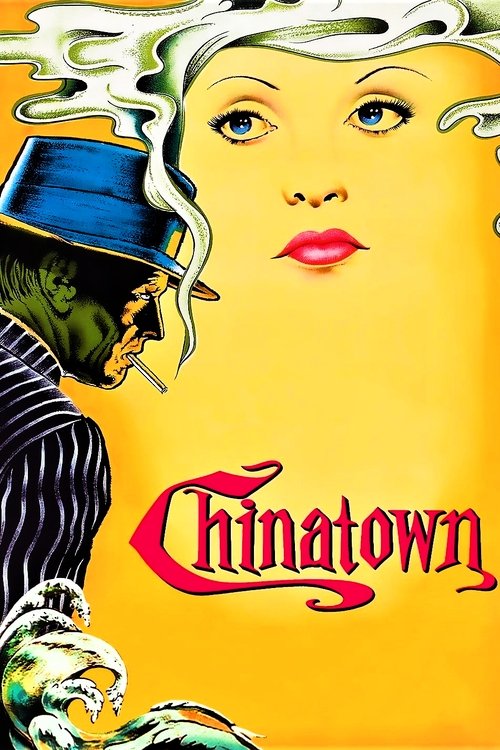
Chinatown
1974 · Roman Polanski
For a night when you want a mystery that treats you like an adult — something to sink into slowly and argue about after. This is a challenge watch in the best sense: it rewards full attention and doesn't offer easy comfort.
What it's about
Los Angeles, the late 1930s. Private eye Jake Gittes makes a comfortable living photographing cheating spouses — until a routine matrimonial job pulls him into a conspiracy over the city's water supply, a dead man in a reservoir, and a widow whose secrets go deeper than any case he's worked. The further he digs, the more the city's money and power close ranks around him.
The experience
Seductive and unhurried, then quietly merciless. It moves with the confidence of a classic detective story while a feeling of wrongness accumulates underneath — sun-drenched, gorgeous, and increasingly cold to the touch.
Performances
Jack Nicholson gives one of the great detective performances, cocky and wounded in equal measure; Faye Dunaway makes brittle elegance heartbreaking; and John Huston is genuinely chilling as a man who has never been told no.
The craft
Robert Towne's screenplay is widely considered one of the finest ever written — every scene a clue, every clue a trap. Roman Polanski shoots it with oppressive beauty, keeping the camera at Gittes's shoulder so you know only what he knows, while Jerry Goldsmith's trumpet-led score gives the whole thing a bruised romantic glow. It's a big-screen film through and through.
Why it matters
The high-water mark of 1970s American filmmaking and the template for every modern noir since — proof that a genre picture could carry the weight of tragedy.
Snapshot
A private investigator hired to document a routine infidelity finds himself entangled in a municipal water conspiracy reaching back decades — and forward into a family secret so monstrous it cannot be named in polite company. Chinatown is the terminal document of New Hollywood pessimism: a classical genre machinery run with maximum craft and then deliberately sabotaged, the detective left helpless as the villain walks free into the Los Angeles night. Screenwriter Robert Towne, director Roman Polanski, cinematographer John A. Alonzo, and composer Jerry Goldsmith produced what many regard as the finest American original screenplay of the sound era in marriage with a visual style of almost oppressive beauty. The film defines neo-noir as a moral condition as much as a generic formula.
Industry & production
Paramount Pictures released Chinatown in June 1974 under the producing hand of Robert Evans, then at the height of his influence following The Godfather (1972). Evans had developed Towne's screenplay over several years; Towne, already celebrated as a script doctor (he had contributed uncredited work to The Godfather), spent years researching the real Los Angeles water wars of the early twentieth century before constructing his fictional analog. The production was defined by creative tension at the top: Polanski, then living largely outside the United States following the murder of his wife Sharon Tate in 1969, brought a European fatalism that collided productively with Towne's more ambivalent intentions for the ending. Towne's original draft allowed Evelyn Mulwray to survive; Polanski insisted on her death and on Jake Gittes's total defeat, arguing that tragedy without qualification was the only honest response to the story's moral landscape. The resulting ending — Evelyn shot through the eye, her daughter-sister led away, Noah Cross triumphant — shocked preview audiences and became one of the most discussed directorial interventions in New Hollywood history.
Jack Nicholson, consolidating his emergence as the era's defining male star following Five Easy Pieces (1970) and The Last Detail (1973), took the role of Jake Gittes with the understanding that the character would fail where Philip Marlowe and Sam Spade had not. Polanski himself appears in an uncredited cameo as the knife-wielding thug who slits Gittes's nose, a piece of casting that carries obvious symbolic freight — the director as the agent of the protagonist's humiliation.
Technology
Chinatown was photographed in anamorphic widescreen using Panavision equipment, a format that suited the film's investment in peripheral threat and lateral geography — Los Angeles as a city of hidden distances and surveilling horizons. Alonzo's lenses tend toward the longer end, producing a compression of foreground and background that keeps characters visually trapped within their environments. The film was cut on conventional flatbed editing systems; nothing in its technology was experimental. The production design and costume department drew on extensive period research to render the late 1930s Los Angeles basin with specificity, though Polanski and Alonzo made no attempt at documentary literalism, preferring heightened verisimilitude to archival fidelity.
Technique
Cinematography
John A. Alonzo's work in Chinatown is a sustained argument for Californian light as a form of moral weather. The palette is amber and dust — a sun-bleached world in which shadow offers no refuge and daylight no clarity. Most of the film's pivotal sequences occur in harsh midday exteriors, inverting noir's traditional grammar of nocturnal revelation: here the crimes happen in the open, laundered by sunshine. Alonzo uses tight close-ups on Nicholson's face to enforce the film's subjective logic — we see only what Gittes sees, and what Gittes sees is almost always insufficient. The bandaged nose Nicholson wears through the film's second half, a practical consequence of the knife attack, becomes a recurring focal object that keeps the spectator's eye anchored to Gittes's humiliation. The frames are clean and spare, with little of the baroque shadow-play of classical noir, communicating a world that has nothing to hide because concealment is no longer necessary.
Editing
Sam O'Steen, who had edited The Graduate (1967) and Rosemary's Baby (1968) for Mike Nichols and Polanski respectively, brought an unobtrusive classicism to the cut. The editing is largely invisible: sequences are assembled to maintain spatial clarity and to control the release of information rather than to impose rhythm as an aesthetic value. The pace is deliberate, sometimes slow by the standards of the period thriller, trusting the screenplay's architecture to maintain tension without recourse to accelerating montage. Transitions favor the cut over the dissolve, maintaining chronological continuity even as narrative comprehension is deliberately withheld from the viewer.
Mise-en-scène / staging
Polanski stages several key scenes with a geometric precision that becomes legible only in retrospect. The Mulwray house interiors create visual corridors suggesting surveillance and enclosure; the water-inspection sequence at the Los Angeles reservoir uses the topography of the landscape — concrete channels, gated infrastructure — as a diagram of institutional power. The scene in which Gittes discovers the alternating salt and fresh water in the irrigation channels, conducted as a series of quiet procedural beats, is representative of the film's method: the mise-en-scène offers information without commentary, trusting the audience to register significance without being directed toward it. Polanski's consistent signature is a refusal of excess: the film's most violent and disturbing events — the incest disclosure, the murder of Evelyn — are handled with a bluntness that precludes spectacle.
Sound
The sound design maintains period discipline, favoring ambient diegetic texture — the creak of a ceiling fan, the percussion of Los Angeles street traffic, the clatter of office equipment — over expressive nondiegetic intrusion. Jerry Goldsmith's score, composed under acute time pressure after an earlier score by composer Phillip Lambro was rejected by Polanski, is paradoxically one of the most iconic in American cinema. Goldsmith's solution was a sparse, jazz-adjacent idiom built around a solo trumpet melody that functions as Gittes's melancholic interiority: the brass sound is simultaneously period-appropriate and existentially mournful, announcing a detective story that will not resolve. Goldsmith is documented to have completed the score in approximately ten days — an extraordinary achievement for work of such emotional precision, and one that gave the film a coherence of affect the rejected score apparently could not provide.
Performance
Nicholson's Jake Gittes is a performance of sustained surface confidence and progressive internal erosion. Where Humphrey Bogart's detectives maintained an unflappable moral center, Nicholson builds Gittes from professional self-assurance that the plot methodically strips away. The performance achieves something uncommon: Gittes is neither wholly sympathetic — he is vain, sexually opportunistic, occasionally cruel — nor unsympathetic, and Nicholson sustains that ambivalence without ever resolving it into a legible attitude. Faye Dunaway's Evelyn Mulwray operates at a higher register of visible distress — her nervous energy and halting speech patterns, which some contemporary reviewers read as mannered, are in retrospect precisely calibrated to the character's unbearable psychological burden. John Huston's Noah Cross is the film's great performance in miniature: Huston, who had directed The Maltese Falcon (1941) and thus embodied a specific tradition of noir authority, plays the patriarch as a man of genuine warmth and total amorality, a figure for whom power has become so naturalized that wrongdoing requires no concealment.
Narrative & dramatic mode
Chinatown operates within the formal conventions of the hardboiled detective narrative — a hired investigator, a femme fatale, a conspiracy — while systematically evacuating those conventions of their traditional satisfactions. In the classical mode, the detective's intelligence and persistence restore legibility to a disordered world; the crime is solved, order partially rehabilitated. Towne and Polanski's screenplay denies every one of these movements. Gittes is intelligent and persistent, and it makes no difference: the institutional power represented by Noah Cross is simply beyond the reach of individual action. The conspiracy is not solved but exposed, and the exposure accelerates the catastrophe it was meant to prevent.
The film's titular concept — "Chinatown" as the name Gittes and his former police colleagues gave to a precinct where the rules were illegible and good intentions reliably produced the worst outcomes — becomes the film's structural logic: meaning is available but intervention is impossible. This is a tragedy in the Greek rather than the thriller sense, structured around dramatic irony (the audience, watching Gittes's competence accumulate, comes to understand before he does that competence is not enough) and a final recognition that arrives too late to produce anything but grief.
Genre & cycle
Chinatown is the central text of the neo-noir cycle that emerged in Hollywood between approximately 1971 and 1981, a body of work that included Klute (1971), The Long Goodbye (1973), Night Moves (1975), and Body Heat (1981, at the cycle's trailing edge). Where classical film noir of the 1940s–50s was produced largely by exiled European directors working within studio genre constraints, neo-noir was a deliberate critical engagement with those precedents, self-conscious about its own generic history. Chinatown is distinguished within the cycle by the completeness of its investment in period setting and by the severity of its nihilism; most neo-noirs retain some residual irony or generic pleasure that softens the despair.
The film also participates in what critics have described as the New Hollywood's systematic revisionism of American genre forms: as McCabe & Mrs. Miller (1971) dismantled the Western and The Godfather complicated the gangster film, Chinatown anatomized the detective story as a form constitutionally unable to address structural power.
Authorship & method
Roman Polanski brought to the project a biography inseparable from its themes. The murder of Sharon Tate had ended his American phase; returning to Hollywood in the early 1970s, he carried a conviction that evil is not aberrant but structural, that innocence cannot be protected by intelligence, that the good suffer and the guilty prosper not exceptionally but as the norm. These convictions — traceable through Repulsion (1965) and Rosemary's Baby (1968) — shape every significant creative decision in Chinatown, and most conspicuously the insistence on the tragic ending against Towne's preference.
Robert Towne is the film's other major authorial presence. His screenplay is distinguished by research depth (he studied the actual history of the Los Angeles Department of Water and Power and the Owens Valley aqueduct construction), structural rigor (the water-as-power metaphor is sustained without strain across two hours), and dialogue that achieves hardboiled economy without self-parody. The Hollis Mulwray character bears a name that is a transparent homage to William Mulholland, the engineer who built the Los Angeles aqueduct; the land speculation scheme and water diversions correspond closely to documented historical events. Towne's screenplay is taught in American screenwriting programs and appears on the Writers Guild of America's list of the greatest screenplays.
John A. Alonzo had shot Sounder (1972) and Lady Sings the Blues (1972) before Chinatown; his work here established him as a major cinematographer, though he and Polanski are reported to have maintained a difficult working relationship, with Polanski frequently overriding Alonzo's choices. The visual consistency of the finished film suggests their disagreements were ultimately productive, or that Polanski's control was simply comprehensive.
Jerry Goldsmith's score proved more durable than the circumstances of its composition would suggest. Composed as a replacement under extreme deadline pressure, it has become one of the most studied scores in Hollywood, the trumpet solo circulating as shorthand for a particular flavor of retrospective melancholy — the sound of intelligence applied too late.
Sam O'Steen edited without drawing attention to the edit, which is the appropriate ambition for this material.
Movement / national cinema
Chinatown is a product of New Hollywood, the period (roughly 1967–1980) in which a generation of American directors reorganized Hollywood production around directorial authority and a willingness to import European art cinema strategies into commercial genre formats. Polanski's sensibility was formed by French and Polish cinema, and the film's fatalism is closer to Jean-Pierre Melville than to Howard Hawks. Unlike many New Hollywood films, Chinatown does not announce its European influences through formal experiment; they are absorbed into a surface of classical Hollywood craftsmanship, which makes the film's pessimism land with particular force — it is wearing the clothes of reassurance while delivering devastation.
Era / period
The film was released in June 1974, in the immediate context of the Watergate scandal, which had begun in 1972 and would produce Nixon's resignation in August of that same year. It is possible to read Chinatown as a parable of Watergate — the exposure of institutional corruption too embedded to be excised by individual action, the investigator overwhelmed by the scale of what he finds — without reducing it to allegory. More broadly, the film belongs to the post-Vietnam, post-assassination moment in American cultural life that produced a generalized skepticism about institutional legitimacy. The detective genre, built on the premise that private intelligence can contest public corruption, was a natural form for this skepticism to work through, and Chinatown works through it to its most extreme conclusion.
Themes
Water and power. The film's central metaphor is sustained at every level: water is the resource around which the conspiracy is organized, but it functions equally as a figure for the liquidity and opacity of power itself — the way authority flows around obstacles, finds hidden channels, shapes the landscape invisibly over time. The Los Angeles basin's actual dependence on engineered water supply gives the metaphor an unusual historical grounding.
The limits of knowledge. Gittes is a professional knower: his trade is the acquisition of information that others wish to conceal. The film's devastating argument is that knowledge without power is not only insufficient but actively dangerous — his discoveries accelerate Evelyn's death rather than preventing it.
Incest and the corruption of lineage. Noah Cross's relationship with his daughter Evelyn — and the child Katherine who results — introduces a dimension of horror that exceeds the political conspiracy. The incest functions thematically as the logical extreme of the film's concern with the abuse of authority within structures of intimacy, the same will to ownership that controls water rights applied to the body of a daughter.
The city as formation. Los Angeles in Chinatown is not a backdrop but a protagonist: the film is as much a history of the city's formation as a detective story. The water infrastructure, the land speculation, the ethnic geography (the film's Chinese characters are largely mute witnesses to events they cannot affect, present in the mise-en-scène but beyond the reach of the plot's concern) are the material of the conspiracy and of the city simultaneously.
Reception, canon & influence
Backward influences. The film draws most directly on the hardboiled American tradition: Raymond Chandler's Philip Marlowe novels, particularly Farewell, My Lovely (1940) and The Long Goodbye (1953), provide the investigative template and the Los Angeles geography. Dashiell Hammett contributes the detective as institutional outsider. John Huston's The Maltese Falcon (1941) is the essential cinematic predecessor — significantly, Huston appears in Chinatown as the villain, a piece of casting that amounts to an editorial on the tradition he represents. Billy Wilder's Double Indemnity (1944) and Sunset Boulevard (1950) provide the model of Los Angeles as a city of ambient corruption. From European cinema, the fatalism of Jean-Pierre Melville's work and the structural pessimism of Polanski's own earlier films (Knife in the Water, 1962; Repulsion, 1965) are legible in the film's moral architecture.
Critical reception. Chinatown was recognized immediately as a major work. It received eleven Academy Award nominations, including Best Picture, Best Director, Best Actor (Nicholson), Best Actress (Dunaway), and Best Supporting Actor (Huston), winning one: Best Original Screenplay for Towne. Contemporary critics identified it as a landmark without fully anticipating its canonical durability. In subsequent decades the film appeared consistently at the upper tier of critical lists — the AFI, the National Film Registry (inducted 1991), and Sight & Sound surveys — its reputation growing rather than diminishing as the neo-noir cycle receded and the film's formal achievement became legible independent of its generic moment.
Forward influence. The film's most direct progeny is L.A. Confidential (Curtis Hanson, 1997), which inherits the period Los Angeles setting, the institutional corruption theme, and the noir revisionism, though it allows its investigators a more qualified victory. Brian De Palma's Blow Out (1981) and Lawrence Kasdan's Body Heat (1981) extend the neo-noir cycle the film helped define. James Ellroy's Los Angeles Quartet — the literary source for L.A. Confidential — acknowledges the film as a shaping influence on his fictional project. In television, the first season of True Detective (Nic Pizzolatto, 2014) operates within the moral and structural framework that Chinatown established: the detective who uncovers a conspiracy reaching into institutional power and cannot dismantle it, the investigation as a form of prolonged, articulate failure. Towne's screenplay remains a primary teaching text in screenwriting programs; its management of exposition through dramatic scene and its three-act rigor are regularly cited as models of the form. Most consequentially, the film's ending — the unequivocal defeat of the protagonist, the triumph of the villain — established a template for prestige American narrative in the decades following: the story that refuses consolation as a condition of its seriousness.
A Deleuzian reading
Jack Nicholson spends half of *Chinatown* with a white bandage taped across his nose.
The full Deleuzian reading of Chinatown →
Reception
No reappraisal needed — it landed as an instant classic in 1974, earning 11 Oscar nominations, though it walked away with just one (Robert Towne's screenplay) after being steamrolled by The Godfather Part II. Its stature has only hardened since: Towne's script is now routinely called the greatest ever written.
How Chinatown was received, from release to now →
Influences: the films it descends from and the films it influenced
- The Maltese Falcon (1941) — Huston and Hammett established the generic convention of the detective's pyrrhic resolution — Spade delivers Brigid to the police but loses everything — which Towne absolutizes: where Spade retains moral agency in his defeat, Gittes is denied even that, stripping the genre formula of its compensatory dignity.
- Double Indemnity (1944) — Wilder and Chandler's screenplay built the femme fatale architecture that Towne's screenplay dismantles piece by piece: Evelyn Mulwray fulfills every femme fatale formal cue (the meet, the secret, the withholding) while being innocent, forcing the audience to inherit Gittes's misreading rather than the genre's reliable moral coding.
- The Big Sleep (1946) — Hawks and Chandler proved that classical noir's formal pleasure is atmospheric rather than hermeneutic — the Sternwood chauffeur murder was never solved because neither director nor writer could determine who killed him — and Chinatown inherits this permission to withhold narrative resolution, converting it from stylistic strategy to tragic structure.
- Sunset Boulevard (1950) — Wilder established Los Angeles as a setting where physical beauty and systemic corruption are inseparable, and Alonzo's amber palette directly inherits Wilder and Franz Planer's approach of rendering the city in light too flattering for its moral content — glamour as camouflage rather than contrast.
- Vertigo (1958) — Hitchcock's use of telephoto lenses to trap Scottie within flattened space is the primary cinematographic debt Alonzo pays: Gittes's tight close-ups and long-lens urban geography use the same lensing strategy to diagram the detective's epistemological limitation, with both films concluding that the male investigator's visual obsession is the mechanism of the woman's destruction.
- Touch of Evil (1958) — Welles staged his corrupt institution as a physical landscape of border infrastructure — cranes, oil derricks, canal channels — and Polanski adopts this grammar directly in his aqueduct and reservoir sequences, making illegitimate power legible as built geography rather than dialogue.
- Rosemary's Baby (1968) — Sam O'Steen cut both films for Polanski and repeats his technique of maintaining spatial clarity while systematically withholding narrative coherence — the viewer sees everything the protagonist sees but cannot interpret it correctly until too late — making the editorial method as much a formal inheritance as the screenplay structure.
- Citizen Kane (1941) — Polanski inherits Kane's proto-noir architecture of a private investigation that terminates in withheld revelation — here a powerful man's crimes whose exposure serves rather than defeats him — extending Kane's critique of the media-industrial power nexus into explicit civic corruption.
- The Godfather (1972) — Inherits Coppola's synthesis of classical Hollywood visual grammar — motivated lighting, anamorphic widescreen, period production design — with New Hollywood moral tragedy; the naïve protagonist hardened and finally destroyed by institutional corruption mirrors Michael's arc with the moral valence reversed.
- Casablanca (1943) — Robert Towne's screenplay consciously inherits Casablanca's narrative architecture — a cynical American operator whose self-protective neutrality is broken by erotic attachment to a woman of withheld interiority, drawn into a historical crime larger than either of them, whose intervention ends in the sacrifice of the innocent — transposing the wartime-conversion arc into neo-noir with systemic corruption replacing political occupation as the irresistible force.
- M (1931) — Polanski extends M's central editorial argument — parallel procedural cross-cutting establishing formal equivalence between official and criminal power — into a structure where the detective's investigation and the criminal's operation are revealed to be not just symmetrical but literally unified, collapsing into identity the distinction M staged as a moral parallel.
- The Third Man (1949) — Polanski structures the inverted mystery identically: the investigator discovers he has been manipulated as a tool, the villain escapes entirely, the innocent dies, and the genre's consolation is refused; Polanski has cited The Third Man as the direct structural model for this ending's refusal of resolution.
- Night Moves (1975) — Penn and Alan Sharp's screenplay is the most direct generic descendant of Chinatown's anti-detective-resolution structure: Harry Moseby fails explicitly, circling helpless in the boat at the film's end, and Hackman performs the progressive erosion of investigative confidence through the same accumulating physical fatigue and narrowing affect that Nicholson uses for Gittes's unraveling.
- All the President's Men (1976) — Gordon Willis stages the investigative process in the architecture of the Washington bureaucracy — underground parking structures, Library of Congress reading rooms, newsroom fluorescence — as moral geography in exactly the way Polanski uses LA's water infrastructure: both films diagram institutional power through the physical spaces it occupies and the quality of light it tolerates.
- Blood Simple (1984) — The Coens inherit Chinatown's epistemological contract — investigator failure as structural rather than incidental — and extend it into pure irony: where Gittes operates from one crucial misconception, Blood Simple's characters each hold a different fatal misreading, distributing the genre's detective function across figures none of whom can perform it.
- Devil in a Blue Dress (1995) — Franklin and Tak Fujimoto use anamorphic long-lens photography to trap Easy Rawlins within the postwar Los Angeles basin in the same compositional grammar as Alonzo — figures compressed against institutional backgrounds, buildings framed to suggest enclosure — while the screenplay's conspiracy reveals that the city's real-estate corruption is structurally inseparable from its racial architecture, the dimension Towne's film cannot reach.
- L.A. Confidential (1997) — Dante Spinotti's anamorphic widescreen palette is the most deliberate visual citation of Alonzo's work: the same amber-saturated California daylight, the same long-lens compression of figures against mid-century institutional landscape, the same strategy of making the city's beauty the aesthetic correlate of its corruption.
- Zodiac (2007) — Fincher uses long-lens photography to isolate Graysmith within Bay Area institutional spaces — newsrooms, police archives, suburban homes — applying Polanski's staging-as-entrapment grammar to a different geography, and the anti-detective resolution, in which the investigator identifies the killer without being able to prove it, is Chinatown's Greek-tragedy structure transposed from murder to obsession.
- Inherent Vice (2014) — Pynchon's novel was written in explicit response to Chinatown, and Anderson's adaptation translates the debt into craft: Robert Elswit's anamorphic cinematography shoots the same Los Angeles basin in the same harsh-daylight register as Alonzo, the conspiracy's engine is the same postwar real-estate corruption, and Doc Sportello's failure to comprehend or prevent the catastrophe is Gittes's defeat absorbed into stoner comedy as a displaced form of grief.
- The Big Lebowski (1998) — Lebowski inverts Chinatown's plot apparatus beat by beat — LA conspiracy, missing woman, investigator defeated by institutional power — converting Polanski's tragic-determinist structure into farce by replacing Nicholson's controlled competence with the Dude's cheerful passivity; the parody only works because the source template is this specific.
- The Dark Knight (2008) — The moral-dilemma architecture in which every correct decision by the protagonist worsens outcomes and every institution—police, law, finance—is depicted as structurally corrupted rather than infiltrated by a single bad actor; Harvey Dent's fall replicates Jake Gittes's catastrophic competence.
- Insomnia (2002) — Polanski's neo-noir establishes the sun-bleached daylit landscape as an environment hostile to concealment — where shadow fails as metaphor, overexposure takes its place — and the structure of an investigation that implicates the detective in the crime he pursues, both of which Nolan and Pfister transpose to Arctic Alaska.
- The Usual Suspects (1995) — Polanski deploys procedural investigation grammar—interrogation two-shots across institutional furniture, the detective accumulating misleading evidence—as total misdirection toward a hidden criminal sovereign, the exact staging-as-structural-deception Singer systematizes with Verbal's testimony.
- Oldboy (2003) — Polanski embeds a Greek incest tragedy inside a noir investigation, establishing the template Oldboy inherits: a protagonist whose relentless quest for truth arrives at a revelation that retroactively contaminates every preceding scene, with the investigator's dogged competence revealed as the very mechanism of catastrophe.
- The Long Goodbye (1973) — Altman and Zsigmond solved the same formal problem as Polanski and Alonzo — how to photograph Los Angeles neo-noir without classical shadow — through opposite methods: Zsigmond desaturates and diffuses through improvised ambient-light shooting while Alonzo overexposes and harshens, both concluding that California daylight is exposure rather than clarity.
- The Conversation (1974) — Walter Murch's layered diegetic sound design — the tape's ambiguous central phrase heard differently on each pass — is the sonic analog of Alonzo's image-based information-withholding: both Watergate-era films build their epistemological structure from the limits of their respective recording technologies, and both investigators are destroyed by what they cannot quite perceive.
- Klute (1971) — Polanski structures his neo-noir investigation around a woman's hidden interior life that the male detective cannot finally penetrate, and refuses genre resolution with a bleakly ambiguous ending — both the detective/woman power dynamic and the anti-cathartic close are crystallized from the template Klute established.
- The French Connection (1971) — Robert Towne's procedural screenplay applied the New Hollywood detective-investigation genre structure French Connection helped crystallize while inverting Friedkin's verité abrasion: John Alonzo's controlled, classical location cinematography produces a period pastiche where French Connection produced a present-tense documentary, demonstrating the genre's formal range.
- The Parallax View (1974) — The investigator destroyed by the case in anamorphic widescreen — John Alonzo's sun-bleached Los Angeles compositions place Gittes in exposed, legible space, the inverse of Willis's obscuring shadow, but both cinematographic strategies perform the same argument: the protagonist is visible to the apparatus while the apparatus remains hidden; both films end with the conspiracy's absolute victory and the investigator's impotence.
- Out of the Past (1947) — Neo-noir descendant inheriting the fatalistic detective structure — an investigator drawn ever deeper toward a doom he cannot avert — and the cool, doomed epigrammatic register.
- Harold and Maude (1971) — John A. Alonzo's cinematography — the plain, true, naturalistic palette he gave Harold and Maude — becomes a defining New Hollywood look, the same unfussy available-light realism applied to period noir.
- Angel Heart (1987) — The template of the hired detective whose investigation incriminates himself and ends in horrified, irreversible revelation — Angel Heart transposes Chinatown's noir Oedipal trap into a literal Faustian one.
Similar films
- L.A. Confidential (1997) — influence & lineage · same viewing thread · often watched together
- The Long Goodbye (1973) — influence & lineage · same viewing thread
- Double Indemnity (1944) — influence & lineage · often watched together
- The Conversation (1974) — influence & lineage · often watched together
- The Big Sleep (1946) — influence & lineage
- The Maltese Falcon (1941) — influence & lineage
- Night Moves (1975) — influence & lineage
- The Killing of a Chinese Bookie (1976) — same viewing thread
All the films related to Chinatown →
Watch it with: curated runs of related films
- American Crime, Long Memory — A run of mob epics, noir, and neighborhood tragedies that all circle the same wound — loyalty, masculine violence, and the past that never lets go — so watch them close together and let the decades and cities blur into one long American story.
Film essays and courses that include it
- Fade In to Fracture: The Screenplay from Architecture to Anarchy
- Guilty by Design: The Art and Architecture of Film Noir
- American Cinema Breaks Open: New Hollywood 1967–1980
- Watched: Ten Landmarks of the Paranoia Thriller
- Premeditated: Cinema's Century of the Kill
- The Investigator's Eye: From Sam Spade to Zodiac
- The Fix Is In: Cinema's Anatomy of Corruption, 1939–2007
- The Paranoid Machine: A Century of Conspiracy Cinema
- The Dream at the End of the Road: Los Angeles & California
- The Case That Won't Close: Eight Films About Detectives Who Can't Detect Anymore
- Name Your Price: Cinema's Anatomy of the Dark Deal
- The Ten Years the Directors Won
- The Style That Knew It Was Doomed