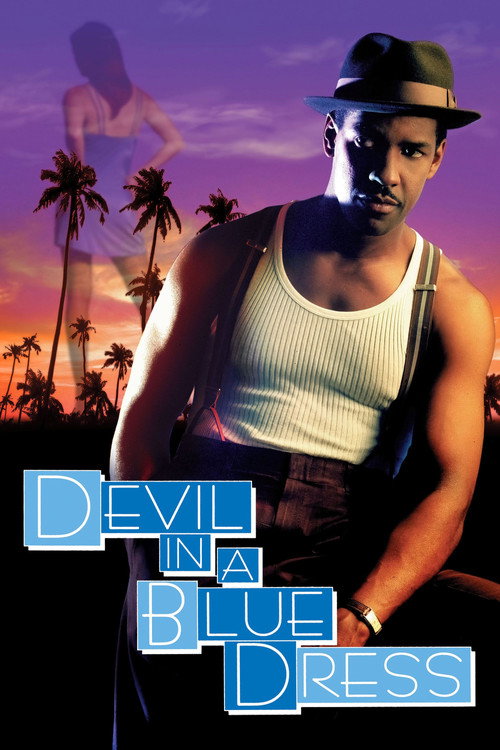
Devil in a Blue Dress
1995 · Carl Franklin
For a late-night noir mood — whiskey-and-jazz cinema, stylish and absorbing rather than punishing. Comfort viewing for crime fans, with real stakes humming underneath.
What it's about
Los Angeles, 1948. Easy Rawlins is a Black World War II veteran who's just lost his aircraft-plant job and is desperate to keep the little house he loves — so when a mysterious white man offers cash to find a missing woman rumored to frequent the city's Black jazz clubs, he takes it. Every question Easy asks pulls him deeper into a scheme of politics, money, and murder, in a city where a Black man investigating anything is himself treated as the crime.
The experience
Smooth, amber-lit, and unhurried — it pours over you like a good record, then tightens the screws. The pleasure is in the atmosphere and the talk; the tension comes from knowing Easy can't call the cops, because the cops are part of the problem.
Performances
Denzel Washington makes Easy's wariness magnetic — a detective whose superpower is reading rooms that could kill him. And Don Cheadle, as his cheerfully trigger-happy friend Mouse, walks off with the movie in a career-making turn: funny, terrifying, and impossible to look away from.
The craft
Carl Franklin directs with unhurried classical confidence, and Tak Fujimoto's cinematography bathes 1948 Central Avenue — the jazz clubs, barbecues, and bungalows classic noir never showed — in warm amber. The smartest craft choice is what the film treats as the real stake: not the femme fatale, but Easy's house and fruit trees.
Why it matters
Adapted from Walter Mosley's novel, it restored Black Los Angeles to a genre that had always kept it offscreen, launched Cheadle toward stardom, and became the touchstone every conversation about Black noir returns to.
Carl Franklin's adaptation of Walter Mosley's novel restores what classic film noir kept offscreen: the Black Los Angeles of 1948, its Central Avenue jazz clubs, backyard barbecues and hard-won bungalows. Denzel Washington plays Easy Rawlins, a laid-off aircraft-plant veteran who takes a white stranger's money to find a missing woman and discovers that in this city, a Black man asking questions is himself the mystery under investigation. Franklin, coming off the lean and brilliant One False Move, directs with unhurried classical confidence; Tak Fujimoto's cinematography bathes the period recreation in amber, and the film treats homeownership — Easy's fierce attachment to his little house and fruit trees — as the true noir stake, more precious than any femme fatale. Then Don Cheadle arrives as Mouse, Easy's cheerfully homicidal friend from Houston, and walks off with the picture; his failure to receive an Oscar nomination remains a standing grievance among critics. A commercial disappointment in 1995 that killed the planned franchise, it has since been reclaimed as one of the great American crime films of its decade.
Reception
A box-office disappointment in 1995 that quietly killed plans for a whole Easy Rawlins franchise — now widely regarded as one of the great '90s neo-noirs, capped by a Criterion Collection release in 2022.
How Devil in a Blue Dress was received, from release to now →
Influences: the films it descends from and the films it influenced
- Chinatown (1974) — The template of the revisionist period-noir where a detective's small case unspools into a buried civic crime beneath a mythologized Los Angeles — Franklin borrows its meticulous, sun-faded period reconstruction and its structure of a fixer pulled out of his depth.
- The Big Sleep (1946) — Supplies the Chandler-derived engine of the willfully knotted private-eye plot, where the investigator (and viewer) can never fully hold the string of bodies and favors — the same labyrinth-as-mood that Mosley and Franklin reproduce over solving-the-puzzle clarity.
- Out of the Past (1947) — Fixes the noir grammar Franklin works within: retrospective first-person voiceover, the doomed man drawn back into a past debt, and the femme fatale whose true allegiance is withheld — Daphne Monet's reveal is a direct descendant of this reversal machinery.
- Farewell, My Lovely (1975) — The nearest precedent for the amber-nostalgic 1940s-LA lighting palette — a warm, honeyed period look applied to a Chandler adaptation, the exact register Tak Fujimoto extends rather than the harsh silver of classic-era noir.
- Shaft (1971) — The genre innovation Easy Rawlins inherits — the Black private detective as center of the frame, reading a segregated city's racial geography as professional terrain, not as sidekick or victim.
- Cotton Comes to Harlem (1970) — Establishes the adaptation of Black-authored crime fiction (Chester Himes) told from inside the Black community's own sightlines and vernacular — the source-fidelity model Franklin applies to Mosley's Watts.
- One False Move (1992) — Franklin's own prior film — his method of coiling menace through restraint, then releasing violence in sudden brutal bursts, plus a plot built on race and hidden identity, is carried straight into Mouse's eruptions and Easy's masked history.
- Body Heat (1981) — The 1980s revival that proved classic femme-fatale-and-fall-guy machinery could be rebuilt at feature scale for a modern audience — the neo-noir precedent that made a straight-faced Mosley adaptation commercially legible.
- L.A. Confidential (1997) — Extends the same mid-century-LA reconstruction ethos two years later — a corruption web threading police, real estate, and race across a fastidiously rebuilt period city, sharing the amber-and-shadow production-design language.
- Mulholland Falls (1996) — Carries forward the recreated post-war Los Angeles as noir backlot — squad-car period detail and stylized 1950s civic corruption in the immediate wake of Franklin's reconstruction.
- The Black Dahlia (2006) — A later 1940s-LA noir (Ellroy) that inherits the same fetishistic period-recreation of a specific historical moment in the city, foregrounding staging and costume as an engine of noir atmosphere.
- BlacKkKlansman (2018) — Extends the Black-detective-under-racial-surveillance framework into period genre filmmaking — a Black investigator using disguise and code-switching to work a case inside a hostile white power structure, the same double-consciousness Easy performs.
- Inherent Vice (2014) — A later period-LA private-eye mystery that inherits the Chandler-via-noir structure of a lone investigator drifting through a hazily-lit, real-estate-and-power-soaked Los Angeles where the plot's coherence matters less than the city's texture.
- The Silence of the Lambs (1991) — Shares Tak Fujimoto's signature method — subjective, character-anchored camera and controlled warm/cool palette contrasts — applied here to make the audience inhabit Easy's wary point of view as he moves through hostile spaces.
- Deep Cover (1992) — A contemporaneous Black neo-noir where a Black protagonist navigates moral corruption and shifting allegiances in LA — the same 1990s project of fusing noir fatalism with a specifically Black-Angeleno vantage on surveillance and survival.
- A Rage in Harlem (1991) — Another period adaptation of Black crime fiction (Himes again) staging a mid-century Black urban world with lush period design — the parallel effort to recover a historical Black city through noir iconography.
- Lone Star (1996) — Repurposes the noir investigation as an epistemology of race — what the detective can learn is strictly bounded by which rooms his skin lets him enter and who will testify to him — the same conversion of detection into a study of who controls the record.
Similar films
- One False Move (1992) — influence & lineage
- L.A. Confidential (1997) — influence & lineage
- Deep Cover (1992) — influence & lineage
- The Big Sleep (1946) — influence & lineage
- Out of the Past (1947) — influence & lineage
- Murder, My Sweet (1944) — shared sensibility
- The Postman Always Rings Twice (1946) — shared sensibility
- Night Moves (1975) — shared sensibility