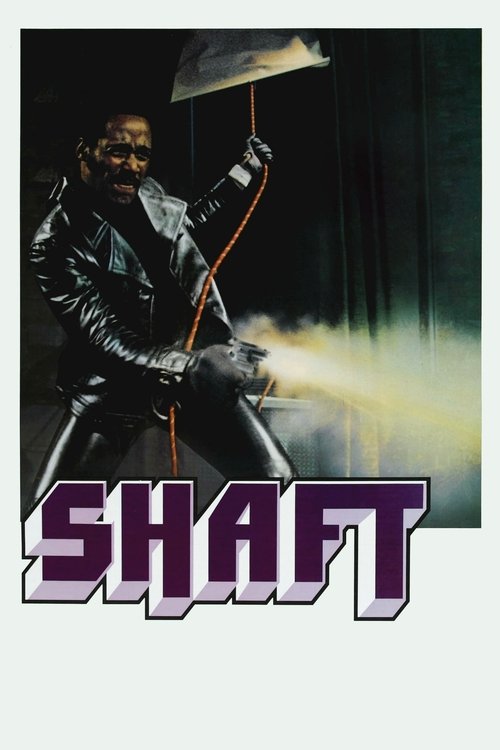
Shaft
1971 · Gordon Parks
For when you want to feel effortlessly cool — a Saturday-night crime picture with style to burn and a hero who never blinks. Easy, confident viewing, not a heavy lift.
What it's about
John Shaft is a Black private detective who moves through Harlem and midtown Manhattan on his own terms, answering to nobody — not the cops, not the mob. A Harlem crime boss hires him to find his kidnapped daughter, a job that drops Shaft into the middle of a brewing war between Harlem's rackets and the downtown Mafia.
The experience
Cool, tough, and propulsive — a lean detective picture with real streets, real attitude, and a hero whose swagger is half the entertainment. It's tense when it needs to be, but mostly it's a pleasure ride powered by pure charisma.
Performances
Richard Roundtree makes Shaft an icon on sheer presence — walking through New York like he owns it, radiating wit and self-possession that a thousand imitators have chased since.
The craft
Photographer-turned-director Gordon Parks shoots on real New York locations, giving the film a gritty documentary texture, and Isaac Hayes's funk score — anchored by its legendary, Oscar-winning theme — practically became a character of its own. Good speakers are non-negotiable here.
Why it matters
A surprise smash that helped rescue a struggling MGM and, with a handful of contemporaries, launched the blaxploitation wave — putting a Black hero at the center of the American action picture and changing who got to be the star.
Snapshot
Shaft is the film that turned a private-eye programmer into a cultural event. Working from Ernest Tidyman's pulp novel, photographer-turned-director Gordon Parks built a hard, location-driven detective picture around a single magnetic figure: John Shaft, a Black private investigator who moves through Harlem and midtown Manhattan with equal authority and answers to no one. The plot is lean—Shaft is hired by Harlem crime boss Bumpy Jonas to recover his kidnapped daughter, a job that pulls him into a war between Harlem's Black rackets and the downtown Mafia—but the film's real subject is the cool, self-possessed sovereignty of its hero. Released by a financially imperiled MGM in the summer of 1971, Shaft became a sizable commercial success and, alongside Cotton Comes to Harlem (1970) and Sweet Sweetback's Baadasssss Song (1971), helped inaugurate the cycle later labeled blaxploitation. Its afterlife is inseparable from Isaac Hayes's score, whose wah-wah-driven theme won the Academy Award for Best Original Song and lodged the character permanently in popular memory.
Industry & production
Shaft was produced for Metro-Goldwyn-Mayer, then in acute crisis. Under new ownership and management, the studio was selling assets and slashing output, and inexpensive genre pictures with clear audience appeal were exactly the kind of bet it needed. The project came to MGM via producer Joel Freeman and was developed from Tidyman's 1970 novel; Tidyman, a white newspaperman who would shortly win an Academy Award for adapting The French Connection, wrote the screenplay with John D. F. Black. The decision to hire Gordon Parks to direct was consequential: Parks, the celebrated Life photographer, composer, and author of The Learning Tree—which he had directed for Warner Bros. in 1969—was among the first Black filmmakers to work inside the major-studio system, and Shaft placed a Black director in command of a mainstream commercial release aimed squarely at a Black urban audience that Hollywood had long underserved.
That audience proved decisive. The film performed strongly, particularly in cities with large Black populations, and it is routinely credited in studio histories with helping to stabilize MGM's balance sheet at a desperate moment. Its success also confirmed a commercial thesis that reshaped early-1970s production: that films centering Black heroes, made relatively cheaply and marketed directly, could be highly profitable. MGM moved quickly to capitalize, producing the sequels Shaft's Big Score! (1972), again directed by Parks, and Shaft in Africa (1973), as well as a short-lived CBS television series. Precise budget and gross figures vary across sources and should be treated cautiously, but the qualitative record—a low-to-mid-budget picture that returned far more than it cost—is well established.
Technology
Shaft is a product of conventional 35mm color filmmaking, and its technological interest lies less in novelty than in how thoroughly it embraces the location-shooting practices that defined American cinema after the late 1960s. Shot largely on the streets of New York—Harlem, Times Square, Greenwich Village—the production depended on the lighter, more mobile equipment and faster film stocks that made extensive on-location work practical. The result is a grainy, available-light texture in many exteriors that aligns the film with the period's broader move away from studio gloss toward documentary immediacy. The soundtrack's prominence also reflects contemporary recording and mixing practice: Isaac Hayes's score was conceived and released as a double LP, and the film's sound design foregrounds that music to an unusual degree, treating the score less as underscore than as a continuous, foregrounded presence.
Technique
Cinematography
Cinematographer Urs Furrer shoots New York as a lived environment rather than a backdrop. The film opens by following Shaft up out of the subway and into Times Square, the camera moving with him through real crowds and traffic, establishing from the first minutes that this is a hero at home in the city's streets. Furrer favors a contrasty, slightly desaturated palette suited to winter exteriors and dim interiors, and the handheld and shoulder-level work in crowd scenes gives the picture a reportorial edge consonant with Parks's photojournalist background. Interiors—Shaft's Village apartment, Bumpy's Harlem headquarters, bars and offices—are staged with practical-feeling, often low-key lighting that keeps the film grounded in a recognizable social texture rather than abstracting it into noir stylization.
Editing
Hugh A. Robertson, who had received an Academy Award nomination for editing Midnight Cowboy (1969), cut the film, and his work is most visible in the rhythmic integration of music and image. The celebrated opening title sequence—Shaft striding through Times Square to Hayes's theme—sets pace and attitude through the marriage of movement and beat, and Robertson sustains that musical sense of tempo through the picture's transitions and montage passages. The climactic hotel rescue is built in classical action-editing fashion, cross-cutting Shaft's assault with the imperiled hostage to generate suspense, but the film's overall tempo is deliberate, allowing scenes of talk, negotiation, and atmosphere to breathe between bursts of violence.
Mise-en-scène / staging
Parks stages Shaft as a study in milieu. The film moves deliberately between worlds—Shaft's bohemian, integrated downtown life; the Black power politics of a Harmlem militant cell; the corridors of organized crime—and uses costume, décor, and location to mark each. Shaft's leather coat and turtlenecks function almost as armor and signature, an image of controlled masculine style; Bumpy's lair and the Mafia's spaces are dressed to signal competing forms of power. Parks's compositional instincts, honed in still photography, show in the care given to Shaft's placement within frames: he is repeatedly centered, framed in doorways, or shot from slightly below in ways that assert command of the space around him.
Sound
Sound is arguably the film's most distinctive technical dimension, and it is dominated by Isaac Hayes's score. The music is mixed forward and used almost continuously, so that the film's mood is carried as much by Hayes's funk arrangements—wah-wah guitar, hi-hat, strings, horns, and Hayes's own spoken-sung vocals on the main theme—as by dialogue or effects. Charles "Skip" Pitts's wah-wah guitar figure on the theme is among the most recognizable sounds in American film music. Diegetic city sound—traffic, crowds, the subway—reinforces the location aesthetic in scenes where the score recedes.
Performance
The film rests on Richard Roundtree, in his breakthrough role. Roundtree plays Shaft with a banked, unhurried confidence: he is verbally quick, physically assured, and emotionally guarded, projecting authority without strain. The performance established a template for the genre's protagonists—competent, sexually self-assured, contemptuous of intimidation—and made Roundtree a star. Around him, Moses Gunn gives Bumpy Jonas a heavy, calculating gravity, and the supporting cast fills out the city's competing factions with character actors who lend the world texture. The casting itself was part of the film's significance: a Black leading man carrying a major-studio action picture as its unambiguous hero was, in 1971, a deliberate and meaningful break.
Narrative & dramatic mode
Structurally, Shaft is a hardboiled detective story in the lineage of the private-eye tradition: a lone investigator is hired, navigates a corrupt and dangerous social landscape, and resolves the case through a mix of deduction, intimidation, and violence. Tidyman's source novel sits comfortably within that genre, and the film preserves its essential beats—the client with dirty money, the missing person, the rival power that complicates the job, the climactic rescue. What distinguishes the film's dramatic mode is its recasting of the form's racial and social terms. The detective is Black, the corrupt powers are both Black (Harlem's rackets) and white (the Mafia), and the hero negotiates between Black militants, Black gangsters, and a white police establishment that needs him more than it respects him. The dialogue is terse and frequently profane, and the film's tone alternates between procedural cool and eruptions of action, with Shaft's unflappability the constant that holds the register together.
Genre & cycle
Shaft is one of the founding texts of the early-1970s cycle of Black-centered American films that came to be known—often pejoratively, and contestedly—as blaxploitation. It arrived in close company: Ossie Davis's Cotton Comes to Harlem (1970) had demonstrated commercial appetite, and Melvin Van Peebles's fiercely independent Sweet Sweetback's Baadasssss Song (1971) had shown a militant, oppositional model of Black filmmaking just months earlier. Shaft offered the studio-system version: a polished genre picture with a charismatic hero, conventional narrative pleasures, and a marketable star and score. Its success helped trigger a wave of films—Super Fly (1972, directed by Parks's son Gordon Parks Jr.), Coffy (1973), Foxy Brown (1974), and many others—that defined the cycle. The label itself remains debated: critics and filmmakers have long argued over whether these films exploited Black audiences with stereotype and spectacle or empowered them with heroes and authorship the mainstream had withheld, and Shaft, as a relatively restrained studio production, sits somewhat apart from the cycle's more lurid entries.
Authorship & method
Shaft is best read as the meeting of several strong authorial signatures rather than a single one. Gordon Parks brought to it the eye of a master photographer and the sensibility of an artist who had documented Black American life across decades; his direction privileges environment, faces, and the dignity of his hero's command over space. Parks also composed music throughout his career, which may inform the film's unusual integration of score and image, though the dominant musical voice is unmistakably Isaac Hayes's. Hayes's contribution is close to co-authorship: the score shapes the film's identity, attitude, and pace, and its independent success as a recording extended the film's authorship into popular music. Screenwriters Ernest Tidyman and John D. F. Black supplied the hardboiled architecture and the character's voice, with Tidyman as originating novelist. Cinematographer Urs Furrer translated Parks's location instincts into the film's gritty visual texture, and editor Hugh A. Robertson gave it its musical rhythm. The method, in sum, was studio genre filmmaking inflected by a documentary-trained director and energized by a singular musical collaborator.
Movement / national cinema
The film belongs to American cinema at a moment of transition—after the collapse of the old studio order and amid the rise of the loosely defined "New Hollywood." It shares that era's appetite for location shooting, moral ambiguity, urban grit, and antiheroes, and it can be read alongside the gritty New York crime cinema that The French Connection (1971)—written by Tidyman—epitomized that same year. But Shaft's deeper significance is its place in the emergence of a Black American commercial cinema: films made by, starring, and substantially for Black Americans, produced within or against the studio system. It is a foundational document of that movement, and its existence reflected and accelerated a broader cultural shift toward Black self-representation in American media at the turn of the 1970s.
Era / period
Shaft is saturated in its moment—New York City in the early 1970s, a period of fiscal strain, visible urban decay, and intense racial and political ferment in the wake of the civil rights and Black Power movements. The film registers this era directly: it acknowledges Black militancy as a live political force, frames the police as a wary and dependent ally rather than a benign authority, and treats organized crime's incursion into Harlem as a question of community sovereignty. Its style of masculine cool, its fashion, and above all its funk score are quintessentially of the early 1970s, and the film now functions partly as a vivid time capsule of that New York.
Themes
At its center, Shaft is about Black autonomy and authority. Shaft owns his terms: he is beholden to no institution, navigates white and Black power structures without deference, and survives by competence and nerve. The film foregrounds dignity and self-determination—Shaft is never a supplicant—and dramatizes the negotiation of Black identity across class and political lines, from the Village bohemian to the Harlem gangster to the militant revolutionary. Masculinity and sexual self-possession are persistent themes, sometimes in ways later critics have read as bound up with the period's gender politics. Power, loyalty, and the porous line between law and crime run throughout, with Shaft positioned as a figure who answers ultimately to his own code rather than to either side of that line.
Reception, canon & influence
Contemporary reception was strong commercially and broadly favorable, with particular and lasting acclaim for Isaac Hayes's music. The score's recognition was historic: Hayes won the Academy Award for Best Original Song for "Theme from Shaft," becoming the first Black artist to win in that category, and the music swept additional honors and topped the charts, becoming a cultural phenomenon in its own right. Critical opinion on the film proper has ranged over the decades from appreciation of its style and significance to debate over its place within the contested blaxploitation label.
Looking backward, the film draws on the hardboiled private-eye tradition of pulp fiction and film noir—the lone investigator navigating urban corruption—filtered through the location-shooting realism of late-1960s American cinema and the immediate precedent of Cotton Comes to Harlem and Sweet Sweetback's Baadasssss Song. Looking forward, its influence is large and durable. It helped launch the blaxploitation cycle and demonstrated the commercial power of Black-led genre cinema; it made Richard Roundtree a star and turned John Shaft into one of American cinema's enduring icons. The franchise extended through two early-1970s sequels and a television series, and the character was revived in John Singleton's 2000 film—with Samuel L. Jackson as Shaft's namesake and Roundtree returning—and again in 2019, an unusual span of continuity for a 1971 detective picture. The film was selected for preservation in the United States National Film Registry by the Library of Congress as a culturally significant work. Its visual and musical iconography—the leather coat, the strut through the city, the wah-wah theme—remains widely recognized and frequently invoked, evidence of a modest studio thriller that became, through the alchemy of star, director, and score, a lasting piece of American culture.
A Deleuzian reading
He comes up out of the ground.
The full Deleuzian reading of Shaft →
Reception
Dismissed by some in 1971 as pulpy 'blaxploitation,' it's now enshrined as a genre-defining landmark and a National Film Registry pick — the cool, self-possessed private eye who rewrote who got to be a Hollywood hero.
How Shaft was received, from release to now →
Influences: the films it descends from and the films it influenced
- The Maltese Falcon (1941) — Establishes the lone hardboiled PI whose self-interested code of integrity navigates urban corruption — the moral architecture Tidyman's script transposes directly onto John Shaft.
- The Big Sleep (1946) — Supplies the Chandler-derived template of labyrinthine criminal plotting subordinated to the detective's verbal cool and unflappable command of every room he enters.
- Cotton Comes to Harlem (1970) — The immediate precedent: a Harlem-set, Black-cast studio genre picture whose box-office success proved the commercial viability Shaft was greenlit to exploit.
- Sweet Sweetback's Baadasssss Song (1971) — Pioneers the independently financed Black protagonist who defies white authority on his own terms, scored wall-to-wall with funk — the autonomy and music-driven attitude Shaft commercializes.
- Bullitt (1968) — Models the location-shot urban thriller built around a laconic masculine-cool hero, with a jazz-funk score (Lalo Schifrin) woven into the cutting rhythm rather than laid over it.
- The Learning Tree (1969) — Parks's own first feature carries the documentary-trained compositional eye and the precedent of a Black director controlling a studio production (and even its music) that he brings to Shaft.
- Shadows (1959) — Legitimized handheld, available-light shooting on live NYC streets — the gritty location texture cinematographer Urs Furrer extends into genre filmmaking.
- Midnight Cowboy (1969) — Pushed grimy, available-light Manhattan location realism into mainstream studio cinema, normalizing the unglamorous urban surfaces Shaft photographs.
- Super Fly (1972) — Parks's son extends the formula with Curtis Mayfield's funk score elevated to co-authorial commentary and the same on-location NYC street shooting.
- Trouble Man (1972) — A Black PI thriller scored by Marvin Gaye, directly modeling Hayes's strategy of letting a soul-funk score define the film's identity and pace.
- Across 110th Street (1972) — Extends the gritty NYC-location crime mode with a Bobby Womack title song foregrounded as thematic voice, following Shaft's score-as-signature integration.
- Black Caesar (1973) — Builds a location-shot urban gangster narrative around a James Brown funk score functioning as the film's emotional and rhythmic spine, in the Hayes mold.
- Truck Turner (1974) — Literalizes the Shaft model by having Isaac Hayes both compose the funk score and play the lead — the music-author becoming the screen presence.
- Jackie Brown (1997) — Reconstructs blaxploitation's funk-scored cool and location texture, casting genre icon Pam Grier and opening on Bobby Womack's '110th Street' as direct period citation.
- Shaft (2000) — A direct franchise revival that returns Roundtree and re-deploys Hayes's wah-wah theme, sustaining the strut-through-the-city iconography as inherited craft.
- Pulp Fiction (1994) — Parks's template of the cool, authoritative Black urban protagonist set to a soul-funk compilation score directly furnishes the Jules Winnfield archetype and the film's blaxploitation musical palette, which Tarantino recombines with existential hitman mythology.
- Enter the Dragon (1973) — Isaac Hayes's wah-wah and brass jazz-funk scoring is the direct template Lalo Schifrin draws on for Enter the Dragon's score, while Jim Kelly's character imports the blaxploitation cool performance model — physical mastery legible as racial pride — from the Shaft persona.
- BlacKkKlansman (2018) — Isaac Hayes' wah-wah jazz-funk score as political assertion within a Black crime procedural is the direct sonic antecedent to Blanchard's BlacKkKlansman score; Parks' Black investigator navigating white institutional authority supplies the genre template Lee reclaims.
- Devil in a Blue Dress (1995) — The genre innovation Easy Rawlins inherits — the Black private detective as center of the frame, reading a segregated city's racial geography as professional terrain, not as sidekick or victim.
- Crime 101 (2026) — Parks translating his own Life photo-essay 'The Atmosphere of Crime' into narrative cinema — smeared practical neon, gelled squad-room greens, crime scenes lit by what is actually in the room — the explicit visual reference for Crime 101's night palette.
- The French Connection (1971) — Same year and same screenwriter, Ernest Tidyman, sharing documentary-style handheld pursuit through real NYC locations as the era's defining crime-realism mode.
- Black Dynamite (2009) — Codified the lone Black private-detective hero and the wah-wah funk score narrating the action, the Isaac Hayes template Adrian Younge's Black Dynamite soundtrack pastiches note-for-note.
Similar films
- The Maltese Falcon (1941) — influence & lineage
- Jackie Brown (1997) — influence & lineage · often watched together
- In the Heat of the Night (1967) — shared sensibility
- Dirty Harry (1971) — shared sensibility
- Straight Outta Compton (2015) — shared sensibility
- Get Carter (1971) — shared sensibility
- Boyz n the Hood (1991) — shared sensibility
- Shadows (1960) — shared sensibility