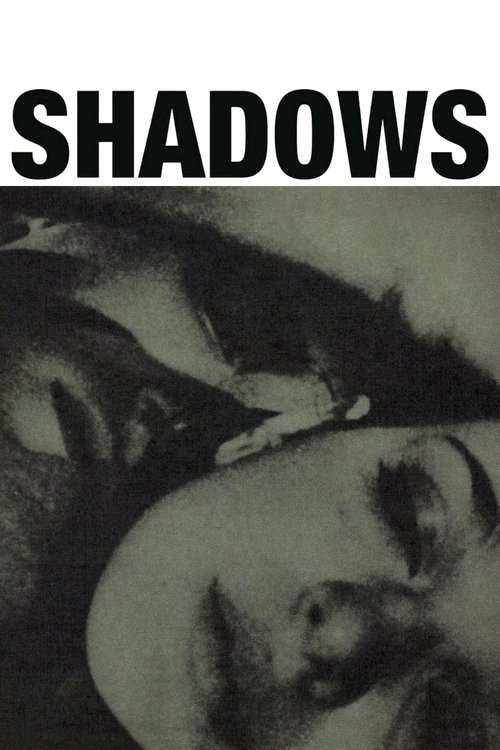
Shadows
1960 · John Cassavetes
For when you want something scrappy and true over something polished — a late-night film for people who love watching actors think. More bracing than comforting, but it makes you feel like you're in the room.
What it's about
Three Black siblings share an apartment in late-1950s Manhattan: Hugh, a proud jazz singer stuck introducing chorus lines; Ben, a restless drifter haunting Beat-era bars and all-night streets; and Lelia, their light-skinned sister, whose romance with a white man turns on what he assumes about her — and what happens when he meets her family. It's a film about race, pride, and love among young people improvising their lives in real time.
The experience
Loose, jagged, and startlingly alive — scenes feel caught rather than staged, full of overlapping talk, awkward silences, and sudden flashes of hurt. It moves like the jazz on its soundtrack: casual on the surface, raw underneath.
Performances
Lelia Goldoni is the film's live wire — her post-seduction scene, wounded and defiant, is one of the most honest moments of its era — and Ben Carruthers gives the drifting brother a moody, ahead-of-its-time cool.
The craft
John Cassavetes shot it on 16mm in real New York locations with actors from his workshop, developing scenes through improvisation and reshooting until the behavior felt true. The jazz score by Charles Mingus and Shafi Hadi isn't decoration — it's the film's nervous system. The rough edges are the style: grain, street noise, and faces caught off guard.
Why it matters
It effectively invented the modern American independent film — proof a feature could be made outside the studio system entirely — and its influence runs through every generation of low-budget, actor-driven American cinema since.
Snapshot
Shadows is the film with which John Cassavetes invented, almost single-handedly, the idea of the modern American independent feature — a low-budget, location-shot, actor-driven picture made entirely outside the studio system and answerable to no one but its maker. Set among the jazz clubs, rented rooms, and night streets of late-1950s Manhattan, it follows three Black siblings: Hugh (Hugh Hurd), a struggling jazz singer reduced to introducing chorus lines; Ben (Ben Carruthers), a directionless young man drifting through the Beat demimonde; and Lelia (Lelia Goldoni), their light-skinned sister, whose tentative affair with a white man, Tony (Anthony Ray), collapses into humiliation when he meets Hugh and grasps that her racial heritage is not what he had assumed. The film grew out of an acting workshop, was shot twice over several years, and ends with the famous title card declaring that "the film you have just seen was an improvisation." More than any single scene, that claim — and the loose, searching, behaviorally raw texture that backs it up — is what made Shadows a manifesto as much as a movie.
Industry & production
Shadows was made in deliberate opposition to the industry around it. In the mid-1950s Cassavetes was a working television and film actor who, with the actor-teacher Burt Lane, ran a Method-based workshop, the Variety Arts Studio (later the Cassavetes–Lane Drama Workshop), in New York. The film began as an improvisational exercise developed there with his students; the cast were essentially his workshop players rather than established names. Financing came from outside Hollywood entirely. In a now-legendary episode, Cassavetes appeared in 1956 on Jean Shepherd's late-night WOR radio program Night People and mused on air that if listeners each sent a dollar, ordinary people could make a movie; donations duly arrived, seeding the production. The remainder was assembled from his own acting earnings, small investments, and deferred favors. The total budget is usually cited in the range of a few tens of thousands of dollars — figures around $40,000 are commonly repeated — though precise accounting is unreliable and should be treated as approximate.
Production unfolded in two distinct campaigns, and this is the single most important fact of the film's history. A first version was shot in 1957 and screened in a handful of midnight shows in New York in late 1958. Cassavetes judged it a failure — too "arty," too reliant on poetic atmosphere over dramatic substance — and in 1959 he reconvened the cast and reshot a large portion of the picture, tightening the story and deepening the performances. It is this second version that circulated as Shadows and that the world has known ever since; it had its more visible exposure in 1959–1960 and reached wider release in the early 1960s. The producer of record was Maurice McEndree, with Seymour Cassel — later one of Cassavetes' great recurring actors — working in a junior producing/associate capacity and helping wrangle money and logistics. The first version was long believed lost; the scholar Ray Carney announced in the early 2000s that he had located a print, a claim that generated considerable interest and some dispute, and access to it has remained limited.
Technology
The film is a document of a specific technological moment: the arrival of lightweight 16mm equipment that made it physically possible for a few people to shoot a feature on real streets without studio infrastructure. Shadows was photographed on 16mm and later blown up to 35mm for theatrical projection, a process that coarsened the grain and contributed to the rough, reportorial look that became part of its aesthetic signature. Shooting was largely on location — in apartments, in Times Square, in the sculpture garden of the Museum of Modern Art, in clubs and on sidewalks — using available and improvised light rather than the controlled lighting plots of a soundstage. Synchronous location sound recording of this kind was technically awkward in the period, and the soundtrack bears the marks of that difficulty; much of the film's audio texture, including its music, was handled in ways that worked around rather than mastered the limitations of the gear. The point is not that Shadows was technically polished but that it proved a feature could be made at all under these conditions, anticipating the portable-camera, direct-cinema and vérité practices that would flower in the following decade.
Technique
Cinematography
The cinematographer was Erich Kollmar, working handheld and close, often in cramped real interiors. The camera in Shadows behaves less like an observer with a fixed plan than like another presence in the room — it follows, hesitates, reframes, loses and recovers its subjects. Faces are shot in tight, mobile close-ups that privilege fleeting expression over composed beauty; the New York exteriors are caught with a snapshot directness, neon and shop windows and crowds bleeding into the frame. The blown-up 16mm grain, the unfussy light, and the willingness to let images go slightly soft or unbalanced all read, deliberately or not, as authenticity. This visual grammar — intimate, restless, unglamorous — became foundational to the look of American independent cinema.
Editing
The cutting of the second version was central to Cassavetes' rescue of the material from the "too poetic" first attempt, and he was deeply hands-on in the editing room alongside his producing collaborators (McEndree among them). The exact division of editorial labor is not cleanly documented and is best not overstated. What is clear is the result: a rhythm that favors behavioral continuity and emotional duration over conventional dramatic economy. Scenes are allowed to run past their narrative "point" so that awkwardness, silence, and recovery register; transitions can feel abrupt, prioritizing the truth of a moment over smooth coverage. The editing serves the performances rather than imposing a tidy structure on them.
Mise-en-scène / staging
Shadows stages its drama in lived-in, unbeautiful spaces — a shared apartment, a literary party, a nightclub, a museum, the street — and lets bodies arrange themselves as they might in life rather than for the camera. Cassavetes' staging is built around the actor's impulse: people interrupt, cluster, drift apart, turn their backs. The MoMA sculpture-garden sequence and the party scenes are exemplary, using real environments and loosely choreographed movement to let social discomfort and attraction play out spatially. The mise-en-scène is the opposite of decorative; it is an instrument for catching behavior.
Sound
The score is one of the film's most celebrated and most complicated elements. Cassavetes engaged the jazz bassist and composer Charles Mingus to write music, but the collaboration was difficult and Mingus's contribution ended up partial; a great deal of what is heard on the finished soundtrack is the plaintive, improvised alto saxophone of Shafi Hadi (a Mingus associate also credited under the name Curtis Porter). The resulting music — spare, bluesy, nocturnal — fuses inseparably with the film's milieu, since jazz is both its subject and its sound. Beyond the score, the location-recorded dialogue carries the imperfections of its making, and that roughness is part of the film's claim to immediacy.
Performance
Performance is the reason Shadows exists. The film is essentially a Method experiment carried to feature length: actors building characters out of themselves through improvisation and exploratory rehearsal. Lelia Goldoni, Ben Carruthers, and Hugh Hurd deliver work that prizes hesitation, contradiction, and emotional spillage over articulate dramatic statement. Goldoni's Lelia, in particular — moving from girlish bravado to wounded confusion after her first sexual experience and the rupture with Tony — embodies the film's discovery that the unguarded, in-between moments of a performance can carry more truth than its set pieces. Hurd's weary dignity as Hugh and Carruthers' jittery aimlessness as Ben complete a portrait of three siblings improvising their way through identity itself.
Narrative & dramatic mode
The film operates in a mode closer to behavioral observation than to plotted storytelling. Its three loose narrative strands — Hugh's stalled career, Ben's drifting, Lelia's affair — are not braided into a tight mechanism; they are situations within which character is revealed. The central dramatic engine is the affair between Lelia and Tony and its collapse over the unspoken fact of race, but even this is rendered as a sequence of charged, ambiguous encounters rather than a melodrama with clean beats. The closing title's insistence on "improvisation" is the key to the dramatic mode: Shadows asks to be received not as a constructed fiction but as caught life, episodic and open-ended, ending without resolution because its people have none.
Genre & cycle
Nominally a drama, Shadows belongs less to a Hollywood genre than to an emerging cycle of postwar independent and "personal" cinema. It sits at the confluence of the Beat-era New York arts scene, the documentary impulse of street photography and early vérité, and the Method-acting culture of the period. It is among the founding works of what Jonas Mekas and others would soon organize as the New American Cinema, and it stands as the originating text of the American independent feature as a recognizable category — the lineage that runs forward to the no-budget, character-driven, director-owned film.
Authorship & method
Shadows is the inaugural statement of one of cinema's most distinctive authorial methods. Cassavetes' signature — derived from his actor's training and his conviction that emotional truth outweighs narrative polish — is fully present here in embryo: the privileging of process over product, the use of nonprofessional or workshop actors, the tolerance for messiness as a price of authenticity. His essential collaborators on this first film established patterns he would refine for decades: the cinematographer Erich Kollmar realized the handheld intimacy; Charles Mingus and Shafi Hadi supplied the jazz idiom that married music to milieu; the producing team around Maurice McEndree and the young Seymour Cassel kept the impossible production afloat; and the workshop cast — Goldoni, Carruthers, Hurd, Anthony Ray, Rupert Crosse and others — were co-authors in the most literal sense, generating the film's substance through improvisation. There is no screenwriting credit in any conventional sense; the "script" was the workshop process itself, which is precisely the authorial claim the film makes.
Movement / national cinema
The film is a cornerstone of American independent cinema and a key early document of the New American Cinema movement that crystallized in New York around 1960–1962, championed by the critic and filmmaker Jonas Mekas. Notably, Mekas' relationship to Shadows embodies the movement's internal tension: he ardently praised the rough, spontaneous first version and was disappointed by the more shaped, conventionally dramatic second version, reading the revision as a retreat from radical spontaneity toward storytelling. That very debate — purity of improvisation versus communicable drama — defines the movement's stakes, and Shadows sits at its center. The film is also routinely set in dialogue with the contemporaneous French New Wave, with which it shares a moment, a youthfulness, and a faith in location shooting and improvisation, though Cassavetes arrived at his methods independently.
Era / period
Shadows is saturated in the texture of its late-1950s American moment: the Beat subculture, the jazz scene, the intellectual party circuit, and the racial anxieties of a country a few years before the height of the civil rights movement. Its treatment of a light-skinned Black woman whose lover recoils on learning her heritage places it squarely within a period reckoning with race, "passing," and the limits of liberal good intentions — handled not as issue-drama but as intimate, uneasy human fact. The film's nocturnal, transient New York is itself a period portrait, a city of rented rooms and all-night talk on the cusp of the 1960s.
Themes
The film's deepest theme is identity as something improvised rather than given — racial, sexual, vocational. Race is its most pointed subject: the social construction and instability of racial categories, the wound of being seen differently once a hidden fact is exposed, the differing experiences of the three siblings across a spectrum of skin tone. Around this cluster other Cassavetes preoccupations that would recur across his career: the fragility of intimacy and the cruelty that surfaces within it; masculine aimlessness and bravado; the difficulty of sincere connection; and the gap between how people perform themselves socially and who they are in unguarded moments. Loneliness within the crowd — the alienation of young people amid a vibrant but indifferent city — runs through every strand.
Reception, canon & influence
Critically, Shadows arrived as an event in independent and avant-garde circles before it found broad audiences; it was always more a touchstone than a popular hit. It was recognized abroad early, winning a critics' prize at the 1960 Venice Film Festival, and Mekas and the New American Cinema community made it a rallying point — even as Mekas' own preference for the lost first version seeded a lasting scholarly debate about which Shadows truly mattered. Over time the second version entered the canon as a foundational American independent film.
Looking backward, the influences ON the film were less other movies than other practices: the Method and Stanislavskian acting culture Cassavetes lived in, the improvisatory ethos of jazz (literally present in the score), the New York street-photography and documentary sensibility, and the Beat literary scene whose milieu it inhabits. Looking forward, its legacy is enormous and well attested. It launched Cassavetes' own directorial career and established the working method he would deepen in Faces, A Woman Under the Influence, and beyond. More broadly it became the originating model for the American independent feature — the proof that a personal, uncompromised film could be made for almost nothing, on real streets, with real faces — and a touchstone for generations of filmmakers who took independence and behavioral realism as their inheritance. Where the historical record on specific figures (precise budget, exact editorial credits, the contents of the first version) is genuinely thin or contested, that uncertainty is itself part of the film's mythology; what is not in doubt is its status as the seed from which modern American independent cinema grew.
A Deleuzian reading
Start with a face.
The full Deleuzian reading of Shadows →
Reception
Championed on arrival by Jonas Mekas and Film Culture as the birth of a 'New American Cinema' — though Mekas famously preferred the rawer 1957 first version and cried sellout when Cassavetes reshot it — it went from downtown provocation to Venice Critics Award winner to the universally cited ground zero of American independent film.
How Shadows was received, from release to now →
Influences: the films it descends from and the films it influenced
- Bicycle Thieves (1948) — Established the neorealist practice Cassavetes inherited: casting nonprofessionals and shooting working-class drama on real streets in available light rather than on sets.
- Rome, Open City (1945) — Pioneered the rough, documentary-grade location aesthetic and tolerance for technical imperfection in service of emotional truth that became Cassavetes' core authorial wager.
- Little Fugitive (1953) — Used a custom lightweight strapped-on 35mm rig to shoot mobile, handheld footage in real New York locations — the portable-camera street intimacy Erich Kollmar carried into Shadows.
- On the Bowery (1956) — Fused documentary observation with staged, improvised scenes performed by real denizens, modeling the vérité-drama hybrid where workshop nonprofessionals generate their own dialogue.
- The Quiet One (1948) — A semi-documentary of a young Black New Yorker shot on location with a poetic, observational realism that prefigured Shadows' street-level portrait of marginal life.
- Marty (1955) — American independent cinema's improvisational, location-shot naturalism builds on the permission Marty granted to make ordinary, lonely, inarticulate lives the entire substance of a film.
- Breathless (1960) — Parallel break from studio polish — handheld available-light shooting on real streets, casual improvised performance, and a jazz-inflected score — the New Wave counterpart Cassavetes is repeatedly linked to.
- Faces (1968) — Cassavetes deepens his own Shadows method — workshop improvisation, handheld 16mm, and editing for behavioral duration that lets scenes run on the actors' emotional clock rather than plot.
- A Woman Under the Influence (1974) — The mature form of the Shadows wager: process-over-product authorship where the camera holds on performers' uncomfortable real-time behavior past the point of narrative comfort.
- Wanda (1970) — A personally financed 16mm-blowup feature shot handheld on location with a drifting, episodic open-endedness, inheriting Shadows' proof that a raw, uncompromised personal film could be made for almost nothing.
- Who's That Knocking at My Door (1967) — Scorsese's debut adopts Cassavetes' location New York shooting and improvised, behavior-driven scenes among aimless young men as the template for personal street cinema.
- Mean Streets (1973) — Extends the Cassavetes inheritance of improvised performance, handheld location energy, and loose episodic structure built around character behavior rather than tight plotting.
- Killer of Sheep (1978) — A 16mm location portrait of Black working-class life shot in available light with nonprofessional actors and an episodic, plotless observational structure descended from Shadows' vérité-drama mode.
- Stranger Than Paradise (1984) — Carries forward the American-independent ethos as deadpan minimalism — micro-budget, location-shot, episodic and open-ended — claiming Shadows' lineage of the personal feature made outside the industry.
- She's Gotta Have It (1986) — A shoestring black-and-white indie built on racial identity and improvisational performance, directly invoking Shadows' proof-of-concept for the personal first feature shot cheaply with real faces.
- Clerks (1994) — The ultimate extension of the Shadows economic model — a no-budget, talk-driven 16mm black-and-white feature shot on a real location, proving again that independence trumps production polish.
- Rumble Fish (1983) — High-contrast black-and-white street photography paired with performance centered on interior psychological withholding rather than emotive display, directly prefiguring Mickey Rourke's Motorcycle Boy stillness.
- La Haine (1995) — Cassavetes' black-and-white ambulatory New York location shooting — following a mixed-race cast navigating racial friction through improvisatory-seeming performance over a compressed time frame — establishes the documentary-adjacent fiction technique that La Haine transposes to the banlieue.
- Pull My Daisy (1959) — Captured the same Beat-Generation milieu in grainy 16mm with an improvised, anti-narrative looseness, sharing Shadows' street-photography sensibility (Frank's photographer's eye) and New American Cinema allegiance.
- The Connection (1961) — Staged improvised, jazz-scored vérité drama among addicts and musicians using a fake-documentary frame, extending the same New American Cinema marriage of live jazz idiom to behavioral realism.
- Shoot the Piano Player (1960) — Cassavetes simultaneously developed location-driven available-light urban cinematography paired with a jazz score (Charles Mingus) functioning as emotional texture rather than illustrative accompaniment — the same formal equation Truffaut and Coutard develop in Paris, independent discoveries converging on identical solutions to shooting cheaply in real urban space with musician-performers.
- Gloria (1980) — Originates the handheld, location-shot New York improvisation and performance-led method Gloria carries into genre — actors discovering scenes in real streets rather than hitting marks.
- Husbands (1970) — Cassavetes' own origin point — the same workshop-bred improvisation and 16mm handheld pursuit of unscripted behavior that Husbands inherits and hardens into the long-take, actor-trusting method.
- Mikey and Nicky (1976) — Establishes the actor-first, seemingly-improvised American independent method May cites by casting Cassavetes — behavior discovered on set rather than illustrated from a plan, the exact philosophy governing Mikey and Nicky's engineered rawness.
Similar films
- Faces (1968) — influence & lineage
- A Woman Under the Influence (1974) — influence & lineage
- Mean Streets (1973) — influence & lineage
- She's Gotta Have It (1986) — influence & lineage
- Breathless (1960) — influence & lineage
- Stranger Than Paradise (1984) — influence & lineage
- The Killing of a Chinese Bookie (1976) — shared sensibility
- Husbands (1970) — shared sensibility
All the films related to Shadows →