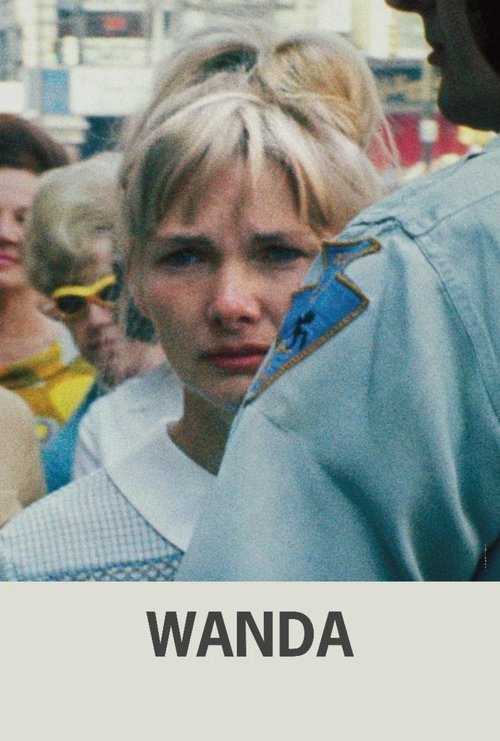
Wanda
1970 · Barbara Loden
For when you want the real thing: no gloss, no rescue, just a life observed with devastating clarity. A film to sit with alone, when you're in the mood to be quietly gutted rather than entertained.
What it's about
In the coal country of northeastern Pennsylvania, a worn-down wife and mother named Wanda walks away from her marriage, her children, and every obligation she has — not toward anything, just away. Broke and adrift, she attaches herself to a surly small-time crook, following him from motel to motel as his schemes grow more reckless.
The experience
Slow, spare, and almost unbearably honest — it refuses every thrill the crime story usually promises and instead just watches, with a patience that becomes its own kind of intensity. It's bleak, but it leaves a mark few louder films manage.
Performances
Barbara Loden, who also wrote and directed, plays Wanda with a passivity so complete it becomes mysterious — hair in curlers, eyes elsewhere, a woman the world has taught to expect nothing. It's one of the most unvarnished performances in American film.
The craft
Shot on grainy 16mm with a skeleton crew and real locations — slag heaps, bars, roadside motels — it has the texture of a documentary that wandered into a crime picture. The rough look isn't a limitation; it's the point, and the restored print makes its bleak landscapes strangely beautiful.
Why it matters
The only film Loden ever completed, it was barely seen on release, then rediscovered and restored decades later to become a foundation stone of American independent and feminist filmmaking — proof of how much was lost when she never got to make another.
Snapshot
Wanda is the sole completed feature directed by Barbara Loden, who also wrote it and played its title role. A spare, drifting portrait of a working-class woman who walks away from her marriage and children in the anthracite coal country of northeastern Pennsylvania and falls in with a small-time, abusive crook, the film is one of the foundational works of American independent cinema and a touchstone of feminist filmmaking. Shot on 16mm with a tiny crew and a documentary sensibility, it refuses the momentum, glamour, and moral legibility of the Hollywood and New Hollywood crime film. Wanda Goronski neither rebels nor triumphs; she submits, drifts, and endures. Largely overlooked on release outside festival circles, the film was rediscovered and restored decades later and is now widely regarded as a landmark — a study of passivity, class, and female non-agency with few equivalents in its era or since.
Industry & production
Wanda was made entirely outside the studio system, financed independently and produced on a famously minuscule budget. The project originated with Loden herself, an actress best known at the time for her stage work and for her roles in films directed by Elia Kazan, to whom she was married. Unable to interest the industry in the material, she assembled a skeleton crew — by most accounts only a handful of people — and shot on location in Pennsylvania over a period of several weeks. The reliance on lightweight 16mm equipment was both an aesthetic choice and an economic necessity: it allowed a four-person unit to work quickly, cheaply, and unobtrusively in real towns, bars, motels, and roadside landscapes.
Exact financial figures should be treated cautiously; the budget is commonly cited in the low six figures (frequently quoted at around one hundred thousand dollars or somewhat more), but the precise number and the film's earnings are not reliably documented, and I will not invent them. What is clear is that the production was hand-to-mouth, with Loden absorbing multiple roles and the cinematographer-editor Nicholas Proferes effectively serving as her principal collaborator and technical partner.
The finished 16mm film was blown up to 35mm for theatrical exhibition. It received a limited release through a small distributor and played in New York, but it never achieved meaningful commercial circulation in the United States and slipped quickly out of view domestically. Its reputation in the immediate term rested almost entirely on its festival reception abroad, particularly its prize at Venice, rather than on box office or studio support.
Technology
The film is inseparable from the technological moment of lightweight, portable filmmaking. By 1970, synchronized-sound 16mm rigs — handheld cameras paired with portable recorders — had matured through a decade of American direct cinema and observational documentary. Wanda exploits exactly this toolkit. The 16mm format kept the camera small and mobile, enabling location shooting in cramped interiors and moving vehicles with available or minimal light. Proferes came out of the documentary world, and the film carries the grain, the slightly desaturated naturalism, and the responsiveness of that tradition.
The optical blow-up to 35mm for projection is itself part of the film's texture: the enlargement coarsens the grain and softens detail, lending the image a roughened, unglamorous quality that suits the material. This pipeline — shoot small, finish large — was a standard strategy for independents seeking theatrical exhibition without studio resources, and Wanda is one of its more artistically purposeful uses. The film's later life is also a technological story: its long-form preservation came through a photochemical-to-digital restoration undertaken by the UCLA Film & Television Archive (supported by The Film Foundation and Gucci), which rescued the film from the obscurity and deteriorating elements that nearly consumed it.
Technique
Cinematography
Nicholas Proferes shot the film handheld in a vérité register: long, watchful takes; loose framing that lets figures drift toward the edges or sit small within wide, unlovely environments; and a willingness to let focus, exposure, and composition feel found rather than designed. The Pennsylvania coal landscape — slag heaps, strip mines, gray skies, flat industrial horizons — is rendered without picturesque emphasis, becoming an expressive correlative for Wanda's diminishment. Interiors are dim and cramped. The camera tends to observe rather than dramatize, holding on Wanda as she waits, follows, or simply exists. There is little of the expressive lighting or graphic composition of conventional narrative cinema; the visual language is deliberately plain, even drab, and that plainness is the point.
Editing
Proferes also edited, which gives the film an unusual unity of shooting and cutting sensibility. The editing is elliptical and unhurried, favoring duration and dead time over compression. Scenes are allowed to extend past their dramatic "point," and transitions can feel abrupt, leaving gaps in time and motivation that the viewer must absorb. This refusal of conventional rhythm reinforces the sense of a life without trajectory — events accrete rather than build. The film's pacing, often described as slow or affectless, is a structural expression of its protagonist's passivity.
Mise-en-scène / staging
The staging is anti-theatrical. Real locations are used with minimal dressing; nonprofessional or naturalistic performance fills the frame's margins. Wanda is frequently positioned as a small, passive element within larger spaces — a figure crossing an enormous coal field, dwarfed in a doorway, tucked into the corner of a bar or motel room. Compositions emphasize her marginality and lack of command over her surroundings. The film's "production design," to the extent it has one, is the lived-in reality of working-class Pennsylvania, and the staging consistently subordinates Wanda to environments she cannot control.
Sound
Sound is location-based and naturalistic, with ambient noise — traffic, jukeboxes, bar chatter, the drone of cars and machinery — given prominence. There is little or no conventional orchestral scoring to cue emotion; the soundscape stays close to the documentary surface of the world. This restraint denies the audience the emotional guidance a score would provide, leaving Wanda's interior life muffled and largely unexpressed, consistent with the film's broader strategy of withholding.
Performance
Loden's performance as Wanda is the film's center and one of its great achievements. It is a study in inarticulacy and passivity: flat affect, downcast or evasive gazes, a body that follows rather than leads. She conveys an interior life that the character herself cannot name or assert. Michael Higgins, as the petty criminal Mr. Dennis, supplies a brittle, irritable, controlling counterforce — a man whose own failures and anxieties curdle into domination. The two performances interlock as a portrait of a relationship organized entirely around need, control, and inertia. The naturalism is total; nothing is "played" in the theatrical sense, despite both leads' stage backgrounds.
Narrative & dramatic mode
Wanda operates in an observational, anti-dramatic mode. Its narrative is loose and episodic: Wanda leaves a divorce hearing having essentially relinquished her children, drifts through menial encounters, is used and discarded by men, and then attaches herself to Mr. Dennis, eventually accompanying him on a bungled bank robbery. The crime plot, which in a conventional film would supply structure and stakes, is handled almost incidentally — its outcome bleak and anticlimactic rather than thrilling.
The dramatic mode withholds the usual mechanisms of identification and catharsis. Wanda has no clear goal, no arc of growth, and little capacity for decisive action; she is acted upon more than she acts. The film resists explaining her, offering neither psychological backstory nor redemptive turn. This refusal of motivation and resolution is the work's defining formal gamble: it asks the viewer to sit with a protagonist whose defining trait is her lack of agency, and to find meaning in that very absence.
Genre & cycle
Nominally a crime drama, Wanda is best understood as a deliberate inversion of the outlaw-couple film then in vogue. Arthur Penn's Bonnie and Clyde (1967) had made the romantic, stylish, doomed criminal pair a defining image of New Hollywood, and the lovers-on-the-run cycle flourished around the turn of the decade. Wanda answers that cycle with everything it lacks: no glamour, no charisma, no liberating transgression, no tragic grandeur. Its "robbery" is squalid and inept; its couple is mismatched and joyless. Loden positioned the film, by her own account in interviews, against the slickness of mainstream cinema, and the result reads as an anti-genre statement — the crime film stripped of romance and reduced to economic desperation and emotional poverty. It belongs less to the crime tradition than to the lineage of social-realist portraiture of the dispossessed.
Authorship & method
Wanda is an intensely personal authorial work: written, directed by, and starring Barbara Loden, it is a rare instance of total female authorship in early-1970s American film. Loden has said the project grew from a newspaper account she encountered years earlier of a woman who participated in a robbery and, when sentenced, reportedly thanked the judge — an image of self-abnegation that became the seed of Wanda's character. Loden worked through the material over a long period before realizing it as a film, and she conceived it explicitly as a corrective to the artifice she associated with Hollywood, including the films of her own milieu.
Her essential collaborator was Nicholas Proferes, who served as cinematographer and editor and brought the techniques and discipline of documentary to the production; the film's look and rhythm are as much his contribution as Loden's. Michael Higgins anchored the film opposite Loden as Mr. Dennis. There is no significant composer credit in the conventional sense, consistent with the film's near-absence of score. The method throughout was lean, location-based, and improvisatory in feel, prioritizing observed reality over staged effect.
Loden's biography inflects the film without simply explaining it. A working actress who had won acclaim on Broadway — including a Tony Award for her stage work in the mid-1960s — and who had appeared in major films directed by Elia Kazan, she was nonetheless largely defined publicly through her relationship to her famous husband. Wanda was her bid for an independent artistic identity. It would also be her only feature; she developed other projects but died of cancer in 1980, at 48, before completing another film. The result is an oeuvre of one, which has intensified the film's mystique and the sense of a major voice cut short.
Movement / national cinema
The film sits at the intersection of several currents in American cinema. It draws on the home-grown traditions of direct cinema and observational documentary, and it shares the independent, anti-Hollywood ethos associated with John Cassavetes, whose actor-centered, naturalistic features had by then demonstrated that intimate American films could be made outside the studios. It also resonates with the postwar legacy of Italian neorealism in its use of real locations, ordinary lives, and undramatized social hardship. Within American cinema of 1970, Wanda stands apart from the male-dominated New Hollywood: it is an independent feature authored by a woman about a woman's experience, made with documentary means, and it anticipates the feminist independent filmmaking that would gather force later in the decade.
Era / period
Wanda is very much a film of 1970 — the cusp between the countercultural energy of the late 1960s and the harder, more disillusioned American films of the early 1970s. While the outlaw romance and the youth picture were ascendant, Wanda turned toward an older, poorer, less romantic America: the declining industrial regions, the economic dead-ends of working-class women, the wreckage left outside the frame of the era's liberation narratives. Its period texture — the bars, motels, dime stores, and coal fields of a depressed region — grounds it in a specific socioeconomic moment, and its refusal of countercultural optimism gives it a sober, almost documentary contemporaneity. The film's concerns with women's autonomy also place it precisely at the dawn of the second-wave feminist movement, though it dramatizes that historical pressure by depicting its absence — a woman who has internalized her own powerlessness.
Themes
The film's central theme is passivity itself — the condition of a person who lacks, or has been deprived of, agency. Wanda neither chooses her path nor resists it; she drifts, attaches, and submits. This makes the film a profound study of female non-selfhood under the combined weight of class, gender, and circumstance. Related themes braid through it: economic precarity and the limited horizons of working-class women; the transactional and abusive structure of Wanda's relationships with men; alienation and the difficulty of articulating an inner life; and the rejection of motherhood and domesticity that opens the film, presented without judgment or explanation. Loden also probes the gap between the cinematic image of liberated transgression and the grim reality of dependence and desperation. Crucially, the film offers no redemption: it refuses to convert Wanda's suffering into uplift, insisting instead on the unresolved fact of a wasted, constrained life.
Reception, canon & influence
On release, Wanda drew limited but serious attention. Its most consequential early recognition came at the Venice Film Festival, where it won an international critics' prize, establishing its reputation in Europe even as it found scant commercial footing in the United States. Domestic distribution was minimal, and the film largely disappeared from American screens for years, surviving more as a rumored, hard-to-see object than as a widely available work.
Its rehabilitation was gradual and then emphatic. The film acquired devoted advocates — Marguerite Duras admired it, and the actress Isabelle Huppert became a prominent champion, helping to spur the restoration that returned the film to circulation. The UCLA-led preservation (with support from The Film Foundation and Gucci) made a clean version available, and critical reassessment followed, cementing Wanda as a canonical work of independent and feminist cinema. The writer Nathalie Léger devoted a book-length meditation, Suite for Barbara Loden, to the film and its maker, further extending its literary and intellectual afterlife.
The influences on the film are legible: the observational methods of American direct cinema (via Proferes), the location naturalism of Italian neorealism, the independent actor's-cinema model of Cassavetes, and — as a negative template — the romanticized outlaw cinema of Bonnie and Clyde against which Loden defined her project. Its influence forward is broad if often diffuse. Wanda became a foundational reference for women directors working in a realist, observational vein and for independent filmmakers committed to portraits of marginalized, inarticulate lives. Its uncompromising depiction of a passive female protagonist, its refusal of catharsis, and its proof that a singular, personal feature could be authored by a woman almost entirely outside the industry have made it a recurring point of return for critics, scholars, and filmmakers concerned with class, gender, and the limits of agency. That so much of this legacy rests on a single completed film is part of what gives Wanda its enduring force.
A Deleuzian reading
She crosses the coal field as a white speck against black slag, so small the frame nearly loses her.
The full Deleuzian reading of Wanda →
Reception
It won the International Critics' Prize at Venice in 1970, then played a single New York cinema and vanished for decades. Rescued by a UCLA restoration and champions like Isabelle Huppert and Marguerite Duras, it's now canonized as a landmark of American independent filmmaking — the ultimate lost-and-found masterpiece.
How Wanda was received, from release to now →
Influences: the films it descends from and the films it influenced
- Bicycle Thieves (1948) — Establishes the neorealist method Wanda adopts wholesale — real locations, available light, and a plot reduced to a marginalized figure drifting through actual streets rather than a constructed dramatic arc.
- Umberto D. (1952) — Models the durational, anti-dramatic attention to a passive, socially discarded protagonist whose 'dead time' (waiting, eating, doing nothing) becomes the substance of the film, which Wanda extends to its inarticulate drifter.
- Shadows (1959) — Provides the actor's-cinema template Loden cites — performance and behavioral truth driving the film over plot, with characters allowed to be unresolved and unphotogenic.
- Faces (1968) — Demonstrates the 16mm handheld intimacy and uncomfortably long-held close work that lets behavior rather than narrative carry meaning, the 'Cassavetes ethos' Wanda inherits.
- Primary (1960) — The direct-cinema observational handheld discipline of this milieu is the exact toolkit Nicholas Proferes brought to Wanda as DP/editor — reactive camera, found compositions, no staging for the lens.
- Bonnie and Clyde (1967) — Functions as the explicit negative template: Loden conceived Wanda against its glamorized, stylized outlaw romance, stripping the crime film of charisma, agency, and catharsis.
- Cléo from 5 to 7 (1962) — Loden inherits the drifting, aimless female protagonist observed in near-documentary real space, decentering plot in favor of a woman's moment-to-moment perception.
- Forever a Woman (1955) — Another actress-turned-director rendering female autonomy in stripped, non-judgmental realism, continuing the lineage of women filming women from inside the profession.
- The Fire Within (1963) — Carries forward the dissociated, drifting protagonist whose despair is observed without dramatization or psychological explanation, the affectless-witness approach Malle used on Alain.
- Il Grido (1957) — Builds a film around an affectless, passively drifting protagonist observed elliptically across a bleak worked landscape, the anti-picaresque with no arc of will.
- Vagabond (1985) — Extends Wanda's drifting, opaque woman without agency — a refusal to psychologize or redeem the protagonist, observing her trajectory toward ruin without sentiment.
- River of Grass (1994) — A near-explicit Wanda echo: the anti-crime road film whose passive protagonists never achieve the outlaw escape the genre promises, deflating momentum into aimlessness.
- Ratcatcher (1999) — Inherits the elliptical editing and found-composition framing of marginalized life, letting environment and gesture carry the film over expository narrative.
- Wendy and Lucy (2008) — Carries forward the minimalist observational study of economic precarity and a near-silent, inarticulate woman whose options narrow without melodrama.
- Fish Tank (2009) — Handheld, immersive shooting of an inarticulate working-class girl, prioritizing reactive camera and lived texture over a clean dramatic structure — Wanda's verite legacy made British.
- The Florida Project (2017) — Location naturalism and non-judgmental observation of people living at the economic margins, with narrative subordinated to behavioral and environmental reality.
- The Rider (2017) — Extends the use of non-professional performers playing near-versions of themselves in real locations, dissolving the line between documentary observation and fiction that Wanda pioneered.
- Never Rarely Sometimes Always (2020) — Grainy 16mm and a near-wordless, passive female drift through transactional encounters, the drifting-woman road structure and nonprofessional texture that Hittman's grammar descends from.
- The Forty-Year-Old Version (2020) — The founding case of a woman writing, directing, and starring in her own semi-autobiographical portrait of drift and reinvention — the writer-director-as-lead lineage Blank inherits.
- Bones and All (2022) — The aimless, marginalized woman drifting through a grubby, deglamorized American landscape in grainy handheld naturalism—Maren's rootless texture and social invisibility.
- Happening (2021) — Grainy 16mm intimacy trailing a drifting, imperiled woman with no score and no judgment, foundational to the female-authored ordeal-realist mode.
- American Honey (2016) — A drifting, economically stranded woman filmed in grainy quasi-documentary 16mm with a loose, wandering itinerary — the precursor to the female-drifter road picture stripped of genre momentum.
- Wild River (1960) — The location-rooted Method realism Loden absorbed working under Kazan, which Wanda turns inside out — keeping the regional authenticity while rejecting the heightened theatrical performance.
- Jeanne Dielman, 23 quai du Commerce, 1080 Bruxelles (1975) — Shares the real-time durational portrait of a constrained woman and the refusal of dramatic emphasis, building meaning from accumulated unremarkable action and female non-agency.
- Killer of Sheep (1978) — Parallel 16mm neorealist portrait of working-class life built from observed, plotless episodes and found locations rather than engineered drama.
- Alice Doesn't Live Here Anymore (1974) — An observational, handheld portrait of a working-class woman adrift, structured episodically and refusing narrative closure on her self-realization.
- Five Easy Pieces (1970) — Handheld, grainy location realism tracking an aimless working-class protagonist to a deliberately unresolved, anti-cathartic ending.
- Husbands (1970) — Sibling — actor-turned-director working in grainy handheld with telephoto observation and anti-plot drift, finding drama purely in how a person behaves with nowhere to hide.
- If I Had Legs I'd Kick You (2025) — DIY 16mm handheld pursuit of a drifting, overwhelmed woman — the indie-female-authorship antecedent for Bronstein's constraint-as-expression method.
- Love Streams (1984) — A contemporaneous American-independent chamber piece of a drifting woman, shot in real locations with unglamorous handheld observation and no narrative machinery — a parallel to Cassavetes' anti-melodrama.
- Mikey and Nicky (1976) — Contemporary sibling of woman-directed New Hollywood naturalism — handheld 35mm immediacy, drifting behavioral observation of marginal figures, structure surrendered to lived duration rather than plot.
- The Panic in Needle Park (1971) — Available-light, near-documentary observational tragedy of a drifting woman built by accumulation and refusing any score or sentiment.
- Love for Sale (2006) — Grainy available-light observation of an aimless woman's self-determination, withholding melodramatic motive — the anti-explanatory portrait of a drifting female protagonist.
Similar films
- Vagabond (1985) — influence & lineage · same viewing thread
- Wendy and Lucy (2008) — influence & lineage
- Bicycle Thieves (1948) — influence & lineage
- Ida (2013) — same viewing thread · often watched together
- Red Desert (1964) — same viewing thread · often watched together
- Jeanne Dielman, 23, quai du Commerce, 1080 Bruxelles (1976) — same viewing thread
- Bonnie and Clyde (1967) — influence & lineage · often watched together
- Sambizanga (1973) — often watched together
All the films related to Wanda →
Watch it with: curated runs of related films
- The World Against Her — A run of women worn down or driven to extremity by a merciless community, marriage, or economy — watch them near each other and the sacrifice, the drift, and the violence start to rhyme.