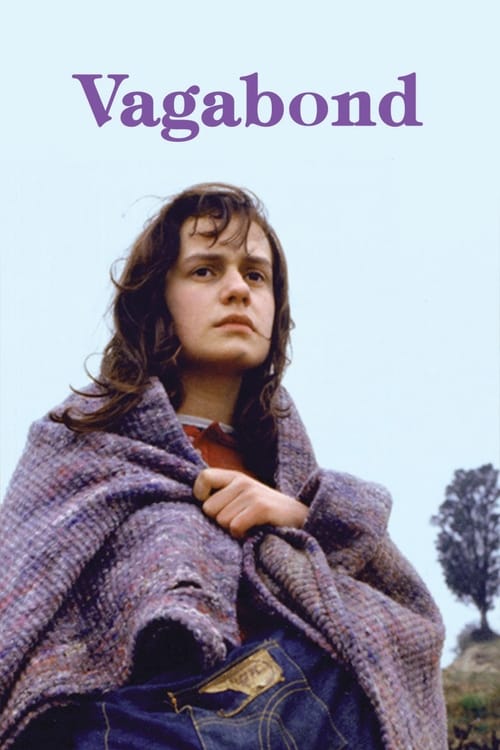
Vagabond
1985 · Agnès Varda
For when you want a film to chew on for days, not comfort viewing — the kind that makes you argue afterward about a person you never quite got to know. Reach for it when you're drawn to lives lived without apology.
What it's about
A young woman's frozen body is found in a ditch in the wintry south of France, and the film works backward to piece together who she was. Mona is a drifter who has walked away from ordinary life, hitchhiking through the Languedoc, taking odd jobs in vineyards and sleeping wherever someone will have her. Her story is assembled from the people she brushed past — a goatherd, a tree scientist, farm workers, housewives — each of whom saw something different in her fierce, unaccommodating freedom.
The experience
Cool, unsentimental, and quietly devastating — it withholds easy sympathy and keeps you working, watching a stranger stay stubbornly out of reach. The chill of the winter landscape gets into you, and the film's refusal to explain her lingers long after.
Performances
Sandrine Bonnaire, still a teenager, is astonishing — dirty, rude, magnetic, and never once asking to be liked. It's a performance without a single bid for sympathy, which is exactly why it haunts.
The craft
Agnès Varda structures the wandering like an inquest, mixing drama with testimony from the people Mona met, so the film feels half fiction, half investigation. A series of long right-to-left tracking shots gives her aimless drift a hidden architecture, each shot ending on an object the next one quietly picks up. Spare, wintry images that reward patience more than spectacle.
Why it matters
It won the Golden Lion at Venice in 1985, the crowning official honor of Varda's career, and stands as a landmark of fiercely independent European filmmaking about women who refuse to be explained.
Agnès Varda opens with the ending — a young woman's frozen body in a ditch in the Languedoc winter — then conducts a kind of inquest, assembling the drifter Mona from the testimony of everyone she brushed past: a goatherd philosopher, a tree scientist, vineyard workers, housewives who envy her freedom and fear it. Sandrine Bonnaire, still in her teens, gives a performance without a single bid for sympathy; Mona is dirty, rude, magnificent, and unknowable, and the film refuses to explain her. Varda — who had preceded the New Wave with La Pointe Courte in 1955 and remained its Left Bank conscience — structures the wandering with a series of right-to-left tracking shots, each ending on an object the next quietly picks up, so that Mona's drift acquires a hidden architecture. It won the Golden Lion at Venice in 1985, Varda's greatest official honor, and stands as her fiercest fiction: a portrait of total freedom that declines to say whether the price was worth it.
A Deleuzian reading
The first thing Varda shows you is the end.
The full Deleuzian reading of Vagabond →
Reception
No rescue arc needed — it won the Golden Lion at Venice in 1985 and was a genuine hit in France. But the 2010s Varda beatification (restorations, Criterion, her late-life icon status) pushed it from 'respected art film' to consensus masterpiece of her filmography.
How Vagabond was received, from release to now →
Influences: the films it descends from and the films it influenced
- Citizen Kane (1941) — Reconstructs a dead protagonist retrospectively through the contradictory eyewitness accounts of people who knew him, the inquest-mosaic armature Varda uses to assemble Mona from witnesses.
- Rashomon (1950) — Builds its story from mutually incomplete testimonies delivered toward the camera, modeling the fragmented-testimony structure that refuses any single authoritative account of the subject.
- Bicycle Thieves (1948) — Neorealist reliance on nonprofessional presence, real locations, and episodic street-wandering to indict social precarity without melodramatic uplift.
- Mouchette (1967) — The affectless, non-psychologizing portrait of a rural adolescent girl advancing toward death, built on a withholding lead performance that denies the viewer interiority.
- Au hasard Balthazar (1966) — Episodic passage of a near-mute protagonist through a chain of indifferent human hands across rural terrain, an accretive-encounter structure ending in cold, unredeemed death.
- La Pointe Courte (1955) — Varda's founding Left Bank experiment braids documentary observation of a working community with a fictional thread, the nonfiction-fiction weave later formalized as the inquest.
- Cléo from 5 to 7 (1962) — Follows a woman moving through real streets via lateral traveling shots in near-real time, Varda's own template for tracking a female subject through public space.
- Hiroshima mon amour (1959) — Left Bank editing that reconstructs a person through elliptical, testimony-driven fragments of spoken recollection rather than continuous chronology.
- Wanda (1970) — An aimless, unexplained female drifter observed without sentiment or supplied motive, refusing to account for her flight from settled life.
- Red Desert (1964) — Long handheld tracking shots following an opaque female protagonist through Languedoc's winter agricultural and post-industrial landscape, refusing psychological explanation with the same anti-cathartic rigor as Giuliana's trajectory, transpose Antonioni's female-alienation grammar to a class-specific exterior register.
- Vivre Sa Vie (1962) — A fragmented document-fiction portrait of a drifting woman assembled from discrete witness testimonies and lateral tracking shots.
- Il Grido (1957) — An anti-picaresque of episodic, resolution-refusing wandering toward death, its drifter framed against wintry rural landscape rather than psychologized by dialogue.
- Rosetta (1999) — Handheld, backstory-free portrait of a young woman battling economic precarity at the social margin, extending the unsentimental drifter into pursuit-camera realism.
- Wendy and Lucy (2008) — Pares a solitary woman's downward economic drift to observed incident, withholding explanatory backstory in Varda's refuse-to-explain manner.
- Fish Tank (2009) — Unsentimental handheld portrait of a marginal young woman played by a nonprofessional, refusing redemption or tidy motive.
- American Honey (2016) — Itinerant youth drifting across landscape in episodic encounters with a largely nonprofessional cast and no imposed dramatic arc.
- Nomadland (2020) — Fiction-documentary hybrid casting real itinerants around a female drifter, extending the neorealist braid Varda structured around Mona's road.
- The Gleaners and I (2000) — Varda returns first-person to society's gatherers-on-the-margins who live off the discarded, extending Vagabond's attention to those outside the economy.
- Morvern Callar (2002) — A young woman drifts across a cold landscape with her motive deliberately withheld, the film refusing psychological explanation and trusting episodic, elliptical structure to build a portrait from the outside.
- The Blue Trail (2025) — Supplies the picaresque drifting-woman structure assembled from a chain of waystation encounters along a single forward trajectory.
- One Million Yen Girl (2008) — Establishes the female-drifter grammar Tanada inherits: a reticent runaway rendered through observational long takes and a chaptered, station-to-station structure that withholds interiority and refuses a redemptive close.
- Microhabitat (2018) — Builds a portrait of a drifting, home-renouncing woman as a mosaic reconstructed from the households she passes through, the exact couch-hopping episodic architecture Microhabitat inherits — each host revealing more about the protagonist than she reveals about herself.
- Never Rarely Sometimes Always (2020) — Lateral tracking shots trailing a solitary young woman, the journey built as episodic encounters with strangers who each extract or offer something — Hittman's bus-terminal itinerary of dependencies.
- 3-Iron (2004) — Supplies the mute, unknowable drifter as parable-protagonist — a figure who barely speaks and refuses explanation, read through others' reactions rather than confession.
- Jeanne Dielman (1975) — Rigorous durational observation of a woman that withholds psychological explanation, treating behavior as surface to be watched rather than decoded.
- Wings of Desire (1987) — Varda's lyric-accumulation portrait gathers testimonial fragments from found winter landscapes, building character through non-causal vignette juxtaposition and treating found locations as historically-charged surfaces — the same structural logic by which Wenders assembles Berlin through its marginal figures and interior monologues.
- Journey to Italy (1954) — Builds a portrait from drift and loosened causality across a wandered landscape, with tracking shots and documentary-textured locations replacing dramatic plotting, carrying forward Journey's faith in duration and place.
- The Company of Strangers (1990) — Varda braids staged drama with witness-testimony to camera, the same weave of performed scene and direct life-account that structures Scott's hybrid.
- Hour of the Star (1986) — A near-contemporary quasi-documentary portrait of a young woman who refuses society, built from elliptical observation and withheld sympathy — the same anti-melodramatic distance from a female drifter that Amaral deploys the same year.
- Love for Sale (2006) — Builds the drifting-woman portrait from quasi-documentary tracking of a woman crossing an indifferent landscape, the observational figure-in-landscape Suely shares.
Similar films
- Wanda (1970) — influence & lineage · same viewing thread
- Cléo from 5 to 7 (1962) — influence & lineage
- The Gleaners and I (2000) — influence & lineage
- Mouchette (1967) — influence & lineage
- Rosetta (1999) — influence & lineage · same viewing thread
- Dogville (2003) — same viewing thread
- Red Desert (1964) — same viewing thread
- Varda by Agnès (2019) — shared sensibility
All the films related to Vagabond →
Watch it with: curated runs of related films
- The World Against Her — A run of women worn down or driven to extremity by a merciless community, marriage, or economy — watch them near each other and the sacrifice, the drift, and the violence start to rhyme.