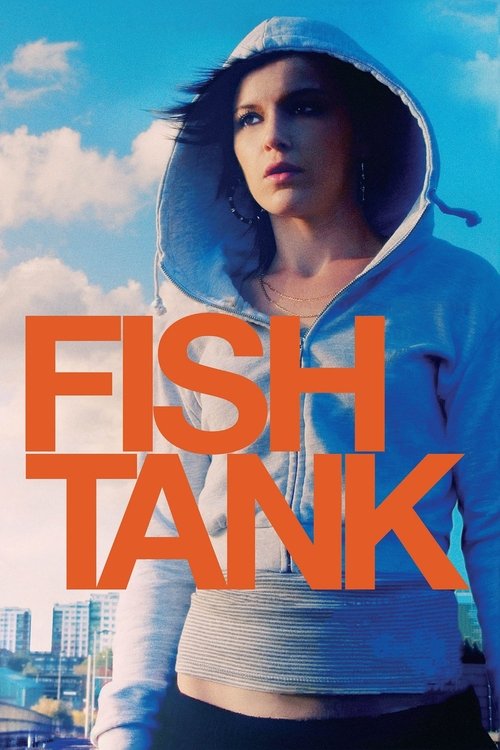
Fish Tank
2009 · Andrea Arnold
When you want a coming-of-age story with real teeth — raw and immersive rather than nostalgic and sweet. Emotionally demanding, but it earns every minute.
What it's about
Mia is fifteen, furious, and stuck — feuding with her hard-partying mother, her foul-mouthed little sister, and everyone else on their Essex council estate, with hip-hop dancing as her one private escape. Then her mother brings home a charming new boyfriend, Connor, who actually pays attention to her, and Mia starts to believe her cramped life might finally open up.
The experience
Restless, handheld, and electric — you're locked inside Mia's point of view, sharing her anger and her flickers of hope, and the film keeps you on edge about where the warmth in it is heading. Tough, tender, and completely gripping.
Performances
Katie Jarvis, discovered with no acting experience, is ferociously believable as Mia — all armor and hunger. Michael Fassbender makes Connor magnetic and unreadable in exactly the way the film needs.
The craft
Andrea Arnold shoots in a boxy, almost square frame that traps Mia the way her life does, with a handheld camera that stays close enough to feel her pulse. The estate is rendered with real sensory beauty — light, music, and weather doing as much storytelling as dialogue.
Why it matters
Winner of the Jury Prize at Cannes and the BAFTA for Outstanding British Film, it confirmed Andrea Arnold as a major voice and reenergized British social realism for a new generation.
Snapshot
Fish Tank is Andrea Arnold's second feature, a coming-of-age drama about fifteen-year-old Mia Williams (Katie Jarvis), a volatile, isolated girl on an Essex council estate whose constricted world cracks open — and then closes painfully again — when her mother's new boyfriend Connor (Michael Fassbender) enters the household. The film belongs to the long lineage of British social realism but is distinguished by its formal compression and sensory intensity: shot in the boxy 1.33:1 Academy ratio, handheld and close, it locks the viewer into Mia's restless, half-formed subjectivity. It premiered in competition at the 2009 Cannes Film Festival, where it won the Jury Prize, repeating the prize Arnold had taken three years earlier for Red Road (2006); it went on to win the BAFTA for Outstanding British Film. The title's metaphor — a creature pressed against the glass of a too-small container, visible to all yet unable to get out — organizes the whole picture. It is widely regarded as one of the defining British films of its decade and a touchstone for a subsequent generation of women directors working in observational realism.
Industry & production
Fish Tank was produced within the public-private architecture that sustained much of British art cinema in the 2000s. It was financed and supported by the UK Film Council and BBC Films, the two institutions that anchored mid-budget British auteur production before the Film Council's abolition in 2010. The producers were Kees Kasander — the Dutch producer long associated with Peter Greenaway — and Nick Laws, working through Kasander's company alongside the UK production outfit. Limelight and BBC Films are credited among the production entities. The budget was modest, in keeping with the social-realist mode, though precise figures are not something I can confirm reliably and will not invent.
The film's production identity was shaped decisively by casting. Arnold and her team built the project around an unknown lead. Katie Jarvis had no acting experience; the much-repeated account is that a casting associate spotted her arguing with her boyfriend on a platform at Tilbury Town railway station and approached her. This discovery is foundational to the film's texture — Jarvis's rawness is not a performance of authenticity but its literal source. Around her Arnold assembled a small professional cast, most notably Michael Fassbender, then on the cusp of major recognition after Hunger (2008), as Connor, and Kierston Wareing as Mia's young mother Joanne.
Distribution followed the festival-to-arthouse route typical of the form: the Cannes prize generated the critical platform, and the film was released theatrically across the UK and internationally to strong reviews. As an industrial object, Fish Tank exemplifies a now partly vanished ecosystem — the Film Council era — in which a director with one acclaimed feature could secure backing for an uncompromising, commercially unhedged second film.
Technology
Technically the film is deliberately unshowy, its choices subordinated to immediacy. It was shot on 35mm film by cinematographer Robbie Ryan, with the negative composed for the 1.33:1 frame — a choice that runs against the widescreen norms of theatrical features and required committing the full film stock area to that squarer image. The production relied on available and practical light wherever possible, favoring natural and source lighting over elaborate rigs, which suited both the documentary aesthetic and the constraints of shooting in real council-flat interiors and exterior estate locations. Camera operation was handheld throughout. There is no technological spectacle here; the relevant innovation is methodological rather than mechanical — the disciplined use of celluloid, a fixed restrictive ratio, and naturalistic light to produce a heightened sense of the real.
Technique
Cinematography
Robbie Ryan's camerawork is the film's signature achievement and the central plank of his long collaboration with Arnold. The 1.33:1 ratio is the governing decision: it crops the lateral world away, isolating Mia within tall, narrow compositions that mirror the "fish tank" of the title and the boxed-in horizons of her life. Ryan shoots close and handheld, often trailing Mia from behind or holding tight on her face, so that space is revealed only as she moves through it. The camera is subjective without being literally point-of-view — it stays bound to her body, her sightlines, her attention. Light is naturalistic, frequently low and ambient, with the Essex marshland and the estate's concrete rendered in muted, overcast tones broken by sudden warmth (the Connor sequences, the drive to the countryside). The result is a cinematography of confinement and momentary release.
Editing
Edited by Nicolas Chaudeurge, the film follows the rhythms of observation rather than conventional dramatic acceleration. Cutting tends to hold on behavior and let scenes breathe, privileging continuity of Mia's experience over efficient plot delivery. The film's pacing is patient in its first half and tightens through its disquieting later movements (Connor's exit, the abduction sequence). The editing's restraint is part of the realist contract: it refuses to italicize or to telegraph, letting moral ambiguity sit unresolved.
Mise-en-scène / staging
The staging is built from real, lived-in spaces: the cramped flat, stairwells and balconies, the grass verges and pylon-strewn flatlands of the Thames estuary. Production design works by accretion of authentic detail rather than statement. Within these spaces Arnold stages physical, often charged blocking — bodies close in small rooms, the recurring motif of dance as Mia's one channel of self-expression, and the tethered white horse Mia repeatedly visits and tries to free, the film's most overt symbolic element. That horse is the picture's one frank metaphor, and Arnold trusts it to carry weight without underlining.
Sound
Fish Tank has no original orchestral score; its soundtrack is entirely diegetic or source music, which is integral to its meaning. Music is Mia's medium — the hip-hop and R&B she dances to, the tracks that pass between her and Connor. The most discussed musical moment is Bobby Womack's "California Dreamin'," which becomes a private bond between Mia and Connor and later returns with devastating irony. Nas's "Life's a Bitch" frames Mia's aspirations. By refusing a composed score, Arnold keeps the sound world inside the characters' reality; emotion arrives through the songs they actually choose, never from an external authorial commentary. Ambient sound — estate noise, wind across the marshes — is foregrounded with equal care.
Performance
Performance is where the film's method and its art converge. Katie Jarvis, a non-professional, delivers a lead turn of remarkable physical truth — guarded, hostile, hungry — built largely from presence and reaction rather than technique. Arnold's process, shooting in chronological sequence and limiting the actors' foreknowledge of the script, was designed to keep Jarvis responding in the moment rather than acting toward a known destination. Fassbender's Connor is the counterweight: charming, warm, and quietly predatory, a performance that withholds judgment so completely that the betrayal lands as a genuine rupture. Kierston Wareing's Joanne avoids the caricature of the neglectful mother, registering a woman barely older in spirit than her daughters. The interplay of a trained actor (Fassbender) and an untrained one (Jarvis) is the film's live wire.
Narrative & dramatic mode
The film operates in the mode of observational realism organized around a coming-of-age arc, but it withholds the consolations of that genre. The narrative is tightly focalized through Mia; we know only what she knows, and the dramatic turns — Connor's seduction of the household, the sexual transgression, the discovery that he has another family, the near-catastrophic act of revenge against his child — emerge from within her limited vantage. There is no voiceover, no expository scaffolding, no clear moral arbiter. The dramatic mode is one of accumulating tension under a placid surface, punctuated by eruptions of violence or feeling. Crucially, the film resists both melodrama and tidy redemption: its ending — Mia leaving with the boy Billy — offers movement and a flicker of possibility rather than resolution, the open close characteristic of the realist tradition.
Genre & cycle
Fish Tank sits squarely within British social realism, the cycle running from the Free Cinema and kitchen-sink films of the late 1950s and early 1960s through Ken Loach, Mike Leigh, and the 1990s–2000s revival that includes work by Lynne Ramsay, Shane Meadows, and others. It is at once a coming-of-age film, a film about class and the contemporary underclass, and a domestic drama. Within the cycle it is notable for its female authorship and female protagonist — the kitchen-sink tradition was historically male-centered — and for fusing realist content with a more sensuous, subjective formal approach drawn from European art cinema. It also resonates with the Dardenne brothers' Belgian realism, with which it shares the close-following camera and the morally unguided protagonist.
Authorship & method
Fish Tank is a definitive statement of Andrea Arnold's authorship. Arnold came to features by an unusual route — a former children's television presenter who turned to directing and won the Academy Award for Best Live Action Short for Wasp (2003). Her method, consistent across her career, is visible throughout: casting non-professionals or untested performers; shooting in story order; restricting actors' access to the full script; favoring the squarer Academy ratio; and an intense, body-bound, handheld camera. Her authorship is collaborative in a stable way — the central partnership is with cinematographer Robbie Ryan, who shot Red Road, Fish Tank, Wuthering Heights (2011), and American Honey (2016), and whose handheld, naturally lit 1.33:1 image is inseparable from Arnold's vision. Editor Nicolas Chaudeurge has likewise been a recurring collaborator. The screenplay is Arnold's own, written as sole credited writer; the absence of a composer is itself an authorial signature, with music supervision and song selection doing the work a score would otherwise do. The 1.33:1 ratio became, after Fish Tank, a recognized Arnold trademark.
Movement / national cinema
The film is a key work of 2000s British national cinema, produced inside the UK Film Council / BBC Films system and rooted in the social-realist movement that is arguably Britain's most distinctive native tradition. Geographically and culturally it is specific: Essex, the Thames estuary, the post-industrial fringe of Dagenham and Tilbury, with its flatlands, pylons, and council estates. That specificity of place — class, region, accent, landscape — is essential to its standing as national cinema. At the same time the film looks outward to continental art cinema, and its Cannes triumph positioned it within an international festival circuit that has long been more receptive to British auteur realism than the domestic commercial market.
Era / period
Fish Tank is firmly of its late-2000s moment: a contemporary-set film registering, without editorializing, the texture of austerity-adjacent Britain — precarious housing, fractured families, limited horizons for working-class youth — on the eve of the 2010 government changes that would dismantle the very funding body that backed it. Within film history it belongs to the digital-era resurgence of celluloid-shot art realism and to a period in which British cinema was producing a cluster of formally adventurous realist films. Its era is also marked by the arrival of a cohort of new talent: it sits at the moment of Fassbender's ascent and Arnold's consolidation as a major international director.
Themes
The governing theme is entrapment and the longing for escape — the fish tank as a figure for class, gender, and adolescence all at once. Mia is hemmed in by economic circumstance, by a mother too young and too overwhelmed to parent, and by the limited scripts available to a girl in her position; dance is her one imagined exit. Closely bound to this is the theme of adolescent sexuality and its exploitation: the Connor relationship dramatizes the perilous overlap of paternal warmth and predation, of a girl's hunger for attention and an adult's abuse of it, without ever offering the comfort of a clear villain. The tethered horse externalizes the wish for liberation. Class and the geography of the underclass run throughout, as does the fraught, mirroring bond between mother and daughter — two versions of the same trapped life. The film's refusal to moralize is itself thematic: it insists on the ambiguity of feeling rather than the clarity of judgment.
Reception, canon & influence
Critical reception was strongly positive from its Cannes premiere onward. The Jury Prize at the 2009 festival and the subsequent BAFTA for Outstanding British Film established its prestige, and it was widely praised for Ryan's cinematography, Arnold's direction, and the performances of Jarvis and Fassbender. Critics consistently singled out the discovery of Katie Jarvis and the controlled intensity of the filmmaking. (I am avoiding attributing specific quoted reviews or precise box-office figures, which I cannot verify here.)
Influences on the film (backward): Fish Tank draws on the British kitchen-sink and Free Cinema realist heritage and its later inheritors — Ken Loach and Mike Leigh most obviously, and among contemporaries Lynne Ramsay, whose Ratcatcher (1999) shares the lyrical-realist sensibility and the child's-eye intensity. The close-following, morally non-judgmental camera and the use of non-professionals align it with the Dardenne brothers' Belgian cinema. It also continues directly from Arnold's own Red Road and Wasp.
Legacy (forward): The film cemented Andrea Arnold's international reputation and helped launch the next phase of Michael Fassbender's career. It established the visual grammar — Academy ratio, handheld naturalism, Robbie Ryan's image — that Arnold would carry into Wuthering Heights and American Honey. More broadly, Fish Tank became a reference point for a wave of subsequent realist coming-of-age cinema centered on young women, and is frequently cited as a model for observational, female-authored realism. Its method — casting from life, shooting in sequence, withholding the script — has been influential as a template for directors seeking unmediated performance. It is now firmly part of the canon of twenty-first-century British cinema and a fixture of teaching and retrospective programming on social realism and on women's filmmaking.
A Deleuzian reading
The first time you really see Mia, she is alone in a gutted upstairs flat, headphones on, drilling the same eight counts of a hip-hop routine into a concrete room nobody else wants.
The full Deleuzian reading of Fish Tank →
Reception
It won the Jury Prize at Cannes and the BAFTA for Outstanding British Film right out of the gate, so this was never a flop-to-classic story — but its stature has only climbed since, riding Michael Fassbender's stardom and Andrea Arnold's rise into the pantheon of British filmmakers.
How Fish Tank was received, from release to now →
Influences: the films it descends from and the films it influenced
- Ratcatcher (1999) — Lyrical-realist child's-eye intensity rendered through tactile close framing and a non-professional young lead — the immediate British template for Arnold's poetic social realism.
- Kes (1969) — Working-class coming-of-age built on a non-professional child lead and a tethered animal (the kestrel) as the protagonist's symbolic surrogate, directly prefiguring Mia's horse.
- Rosetta (1999) — The body-bound handheld camera locked behind a volatile young woman, morally non-judgmental and never cutting away, is the Dardenne grammar Arnold adopts wholesale.
- Naked (1993) — Leigh's process-driven, improvisation-grounded performance of a charismatic predatory drifter informs the lived-in, withheld-script realism of Fassbender's Connor.
- Saturday Night and Sunday Morning (1960) — Founding kitchen-sink film whose Free Cinema commitment to working-class location shooting and unsentimental restlessness is the movement Fish Tank consciously inherits.
- L'Enfant (2005) — Sibling Dardenne work whose unbroken following camera and ethically neutral proximity to an impulsive protagonist parallel Arnold's documentary-grade closeness.
- Young Mothers (2025) — Handheld, boxed-in Academy-ratio pursuit of a working-class girl played by a non-professional, in natural light and diegetic sound, directly downstream of Rosetta's chase aesthetic.
- Breaking the Waves (1996) — Arnold extends the Müller visual grammar—handheld zoom, available-light desaturated location photography, performance-driven editing that holds close-ups past editorial convention—into British social realism, applying it to female abjection and marginal belonging in a register directly traceable to von Trier's template.
- 4 Months, 3 Weeks and 2 Days (2007) — Arnold's handheld available-light tracking of a female protagonist through crisis deploys the same formal restraint — no non-diegetic score, behavioral performance from a non-professional lead, ellipsis that omits dramatic peaks — extending the Dardenne-via-Mungiu grammar into British social realism with the same ethical refusal to aestheticize suffering.
- Pusher (1996) — Arnold's 16mm handheld photography with invasive close framings of a working-class body in peripheral urban space, ambient sound preserved, practical-source lighting, and accumulation-over-escalation narrative structure directly extend Pusher's formal method into British social realism.
- Secrets & Lies (1996) — Robbie Ryan's sustained handheld available-light cinematography in Essex working-class domesticity and Arnold's casting of non-professional Katie Jarvis — found spontaneously rather than through audition — directly extend Leigh's performance-as-documentary authenticity as a core formal principle.
- This Is England (2007) — Arnold casts non-professional teenager Katie Jarvis (discovered at a train station mid-argument) in Essex working-class surroundings and uses diegetic music — Nas's 'Life's a Bitch' — as a class and aspiration marker, extending Meadows' casting methodology and observational handheld grammar into female working-class social realism.
- American Honey (2016) — Extends the method — discovered non-professional lead, chronological shoot, needle-drop diegetic music doing a score's work, Ryan's Academy-ratio handheld — to American road-movie scale.
- Aftersun (2022) — Inherits Arnold's tactile, observational coming-of-age intimacy and needle-drop diegetic soundtrack to convey adolescent feeling without exposition or score.
- Poor Things (2023) — Robbie Ryan's handheld anamorphic grammar developed across his Andrea Arnold collaborations — intimate close-body tracking, frames that crowd the protagonist's body against environmental edges — establishes the physical syntax of proximity and enclosure that he brings to *Poor Things*' staging of Bella's embodied discovery.
- Boiling Point (2021) — British social realism with handheld observational cinematography and naturalistic ensemble performance centered on class-conscious labor conditions and institutional constraint; shares the methodological commitment to handheld proximity to working-class British bodies that Barantini inherits alongside Loach and Leigh.
- Emily the Criminal (2022) — Arnold's close-quarters handheld technique, tracking a young woman's body through marginalized urban space in available light with ambient sound replacing score, provided a key technical model for the cinematographic approach Jeff Bierman applies to Emily's navigation of the city.
- Mommy (2014) — Arnold's 4:3 handheld working-class realism, fusing a volatile mother-child household with diegetic pop and overexposed natural light, prefigures Mommy's framing and texture.
- Short Term 12 (2013) — Immersive close-follow handheld camera locked to a volatile teen's body and POV, discovering emotion in real time rather than framing it from outside.
- God's Own Country (2017) — Camera kept clenched to the body of a near-nonverbal protagonist, British-new-realist naturalism that reads feeling off posture and skin, not speech.
- System Crasher (2019) — Built a volatile, aggressive girl around a non-professional street-cast discovery, shot in intimate Academy-ratio handheld that never leaves her side.
- Never Rarely Sometimes Always (2020) — A nonprofessional newcomer lead (Katie Jarvis) filmed in boxed Academy-ratio handheld pressed tight to an inarticulate teenage girl's face — the restraint-plus-intimacy template Hittman runs on 16mm.
- C'mon C'mon (2021) — Robbie Ryan's collaborator method — available-light, handheld, actor-following naturalism — here honed on a volatile youth, the intimacy Mills reroutes into composed black-and-white.
- A Thousand and One (2023) — Handheld, available-light naturalism inside a volatile single-mother household, using nonprofessional texture to make domestic instability feel unmediated.
- Red Road (2006) — Arnold's own debut feature establishing the Robbie Ryan partnership — surveillance-intimate handheld, natural light, and watchful observational rhythm carried straight into Fish Tank.
- Wasp (2003) — Arnold's Oscar-winning short prototypes the method — non-professionals, deprived estate setting, restless close camera on a struggling mother — that Fish Tank expands to feature length.
- The 400 Blows (1959) — The originating template of the troubled-youth coming-of-age — non-professional adolescent lead, real locations, and an open, unresolved ending — that Fish Tank's structure echoes.
- Wuthering Heights (2011) — Arnold carries Fish Tank's exact grammar forward — 1.33:1 Academy ratio, Robbie Ryan's handheld natural-light image, non-professional leads, no composer — onto the Yorkshire moors.
- The Selfish Giant (2013) — Post-Fish Tank British realism centering deprived youth and a tethered work animal, shot observationally on real estates with non-professional children in the Loach-Arnold mode.
- Honeyboy / The Fits (2015) — Female-authored observational coming-of-age built on a non-professional young lead and body-focused, near-wordless realism, citing Fish Tank's template of unmediated girlhood performance.
- Girlhood (Bande de filles) (2014) — Female-authored coming-of-age of a working-class girl, with a non-professional lead and a music-driven, needle-drop emotional grammar in place of conventional score.
- Rocks (2019) — Workshop-cast non-professional teenage girls and improvisation-grounded estate realism — a direct descendant of Fish Tank's casting-from-life, withheld-script method.
- Andrea Arnold's Cow (2021) — Pure distillation of Arnold's craft — Robbie Ryan's handheld, body-bound camera on a single tethered animal subject, the symbolic-tethered-horse motif taken to its logical extreme.
- The Little Sister (2025) — Lead found by chance/open casting (Katie Jarvis), shot in boxed Academy ratio with observational proximity to a restless, guarded working-class girl.
- Die My Love (2025) — The British art-cinema sibling: handheld, haptic naturalism and boxed academy-ratio framing built to immerse the viewer in a volatile woman's bodily, sensory subjectivity.
- Elephant (2003) — Sibling in the Academy-ratio, follow-the-youth idiom — handheld camera trailing a non-professional adolescent through real housing-estate architecture with improvised, present-tense performance.
Similar films
- Ratcatcher (1999) — influence & lineage
- Rosetta (1999) — influence & lineage
- American Honey (2016) — influence & lineage
- System Crasher (2019) — same viewing thread
- Lilya 4-ever (2002) — same viewing thread
- Hard Truths (2024) — shared sensibility
- Urchin (2025) — shared sensibility
- Left-Handed Girl (2025) — shared sensibility
All the films related to Fish Tank →
Watch it with: curated runs of related films
- No One Coming to Save Her — Watch these in a run for the same unblinking gaze on girls left to fend for themselves — abandoned by their mothers, circled by predatory men, and armed with nothing but their own nerve.