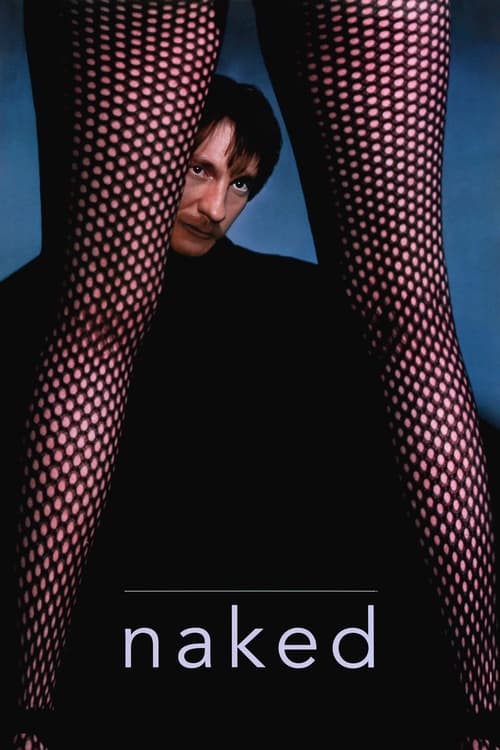
Naked
1993 · Mike Leigh
For when you want to be challenged, not comforted — a film for a night when you're ready to stare at something bleak and brilliant and argue with it afterward. Absolutely not date-night viewing.
What it's about
Johnny, an unemployed, ferociously intelligent drifter from Manchester, lands in London and spends a long sleepless stretch of nights moving through the city — crashing at an ex-girlfriend's flat, latching onto strangers, and unloading torrents of dazzling, corrosive talk on anyone who'll listen. He's magnetic and cruel in equal measure, a man using his brain as a weapon against a world he's decided is ending, in a Britain hollowed out by recession.
The experience
Harrowing, abrasive, and blackly funny — Johnny's monologues are so electric you laugh, then feel implicated for laughing. It's a genuinely dark ride with scenes of real cruelty, and it leaves you rattled, but the language and the performance are impossible to look away from.
Performances
David Thewlis's Johnny is one of the towering performances of the 1990s — a nonstop verbal fireworks display of philosophy, insult, and despair, delivered with such wit and pain that you can't decide whether to save him or run from him.
The craft
Built through Leigh's signature method of long improvisation with the cast before shooting, so every character feels lived-in down to the bone. The nighttime London photography is all sodium-lamp murk and empty streets, and the dialogue has the density of great theater — this is a film you watch for the words as much as the images.
Why it matters
It won major prizes at Cannes and marked a startling turn in Leigh's career, from humane social comedy to something apocalyptic — and it remains the defining screen portrait of early-'90s British disillusionment.
Snapshot
Naked is Mike Leigh's blackest, most corrosive film: a nocturnal odyssey through a recessionary London in which Johnny, a brilliant, self-lacerating Mancunian drifter, talks, abuses, seduces, and theorizes his way across the city over a single sleepless stretch of hours. Where Leigh's earlier work had married social observation to a fundamentally humane comedy of manners, Naked pushes that sensibility into something close to apocalyptic — a film about millennial dread, masculine rage, and the failure of meaning in a country gutted by a decade of Thatcherism. It is anchored by David Thewlis's performance as Johnny, one of the great verbal creations of 1990s cinema: a fugitive autodidact who weaponizes his own intelligence and whose cruelty is inseparable from his despair. The film premiered in competition at Cannes in 1993, where Leigh won Best Director and Thewlis Best Actor — a double award that announced Naked as a turning point both for its maker and for British cinema's capacity for darkness. It remains divisive precisely because it refuses consolation: a portrait of a man who sees too clearly and feels too much to be saved, set against a city that has stopped expecting salvation.
Industry & production
Naked was produced through Thin Man Films, the company Leigh ran with producer Simon Channing-Williams, and financed primarily by Channel Four (through its Film on Four / Film4 arm) with support from British Screen Finance. This funding structure was characteristic of the British film economy of the early 1990s, when theatrical production had largely collapsed and Channel Four television money was the lifeline that kept auteur-driven British features alive. Leigh had spent much of his career in television — his run of BBC "Play for Today" works through the 1970s and 1980s — and Naked arrived as part of his consolidation as a feature director following High Hopes (1988) and Life Is Sweet (1990).
The production followed Leigh's by-then established model: a relatively modest budget, a long preparatory rehearsal period funded as part of the project, and a comparatively compressed shoot. Leigh does not begin with a finished screenplay; financiers commit to a Mike Leigh film on the strength of his method and track record rather than a script they can read, which made his work an unusual proposition for any funder and helps explain his reliance on Channel Four's relative tolerance for risk. The film was shot in London in 1992 for a 1993 release. Specific budget figures are not something I can state with confidence, so I won't invent one; what is clear is that Naked operated at the low-budget end of feature production, with its resources visible on screen as a virtue — the stripped, unglamorous textures of night-time streets, bare flats, and the deserted office block where Johnny shelters.
Technology
Naked was shot photochemically on 35mm film, the standard for theatrical features of its moment, and finished for conventional cinema projection. There is nothing technologically experimental about its production; if anything, its power derives from a deliberate plainness. The film makes expressive use of available and minimal lighting to render London at night — sodium streetlamps, the cold fluorescence of an empty office, the gray wash of pre-dawn. The aesthetic belongs to the pre-digital era of British realism, where the grain and limited latitude of film stock in low light contribute to the picture's clammy, sleepless atmosphere rather than being smoothed away. This is a film whose "technology" is essentially the craft of exposing film stock in difficult conditions, and it predates the digital intermediate and color-grading pipelines that would later let filmmakers manufacture such a palette in post-production.
Technique
Cinematography
The cinematography is by Dick Pope, who had begun what would become one of the most enduring director–cinematographer partnerships in British cinema. Pope's work on Naked is defined by a cold, desaturated palette — blues, grays, sickly greens — that turns London into an alienating, half-abandoned landscape. The camera favors a restrained realism, holding on faces during Johnny's long verbal arias and letting performance, rather than coverage, carry the scenes. Night exteriors are rendered with a murky, under-lit quality that refuses the romanticism of the city; interiors are flat and unforgiving. There is little of the picturesque here. Pope's restraint is itself a statement: the film looks at its world steadily, without flinching and without prettifying, which intensifies both the comedy and the cruelty.
Editing
Jon Gregory edited the film. The cutting serves Leigh's actor-centered approach: scenes are allowed to breathe at length, particularly the extended dialogues — Johnny with Brian the night watchman, Johnny with Louise and Sophie — where the rhythm of speech and the slow turns of mood are the substance of the drama. The structure is episodic, a picaresque chain of encounters threaded along Johnny's wandering, intercut with a secondary strand involving the predatory landlord-figure. The editing's discipline lies in knowing when to let a monologue run and when to break away; it sustains a film that is largely composed of talk without letting it slacken into stasis.
Mise-en-scène / staging
The film's physical world is one of bedsits, empty offices, doorways, and deserted streets — the spaces of the dispossessed and the transient. The flat in Dalston where Louise and Sophie live, the glass-and-concrete office block where Johnny finds temporary refuge with the lonely security guard, the cafés and pavements of his wandering: each location is chosen for its bleakness and its ordinariness. Leigh stages his actors with a theatrical attention to the dynamics of a room — who sits, who stands, who controls the space — which reflects his roots in devised theater. The mise-en-scène never decorates; it documents a London of the recession, of homelessness and emptied workplaces, and lets the architecture of late-Thatcherite Britain stand as a moral landscape.
Sound
Andrew Dickson composed the score, scored notably for harp and viola — instruments whose plangent, slightly archaic tone lends the film an elegiac, mournful undercurrent at odds with its squalor and verbal violence. The music functions as a kind of lament for Johnny, dignifying his suffering without excusing his conduct. Beyond the score, the sound design is naturalistic: the ambient hum of the city, the dead acoustics of the empty office, the texture of voices in cramped rooms. The film is fundamentally a sonic experience because it is a film of language, and the recording privileges the clarity and cadence of Thewlis's torrential speech.
Performance
Performance is the film's engine. David Thewlis's Johnny is a tour de force of verbal aggression and wounded intelligence — a character who can shift in a sentence from scabrous comedy to genuine philosophical anguish, and whose charisma is bound up with his capacity to wound. The Cannes Best Actor award recognized a performance of rare density. Around him, Lesley Sharp plays Louise, Johnny's ex, with grounded weariness; Katrin Cartlidge is extraordinary as the damaged, drifting Sophie; Peter Wight gives the night watchman Brian a melancholy gravity in the film's central dialogue; Claire Skinner, Ewen Bremner, Susan Vidler, and others fill out the world. Greg Cruttwell plays the sadistic landlord Jeremy (also called Sebastian), a moneyed predator whose violence runs parallel to Johnny's, complicating any reading of Johnny as merely a victim. These are not performances built from a script handed down; they are characters the actors constructed over months, and the result is a uniformly lived-in ensemble.
Narrative & dramatic mode
Naked is structured as a nocturnal picaresque: a loose, episodic chain of encounters as Johnny moves through the city, each meeting a self-contained scene of seduction, confrontation, or philosophical sparring. The dramatic mode is largely dialogic — the film advances through talk, through Johnny's monologues and the way other characters absorb, resist, or are wounded by them. The central sequence with Brian the night watchman, in which Johnny improvises an apocalyptic cosmology drawing on the Book of Revelation, Nostradamus, barcodes, and entropy, is the film's intellectual and emotional core: a conversation that is at once stand-up routine, prophetic rant, and cry of despair. Running alongside Johnny's journey is the colder, more straightforwardly menacing strand of Jeremy/Sebastian's intrusion into the women's flat, which functions as a structural counterweight — a different, unredeemed face of male predation. The film resists conventional resolution; it ends not with catharsis but with a wounded man limping away into an uncertain morning.
Genre & cycle
Nominally a drama with strands of black comedy — the official framing as "Drama, Comedy" is accurate in that Johnny's wit is genuinely funny even at its most savage — Naked belongs most truly to the tradition of British social realism, while pushing that tradition toward something more existential and apocalyptic. It is realism inflected by the morality play and by a strain of millennial pessimism that looks ahead to the anxieties of the approaching end of the century. It sits within a cycle of early-1990s British films reckoning with the social wreckage of the Thatcher years, though Naked is harsher and more philosophically ambitious than most. Its comedy is never comfort; it is the comedy of a mind so quick it cannot stop itself, even as it destroys.
Authorship & method
Naked is unmistakably the work of Mike Leigh, and it exemplifies his singular method. Leigh begins not with a screenplay but with actors: he casts performers and then works with them, individually and in secret from one another, over a long rehearsal period to build characters from the ground up — biographies, relationships, ways of speaking — before bringing them into improvised situations that are gradually shaped, refined, and finally fixed into structured scenes. The "script" emerges from this process; the dialogue's lived authenticity is the product of months of devising rather than solitary writing. Leigh takes sole writing and directing credit, but the characters are genuine collaborations with his actors, which is why a creation like Johnny feels so wholly inhabited.
His key collaborators on Naked form the core of his repertory craft team: cinematographer Dick Pope, whose cold realism defines the film's look and who would shoot Leigh's films for decades; composer Andrew Dickson, whose harp-and-viola scores recur across Leigh's work of this period; editor Jon Gregory; and producer Simon Channing-Williams, Leigh's long-term partner at Thin Man Films. The film also marks a notable darkening of Leigh's authorial voice — a willingness to follow a character into genuine cruelty and nihilism that distinguishes Naked from the warmer, more redemptive register of Life Is Sweet or the later Secrets & Lies.
Movement / national cinema
Naked is a landmark of British national cinema and of the social-realist lineage that runs from the kitchen-sink films of the early 1960s through Ken Loach and into Leigh's own work. But it complicates that lineage. Where the realist tradition tends toward solidarity and social diagnosis, Naked is more solitary and metaphysical, its protagonist an alienated intellectual rather than a representative worker. It belongs to a moment when British cinema, sustained by Channel Four, was producing auteur work of real seriousness on minimal means. The film is deeply national in its specificity — the accents, the geography of a recession-hit London, the texture of the welfare state's decline — yet its concerns reach beyond Britain toward a more universal account of masculine despair and the search for meaning.
Era / period
The film is saturated with its moment: Britain in the early 1990s, in the trough of recession, in the aftermath of the Thatcher decade and on the cusic of a fin-de-siècle unease about the coming millennium. Homelessness, unemployment, emptied workplaces, and a pervasive sense of social abandonment are the film's ambient conditions. Johnny's apocalyptic monologues give explicit voice to the period's millennial anxiety, projecting personal despair onto a cosmic screen. Naked captures a particular exhaustion in British life — the sense of a society that had been told there was no alternative and had stopped believing in a future. It is, in that sense, one of the defining films of post-Thatcher Britain.
Themes
The film's great theme is despair — intellectual, spiritual, and social. Johnny embodies a nihilism that is also a form of hyper-lucidity: he sees through everything and is destroyed by what he sees. Closely bound to this is the theme of masculine rage and its relation to violence: the film draws a deliberate, uncomfortable parallel between Johnny's verbal and sexual cruelty and the cold predation of Jeremy/Sebastian, refusing to let the audience simply absolve its charismatic anti-hero. Apocalypticism runs throughout — the Book of Revelation, prophecy, entropy, the end of meaning — as Johnny converts his suffering into cosmology. There are themes of dispossession and homelessness, of the failure of love and connection (his bruised history with Louise, his exploitation of Sophie), and of intelligence as a curse rather than a gift. Underneath the savagery, the film mourns: it grieves for a man, and a country, that can no longer believe in anything.
Reception, canon & influence
At Cannes in 1993, Naked won Mike Leigh the Best Director prize and David Thewlis the Best Actor prize, a major critical endorsement that elevated both. Critical reception was strong but genuinely divided: many hailed it as a masterpiece of ferocious intelligence and one of Leigh's finest achievements, while others were repelled by its bleakness and troubled by its treatment of gender and violence — a debate the film deliberately provokes and does not resolve. That very divisiveness has helped secure its place; Naked is now widely regarded as one of the key British films of its decade and a high point in Leigh's career.
Influences on the film run backward through the British social-realist tradition — the kitchen-sink cinema of the early 1960s and the politically engaged realism of Ken Loach — refracted through Leigh's own theatrical, devising method and his television apprenticeship. Its apocalyptic and philosophical dimension draws on older literary and religious sources (Revelation, prophetic literature) channeled through Johnny's autodidact's bricolage. Forward, the film's legacy is substantial: it confirmed Leigh as a major feature auteur and helped clear space for a harder, more uncompromising strain of British cinema in the 1990s. It made David Thewlis a star and gave him his definitive early role, and Johnny became a touchstone for the figure of the articulate, self-destructive drifter. Among Leigh's own work it stands as the darkest pole, against which his more compassionate films are measured. Its precise influence on individual later filmmakers is difficult to document without overreach, so I'll put it plainly: its lasting impact lies less in stylistic imitation than in having demonstrated how far British realism could be pushed toward despair, intelligence, and moral discomfort without losing its grip on the real.
A Deleuzian reading
Start with Brian.
The full Deleuzian reading of Naked →
Reception
It stormed Cannes in 1993 but was immediately dogged by accusations of misogyny that split critics down the middle; three decades on it's settled in as Mike Leigh's masterpiece, with the debate now folded into its legend rather than held against it.
How Naked was received, from release to now →
Influences: the films it descends from and the films it influenced
- Look Back in Anger (1959) — Establishes the articulate working-class male whose verbal aggression erupts as sustained dialectical tirade — Jimmy Porter's rhetorical assault is the direct template for Johnny's monologic torrents.
- Saturday Night and Sunday Morning (1960) — Founds the kitchen-sink mode Naked descends from: on-location working-class settings shot with documentary plainness around a defiant, self-sabotaging antihero.
- The Loneliness of the Long Distance Runner (1962) — Models the alienated young man as a figure of principled refusal, threading subjective interiority through a realist surface that Leigh inherits and hardens.
- Kes (1969) — Loach's politically engaged naturalism and regional, near-documentary observation form the realist bedrock Leigh refracts through his theatrical devising.
- Bleak Moments (1971) — Leigh's debut feature establishes his core method — characters built from the ground up with actors over long rehearsal before scenes are fixed — that produces Johnny.
- Meantime (1983) — The devised-from-actors method applied to recession-era despair, with Tim Roth and Gary Oldman, rehearsing the unemployed-drifter register Naked pushes to nihilism.
- Taxi Driver (1976) — Pioneers the nocturnal urban picaresque organized around a single alienated male voice prowling the city at night — the structural and tonal engine of Johnny's odyssey.
- Life Is Sweet (1990) — Immediate predecessor sharing the exact repertory craft team — Dick Pope's cold realism and Andrew Dickson's harp-and-viola scoring — whose warmer register Naked deliberately inverts.
- This Sporting Life (1963) — David Thewlis's performance mode — a working-class body radiating intelligence and damage while withholding psychological access to the character's interiority — is the direct descendant of Harris's method of externalizing inner states through physical texture rather than actorly revelation.
- A Taste of Honey (1961) — Leigh's improvisatory staging method, derived through Joan Littlewood's actor-generation process (the same source that shaped Delaney's sense of character), produces the same behavioral-accumulation dramaturgy and episodic picaresque structure without redemptive movement.
- High Hopes (1989) — It pushes High Hopes's improvisation-built ensemble and long-scene structure to an incendiary extreme, keeping Dickson's plaintive score and observational camera while abandoning the earlier film's tenderness.
- Secrets & Lies (1996) — Extends the devised method into long-take, single-setup confrontation scenes shot by Dick Pope, the dialogic technique Naked perfected in its bedsit two-handers.
- Career Girls (1997) — Continues the nocturnal-drifter and bedsit-recession staging with Pope's available-light naturalism, foregrounding the dialogic monologue inherited directly from Johnny.
- Mr. Turner (2014) — Carries forward Dick Pope's available-light photochemical naturalism — the same cinematographer's eye for ungilded light that defined Naked's look — to its mature extreme.
- Nil by Mouth (1997) — Pushes British realism toward unflinching cruelty through improvised-feeling, devised-quality performance, taking Naked's permission to follow a man into genuine ugliness.
- Dead Man's Shoes (2004) — Low-budget British naturalism organized around a charismatic, menacing male lead developed through improvisation — extending Naked's articulate-predator performance mode.
- Tyrannosaur (2011) — Builds its lead via Leigh-style character immersion to stage articulate male rage and nihilistic despair within an unsoftened social-realist frame.
- Fish Tank (2009) — Continues British social realism through available-light, handheld naturalism and a non-professional lead, the observational textures Naked shares with the tradition.
- Ratcatcher (1999) — Extends post-Naked British realism into a harsher poetic register, retaining the on-location naturalism and bleak working-class milieu while individualizing the camera.
- Urchin (2025) — Leigh's harder-edged London drift built around a volatile, magnetic, self-destructing male lead (David Thewlis) is the direct template for Dillane's nervy, un-romanticised charm carrying the film.
- Pusher (1996) — Leigh's staging of physiological desperation — performance grounded in bodily states and economic precarity rather than dramatic psychology, actors inhabiting rather than demonstrating — and his accumulation-over-escalation narrative structure feed directly into Refn's direction of Bodnia as Frank.
- This Is England (2007) — Leigh's method of building ideological monologue through improvisation — Johnny's rants arrive from character rather than authorial argument, making extremist views feel inhabited rather than written — establishes the technique Meadows uses to render Combo's National Front speeches legible from inside, creating the film's central moral tension.
- Boiling Point (2021) — David Thewlis's sustained performance across a single compressed night — the film's formal and emotional argument depending entirely on maintaining the actor's unbroken internal state across real time — establishes the model of a single-sustained-performance as the film's structural spine that Boiling Point inherits.
- My Name Is Joe (1998) — Carries the socially engaged naturalist tradition into the late '90s with a charismatic self-destructive male built through Loach's improvisatory, non-professional performance technique.
- Trainspotting (1996) — Leigh's improvisation-based method produced a physically committed performance from David Thewlis as a contradictory, verbally dazzling British working-class protagonist whose monologue simultaneously critiques and inhabits its own world—a parallel development of the performance register Boyle sought from McGregor, with expressionist staging embedded in authentic London locations.
- Pi (1998) — A motormouthed obsessive's apocalyptic theorizing rendered through deteriorating performance and nocturnal urban dread — kin to Gullette's verbal, physically degrading portrait of a mind eating itself.
- Withnail & I (1987) — Drives its film on the articulate, savage verbal monologue of a bohemian drifter through squalid London, the same dialogue-as-engine privileging of a literate ranting protagonist.
- Day of the Wacko (2002) — Centers a torrential, self-hating erudite monologist (Thewlis's Johnny) whose verbose misanthropic riffs mirror Miauczyński's logorrheic intellectual bile as pure vocal performance.
- Stuart: A Life Backwards (2007) — Centers a volatile, articulate underclass drifter whose monologues carry the film, establishing the abrasive marginal-male performance mode that Hardy's Stuart extends.
Similar films
- Urchin (2025) — influence & lineage
- Nil by Mouth (1997) — influence & lineage
- Bleak Moments (1971) — influence & lineage
- Secrets & Lies (1996) — influence & lineage
- Meantime (1983) — influence & lineage
- Naked Lunch (1991) — shared sensibility
- Trainspotting (1996) — shared sensibility
- Hard Truths (2024) — shared sensibility
All the films related to Naked →