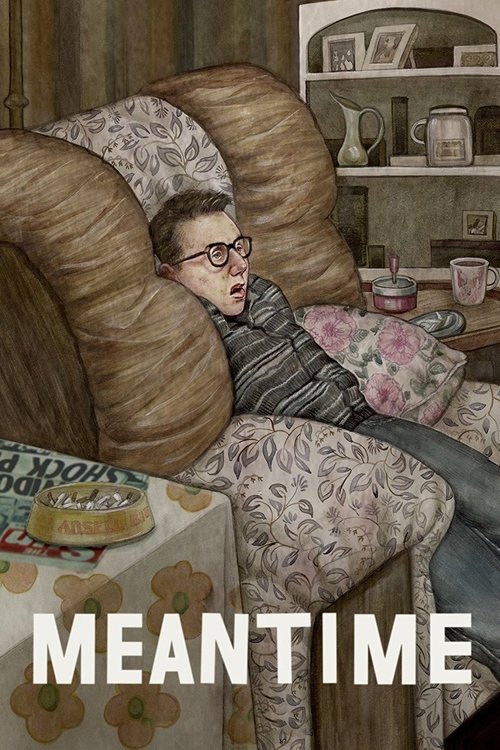
Meantime
1983 · Mike Leigh
For when you want something real — a film about ordinary people that earns every emotion honestly. Not an easy watch, but a deeply rewarding one when you're up for it.
What it's about
An East End London family scrapes by in a cramped council flat during the Thatcher-era recession: only the mother works, while the father and two grown sons idle on the dole. Mark, the sharp-tongued elder brother, and Colin, painfully shy and withdrawn, orbit each other with love and cruelty in equal measure — while their well-off aunt's attempt to help sets something quietly combustible in motion.
The experience
Grimly funny and slow-burning, with an authenticity that can be uncomfortable — you're not watching a plot so much as living inside a family's stalled lives. It builds to moments of surprising tenderness that hit harder for how unsentimental everything around them is.
Performances
A jaw-dropping cast of then-unknowns: Tim Roth disappears into the near-mute Colin, Phil Daniels crackles as Mark, and a young Gary Oldman is electric in a small role as a skinhead. Watching these actors before anyone knew them is half the film's fascination.
The craft
Built through Mike Leigh's signature method — months of improvisation with the actors before a script existed — which gives every scene the texture of overheard life. The cramped flats, the dole queues, the pub silences: nothing feels designed, and that's the design.
Why it matters
A defining portrait of Thatcher-era Britain and a launching pad for Roth and Oldman, it stands among the key works of British social realism and marked Leigh's road back to feature filmmaking.
Snapshot
Meantime is Mike Leigh's chronicle of a working-class family slowly corroding under the weight of mass unemployment in the East End of London during the first Thatcher government. Made for Central Independent Television and broadcast on Channel 4 in December 1983, it followed more than a decade in which Leigh had worked almost entirely in theater and television after his lone early feature, Bleak Moments (1971). The film watches the Pollocks — mother Mavis, the only earner; idle, beaten father Frank; the volatile, articulate elder son Mark; and the withdrawn, near-mute younger son Colin — as they circle one another in a cramped council flat, their stasis thrown into relief by Mavis's better-off sister Barbara and her drinking, dissatisfied husband John. Its lasting fame rests partly on a now-startling cast of unknowns: Tim Roth as Colin and Gary Oldman as the swaggering skinhead Coxy in their breakthrough screen roles, alongside Phil Daniels, Marion Bailey, Alfred Molina, and Pam Ferris. Meantime is among the defining works of the early Channel 4 "Film on Four" moment and a cornerstone of late-twentieth-century British social realism.
Industry & production
Meantime belongs to the founding period of Channel 4, which launched in November 1982 with a remit to commission rather than produce, and which made the funding of low-budget, single films a pillar of its identity. The film was produced by Graham Benson for Central Independent Television, one of the ITV franchises, in association with Channel 4 — part of the wave of television-financed features that gave British cinema a lifeline in a decade when the theatrical industry had collapsed. This commissioning model is essential to understanding the film: it was conceived, budgeted, and exhibited as television, premiering on the small screen rather than in cinemas, and its modest economics underwrote precisely the kind of unhurried, ensemble, character-driven work that commercial features could not easily justify.
The production's defining feature was time. Leigh's method requires a long rehearsal and development period before a frame is shot, and the television-film structure of the early 1980s — with its relatively protected budgets and public-service ethos — accommodated that process in a way the open market rarely did. The film was shot on location in and around the East End, using real streets, estates, pubs, and flats rather than sets, in keeping with both Leigh's working method and the documentary inheritance of British realism. Precise budget figures are not something I can state reliably, and as a television commission the film had no theatrical box office; its "success" was registered in broadcast reception, critical standing, and the subsequent careers it launched.
Technology
The film was made on 16mm — the standard acquisition format for British television drama of the period and for the lower-budget end of the Film on Four slate — and framed for the 1.33:1 television screen. That technical baseline matters aesthetically: 16mm's grain, its tolerance for available and practical light, and its relative mobility suited the cramped interiors and overcast exteriors of the East End, lending the image a granular, unglamorous texture consonant with the subject. The squarish Academy-adjacent frame concentrates attention on faces and on the claustrophobic geometry of small rooms, where much of the drama's pressure is generated. The film's later life on home video — including a digital restoration issued by the BFI and a release by the Criterion Collection — has brought that 16mm image to audiences in a form its original broadcast could not, while preserving its deliberately rough, observational surface rather than smoothing it into something more "cinematic."
Technique
Cinematography
The cinematography is by Roger Pratt, early in a career that would later encompass Brazil, Mona Lisa, and large-scale studio pictures — a trajectory that makes his restraint here the more notable. Pratt and Leigh favour an observational, often static or slow camera that holds on the actors and lets behavior unfold within the frame rather than carving it up. Long and medium lenses, naturalistic interior light, and a muted, gray-brown palette register the estate and the flat as lived-in, oppressive spaces. The camera tends to watch rather than dramatize, frequently shooting through doorways and across rooms so that figures are boxed in by architecture. The contrast between the Pollocks' dim flat and Barbara and John's tidier, brighter home is carried as much by light and décor as by dialogue.
Editing
Edited by Lesley Walker, the film moves at the patient, accretive pace characteristic of Leigh's work, in which meaning emerges from duration and repetition rather than from narrative propulsion. Scenes are allowed to run past the point a conventional drama would cut, so that awkward silences, dead time, and the sheer boredom of enforced idleness become the film's true content. The editing serves the performances, holding shots long enough for small shifts of behavior to land, and cross-cutting between households to build the social comparison that structures the film.
Mise-en-scène / staging
Mise-en-scène is where Leigh's theatrical instincts are most visible. The detailed, naturalistic dressing of the flat — the furniture, clothes, and clutter of a family with no money and nowhere to go — functions as character exposition. Staging tends to keep the family physically close but emotionally non-communicating, bodies arranged in the same small room facing away from one another. Spaces themselves dramatize the film's themes: the dole office, the pub, the estate's concrete walkways, and the gulf between the two homes. The much-cited image of Colin's shaved head, and Coxy's restless physical business (notably his banging about inside an oil drum), are staged as eruptions of frustrated energy with nowhere productive to go.
Sound
The soundscape is largely diegetic and naturalistic — television sets, traffic, the ambient drone of the estate — reinforcing the documentary texture. The original score is by Andrew Dickson, who would become one of Leigh's most important long-term collaborators (later scoring High Hopes, Naked, and Secrets & Lies). Music is used sparingly rather than to underline emotion, in keeping with the film's refusal of sentimentality. Dialogue, dense with the rhythms, evasions, and aggressions of East End speech, is the dominant sonic element, and the performances are calibrated to its hesitations and overlaps.
Performance
Performance is the film's center of gravity, and Meantime is now legendary for its ensemble. Tim Roth's Colin — slack-jawed, frightened, retreating inward — is a study in inarticulacy that made his name, while Gary Oldman's Coxy is a coiled, menacing comic-grotesque turn that announced a major actor. Phil Daniels, already known from Quadrophenia, gives Mark a verbal quickness and a cruelty laced with protectiveness toward his brother. Marion Bailey (Barbara), Alfred Molina (John), Pam Ferris (Mavis), and Jeff Robert (Frank) complete a cast in which no one performs "below" the others; the realism is collective. Because these performances were built through Leigh's improvisatory rehearsal process, they have the density of fully inhabited lives rather than written parts — every actor seems to carry an unseen biography into frame.
Narrative & dramatic mode
Meantime is a deliberately plotless film in the conventional sense: there is no engine of suspense, no goal-driven protagonist, no resolving climax. Its dramatic mode is observational and behavioral, building a portrait through accumulation of incident — a dole queue, a family meal, a pub encounter, a visit between sisters. The nearest thing to a plot thread is Barbara's offer to pay Colin to redecorate a room, a small act of patronage that exposes the family's pride, Mark's resentment, and the humiliations of charity between relations. The drama is fundamentally Chekhovian: it locates significance in subtext, in what cannot be said, and in the way social and economic forces register as private misery. The film resists catharsis; its quiet final gestures (Mark's protectiveness toward Colin) offer human tenderness without pretending the larger conditions have changed.
Genre & cycle
Nominally a drama with strong veins of bleak comedy, Meantime sits within the British social-realist tradition and specifically within the 1980s cycle of state-of-the-nation films produced under the Channel 4 banner. It is a "Thatcher-era" film in the most literal sense — a direct dramatization of the human cost of recession and unemployment — and belongs alongside other Film on Four works that used the small budget and intimate scale of television to examine ordinary lives. Its genre identity is hybrid: the comedy of embarrassment and class friction that runs through Leigh's work coexists with the gravity of the subject, so that laughter and despair are rarely far apart.
Authorship & method
Meantime is a definitive demonstration of Mike Leigh's authorship and his singular working method. Leigh does not begin with a finished screenplay; he assembles a cast, develops each character privately and at length with the individual actor, and then builds scenes through structured improvisation, gradually shaping the material into a fixed, scripted film. Authorship is therefore both total — Leigh controls the whole — and genuinely collaborative, since the characters are co-created with the performers. The film also documents Leigh's key creative partnerships at an early stage: composer Andrew Dickson, who would become a recurring collaborator; cinematographer Roger Pratt; and editor Lesley Walker. Within Leigh's filmography, Meantime marks the bridge between his long apprenticeship in television plays (Nuts in May, Abigail's Party, Grown-Ups) and the run of theatrical features that would begin with High Hopes (1988); it is the work in which his mature cinematic style is fully formed.
Movement / national cinema
The film is a central text of British realist cinema, the lineage that runs from the documentary movement of the 1930s and the British New Wave "kitchen sink" films of the late 1950s and early 1960s through the politically engaged television drama of Ken Loach, Tony Garnett, and the Wednesday Play tradition. Leigh refines that inheritance into something distinctively his own — less overtly polemical than Loach, more attentive to the comedy and texture of behavior, but equally committed to the dignity and specificity of working-class life. As a product of the Channel 4 / ITV system, Meantime also exemplifies the peculiarly British porousness between television and cinema, a national-cinema condition in which some of the country's most important films of the 1980s were first seen on the small screen.
Era / period
Few films are more precisely of their moment. Meantime is set and made in the depths of the early-1980s recession, when mass unemployment reshaped British working-class life and the welfare state's safety net became, for families like the Pollocks, both lifeline and cage. The dole office, the council estate, and the rhetoric of self-reliance against which these characters' enforced idleness is measured are all markers of the Thatcher period. The film captures the era not through speeches but through atmosphere — the boredom, the small humiliations, the sense of a generation (Colin and Mark) entering adulthood with no work to enter. It stands as one of the most enduring cinematic records of what the recession felt like from below.
Themes
The film's governing theme is unemployment and its corrosion of identity, particularly masculine identity: men defined by work and left without it, their authority and purpose hollowed out (Frank's defeat, Mark's aggression, Colin's retreat). Around this cluster its other concerns: class and the fine, wounding gradations within and just above the working class, embodied in the contrast between the two households; family as a site of both confinement and loyalty; the indignity of dependence, whether on the state or on better-off relations; and the inarticulacy that poverty and hopelessness breed. Beneath the social critique runs a deep current of compassion — the film insists on the inner lives of people the wider culture was content to dismiss as statistics, and on the fragile bonds (especially between the brothers) that survive even total economic abandonment.
Reception, canon & influence
On broadcast Meantime was recognized as a significant work, and its reputation has grown steadily in the decades since, to the point where it is now widely regarded as one of Mike Leigh's finest films and a landmark of British cinema; I'd flag, however, that contemporary 1983 reviews are less thoroughly documented than those of Leigh's later theatrical features, so its initial reception is best described in general rather than specific terms. Its canonical status was consolidated by restoration and home-video release through the BFI and the Criterion Collection, which introduced it to international audiences and critics as a major rediscovery.
Looking backward, the film draws on the British realist and documentary traditions, the kitchen-sink New Wave, the socially committed television drama of Loach and Garnett, Italian neorealism's use of real locations and the texture of ordinary life, and — in its dramaturgy of subtext and stasis — a Chekhovian theatrical sensibility filtered through Leigh's own devised method.
Looking forward, its influence is twofold. As a launching pad it is extraordinary: it gave early, career-defining roles to Tim Roth and Gary Oldman, both of whom became international stars, as well as significant work to Phil Daniels and Alfred Molina. As an aesthetic and thematic model it shaped the later British realist revival — its unsentimental portrait of unemployed youth, estate life, and skinhead culture is a clear ancestor of Shane Meadows's work, This Is England in particular, and it stands behind the broader resurgence of social realism associated with filmmakers such as Andrea Arnold. Within Leigh's own career it is the proving ground for the methods and partnerships that would produce High Hopes, Naked, and Secrets & Lies. More than forty years on, Meantime endures as both a precise historical document of Thatcher-era Britain and a deeply humane work of art whose quiet attention to the overlooked has lost none of its force.
A Deleuzian reading
A young man climbs inside an empty oil drum on a concrete estate and starts banging it around from the inside — going nowhere, making a racket for the sake of a racket.
The full Deleuzian reading of Meantime →
Reception
Made for Channel 4 and broadcast into living rooms in 1983 rather than released to cinemas, it was long a hard-to-see deep cut in Mike Leigh's run — until decades of word-of-mouth and a 2017 Criterion edition sealed its reappraisal as one of his very best.
How Meantime was received, from release to now →
Influences: the films it descends from and the films it influenced
- Bicycle Thieves (1948) — Establishes the neorealist grammar Leigh inherits — shooting in real streets and flats with the camera observing characters trudge through dead economic time rather than dramatic incident, letting unemployment itself dictate the film's rhythm.
- Saturday Night and Sunday Morning (1960) — British New Wave kitchen-sink template: location shooting in working-class terraces with an attentiveness to the textures of factory-and-pub life that Leigh transposes onto the council estate.
- The Loneliness of the Long Distance Runner (1962) — Pioneers the disaffected working-class young man framed against institutional confinement (borstal/dole), the precise figure Leigh reworks through Colin and Mark's aimless estate drift.
- Cathy Come Home (1966) — Loach-Garnett socially committed TV drama: 16mm documentary-style camerawork and diegetic naturalism applied to housing and poverty, the small-screen realist mode Leigh was working within and refining.
- Kes (1969) — Observational static framing of non-actorly performance and regional working-class speech, letting long takes hold on ordinary behavior — the patient unsentimental gaze Leigh's static camera extends.
- Abigail's Party (1977) — Leigh's own televised proving ground for character-built-through-improvisation and comedy-of-embarrassment, where excruciating social awkwardness is staged in real time within a single claustrophobic interior.
- Nuts in May (1976) — Earlier Play for Today where Leigh first fully deploys his devised method — actors privately developing characters then colliding in structured improvisation — the technique Meantime brings to maturity.
- High Hopes (1988) — Leigh's first theatrical feature carries forward the Meantime method intact — co-created characters, Andrew Dickson's sparse score, plotless observation of class — now scaled to cinema.
- Naked (1993) — Extends Meantime's portrait of unemployed masculine drift into a more savage register, with David Thewlis's character a direct descendant of the corrosive, articulate aimlessness Leigh built through improvisation.
- Secrets & Lies (1996) — Refines the same long-take, static-camera observation of devised characters into the celebrated unbroken two-shots, the mature flowering of the dramaturgy of subtext rehearsed in Meantime.
- Nil by Mouth (1997) — Meantime's own Coxy turns director, channeling Leigh's unsentimental estate realism and improvisatory rawness into a first-person account of South London working-class family violence.
- TwentyFourSeven (1997) — Meadows builds his Midlands realism on Leigh's foundation — ensemble portraits of jobless young men with nowhere to go, shaped through improvisation around non-professional energy.
- This Is England (2006) — The most direct heir: its skinhead subculture, council-estate milieu and Thatcher-era youth-without-prospects descend straight from Meantime's portrait, down to the menacing-but-pitiable hard-man figure Tim Roth/Oldman prefigured.
- Ratcatcher (1999) — Carries the observational-static camera and 16mm-textured attention to estate childhood into a more lyrical key, holding on ordinary deprivation with the same refusal of plot momentum.
- Fish Tank (2009) — Arnold revives the British social-realist gaze on Academy-ratio estate life and inarticulate working-class youth, using non-professional leads and observational handheld proximity that updates Leigh's unsentimental humanism.
- Sid and Nancy (1986) — Leigh's rehearsal-built improvisation method gave Oldman the physical vocabulary of the inarticulate — slumped posture, swallowed line readings — worked out in cramped council-flat blocking and carried whole into Sid.
- Hard Truths (2024) — Leigh worked out blocking-as-exposition here — council-flat stasis shot in flat frontal wides where where a body sits, and for how long, carries the information the dialogue withholds.
- Grown-Ups (1980) — Immediate companion piece using the same improvised-ensemble method on estate domesticity and intergenerational friction, sharing doorway-framed interiors and Chekhovian stasis.
- Riff-Raff (1991) — Loach's Thatcher-era return to building-site casual labor runs parallel to Meantime — diegetic-naturalist sound, improvised-feeling regional dialogue, and structural unemployment as the real subject.
Similar films
- Naked (1993) — influence & lineage
- Nil by Mouth (1997) — influence & lineage
- Secrets & Lies (1996) — influence & lineage
- The Loneliness of the Long Distance Runner (1962) — influence & lineage
- Bleak Moments (1971) — shared sensibility
- Life Is Sweet (1991) — shared sensibility
- High Hopes (1989) — shared sensibility
- Another Year (2010) — shared sensibility
All the films related to Meantime →