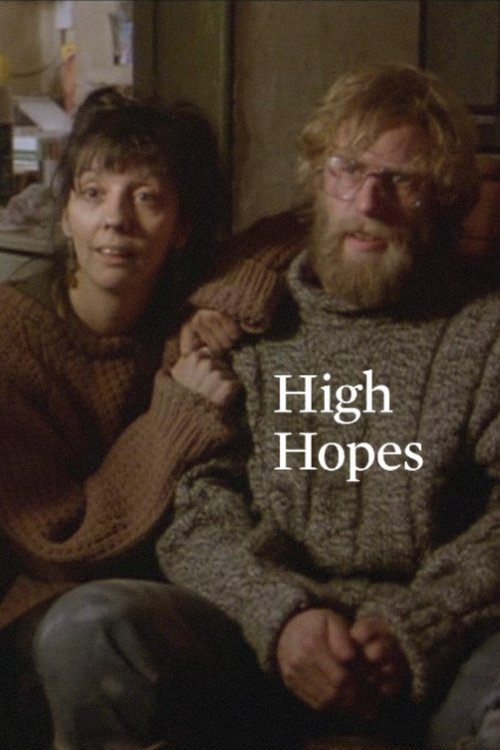
High Hopes
1989 · Mike Leigh
When you want comedy with teeth — a film that's angry about the world but still believes in kindness. Good for a night when you'd rather feel something true than be purely entertained.
What it's about
Cyril and Shirley, an unmarried working-class couple in King's Cross, London, are muddling through late-Thatcher Britain while debating whether to bring a child into it. Around them orbit Cyril's elderly mother — stranded in the last council house on a gentrifying street — his sister's ghastly nouveau-riche household, and the braying yuppie couple who've moved in next door to Mom. Everything converges on the old woman's seventieth birthday.
The experience
Funny and furious at once: the satire of the rich is broad enough to make you laugh out loud, while the scenes between Cyril, Shirley, and his fading mother sneak up on you with real tenderness. It leaves you somewhere between a grin and a lump in the throat.
Performances
Philip Davis and Ruth Sheen make Cyril and Shirley one of British cinema's most believable couples — scruffy, bickering, obviously in love — and Edna Doré is quietly devastating as the bewildered, dignified old mother.
The craft
Mike Leigh built the film through his signature method of long improvisation with actors, and the result is dialogue and behavior that feel caught rather than written. The caricature of the wealthy is deliberately cartoonish against the naturalism of the poor — a tonal gamble that becomes the film's argument.
Why it matters
This was Leigh's return to cinema after seventeen years in television, the film that relaunched him as an internationally recognized filmmaker and set the template for his later career.
Snapshot
High Hopes is Mike Leigh's return to the cinema screen after seventeen years — the film that ended the long interregnum between his debut feature Bleak Moments (1971) and a sustained movie career, and that recast him from a maker of television plays into an internationally recognized film author. Set in a contemporary London riven by the social transformations of late Thatcherism, it follows Cyril and Shirley, an unmarried working-class couple in King's Cross, as they orbit three worlds in miniature: Cyril's aging mother Mrs. Bender, marooned in the last council house on a gentrifying terrace; the braying nouveau-riche of Cyril's sister Valerie and her car-dealer husband Martin; and the wine-bar Thatcherites, Rupert and Laetitia Boothe-Braine, who have colonized the house next to Mrs. Bender. Built as a state-of-the-nation comedy that curdles repeatedly into pathos, the film uses a mother's seventieth birthday and a couple's argument about whether to have children as the small human hinges on which a much larger argument — about socialism, inheritance, and what Britain was becoming — is made to turn. It is at once one of Leigh's angriest films and one of his tenderest.
Industry & production
High Hopes is a product of the specific ecology that revived British feature filmmaking in the 1980s: the coalition of Channel 4's Film Four International, British Screen, and independent producers who financed relatively low-budget, culturally serious films with one eye on theatrical release and the other on television. Leigh had spent the 1970s and early '80s working almost entirely for the BBC and the theater — Nuts in May, Abigail's Party, Grown-Ups, Meantime — accumulating a reputation as a television dramatist rather than a filmmaker. High Hopes was produced by Simon Channing-Williams (beginning a long producing partnership with Leigh) together with Victor Glynn, under the Portman Productions banner with Film Four and British Screen backing.
The production's central industrial fact is its method, which is also a budget: Leigh's films are built through months of paid rehearsal and improvisation before a frame is shot, an approach that requires a financier willing to fund a picture with no conventional screenplay to green-light. That the money existed at all owed much to the Channel 4 model, which had already underwritten the British films — Stephen Frears and Hanif Kureishi's My Beautiful Laundrette chief among them — that proved socially engaged, modestly budgeted work could travel. Precise budget and box-office figures for High Hopes are not something I can state reliably, and I will not invent them; it was, by any measure, a small film whose commercial life ran through the art-house and festival circuit rather than mainstream exhibition.
Technology
The film was shot on 35mm color stock using conventional late-1980s equipment, and its technological profile is deliberately unassertive. Leigh and his cinematographer Roger Pratt were not interested in the glossier possibilities of the period; the film's look derives from available and naturalistic lighting, real interiors and streets, and a restrained camera. The relevant "technology," in Leigh's practice, is less photochemical than procedural — the long rehearsal process, the building of characters and situations through improvisation, is the machinery that generates the material the camera then records. In an era when British screens were increasingly shaped by the aesthetics of television film, High Hopes sits at the hinge: made with cinema stock and cinema ambitions, but by a director whose visual grammar had been formed in the television play.
Technique
Cinematography
Roger Pratt's photography is observational and composed rather than showy. Interiors — Cyril and Shirley's cramped, plant-filled flat, Mrs. Bender's dim council house, Valerie's vulgar knock-through with its status objects — are lit to read as lived-in spaces, and the camera tends to hold and watch rather than chase. Pratt uses framing to make class legible: the boxed-in quality of working-class rooms against the show-home emptiness of the aspirant middle class. The film's most quoted images are its two "elevations." Early on, Cyril and Shirley visit Karl Marx's grave in Highgate Cemetery, the camera contemplating the monument and its famous injunction to change rather than merely interpret the world. At the close, the couple take Mrs. Bender onto the roof of their building to look out over London — a literal rise to a vantage from which the whole city, and the film's argument, can be surveyed. These vertical gestures give a broadly naturalistic film two moments of frank, almost emblematic composition.
Editing
Jon Gregory's cutting serves Leigh's dramaturgy, which is structured as a series of extended encounters. Scenes are allowed to run to their full social length — the excruciating birthday party, the awful tea at Valerie's, the exchanges with the Boothe-Braines — so that comedy and discomfort accumulate in real time rather than being clipped for pace. The editing's task is largely one of orchestration across the film's parallel milieus, intercutting the three social worlds so that their contrasts register structurally, and holding the long takes steady enough that performance, not montage, carries the meaning.
Mise-en-scène / staging
This is the level at which High Hopes is richest, because Leigh's method makes décor a form of characterization. Every setting is a thesis about its inhabitants: the greenery and clutter of Cyril and Shirley's flat versus the brittle, over-decorated affluence of Valerie's home versus the tasteful, evacuating minimalism the Boothe-Braines impose on the old terrace. Objects carry weight — a cactus tended in the flat, Mrs. Bender's threadbare rooms, the props of yuppie consumption. Leigh stages class as spatial fact, and the gentrifying terrace where a council tenant and a wine-drinking couple share a party wall is the film's central image of a Britain being divided in place.
Sound
Andrew Dickson's score is spare and distinctive, leaning on small, plaintive instrumental textures rather than lush orchestration — a sound that underlines the film's melancholy without sentimentalizing it. Otherwise the soundscape is naturalistic, built from the dense, overlapping talk that is Leigh's true music: the film is carried by dialogue, by the rhythms of class idiom, by the difference between how each social group speaks. Voice — accent, vocabulary, volume — is itself a sound-design element that locates every character on the social map.
Performance
Performance is the film's engine, and its cast is drawn from Leigh's stock company of collaborators. Philip Davis's Cyril is watchful, wry, and quietly disappointed — a man whose inherited socialism has nowhere to go; Ruth Sheen's Shirley is warm, grounded, and the moral center, her longing for a child set against Cyril's political despair. Edna Doré's Mrs. Bender is a study in frail, near-silent dignity, and her scenes anchor the film's pathos. Around this core Leigh deploys sharper, more caricatured turns: Heather Tobias's Valerie is a grotesque of nouveau-riche hysteria, Philip Jackson's Martin a coarse philanderer, and Lesley Manville and David Bamber play the Boothe-Braines as almost cartoonish emblems of Thatcherite entitlement. The friction between naturalistic and caricatured registers — the tender Benders against the satirized strivers — is both the film's method and, for its critics, its central problem.
Narrative & dramatic mode
The film has no conventional plot so much as a set of converging pressures. Its dramatic mode is the tragicomedy of manners transplanted to the class politics of 1988: scenes of social embarrassment escalate until they expose real fault lines, and comedy repeatedly gives way to grief. The two structuring events — Mrs. Bender's seventieth birthday, which forces the family together, and the unresolved question of whether Cyril and Shirley will have a child — are domestic in scale but allegorical in reach, standing in for questions of legacy, care, and whether anything worth continuing can be handed on in the world the film depicts. Leigh works by juxtaposition rather than causation, cross-cutting three households so that the meaning emerges from contrast, and the film ends not with resolution but with a small, hard-won gesture of tenderness on a rooftop.
Genre & cycle
High Hopes belongs to the British "state-of-the-nation" cycle of the 1980s — films that took the measure of Thatcher's Britain through the lives of ordinary people. It is a hybrid: a social-realist drama shot through with satirical comedy, extending the lineage of the British kitchen-sink film into the specific conditions of gentrification and yuppie ascendancy. Its nearest cousins are the socially engaged British films of the decade — Frears and Kureishi's work, Ken Loach's continuing realism — but its comic-grotesque streak, its willingness to caricature, marks it as distinctly Leigh's. The gentrification plot, the council tenant besieged by incoming money, also makes it an early and unusually direct entry in what would become a recognizable subgenre of films about property, displacement, and the remaking of the inner city.
Authorship & method
High Hopes is a paradigmatic Mike Leigh film, and the fullest early demonstration on the big screen of his signature process. Leigh does not begin with a script; he assembles a cast, then works with each actor individually and in combination over months, building characters from biographical detail outward and improvising situations that are gradually shaped, structured, and finally fixed into scenes. The "written" screenplay, in effect, is the sediment of that collaborative rehearsal. This makes his key collaborators unusually central: the actors are co-creators of their roles, and the film's authorship is genuinely distributed even as its sensibility is unmistakably Leigh's.
The craft team is drawn from the collaborators who would define his cinema. Cinematographer Roger Pratt gives the film its observational, unglamorised look; editor Jon Gregory shapes the long-scene structure; and composer Andrew Dickson supplies the fragile, recurring musical motifs that became a hallmark of Leigh's late-'80s and '90s work. Producer Simon Channing-Williams's involvement here begins the producing partnership that would underwrite Leigh's subsequent features. The result is a body of authorship in which method, ensemble, and a fixed circle of craftspeople are as much the "author" as the director's name on the credit.
Movement / national cinema
The film is a landmark of the 1980s British film revival, the period in which Channel 4's funding and a cohort of serious independent filmmakers reanimated a national cinema that had seemed moribund. Within that revival Leigh represents the strand most continuous with British social realism — the documentary-inflected, class-conscious tradition running from the Free Cinema and kitchen-sink films of the late 1950s and '60s through the television plays of the 1970s. High Hopes carries that tradition's attention to working-class life and regional speech into the Thatcher era, while its improvisatory method and its comic grotesquerie give it a texture unlike anyone else working in the mode. It is British national cinema at its most explicitly engaged with the domestic political moment.
Era / period
The film is inseparable from its precise historical juncture: Britain in 1988, near the end of a decade of Conservative government, with the ideological project of Thatcherism — privatization, the celebration of enterprise and property, the erosion of the postwar social-democratic settlement — at high tide. Every element of the film is dated to this moment: the sell-off and gentrification of council housing, the ascendant figure of the yuppie, the disorientation of a Left whose language and hopes suddenly seemed residual. Cyril's visit to Marx's grave is the film's way of asking whether the socialist inheritance has any future in such a Britain, and the answer the film offers is rueful. It is a period piece about its own present, and among the sharpest cinematic portraits of the England the 1980s made.
Themes
The film's governing theme is inheritance in every sense — political, familial, generational. What does Cyril inherit from a Marxist tradition that no longer has a movement behind it, and what will he and Shirley pass on if they have a child? Around this run the film's other preoccupations: class, rendered not as abstraction but as speech, space, and manners; gentrification and displacement, embodied in Mrs. Bender's isolation on a bought-up terrace; the corrosion of solidarity by aspiration and consumption; aging, loneliness, and filial care; and the persistence of ordinary tenderness as the only available answer to political despair. The title is bitterly double-edged — "high hopes" for a better society, dwindled to modest, private hopes for kindness and continuity. Leigh refuses to resolve the tension between his satirical contempt for the strivers and his compassion for the vulnerable; the film holds both, and that unresolved doubleness is its argument.
Reception, canon & influence
High Hopes was received as a significant event — the reintroduction of Mike Leigh as a filmmaker — and traveled the international festival and art-house circuit, screening at Venice in 1988, where its critical standing was high. Edna Doré's performance as Mrs. Bender drew particular praise and won recognition on the awards circuit; I'd rather flag that the exact roster of prizes is something I can't enumerate with confidence than misstate it. Critically the film divided viewers along a fault line that would follow Leigh for the rest of his career: admirers celebrated its emotional truth and political nerve, while detractors charged that its treatment of the middle classes — the shrieking Valerie, the odious Boothe-Braines — collapsed into cruel caricature, unbalancing the naturalism of the working-class scenes. That debate about the ethics of Leigh's caricature is itself part of the film's legacy.
The influences on the film are clear: the British social-realist tradition and the Free Cinema/kitchen-sink lineage; the improvisatory theater and the television-play form in which Leigh had matured; and the comic-observational mode of English social satire, with its Chekhovian undertow of comedy shading into sorrow. Its forward influence is considerable. High Hopes relaunched Leigh's cinema and led directly to the run of features that made his international reputation — Life Is Sweet (1990), the incendiary Naked (1993), and Secrets & Lies (1996), which took the Palme d'Or — establishing improvisation-built ensemble realism as a viable and prestigious mode of authorship. More broadly, the film helped keep alive a politically engaged British realism into the 1990s and beyond, and its portrait of gentrification, of a council tenant hemmed in by incoming wealth, reads now as an early, prescient entry in a cinema of urban displacement that has only grown more urgent since.
A Deleuzian reading
Two people stand in front of a big stone head in Highgate Cemetery.
The full Deleuzian reading of High Hopes →
Reception
Warmly received in 1988–89 — it took the FIPRESCI critics' prize at Venice and landed on year-end lists — and it's now read as the film that kicked off Mike Leigh's great run, one of the definitive portraits of Thatcher's Britain even if Naked and Secrets & Lies later stole its thunder.
How High Hopes was received, from release to now →
Influences: the films it descends from and the films it influenced
- Bleak Moments (1971) — Leigh's first feature is the original proof of the build-from-biography-outward improvisation-into-fixed-scenes method whose mature big-screen sediment is High Hopes, down to the excruciating long-held silences played for tragicomic discomfort.
- Abigail's Party (1977) — This TV play established Leigh's split register — naturalistic pathos in the have-nots set against grotesque aspirational-class caricature — the exact tonal machine High Hopes runs through Valerie versus Cyril and Shirley.
- Nuts in May (1976) — Its finely observed comedy of a self-righteous couple's manners and props anticipates High Hopes's use of decor and behavioral tics as class characterization built up through rehearsal detail.
- Kes (1969) — Loach's patient, unglamorised observational framing of working-class domestic and neighborhood space is the documentary-inflected look Roger Pratt extends in High Hopes's council-flat interiors.
- Saturday Night and Sunday Morning (1960) — The kitchen-sink template of on-location shooting and class-legible framing of the industrial working class supplies the social-realist grammar High Hopes inherits and updates for Thatcher's London.
- A Taste of Honey (1961) — Its Free Cinema practice of shooting ordinary lives in real streets and rooms, letting environment carry the drama, is the observational-naturalist ancestor of High Hopes's method.
- The Loneliness of the Long Distance Runner (1962) — Richardson's fusing of social-realist detail with a bristling working-class political consciousness prefigures the way High Hopes lets Cyril's dissatisfaction be both character and state-of-the-nation argument.
- Faces (1968) — Cassavetes pioneered character built from actors' behavioral improvisation rather than plot, letting scenes run long past their dramatic 'point' — the distributed, actor-as-co-author authorship Leigh formalizes into his rehearsal process.
- Meantime (1983) — Leigh's first theatrical feature carries forward the Meantime method intact — co-created characters, Andrew Dickson's sparse score, plotless observation of class — now scaled to cinema.
- Life Is Sweet (1990) — Leigh's immediate follow-up reuses the same distributed-rehearsal ensemble craft and mixed naturalistic/caricature register, again scoring domestic tragicomedy with Andrew Dickson's fragile recurring motifs.
- Naked (1993) — It pushes High Hopes's improvisation-built ensemble and long-scene structure to an incendiary extreme, keeping Dickson's plaintive score and observational camera while abandoning the earlier film's tenderness.
- Secrets & Lies (1996) — The Palme d'Or winner is the fullest flowering of the same method — months of individual actor rehearsal fixed into long confrontation scenes — that High Hopes first demonstrated at feature scale.
- Vera Drake (2004) — It extends High Hopes's period-and-class specificity built entirely through the actors' undisclosed backstory improvisation, with Dick Pope's framing reading social position through room, dress and gesture.
- Nil by Mouth (1997) — Oldman builds a South London family drama from lived-in, improvisation-feeling performance and handheld observational framing, inheriting Leigh's ethic of character truth accreted from behavioral detail.
- This Is England (2006) — Meadows works Leigh-style from extensive improvised rehearsal with a semi-repertory ensemble, and sets his tragicomedy explicitly in the Thatcher-era working class that High Hopes anatomized.
- Fish Tank (2009) — Arnold shoots a council-estate life with untrained leads and patient observational naturalism, framing constrained domestic space to make class inescapably visible — the cinematographic values High Hopes helped keep alive.
- Riff-Raff (1991) — Loach carries the same politically engaged British realism into the 1990s, using regional non-actors and semi-improvised location dialogue to make casualised labor legible the way High Hopes maps council-tenant precarity.
- Ratcatcher (1999) — Ramsay renews British social realism with the same commitment to non-professional performance and environment-as-meaning, letting decor and derelict space carry the sociology that High Hopes reads through interiors.
Similar films
- Secrets & Lies (1996) — influence & lineage
- Bleak Moments (1971) — influence & lineage
- Vera Drake (2004) — influence & lineage
- Naked (1993) — influence & lineage
- Meantime (1983) — shared sensibility
- Life Is Sweet (1991) — shared sensibility
- Howards End (1992) — shared sensibility
- Sweet Charity (1969) — shared sensibility