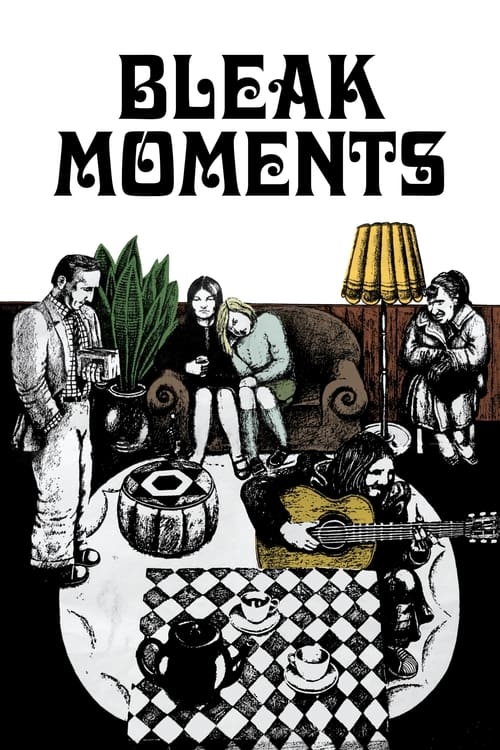
Bleak Moments
1971 · Mike Leigh
For when you're in a patient, contemplative frame of mind and want a film about loneliness that treats it honestly — a challenge, not a comfort watch, but a deeply humane one.
What it's about
Sylvia, a South London secretary, keeps house for her intellectually disabled sister while tentatively courting a schoolteacher so shy he can barely finish a sentence. Around them: a gentle hippie renting the garage, a chattering workmate, cups of tea, offered sherry, and long silences in which everyone fails to say the one thing that might change their lives.
The experience
Slow, quiet, and almost unbearably precise — the tension comes not from events but from watching people ache to connect and miss by inches. It's often deadpan funny, in a wincing way, and it stays with you like a bruise.
Performances
Anne Raitt's Sylvia is a marvel of contained performance — dry, watchful, letting you read whole inner lives in a raised eyebrow or a too-long pause. A date-night scene in a restaurant is an agonizing small masterpiece of two actors saying almost nothing.
The craft
Mike Leigh's first feature, built through his soon-to-be-famous method of developing characters with the actors through long improvisation before a single scene is shot. The result is dialogue and silence that feel eavesdropped rather than written, filmed with plain, unblinking patience that makes every hesitation land.
Why it matters
It launched Mike Leigh's career and inaugurated the improvisation-based working method behind five decades of British cinema's most acute character studies — a founding document of a whole strand of realist filmmaking.
Snapshot
Bleak Moments is Mike Leigh's first feature film, a quiet, agonisingly precise study of inarticulacy and emotional paralysis in the suburbs of South London. Its center is Sylvia, an office worker who keeps house for her intellectually disabled younger sister Hilda; around them orbit a tongue-tied schoolteacher whom Sylvia tentatively courts, a gentle hippie who rents the garage, and a chattering, oblivious colleague. Almost nothing "happens" in the conventional sense — there are tea-times, a visit to a Chinese restaurant, a glass of sherry offered and declined, long silences in which people fail to say what they mean — yet the film draws an extraordinary tension from withheld feeling and missed connection. Adapted by Leigh from his own stage piece, it inaugurated the working method that would define his career: characters built collaboratively with actors over months of improvisation and rehearsal, then fixed into a tightly scripted shape. Received with bafflement by some and acclaim by others, it won major festival prizes, briefly announced a singular new talent, and then — owing to the film's commercial fate and the inhospitality of early-1970s British features — sent Leigh into nearly two decades of television work before he returned to the cinema. It now reads as both a fully formed first statement and the seed of everything that followed.
Industry & production
Bleak Moments emerged from the margins of a British film industry in steep contraction. By the early 1970s American studio money, which had fueled the British "New Wave" and the Swinging-Sixties boom, was withdrawing, and the space for low-budget, non-commercial features had narrowed sharply. Leigh's film was made possible by an unusual alliance: Memorial Enterprises, the production company run by the actor Albert Finney and the producer Michael Medwin, and the British Film Institute's Production Board, which existed precisely to back work that the commercial sector would not. The picture grew directly out of a stage production Leigh had mounted at the Open Space Theatre in London in 1970; the screen version was developed and shot on a tiny budget — the film is routinely described as having been made for a sum in the very low tens of thousands of pounds, financed jointly by Memorial and the BFI. (Exact figures vary between sources and should be treated with caution.)
The production was, by Leigh's own later accounts, slow, under-resourced and shot over an extended period, conditions that suited a method requiring lengthy character development rather than a conventional fast shoot. The commercial release was minimal; the film reached audiences chiefly through festivals and specialist screenings. Its industrial significance is partly a matter of what it did not lead to: despite its festival success, Leigh found no path to a follow-up feature, and he turned to the BBC and other television outlets, where across the 1970s and early 1980s he made the plays — Nuts in May, Abigail's Party, Grown-Ups, Meantime and others — that built his reputation. He would not direct another theatrical feature until High Hopes in 1988. Bleak Moments thus sits at a hinge point: a product of the BFI's patronage of difficult cinema, and a casualty of an industry with nowhere to put it.
Technology
Technologically the film is modest and of its moment: shot on 35mm color stock with the relatively unobtrusive equipment available to a low-budget early-1970s production, using available and simple practical lighting to render cramped domestic interiors. There is no technological showmanship — no elaborate camera rigs, optical effects or post-production trickery — and the film's aesthetic deliberately runs against the grain of contemporary stylistic fashion. What is notable is the absence of the handheld, vérité restlessness that low-budget realism of the period often reached for; Leigh and his cinematographer chose instead a composed, static, almost theatrical stillness. The technology serves a program of restraint: the means are kept invisible so that attention falls entirely on faces, rooms and the unbearable passage of real-feeling time.
Technique
Cinematography
The photography, by the Iranian-born cinematographer Bahram Manocheri, is one of the film's defining achievements. The camera is predominantly still, the framing frontal and formal, the shots held far longer than convention allows. Interiors are observed in muted, drab color — browns, grays, the dim light of net-curtained front rooms — that gives the suburban settings a quality of genteel imprisonment. Characters are frequently placed at the edges of the frame, isolated within doorways and against walls, or held in static two-shots that emphasize the physical and emotional distance between them. The refusal to cut in for reassuring close-ups at moments of feeling forces the viewer to sit, as the characters do, inside discomfort. This is realism pushed toward the formal and the painterly rather than the documentary; the stillness is expressive, turning ordinary rooms into arenas of quiet suffering.
Editing
The cutting follows from the shooting: sparing, patient, content to let scenes run well past the point at which a conventional film would relieve the tension. Editing rhythm is dictated by behavior rather than plot — a pause is allowed to become excruciating, a silence permitted to expand until it acquires almost physical weight. The comedy and the pathos both depend on this withholding; the film's signature effect is the held beat in which a character fails to speak, and the edit's refusal to rescue them. The specific editing credit on the film is not always consistently recorded across sources, and I won't assert a name I can't verify; what matters technically is the governing principle of duration, the decision to make the audience feel time rather than have it managed for them.
Mise-en-scène / staging
Staging is where the film's theatrical origins are most legible and most productively transformed. Leigh blocks his actors in real, lived-in suburban spaces — the front room, the kitchen, the office, the dim restaurant — and choreographs the small physical business of English social ritual: the making of tea, the offering of a chair, the management of a sherry glass. The famous sherry sequence, in which Sylvia and her teacher visitor founder on the simple act of pouring and drinking, is a masterclass in staging awkwardness as drama. Objects and the etiquette around them become the vocabulary of feelings that cannot be spoken. The compositions trap people in their settings; the décor — modest, dated, scrupulously observed — is itself characterization, mapping a world of lower-middle-class propriety and constraint.
Sound
The soundscape is spare and naturalistic, built largely from the ambient quiet of domestic interiors against which every awkward word lands with disproportionate weight. There is little non-diegetic music; what music there is tends to arise within the scene — the hippie lodger Norman's guitar, the noises of the world outside. The film leans heavily on silence as an active element, using the absence of sound to make pauses unbearable and to expose the characters' inability to fill the space between them with words. Sound design here is essentially a discipline of restraint, refusing the cushioning that a score would provide.
Performance
Performance is the film's foundation, and the ensemble is remarkable. Anne Raitt as Sylvia gives a performance of contained, watchful intelligence — a woman of evident inner life held rigid by responsibility and reticence, her wit and longing surfacing only in glances and small ironies. Sarah Stephenson plays her sister Hilda with care and without sentimentality. Eric Allan's schoolteacher, Peter, is an indelible study in repression, so locked into his own awkwardness that ordinary intimacy becomes impossible. Mike Bradwell brings a loose, gentle counterpoint as Norman the lodger, and Joolia Cappleman's relentlessly cheerful workmate Pat supplies a comedy of oblivious chatter that throws the central silences into relief. These are not "showy" performances but deeply inhabited ones, the fruit of Leigh's long developmental process, in which actors construct their characters from the inside before a frame is shot.
Narrative & dramatic mode
Bleak Moments dispenses almost entirely with plot. It is structured not as a story with rising action and resolution but as a series of observed encounters — moments, as the title insists — that accumulate into a portrait of lives stalled in quiet desperation. The dramatic mode is one of behavioral realism shaded into a comedy of embarrassment: situations are funny and painful at once, the humor arising from social agony rather than from wit or incident. Tension is generated by what is not said and not done; the drama lives in subtext, in the gap between what characters feel and what they can express. This is a cinema of the unspoken, where the smallest gesture — an offered drink refused, a hand not taken — carries the freight that dialogue cannot. The refusal of catharsis is deliberate: the film ends without the relief of change, leaving its characters where it found them, which is precisely its point.
Genre & cycle
Nominally a comedy-drama, the film belongs to no tidy genre. It can be placed within a British tradition of social realism, but it pointedly departs from the kitchen-sink cinema of the early 1960s: where that movement was muscular, angry and event-driven, Bleak Moments is still, interior and almost actionless. It is better understood as an early instance of the "comedy of discomfort" that Leigh would make his own and that later filmmakers would inherit — a mode in which excruciating social awkwardness is the primary dramatic and comic engine. As the first feature in Leigh's body of work, it inaugurates a personal cycle more than it joins an existing one; its closest kin are his own subsequent films and television plays, with which it shares method, milieu and a fascination with the inarticulate.
Authorship & method
The film is the origin document of Leigh's authorship. Its method — actors developing characters over a long period of improvisation and research before a structured screenplay is fixed and shot — is here arriving fully formed, and it accounts for the film's texture of lived truth. Leigh is the sole credited writer and director, but his authorship is, characteristically, collaborative at the level of character creation: the performances are co-authored by the actors who built them. The cinematography of Bahram Manocheri is the decisive technical collaboration, supplying the still, composed visual language that distinguishes the film from documentary-style realism. The film deliberately eschews a conventional musical score, so there is no composer-authorial signature of the kind one might look for elsewhere; what unscored music exists is diegetic. The editorial and other technical credits are more modestly documented, and I'll refrain from attributing names I cannot confirm. The essential authorial fact is that Bleak Moments establishes Leigh's lifelong concerns and his unique process in a single, uncompromising stroke.
Movement / national cinema
Bleak Moments is a distinctly British film and an important, if marginal, entry in British national cinema. It stands at the tail of the social-realist lineage that runs from Free Cinema and the British New Wave through to the television drama of the 1960s and 1970s, but it pushes that lineage in a new, more austere and more psychologically interior direction. It is not part of any organized movement; rather, it is a singular work made under the patronage of the BFI's experimental arm at a time when British features had little room for such projects. Its truest affiliation is with the strain of British art that finds tragedy and comedy in lower-middle-class manners, repression and the suburbs — a strain Leigh would do more than anyone to extend into the cinema.
Era / period
The film is saturated in the texture of early-1970s suburban England: a world of net curtains, sherry and reticence, of social conventions observed and feelings suppressed, photographed in the drab color palette of the period. It captures a particular post-Sixties moment in which the energies of the previous decade — embodied glancingly by Norman the hippie lodger — sit uneasily beside an older, repressed gentility that the central characters cannot escape. As a production it belongs to the lean years of British cinema's commercial collapse, and its very existence depended on the non-commercial funding structures of its time. It is, in both content and circumstance, a document of England at the start of the 1970s.
Themes
The film's great theme is inarticulacy — the human failure to say what one feels, and the loneliness that failure produces. Repression, in the specifically English, class-inflected key of suppressed emotion and rigid propriety, runs through every scene. Around it cluster loneliness and isolation; the burden and the love of caring for a dependent relative; the quiet desperation of ordinary, constrained lives; and the comedy of social embarrassment, which Leigh treats not as a diversion from his serious concerns but as their truest expression. There is compassion in the film's gaze — it never mocks its characters from above — and an unblinking honesty about the smallness and difficulty of their lives. The "bleakness" of the title is real, but it is shot through with tenderness and with a humor that makes the bleakness bearable and human.
Reception, canon & influence
On release, Bleak Moments divided viewers: its slowness and refusal of incident alienated some, while others recognized an original and serious talent. Its most consequential early champion was the American critic Roger Ebert, who saw it at the Chicago International Film Festival and praised it in strong terms, helping to secure its reputation; the film took the top prize at Chicago and won the Golden Leopard, the grand prize at the Locarno Film Festival, in 1972. These honors announced Leigh as a major new director — and yet, tellingly, they did not translate into the chance to make another feature, a gap that says much about the British film economy of the era.
The influences on the film are several and worth naming. Leigh's grounding in theater and his improvisatory rehearsal practice were decisive; so was the broader British social-realist tradition, against which he both worked and reacted. A strain of European art cinema's patience and attention to the texture of ordinary time is discernible in the long takes and the refusal of plot, and the comedy of social agony connects to a deep vein in British humor. Bleak Moments synthesizes these into something new.
Its legacy, looking forward, is large. Most directly, it established the working method and thematic territory that Leigh would pursue across a celebrated career — from his 1970s and 1980s television plays through High Hopes, Life Is Sweet, Naked, the Palme d'Or-winning Secrets & Lies, Vera Drake and beyond. More widely, its model of building cinema from deeply developed character and of mining excruciating social awkwardness for both comedy and pathos has rippled through later British film and television, informing a whole tradition of the "comedy of embarrassment." As a debut it is unusually complete: a film that already knows exactly what it is, and that contains, in compressed form, the artistic project of one of Britain's most important filmmakers.
A Deleuzian reading
Watch the sherry.
The full Deleuzian reading of Bleak Moments →
Reception
Barely released in 1971 and seen by almost no one, it quietly won top prizes at Locarno and Chicago — and decades later, helped by a BFI restoration for its 50th anniversary, it's been reclaimed as one of the great British debuts.
How Bleak Moments was received, from release to now →
Influences: the films it descends from and the films it influenced
- Saturday Night and Sunday Morning (1960) — Establishes the British New Wave's working-class milieu and location-shot social realism that Leigh inherits as raw material but reacts against by stripping out its plotted melodrama and incident.
- A Taste of Honey (1961) — Shelagh Delaney's inarticulate, emotionally stranded English characters model the depiction of loneliness and repression through hesitant, half-spoken kitchen-sink dialogue that Leigh pushes toward near-total inexpression.
- This Sporting Life (1963) — Anderson's emotionally blocked, inarticulate protagonist demonstrates British realism turned inward on psychological paralysis rather than outward incident, a closing-off Leigh adopts.
- L'Avventura (1960) — Pioneers duration-over-plot and 'dead time' — extended takes of characters in unfilled silence — and the structural refusal of narrative resolution that underwrites Leigh's refusal of catharsis.
- Faces (1968) — The method of actors building characters through extended improvisation to reach a texture of lived truth is the direct precedent for Leigh's rehearsal-derived performances, though Cassavetes shoots them handheld where Leigh holds still.
- Late Spring (1949) — Ozu's static, frontal, low-set framing and patient domestic stillness anticipate Manocheri's composed visual language, which separates the film from jittery documentary realism.
- A Kind of Loving (1962) — Inherits the cycle's patient, behavior-led attention to repression and inarticulate longing in cramped domestic settings, advancing the naturalistic-ensemble realism through improvisational development.
- Abigail's Party (1977) — Leigh's own follow-on that pushes the same improvisation-built characters fully into the comedy of social agony, codifying the excruciating drinks-party awkwardness latent in Bleak Moments.
- Naked (1993) — The improvisation-into-fixed-screenplay method matured, demonstrating that the working process arriving fully formed here scales to verbally explosive material.
- Secrets & Lies (1996) — Extends the long-take, ensemble-inhabited scene to its limit in the unbroken café two-shot, where the same buried inarticulacy finally breaks into emotional release.
- Happiness (1998) — Inherits the 'comedy of embarrassment' — sustained, unrelieved social awkwardness played for simultaneous laughter and pain — that Leigh's model seeded.
- Fish Tank (2009) — Carries forward British social realism built from a deeply inhabited, inarticulate working-class character developed through performance, the tradition Leigh's method helped reshape.
- Life Is Sweet (1991) — Leigh's feature debut establishes the entire method later used here — casting actors who build characters through months of one-on-one biographical improvisation before any scene is scripted.
- Vera Drake (2004) — Leigh's own origin point for the screenplay-less method: characters built through months of one-on-one improvisation before any scene is fixed.
- Another Year (2010) — Leigh's debut established the devised method's signature grammar of excruciating silence and thwarted teatime conversation that Another Year refines into elegy.
- High Hopes (1989) — Leigh's first feature is the original proof of the build-from-biography-outward improvisation-into-fixed-scenes method whose mature big-screen sediment is High Hopes, down to the excruciating long-held silences played for tragicomic discomfort.
- Hard Truths (2024) — Leigh's first feature established the device Hard Truths runs on — the held, unbroken two-shot in which a conversation is allowed to fail and die on camera, so that inarticulacy becomes the scene's actual event rather than its obstacle.
- Distant Voices, Still Lives (1988) — Shares the static frontal tableau, muted palette, English emotional repression, plotless vignette construction and reliance on diegetic-only music in place of a nondiegetic score.
- The Match Factory Girl (1990) — Builds comedy of discomfort and pathos from a near-silent, repressed, inarticulate protagonist held in static muted frames, the Finnish cousin of Leigh's deadpan stillness.
- Songs from the Second Floor (2000) — Locks the camera into rigorously static, frontal, theatrically staged tableaux that mine social discomfort from held stillness, an extreme formalization of Leigh's composed-frame approach.
- Stranger Than Paradise (1984) — Constructs cinema from static, frontal long takes and plotless deadpan vignettes where duration and dead air, not story, carry the meaning.
- Wendy and Lucy (2008) — Practices the same duration-over-plot minimalism with no nondiegetic score and a refusal of catharsis, observing an undramatized ordinary life in muted, patient framing.
Similar films
- Secrets & Lies (1996) — influence & lineage
- Naked (1993) — influence & lineage
- Distant Voices, Still Lives (1988) — influence & lineage
- Wendy and Lucy (2008) — influence & lineage
- Another Year (2010) — shared sensibility
- Life Is Sweet (1991) — shared sensibility
- Hard Truths (2024) — shared sensibility
- Brief Encounter (1945) — shared sensibility
All the films related to Bleak Moments →