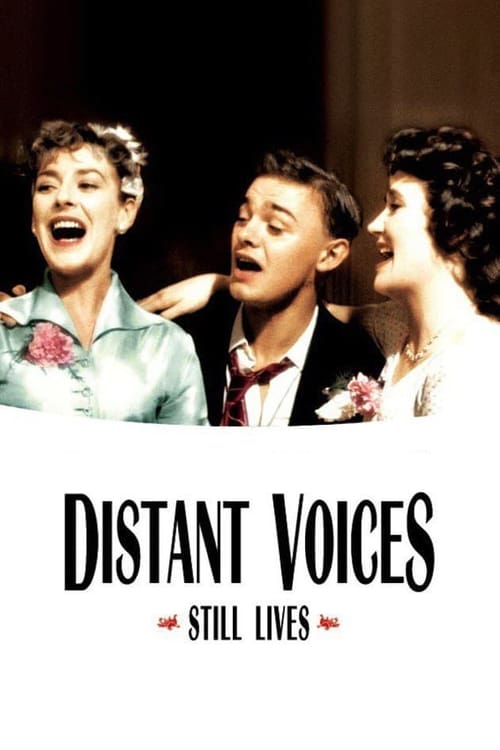
Distant Voices, Still Lives
1988 · Terence Davies
For when you want a film that aches — one to watch quietly and carry around for days. It's emotionally heavy but formally gentle, closer to an elegy than an ordeal.
What it's about
A working-class Catholic family in Liverpool across the 1940s and 50s, seen through the occasions that punctuate their lives: weddings, christenings, funerals, and nights of singing in the pub. At the center is a father whose sudden violence shadows his wife and three children long after the events themselves, and the grown siblings who carry that damage into their own marriages — held together, always, by the songs everyone knows by heart.
The experience
Sorrowful and luminous in equal measure — brutality and tenderness sit side by side, and the communal singing keeps lifting the film from grief into something like grace. It moves by association rather than story, like leafing through a family album where every photograph hums.
Performances
Pete Postlethwaite is terrifying and pitiable as the father, capable of switching registers in a single look, and Freda Dowie gives the mother a stillness that says everything her lines don't.
The craft
Davies composes memory itself: static, painterly tableaux, slow drifts down hallways, and a soundtrack of pub singalongs and period songs that does the narrative work dialogue won't. Assembled from two films shot two years apart, it runs barely eighty-five minutes yet feels like a whole family history. The sound design and songs deserve good speakers.
Why it matters
A landmark of British cinema that announced Terence Davies as the great poet of working-class memory, and a model for autobiographical filmmaking built from fragments rather than plot.
Snapshot
Distant Voices, Still Lives is Terence Davies's autobiographical portrait of a working-class Catholic family in Liverpool across the 1940s and 1950s, structured not as a story but as an anthology of memory. Assembled from two films shot roughly two years apart — Distant Voices (completed 1986) and Still Lives (completed 1988) — and released together as a single feature of around eighty-five minutes, it dispenses with linear plot in favor of associative tableaux organized by ritual: weddings, funerals, christenings, and above all the communal singing of popular songs in pubs and parlors. At its center stands a violent, unpredictable father (Pete Postlethwaite) whose cruelty shadows the family long after his death, and a mother (Freda Dowie) and three grown children who metabolize that trauma through endurance and song. The film is widely regarded as a landmark of British art cinema and one of the most formally radical treatments of memory and family in the medium.
Industry & production
The film is a product of the specific funding ecology of 1980s Britain, in which the British Film Institute Production Board and the newly influential Channel Four Films underwrote low-budget, artistically ambitious work that the commercial industry would not touch. The two halves were financed and produced separately: Davies made Distant Voices first, and only after its festival success secured the resources to complete Still Lives, the two then exhibited as one feature. This staggered production accounts for the film's diptych structure and for subtle shifts in texture between its parts. German television (ZDF) is generally credited among the backers, reflecting the cross-European co-financing typical of BFI/Channel Four projects of the period. Jennifer Howarth produced.
The budgets were small even by the standards of British independent cinema, and the production drew on non-star casting and Liverpool locations and interiors reconstructed to Davies's exacting memory. That the film reached international audiences at all owes to the festival circuit rather than conventional distribution: it announced itself at Cannes and Locarno in 1988 before art-house release. The record on precise budget figures and grosses is thin, and I will not invent numbers; what is certain is that this was a marginal, subsidy-dependent production whose reputation vastly exceeded its commercial scale.
Technology
Technologically the film is unshowy but deliberate. It was shot on 35mm color stock, and its most consequential technical decision is chromatic: the image is drained toward sepia, amber, and muted browns, evoking hand-tinted and faded family photographs rather than the saturated palette of contemporary cinema. This desaturation was achieved through lighting, art direction, and laboratory processing rather than digital means — the film predates digital color grading entirely. Davies has spoken of wanting the look of a family album, and the color timing serves that memorial function. The sound is likewise a constructed artifact: recorded singing, period gramophone recordings, and ambient effects are layered and mixed to foreground the human voice. There is no reliance on optical or mechanical spectacle; the technology is entirely in service of a photographic and acoustic idea of remembrance.
Technique
Cinematography
The cinematography — credited across the two parts to William Diver and Patrick Duval — is built on stillness. Davies favors static, frontally composed shots, frequently arranging figures in symmetrical, almost devotional tableaux: family members ranged along a staircase, gathered at a table, or lined against a wall as if posed for a portrait. The camera moves rarely, and when it does the movement is slow, formal, and motivated by feeling rather than action — a measured track or a deliberate craning motion that lends everyday domestic space a liturgical weight. Because I cannot verify with certainty which cinematographer shot which half, I attribute the visual scheme to the collaboration as a whole. The compositions consistently subordinate individual psychology to the group and to the architecture of the home, so that rooms, doorways, and the recurring image of the terraced-house frontage become as expressive as any face.
Editing
Editing, by William Diver, is the film's true grammar. In place of narrative causality, Davies and Diver cut by association — a song, a gesture, a phrase of dialogue triggers a leap across years, between the living and the dead, between joy and terror. Slow dissolves are used insistently to bleed one memory into another, refusing clean temporal boundaries and enacting the way recollection layers rather than sequences. A wedding may dissolve into a funeral, a moment of tenderness into one of violence, so that the film's structure reproduces the involuntary, non-chronological logic of memory itself. This associative editing is the single most imitated feature of Davies's style.
Mise-en-scène / staging
The staging is theatrical in the best sense: figures are blocked in stable, frieze-like arrangements, and the pub and parlor become stages for performance. Davies reconstructs a vanished working-class interior world — patterned wallpaper, mantelpieces, the pub snug — with obsessive fidelity, and then stills it into tableau. The recurring motif of people singing together, facing outward, turns social ritual into direct address. Domestic violence erupts within these carefully composed frames, the very orderliness of the mise-en-scène making the father's brutality more shocking by contrast.
Sound
Sound is arguably the film's most original element. There is essentially no conventional non-diegetic score; instead the soundtrack is woven from popular songs of the 1940s and 1950s and from hymns, performed communally by the characters and supplemented by period recordings. Singing functions as the family's language of feeling — a means of solidarity, consolation, and survival that the abusive father cannot fully control. The layering of voices, the acoustic of the pub, and the emotional charge of standards and sentimental ballads carry meaning that dialogue withholds. I will refrain from listing a definitive tracklist beyond noting that the film draws on the popular standards and hymns of its period, since I cannot confirm every specific title.
Performance
Performances are restrained and frontal, tuned to Davies's tableau aesthetic rather than to naturalistic psychology. Pete Postlethwaite's father is the film's engine of dread — coiled, capricious, capable of tenderness and terror within the same scene — in a performance often cited as a breakthrough for the actor. Freda Dowie's mother embodies patient endurance, and the grown children (played by Angela Walsh, Lorraine Ashbourne, and Dean Williams among the principal siblings) register feeling through stillness and song rather than dramatic outburst. The ensemble works less as individuated characters than as a chorus of remembrance.
Narrative & dramatic mode
The film is essentially anti-narrative. It has characters, a milieu, and a governing situation — a family under and after the reign of a violent father — but no plot in the conventional sense of goal, obstacle, and resolution. Its dramatic mode is elegiac and lyric rather than dramatic: it proceeds by mood, motif, and ritual repetition. Time is treated as simultaneous and recursive; the dead coexist with the living in memory. Emotion is organized around set-pieces of collective feeling — the wedding, the funeral, the pub singalong — that recur and rhyme. This places the film closer to poetry or music than to storytelling, and audiences accustomed to narrative momentum often experience it as a succession of intensely felt fragments.
Genre & cycle
Nominally a drama with strong musical elements, the film resists genre placement. It is not a musical in the Hollywood sense, though Davies's love of the Hollywood musical and of communal song plainly informs it; nor is it a conventional family melodrama, though it draws on melodrama's emotional register. It belongs most naturally to a cycle of poetic, memory-driven autobiographical cinema, and within Davies's own body of work it forms a clear pair with The Long Day Closes (1992), his subsequent Liverpool memoir. Its fusion of domestic realism with formal abstraction sets it apart from the dominant British realist cycle of its moment.
Authorship & method
This is an intensely authored film, and its authorship is inseparable from autobiography. Davies wrote and directed it, drawing directly on his own childhood in a large Liverpool Catholic family and on the memory of his own violent father, who died when Davies was young. His method was one of reconstruction and distillation: rather than dramatize events, he sought to recover their emotional residue, staging remembered feeling with painterly precision. Key collaborators shaped that vision — editor William Diver, whose associative cutting realized Davies's conception of memory, and the cinematographers Diver and Patrick Duval, who gave the film its faded-photograph palette. Crucially, Davies eschewed an original composer, treating pre-existing popular song as the film's score and thereby making the soundtrack itself an authorial statement about how working-class culture remembers and consoles itself. The precise credits for production design across the two separately shot halves are not something I can state with confidence, and I flag that gap rather than fill it.
Movement / national cinema
The film is a touchstone of 1980s British art cinema, produced within the Channel Four/BFI system that also enabled figures such as Peter Greenaway and Derek Jarman. Yet Davies stands apart from the two dominant strands of British filmmaking of the era. He rejects the social realism associated with the kitchen-sink tradition and with contemporaries like Ken Loach — though he shares their working-class subject matter — in favor of a modernist, poetic approach to that same material. And he is warmer, more emotionally direct, than the arch formalism of Greenaway. Distant Voices, Still Lives thus occupies a singular position: rooted in the specifics of English working-class life, but rendered through an avant-garde vocabulary of tableau, dissolve, and song that has few precedents in British cinema.
Era / period
The film operates across two temporal registers. Its diegetic world is the Liverpool of the Second World War and its austere aftermath — the 1940s and 1950s of rationing, terraced housing, the pub, and the Catholic Church — recreated with documentary fidelity to texture if not to chronology. Its moment of production, however, is Thatcher-era Britain of the mid-to-late 1980s, and the film can be read as an act of cultural recovery aimed at a vanishing working-class world, made possible precisely by the public-subsidy funding structures then under political pressure. This doubled temporality — a 1980s film mourning a 1950s world — is central to its elegiac force.
Themes
The film's abiding subject is memory itself: its non-linearity, its fusion of pain and tenderness, its transmission of trauma across a family. Domestic violence and patriarchal terror sit at its core, embodied in the father whose brutality structures the family's inner life even after death. Against that terror the film sets the endurance of women — the mother above all — and the sustaining power of communal culture: song, ritual, and shared feeling as instruments of survival. Catholicism, with its liturgy, guilt, and consolation, permeates the imagery. Nostalgia is present but complicated; Davies refuses to sentimentalize a past that contained real cruelty, holding joy and horror in the same frame. Time, mortality, and the coexistence of the living and the dead recur as almost metaphysical concerns.
Reception, canon & influence
Critical reception was strong and quickly canonizing. The film was honored on the festival circuit in 1988, including recognition from the international critics (FIPRESCI) at Cannes and a top prize at Locarno, and it drew fervent admiration from critics who saw in it a genuinely original cinematic voice. It has since been regularly cited among the finest British films, appearing on critics' lists and in institutional canons, and is frequently paired with The Long Day Closes as the summit of Davies's achievement. I note that specific poll placements and award citations should be checked against the record, but the broad fact of its canonical standing is well established.
Looking backward, the influences on the film are cultural as much as cinematic. Davies drew on the Hollywood musical and on the emotional grammar of American melodrama, on Catholic liturgy, and on the popular song and communal singing of his own upbringing; his sensibility has affinities with the lyric modernism of poets and with the memorial impulse of family photography. Looking forward, the film's associative, dissolve-driven memory structure and its use of pre-existing popular song as emotional architecture have influenced subsequent poetic and autobiographical filmmakers, and it remains a reference point for any cinema that seeks to render memory formally rather than merely to narrate the past. Within Davies's own long career — extending through The Neon Bible, The House of Mirth, Of Time and the City, The Deep Blue Sea, Sunset Song, A Quiet Passion, and Benediction, up to his death in 2023 — it stands as the foundational statement of his art, the film in which his unmistakable method of stillness, song, and remembered feeling first achieved full expression.
A Deleuzian reading
A family lines the staircase of a Liverpool terraced house, faces turned outward, and someone begins to sing.
The full Deleuzian reading of Distant Voices, Still Lives →
Reception
Acclaimed straight out of the gate — it took the FIPRESCI prize at Cannes and the Golden Leopard at Locarno in 1988 — yet stayed a critics' treasure rather than a public one for decades. The BFI's restoration and Davies's death in 2023 turned quiet reverence into open canonization, and it's now routinely called one of the greatest British films ever made.
How Distant Voices, Still Lives was received, from release to now →
How to watch Distant Voices, Still Lives: what to notice on a first viewing
- Watch how still the camera stays during family gatherings. Davies frames the family in symmetrical, frontal tableaux, staircases, tables, walls, holding the shot instead of moving in for reaction or detail. The stillness treats the family as a group portrait first, individuals second.
- Listen for group singing instead of any film score. There's no conventional underscore; instead the family and neighbors sing pub and hymn standards together, and the songs carry the feeling the dialogue withholds. Singing is this family's language for what they can't otherwise say out loud.
- Notice when one scene dissolves slowly into a different year. Editor William Diver bleeds one memory into the next with slow dissolves, a wedding sliding into a funeral, tenderness into fear, without announcing the jump. The editing is built to feel like memory itself, layered rather than told in order.
- Watch people line up and face outward together. Figures are repeatedly arranged along a staircase or wall in stable, frieze-like rows, posed almost like a photograph rather than blocked for conversation. The arrangement makes ordinary rooms feel almost like a place of ritual.
- Watch for the drained, amber-and-brown color of every scene. The image is pushed toward sepia and muted brown throughout, so the whole film looks like it's lit from inside an old photograph. The color itself tells you that you're watching something already remembered, not happening now.
The whole guide to watching Distant Voices, Still Lives, with the keys for a rewatch →
Influences: the films it descends from and the films it influenced
- Listen to Britain (1942) — The direct model for Davies's soundtrack-as-score: associative montage binding scenes of communal British life through diegetic popular song and ambient sound rather than any narrating voice.
- Meet Me in St. Louis (1944) — Davies lifts the Hollywood musical's device of the family gathered around domestic communal song and seasonal ritual as the emotional architecture organizing remembered life.
- All That Heaven Allows (1955) — Supplies the melodramatic grammar Davies distills — domestic interiors composed as expressive tableaux where repressed feeling is carried by staging, color and framing instead of action.
- Tokyo Story (1953) — Frontal, symmetrical, static compositions holding family members in frieze-like stillness, the camera locked as figures arrange themselves within a held frame.
- Gertrud (1964) — Extreme durational stillness and restrained, near-immobile ensemble performance staged as symmetrical tableaux where emotion registers through withholding.
- Mirror (1975) — The precedent for anti-narrative autobiographical memory built by association and dissolves, drifting between time-layers marked by shifts in palette from color to sepia monochrome.
- Amarcord (1973) — Autobiographical small-town memory rendered as episodic tableaux of communal ritual and song rather than plot, the past recovered as emotional set-pieces.
- My Childhood (1972) — The British precedent for austere autobiographical working-class childhood distilled to essential still images, memory pared to its emotional residue without dramatic connective tissue.
- How Green Was My Valley (1941) — The most direct heir: a working-class family memory-film structured by communal singing as integrated choral sound, frozen tableau staging, and retrospective recollection, by a director who openly venerates Ford's film.
- El Sur (1983) — Builds family memory as static, painterly tableaux scored to communally sung preexisting songs, treating recollection as arranged music rather than plot.
- The Long Day Closes (1992) — Davies's own companion piece extending the identical method — dissolve-driven associative memory montage scored by pre-existing popular song and Hollywood soundtrack fragments.
- Ratcatcher (1999) — Inherits Davies's poetic anti-social-realism: British working-class experience built from static painterly tableaux and expressive sound design rather than narrative causation.
- In the Mood for Love (2000) — Extends the use of a pre-existing popular song (Nat King Cole's recurring refrain) as emotional architecture, privileging held tableaux and mood over story.
- The Tree of Life (2011) — Associative, elliptical autobiographical montage of family life, rendering memory formally through dissolves and pre-existing classical/liturgical music used as emotional score.
- Lovers Rock (2020) — Builds an extended emotional set-piece from diegetic communal singing (the a cappella 'Silly Games'), using shared song to bind a working-class community exactly as Davies does at the pub and hearth.
- Aftersun (2022) — Reconstructs a parent through elliptical, associative memory recovered as feeling rather than narrated, anchored by pre-existing pop songs functioning as emotional score.
- All of Us Strangers (2023) — Model for autobiographical working-class British memory assembled from period needle-drops, where pop songs function as emotional time-machines rather than scoring.
- Control (2007) — Davies' frontal, locked-off tableau of the working-class front room — held past the point of narrative usefulness, with diegetic singing carrying the emotional register instead of score — is the compositional template for Control's static two-shots of the Curtis kitchen and bedroom.
- Songs from the Second Floor (2000) — Pushes frieze-like blocking to its extreme — fixed-camera, deep-staged symmetrical tableaux in which figures compose themselves within an unmoving frame.
- Jeanne Dielman (1975) — Shares the static, symmetrical, frontal framing of domestic ritual held in anti-narrative stillness, letting duration and fixed composition carry meaning.
- Life Is Sweet (1991) — Builds a working-class family portrait through accretive, episodic, memory-like vignettes rather than linear plot, paralleling Leigh's accretive editing rhythm.
- Hope and Glory (1987) — Sibling in memoir-episodic British autobiography: reconstructs a working-class wartime childhood as a tableau of remembered fragments fused to period song, the same memory-as-music structure Boorman pursues.
- Bleak Moments (1971) — Shares the static frontal tableau, muted palette, English emotional repression, plotless vignette construction and reliance on diegetic-only music in place of a nondiegetic score.
- Jacquot (1991) — Contemporaneous braided memoir of a working-class WWII-era childhood built from composed, near-static tableaux and remembered song, sharing Jacquot's non-linear memory architecture.
- The Dead (1987) — Davies makes diegetic parlor and pub singing the film's principal emotional register — a song performed in full by a character, stopping the drama the way 'The Lass of Aughrim' does.
Similar films
- The Long Day Closes (1992) — influence & lineage
- Mirror (1975) — influence & lineage
- Tokyo Story (1953) — influence & lineage
- The Time to Live and the Time to Die (1985) — shared sensibility
- Au Revoir les Enfants (1987) — shared sensibility
- All of Us Strangers (2023) — shared sensibility
- How Green Was My Valley (1941) — shared sensibility
- Secrets & Lies (1996) — shared sensibility