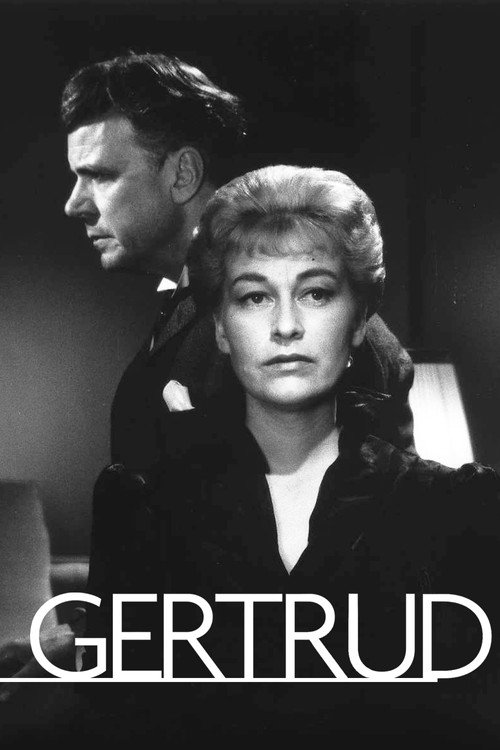
Gertrud
1964 · Carl Theodor Dreyer
For when you're in a contemplative mood and want to meet a film entirely on its own terms — patient, severe, and haunting. Absolutely a challenge pick; save it for a night when slowness sounds like a gift.
What it's about
In a turn-of-the-century world of salons, poets, and musicians, a former opera singer decides she will accept nothing less than absolute love. She leaves her distinguished lawyer husband for a young composer, finds him unequal to what she demands, and faces the return of a famous old flame with fresh disappointment. It's a portrait of a woman who would rather be alone than compromise.
The experience
Hushed, formal, and glacially paced — conversations unfold in long, unbroken takes while lovers gaze past each other, and the effect is strangely mesmerizing once you settle into its rhythm. It feels less like watching a drama than attending a ceremony, and its quiet builds to something unexpectedly moving.
The craft
Dreyer strips the film down to essentials: long takes, slow lateral camera moves, spare rooms, and dialogue delivered with an almost musical formality. Every gesture and glance is placed with total deliberation, so the smallest shift carries enormous weight. Watch it undistracted or not at all.
Why it matters
Booed at its Paris premiere, then championed by French critics, Dreyer's final film has grown into a touchstone of slow cinema and a summit of uncompromising personal filmmaking.
Snapshot
Gertrud is Carl Theodor Dreyer's final completed feature, a chamber drama of renunciation drawn from Hjalmar Söderberg's 1906 play. Its title figure, a former opera singer married to a rising lawyer-politician, leaves her husband for a young composer, finds him unequal to her absolute conception of love, refuses a reconciliation with an old poet-lover, and at last withdraws into a solitary old age that she regards not as defeat but as fidelity to an ideal. Dreyer renders this material in an austere, almost liturgical style: very long takes, slow lateral camera movements, actors who deliver their declarations of love while looking away from one another or past the lens. Booed at its Paris premiere in December 1964, the film was quickly defended by a cohort of French critics and has since become a touchstone of "slow cinema" and of the modernist art film's interest in stillness, duration, and interiorized emotion. It is widely treated as the summit and the seal of Dreyer's career.
Industry & production
Gertrud was a Danish production, made through Palladium, the studio with which Dreyer had a long if intermittent relationship and which had produced his previous feature, Ordet (1955). Nearly a decade separated the two films — a gap characteristic of Dreyer's whole career, in which long stretches of unrealized projects (most famously a never-made film on the life of Jesus) alternated with sparse, hard-won productions. By the early 1960s Dreyer was in his seventies and held a near-iconic status in international art cinema, even as his domestic standing in Denmark remained complicated. For much of his later life his income was secured by the management of the Dagmar Bio cinema in Copenhagen, a sinecure granted in recognition of his stature, which gave him a measure of independence from the commercial fortunes of his films.
The choice of Söderberg's play continued Dreyer's habit of adapting existing theatrical and literary works — The Word from Kaj Munk, Day of Wrath from a Norwegian play, The Passion of Joan of Arc from the trial records. Söderberg's drama, set in a Swedish milieu of the early 1900s, is partly rooted in the author's own romantic disappointments. Dreyer's film is talky, interior, and stage-derived in its source, yet he transposed it into a thoroughly cinematic register. The production was modest in scale, confined largely to a handful of interiors plus a park sequence. Precise budget and box-office figures are not something I can state reliably; what the record makes clear is that the film was made cheaply and was not a commercial success on release.
Technology
Gertrud was shot on black-and-white 35mm at a moment when color and widescreen had become the commercial norm, and Dreyer's monochrome, Academy-ratio compositions already read as a deliberate archaism. The technological interest of the film lies less in any novel apparatus than in how conventional tools were used against the grain. Dreyer and his cinematographer relied on careful, diffused studio lighting to produce the film's distinctive pearly grayscale — soft, even illumination with little of the dramatic chiaroscuro one might expect from a story of passion. The camera mountings and dolly work, ordinary in themselves, were deployed for unusually slow, sustained reframings that demanded precise floor marks and rehearsal. The film's technology is in this sense subordinated entirely to a stylistic program of duration and smoothness; nothing in the image is permitted to call attention to mechanism.
Technique
Cinematography
The cinematography is by Henning Bendtsen, who had also shot Ordet and whose collaboration is central to the look of late Dreyer. The film is celebrated for its long takes and for one of the longest average shot lengths in narrative cinema — the picture is built from a comparatively small number of shots across its roughly two-hour running time, so that scenes unfold in extended, slowly evolving compositions rather than through cutting. Bendtsen's lighting is high-key and enveloping, lending faces and fabrics a luminous, slightly unreal softness. The camera moves often but almost imperceptibly: gentle lateral tracks and reframings that follow figures as they cross a room or that subtly recompose two seated speakers. Dreyer favored medium and medium-long framings that keep the body and its bearing in view, and he resisted the emphatic close-up except at carefully chosen moments. The overall effect is of a camera that observes rather than dramatizes — patient, frontal, and grave.
Editing
Editing, credited to Edith Schlüssel, is by ordinary standards minimal, and that minimalism is the point. Where classical continuity would fragment a conversation into a volley of shot/reverse-shots, Dreyer holds the two-shot, letting the scene's tension accumulate within the unbroken frame. Cuts, when they come, register as events. The film's celebrated slowness is in large part an editorial choice — a refusal of the cut as the primary engine of meaning. The structure also incorporates a flashback (Gertrud's memory of an earlier love) and a coda set decades after the main action, so that the film's temporal architecture is larger than its sparse scene-count might suggest; the cutting serves this architecture quietly rather than calling attention to it.
Mise-en-scène / staging
The staging is the film's most discussed and most divisive feature. Dreyer arranges his actors with a sculptural deliberateness: figures sit or stand in planar, frieze-like compositions, frequently side by side rather than face to face. In the film's signature device, characters declare love or confess betrayal while gazing not at their interlocutor but into the middle distance or downward, as if addressing an inner image rather than the person beside them. This averted, non-reciprocal looking externalizes the film's theme — that Gertrud loves an ideal, not the men who fail it. Interiors are appointed with period furniture, mirrors, and a recurring tapestry depicting a naked woman pursued by hounds, an emblem of woman as quarry that comments mutely on the action. Movement is slow and ceremonial; actors rise, cross, and settle as though performing a rite. The world outside is largely banished, concentrating attention on the charged enclosure of the drawing room.
Sound
The sound design is sparse and restrained, in keeping with the visual asceticism. Dialogue dominates, delivered in measured, deliberate cadences that match the slowness of the images and give the spoken word an almost incantatory weight. Music is used economically rather than as a continuous emotional underscore; the film includes diegetic music appropriate to its milieu of musicians and salons, most pointedly the performance setting in which Gertrud's affair with the young composer is framed, and a sung passage associated with the heroine. Silence and the unhurried rhythm of speech are themselves expressive resources here, so that the absence of conventional scoring throws the actors' voices and the long pauses between lines into relief.
Performance
Gertrud is played by Nina Pens Rode, whose performance anchors the film in a register of controlled intensity — outwardly composed, inwardly absolute. The role demands stillness and the suppression of overt display, and the performance works precisely by what it withholds. Around her, Bendt Rothe plays the husband Gustav Kanning, the successful lawyer poised for high office; Baard Owe plays Erland Jansson, the young composer-pianist who cannot meet her demand for total love; Ebbe Rode plays Gabriel Lidman, the celebrated poet and former lover who returns; and Axel Strøbye plays Axel Nygren, the friend and psychologist who is the witness to her final solitude. All the performances are pitched to Dreyer's anti-naturalistic key: slow, frontal, deliberately undemonstrative, more recitation than impersonation. This stylization was among the qualities that alienated the film's first audiences and that later admirers came to regard as its rigor.
Narrative & dramatic mode
The film's dramatic mode is one of confrontation and renunciation, structured as a series of dialogues — Gertrud with her husband, with her young lover, with the returning poet, and finally with her old friend. Each encounter is a kind of trial in which Gertrud measures a man against her demand that love be everything, and finds him wanting. The mode is closer to chamber tragedy than to melodrama: the events are few, the reversals internal, the stakes wholly emotional and ethical. Dreyer adds a frame of memory and aftermath — the flashback to an earlier passion and the late epilogue in which an aged Gertrud looks back — that converts what might have been a domestic drama into a meditation on a whole life organized around a single principle. The narration is sober and unironic; it neither mocks Gertrud's absolutism nor sentimentalizes it, but presents her choice with grave neutrality, leaving the audience to weigh whether her fidelity is heroic, deluded, or both.
Genre & cycle
Nominally a drama and romance, Gertrud sits at the far modernist edge of both. It belongs less to any popular cycle than to the lineage of the European art film of the late 1950s and 1960s, the moment of Antonioni, Bergman, and Bresson, in which interiority, duration, and the failure of communication became central subjects. Within Dreyer's own filmography it forms a loose late cycle with Day of Wrath and Ordet — works of extreme stylistic concentration, slow rhythm, and metaphysical or ethical seriousness, often centered on a woman in conflict with the surrounding social order. If it has generic kin, they are the films of spiritual or emotional austerity rather than the romantic dramas with which its plot superficially aligns.
Authorship & method
Gertrud is among the most uncompromising statements of Dreyer's authorship, the culmination of a method refined across four decades. Dreyer adapted the screenplay himself from Söderberg, and the film bears every mark of his signature concerns: the suffering or resolute woman at the center, the tension between earthly and absolute love, the reduction of cinema to its essentials of face, gesture, light, and duration. His method was famously exacting and slow, built on meticulous control of every element of staging and a refusal of conventional dramatic emphasis.
His key collaborators here had largely worked with him before. Cinematographer Henning Bendtsen, carried over from Ordet, was the instrument of the film's luminous monochrome and its long, gliding takes. Editor Edith Schlüssel realized the radical sparseness of the cutting. The production design and the period appointments served Dreyer's planar, tapestry-like compositions. The cast — Pens Rode, Rothe, Owe, Ebbe Rode, Strøbye — were directed into a unified, anti-naturalistic performance style that is unmistakably Dreyer's rather than any actor's. The film is, in the strongest sense, an auteur's work, in which adaptation, direction, and stylistic system are fused into a single authorial vision.
Movement / national cinema
Dreyer is the towering figure of Danish national cinema, yet his international standing has always exceeded his national context, and Gertrud exemplifies that paradox. Made in Denmark from a Swedish play set in a Swedish milieu, it belongs to the broader Scandinavian tradition of serious, literary, psychologically searching cinema, with Bergman as its other great contemporary pole. At the same time the film was received, championed, and canonized largely through the French critical establishment, which positioned Dreyer within the pantheon of cinematic modernism. The film thus stands at a crossroads: a product of Danish studio craft, rooted in a Nordic literary culture, but consecrated by the transnational art-cinema discourse of the 1960s.
Era / period
The film occupies two periods at once. Its setting is the turn of the twentieth century — a Swedish world of salons, concert halls, poets, and politicians, of bourgeois respectability and the constraints it placed on women — and that period setting is essential to the drama, since Gertrud's insistence on love as a woman's right and her willingness to leave a powerful husband for it are framed against an era of rigid gender expectation. Its moment of production, the mid-1960s, is the high tide of international art cinema and of nascent feminist reconsideration of women's autonomy. The collision of these two periods — a fin-de-siècle story told with the ascetic modernism of the 1960s — gives the film much of its strange, suspended quality, at once antique and radically contemporary.
Themes
The governing theme is the demand for absolute love and the cost of refusing anything less. Gertrud will not accept love that is partial, secondary, or compromised by ambition, work, or pride, and she renounces each relationship in turn rather than betray that principle. Bound up with this is the theme of women's autonomy: Gertrud claims the right to define her own life by her own measure of feeling, in defiance of the social roles of wife and mistress. The film also meditates on the conflict between love and worldly success — the husband's politics, the poet's fame, the composer's career all reveal themselves as rivals to love rather than vessels for it. Renunciation, solitude, and fidelity to an ideal run through to the coda, where Gertrud's chosen isolation is presented as the logical end of her absolutism and her wish to be remembered under the sign of love alone. The recurring tapestry of the hunted woman gives these themes a visual emblem, casting the heroine's pursuit of love against an older image of woman as prey.
Reception, canon & influence
The film's first reception was famously hostile: its Paris premiere in December 1964 met with derision from much of the audience, who found its slowness, its averted gazes, and its solemn stylization risible or inert. That hostility, however, was almost immediately countered by a body of critics — centered in the French cinephile press — who recognized the film as a masterwork and defended its radicalism. Over the following decades the verdict reversed decisively. Gertrud came to be regarded as one of the supreme achievements of late Dreyer and a landmark of cinematic modernism, appearing in critical surveys of the greatest films and serving as a perennial reference point in writing on style, duration, and the relation of cinema to the other arts.
Looking backward, the film draws on Söderberg's turn-of-the-century play and its semi-autobiographical roots in the author's own thwarted passion, and on Dreyer's lifelong engagement with theatrical and literary adaptation and with the figure of the resolute, suffering woman that runs from Joan of Arc through Day of Wrath. Looking forward, its influence is most legible in the tradition of austere, durational art cinema. Its extreme long takes, its refusal of conventional coverage, its trust in stillness and the held frame anticipate and inform the practices later grouped under "slow cinema," and its rigorous reduction of film to face, voice, light, and time has made it a continual touchstone for directors and theorists committed to a contemplative, anti-spectacular conception of the medium. As Dreyer's last completed film — he died in 1968 without realizing further projects — Gertrud also carries the weight of a final testament, the closing and clarifying statement of one of cinema's most singular bodies of work.
A Deleuzian reading
Two people sit on a sofa.
The full Deleuzian reading of Gertrud →
Reception
Its 1964 Paris premiere was a legendary disaster — critics jeered and walked out, dismissing it as static filmed theater — yet within years the tide turned, and Dreyer's final film is now widely held up as one of cinema's great last testaments.
How Gertrud was received, from release to now →
Influences: the films it descends from and the films it influenced
- The Passion of Joan of Arc (1928) — Dreyer's earlier reduction of cinema to the isolated suffering woman's face, voice, and white light established the spiritual-portrait economy that Gertrud transposes into chamber-room long takes.
- Vampyr (1932) — Its disembodied, narratively unmotivated gliding camera prototypes the slow lateral tracking that detaches from action in Gertrud.
- Day of Wrath (1943) — The planar, tapestry-like frieze blocking of figures and the funereal slow tempo are the direct compositional grammar Gertrud refines.
- Ordet (1955) — Same cinematographer Henning Bendtsen supplies the luminous high-key monochrome and the long gliding takes within enclosed interiors that Gertrud pushes to extremity.
- Sunrise: A Song of Two Humans (1927) — Murnau's expressive 'unchained' tracking camera moving through built space as an emotional instrument is the silent-era source for Dreyer's autonomous lateral glides.
- Persona (1966) — Scandinavian chamber distillation to two faces, withheld gaze, and sparse sound, pursuing the same austere reduction within the art-film 1960s.
- Jeanne Dielman, 23 Quai du Commerce, 1080 Bruxelles (1975) — Extends the durational held frame and frontal frieze blocking into real-time domestic observation centered on a woman's autonomy.
- India Song (1975) — Builds an entire film from averted gazes, figures who never quite meet eyes, slow lateral tracks, and detached voices in Gertrud's anti-naturalistic stillness.
- The Travelling Players (1975) — Inherits the refusal of conventional coverage, sustaining action in extended slow lateral tracking takes rather than cutting for emphasis.
- Doomed Love (1979) — Carries forward theatrical literary adaptation with planar frieze-like blocking and deliberately anti-naturalistic, declamatory performance.
- Flowers of Shanghai (1998) — Slow lateral tracking through lamplit chamber interiors, holding ensemble tableaux in long takes that never break the enclosed frieze.
- Sátántangó (1994) — Pushes the extreme long take and gliding camera into the canonical 'slow cinema' practice that Gertrud's held frame anticipated.
- Goodbye, Dragon Inn (2003) — Trusts stillness, silence, and the held empty or near-static frame as primary expressive material in the contemplative, anti-spectacular mode Gertrud founded.
- Vitalina Varela (2019) — Reduces cinema to a resolute woman's face emerging from controlled high-contrast light held in durational, sculptural stillness — late-Dreyer portraiture made contemporary.
- The Piano Teacher (2001) — Dreyer's filmed dialogue scenes held without shot-reverse-shot cuts — figures placed parallel to the camera plane in sustained wide or medium frame across entire exchanges — is the specific staging architecture Haneke imports for Erika's confrontational two-person scenes, including the instruction-letter scene.
- Cries and Whispers (1972) — Dreyer's commitment to holding duration past conventional dramatic resolution — cutting only when the emotional experience is exhausted rather than efficiently communicated — directly anticipates the patient editing rhythm Bergman and Lundgren employ, where a held reaction becomes an argument about what comprehension actually takes.
- Woyzeck (1979) — Dreyer's final film uses the flattest, most evenly lit cinematography of his career, with scenes sustained in long takes and frontal theatrical blocking that refuses shot-reverse-shot convention — the same grammar of formal distance that Schmidt-Reitwein deploys in Woyzeck to prevent psychological identification with the subject.
- Diary of a Country Priest (1951) — Shares the flattened, anti-naturalistic 'model' performance and reduction of drama to face, voice, and duration drained of conventional emphasis.
- Last Year at Marienbad (1961) — Frieze-frozen tableaux, slow tracking through formal interiors, and stylized averted-gaze performance parallel Gertrud's anti-naturalistic, time-suspended staging.
- The Silence (1963) — Shot in Academy ratio with static long takes and slow pans between interlocutors who cannot reach one another emotionally, Gertrud inhabits the same Scandinavian chamber grammar and temporal latitude as The Silence — Dreyer's last film completing the tradition one year after Bergman radicalized it.
- The Trial of Joan of Arc (1963) — Shares the flattened, near-monotone line delivery and characters who speak past one another with averted gaze, an austere anti-expressive front that parallels Bresson's recorded-voice primacy.
Similar films
- Day of Wrath (1943) — influence & lineage
- India Song (1975) — influence & lineage
- Ordet (1955) — influence & lineage
- The Passion of Joan of Arc (1928) — influence & lineage
- Last Year at Marienbad (1961) — influence & lineage
- Vampyr (1932) — influence & lineage · often watched together
- Diary of a Country Priest (1951) — influence & lineage · often watched together
- Charulata (1964) — often watched together
All the films related to Gertrud →