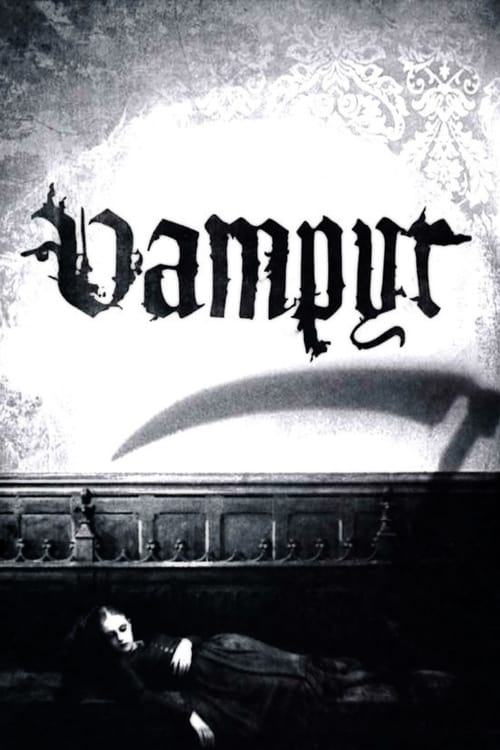
Vampyr
1932 · Carl Theodor Dreyer
For a late night when you want atmosphere over plot — old, strange, and genuinely eerie. A challenge if you need momentum; a treasure if you want to be haunted rather than startled.
What it's about
Allan Gray, a young drifter obsessed with the supernatural, takes a room in a riverside village where something is wrong in a way he can't name. An old man appears in his room at night asking him to protect two daughters — one of whom is wasting away under the influence of a vampire — and Gray is pulled into a world where shadows move on their own and dreams bleed into waking life.
The experience
Less a story than a spell — slow, misty, and deeply uncanny, with images that feel remembered from a nightmare. It doesn't jump-scare you; it makes the whole visible world feel untrustworthy.
The craft
Dreyer shoots through a milky, diffused haze that makes every frame look like fog on glass, and stages effects — independent shadows, a famous sequence from inside a coffin — that still unsettle nearly a century later. An early sound film that uses silence and sparse noise as weapons. The bigger and darker the screen, the deeper the spell.
Why it matters
A commercial failure on release, it was later recognized as one of the foundations of atmospheric horror — proof that dread could be built from light and texture alone.
Snapshot
Vampyr is Carl Theodor Dreyer's first sound film and one of the strangest objects in the early-sound canon: a vampire story told almost entirely as atmosphere, in which dread is generated by light, texture, and the dissolution of spatial certainty rather than by plot or shock. Made in the wake of the artistic triumph and commercial collapse of The Passion of Joan of Arc (1928), it follows Allan Gray, a young dreamer drawn to the occult, into a riverside village where a malign force is feeding on the daughters of an old châtelain. The film is celebrated less for what happens than for how thoroughly it estranges the visible world — a milky, diffused image in which shadows act on their own, the camera adopts a corpse's point of view, and the boundary between waking and dream is never restored. It failed on release and was long seen only in damaged, incomplete prints; it is now regarded as a foundational work of art-horror and one of the supreme achievements of cinematic atmosphere.
Industry & production
Vampyr was an independent production financed largely by its leading man. The Baron Nicolas de Gunzburg, a wealthy young aristocrat with theatrical ambitions, underwrote the film in exchange for the central role, which he played under the stage name Julian West. This patronage arrangement freed Dreyer from studio oversight but kept the production modest in resources, and it is the reason the lead is performed by a non-professional. The film was shot on location in and around the village of Courtempierre in France in 1930–31, using real buildings — a manor, a riverside mill — rather than constructed sets, which is integral to its sense of a found, decaying world.
The picture arrived at a difficult industrial moment. The transition to sound had fractured international distribution, and to reach multiple markets Vampyr was produced in several language versions — German, French, and English — a common practice in the early-talkie years. The German version became the standard surviving text; the English version is effectively lost to general circulation, and the film's restoration history is a story of reassembling a damaged work from imperfect materials. Released in 1932 (its German premiere was in Berlin that May), Vampyr was a commercial and critical failure. Audiences expecting either a conventional horror entertainment in the Universal mode or a sound follow-up to Joan of Arc found an oblique, near-silent mood piece, and its poor reception contributed to a long, painful hiatus in Dreyer's directing career.
Technology
The film sits exactly on the technological fault line of the early 1930s. It is a sound film, but one made by a director deeply formed by silent practice, and its handling of the new technology is deliberately minimal — sound is used as an instrument of atmosphere rather than as a vehicle for dialogue. The multiple-language-version strategy was itself a technological-industrial response to the fact that recorded speech could no longer be cheaply translated by swapping intertitles, as in the silent era. Where Vampyr is most radical, though, is photographic: the production sought, and achieved, a soft, fog-suffused image that runs against the grain of the harder, more sharply resolved look that panchromatic stock and improving lenses were then making possible. The film bends contemporary technology backward, toward indistinctness, to serve an aesthetic of unreality.
Technique
Cinematography
The cinematography, by Rudolph Maté — who had also shot The Passion of Joan of Arc — is the film's defining achievement. The image throughout is gauzy, grayed, and luminous, as though seen through a film of mist or a partial blindness. The established account of how this was produced is that Maté placed a thin layer of gauze a short distance in front of the lens, diffusing the light into the soft, sourceless glow that pervades nearly every shot; a persistent anecdote attributes the discovery to a lighting accident, but the gauze technique is the documented method. The result deliberately suppresses the deep blacks and crisp definition of orthodox horror photography in favor of a pale, overexposed-seeming world without firm edges.
The camera is also mobile and exploratory in a way unusual for 1932, drifting through the village and the manor as if disembodied, following Allan Gray's gaze and sometimes detaching from him entirely. Its most famous gesture is the coffin sequence, in which the camera assumes the point of view of a corpse — Gray's own, in a dream of his death — gazing up through the small glass window of the coffin lid as it is carried out and past trees and sky. Few images in cinema so literally enact Dreyer's stated ambition to make the spectator feel a door had opened onto another world.
Editing
The editing works to dissolve rather than clarify spatial and temporal relations. Continuity is loosened so that the geography of the village, the manor, and the mill becomes uncertain and dreamlike; the viewer is rarely allowed a secure mental map. The cutting joins glances, shadows, and movements into associative chains that feel governed by dream logic, and the film's structural masterstroke is that it never definitively signals where Gray's reality ends and his vision begins. The pacing is unhurried, even becalmed, holding on charged images until they begin to feel haunted — an editorial patience that is the temporal equivalent of Maté's diffused light.
Mise-en-scène / staging
Dreyer stages the film in real, weathered spaces and fills them with uncanny detail: a doctor's room cluttered with specimen jars, a mill whose machinery becomes an instrument of death, rooms where light falls without an evident source. The most celebrated device is the autonomous shadow — shadows that move, dance, and act independently of the bodies that should cast them, including a sequence of spectral figures whose shadows gather and disperse on their own. These effects are achieved in-camera and through staging rather than elaborate optical trickery, and their handmade, slightly impossible quality is central to the film's disquiet. The famous climax, in which the malevolent village doctor is trapped in a mill room and slowly buried alive under a rising tide of white flour, is a triumph of staging: an abstract, suffocating death rendered in pure texture.
Sound
Vampyr uses sound with extreme restraint, and this restraint is itself an aesthetic statement. Dialogue is sparse and often functions more as texture than as exposition; much of the film proceeds in near-silence broken by ambient sound, footsteps, wind, and the river. Dreyer post-synchronized much of the audio, and the spareness of the sound design — combined with Wolfgang Zeller's score — sustains a hushed, suspended atmosphere in which any sound becomes ominous. The film effectively treats sound as a new kind of shadow rather than as a tool for naturalistic speech, which is one reason it disappointed audiences primed for a "talkie."
Performance
The casting mixes a small number of professionals with non-actors, and the performances are pitched toward the somnambulant. Baron de Gunzburg, as Julian West, plays Allan Gray as a passive, drifting observer — a deliberately blank and dreamlike presence rather than a conventional protagonist. Sybille Schmitz, as the afflicted daughter Léone, gives the film's most charged performance; her face, as the vampire's influence works on her, registers a frightening oscillation between suffering and predatory hunger. Maurice Schutz plays the doomed lord of the manor, Henriette Gérard the aged vampire Marguerite Chopin, and Jan Hieronimko the sinister doctor. Dreyer directs them all toward stillness and ambiguity, so that the human figures seem nearly as estranged from ordinary life as the shadows around them.
Narrative & dramatic mode
The film's dramatic mode is oneiric and associative rather than causal. Its nominal source is Sheridan Le Fanu's collection In a Glass Darkly — the vampire material drawing on the lineage of his "Carmilla" — but Dreyer and co-writer Christen Jul retain only a loose armature of the vampire plot and subordinate it entirely to mood. Events unfold with the inevitability and discontinuity of a dream: a stranger arrives, a warning is delivered, a daughter sickens, a death is dreamed and perhaps suffered, an evil is destroyed. The film refuses to firmly distinguish vision from event, and its narration is deliberately incomplete, withholding the connective tissue that would let a viewer reconstruct a coherent sequence. This makes Vampyr less a story about a vampire than a sustained evocation of the state of dread itself.
Genre & cycle
Vampyr belongs to the vampire film and to the broader horror cycle, but it stands almost entirely apart from the cycle's commercial center. It appeared in the same brief window as the foundational Universal horrors — Dracula and Frankenstein (both 1931) — yet shares almost nothing with their theatrical staging and legible thrills. Where the American films externalize horror in monstrous bodies and gothic spectacle, Dreyer interiorizes it as atmosphere and dread. The film is better understood as a bridge between the pictorial horror of German silent cinema — the tradition of Nosferatu (1922) — and a later strain of art-horror that locates fear in mood, ambiguity, and the uncanny rather than in incident. It is, in effect, the great early example of the "atmospheric" or "poetic" horror film.
Authorship & method
Vampyr is unmistakably a Dreyer film, continuous with his lifelong preoccupations even as it departs from his other work in surface. Dreyer co-wrote the screenplay with Christen Jul, freely adapting Le Fanu, and directed with his characteristic insistence on controlling every expressive element toward a unified emotional effect. His key collaborator was the cinematographer Rudolph Maté, whose gauze-diffused photography realizes Dreyer's conception of a world seen as if by the dead or dreaming; the continuity from Joan of Arc is significant, even as the two films pursue opposite textures — that film's stark, sculptural close-ups against this one's dissolving softness. The score is by the composer Wolfgang Zeller, whose music underpins the film's hushed, suspended mood. Dreyer's method here — location shooting, non-professional casting, sound used as atmosphere, narrative deliberately loosened toward dream — represents a coherent authorial program rather than a genre assignment, which is precisely why it disappointed the marketplace and rewards study.
Movement / national cinema
Dreyer is a Danish director, but Vampyr is a thoroughly transnational work, financed by an aristocrat, shot in France with a multinational cast, and produced in German, French, and English versions. It cannot be cleanly assigned to a single national cinema; rather, it absorbs and transforms the legacy of German Expressionist and silent horror — the shadow-play, the morbid atmospherics — while standing outside any national movement. It is best placed within an international current of art cinema in which directors used the new medium's resources for personal, non-commercial ends. Its closest affinities are with the surrealist sensibility of its moment and with the European tradition of the cinematic uncanny, rather than with any school or industry.
Era / period
The film is a product of the precise hinge between the silent and sound eras, roughly 1930–32, and its character is inseparable from that transitional instant. It carries the pictorial intelligence and rhythmic patience of late silent cinema into the sound film, treating recorded audio as one more atmospheric element rather than as the engine of drama. Made just as the horror genre was being industrialized in Hollywood and just before the European art film would be constrained by the political upheavals of the 1930s, Vampyr occupies a narrow window in which an independently financed, formally radical horror film of this kind was possible. It is both a late masterpiece of the silent sensibility and an early, idiosyncratic sound film.
Themes
The film's governing theme is death — not as event but as a state that seeps into and discolors the living world. Its central conceit is the permeability of the boundary between life and death, dramatized in Gray's dream of his own burial and in the vampire's slow draining of the living. Closely bound to this is the theme of the dream and the unreliability of perception: the film's whole method insists that we may not be able to tell waking from vision, sight from blindness. There is a current of contagion and predatory desire in Léone's affliction, in which sickness shades toward hunger. And running beneath all of it is dread as a condition in its own right — a pervasive, sourceless anxiety that the film treats as the fundamental texture of existence rather than as a response to any single threat.
Reception, canon & influence
On release Vampyr was a failure, commercially and with much of the contemporary press; audiences and critics expecting either conventional horror or a worthy successor to Joan of Arc were baffled by its slowness and obscurity, and the reception helped open a long interruption in Dreyer's career. Its survival was further jeopardized by the loss and damage of original materials, so that for decades it circulated mainly in compromised, incomplete prints. Its canonical standing was built gradually over the following decades, as critics, programmers, and later restoration efforts recovered the film and its reputation, until it came to be regarded as one of the essential works of horror and of the cinematic avant-garde.
Looking backward, the film draws on Sheridan Le Fanu's In a Glass Darkly for its vampire material and on the German silent tradition of shadow and atmosphere — the world of Nosferatu — for its pictorial sensibility, while filtering both through Dreyer's own metaphysical preoccupations. Looking forward, its influence has been enormous and is generally located in mood and method rather than in plot: in the way it makes atmosphere and ambiguity the substance of horror. It stands as the great ancestor of poetic, art-horror cinema, and its imprint is widely felt in later filmmakers drawn to dream logic and the uncanny — the spiritual gravity of Ingmar Bergman, the long, haunted duration of Andrei Tarkovsky, and the oneiric dread of figures such as David Lynch and Guy Maddin. More than most films of its period, Vampyr is honored less as a museum piece than as a living lesson in how cinema can render the feeling of a world tilted toward death.
A Deleuzian reading
There is a shot in *Vampyr* taken from inside a coffin.
The full Deleuzian reading of Vampyr →
Reception
A genuine disaster in 1932 — audiences jeered, critics were baffled, and the flop (plus Dreyer's subsequent breakdown) kept him from finishing another feature until Day of Wrath over a decade later. Now it sits comfortably on greatest-horror-ever lists as one of the medium's great dream-films.
How Vampyr was received, from release to now →
Influences: the films it descends from and the films it influenced
- Nosferatu (1922) — Supplies the autonomous, independently-moving shadow as a horror agent and the use of real-location exteriors as uncanny texture — both refined into Vampyr's free-floating, detached shadows.
- The Cabinet of Dr. Caligari (1920) — Establishes the Expressionist frame of horror as an unstable subjective/dreamer's reality, which Dreyer abstracts past painted sets into pure oneiric drift untethered from plot.
- The Passion of Joan of Arc (1928) — Carries over cinematographer Rudolph Maté, but Dreyer deliberately inverts its stark sculptural hard-edged close-ups into the gauze-diffused softness of a world seen by the dead.
- Schatten (Warning Shadows) (1923) — Pioneers shadows as autonomous dramatic agents that act independently of the bodies casting them — the precise device Vampyr extends to a dancing, disembodied shadow.
- Sunrise (1927) — Models the unchained mobile camera and gauze/superimposition dissolves that render space as a continuous subjective dream-state rather than measured geography.
- Faust (1926) — Extends Faust's superimposition for soul/spirit imagery and diffuse atmospheric light into a metaphysical horror of dread rather than shock.
- The Phantom Carriage (1921) — Inherits the superimposed-spectre technique (the detaching shadow, the soul leaving the body) and the Nordic moral-dread atmosphere descended from Sjöström's spectral imagery.
- Häxan (1922) — Carries forward Christensen's fusion of documentary plainness and dread, using diffused chiaroscuro and in-camera optical effects to let the supernatural seep into an ostensibly observed world.
- Cat People (1942) — Inherits the principle that horror is built from suggestion, shadow, and off-screen sound rather than a shown monster — atmosphere and ambiguity as the substance of dread.
- I Walked with a Zombie (1943) — Extends the somnambulant performance and dream-logic drift, structuring a film around a living-dead wanderer moving through a hushed, death-tilted world.
- Carnival of Souls (1962) — Literalizes Vampyr's corpse-POV conceit (a protagonist already dead) and uses minimalist non-studio location shooting to produce the same sense of a world slightly out of true.
- Hour of the Wolf (1968) — Transposes art-horror into metaphysical spiritual gravity, treating the vampiric/uncanny as an interior haunting rendered through duration and dread rather than incident.
- Valerie and Her Week of Wonders (1970) — Builds a Le Fanu-derived oneiric vampire fairytale governed entirely by dream-logic editing and spatial dislocation in place of causal narrative.
- Le Viol du vampire (1968) — Founds Rollin's atmosphere-over-narrative vampire cinema descending directly from Le Fanu and Vampyr, prizing mood, ambiguity, and oneiric drift over coherent plot.
- Eraserhead (1977) — Carries forward the oneiric dread through a minimalist, sustained atmospheric sound design used — as in Vampyr — as the primary carrier of horror.
- Careful (1992) — Deliberately revives gauze-diffused soft-focus silent-era photography and post-synchronized atmosphere as an expressive method, an explicit homage to Maté's textures.
- Begotten (1990) — Pushes extreme diffused, degraded high-contrast imagery to dissolve figures into a primal landscape of death, extending the 'seen by the dead' visual conception.
- The Innocents (1961) — Makes unresolved ambiguity the substance of horror, using soft-edged deep-focus diffusion and a ghost story that never confirms whether the supernatural is real.
- The Mirror (1975) — Inherits the long, haunted duration and the slow camera drift through atmosphere-charged space, organizing the film by dream/memory logic rather than narrative sequence.
- The Ice Tower (2025) — Diffused fog-gray light and dilated, somnambulant pacing with sound and image deliberately unmoored from narrative cause — early diegetic ambiguity as method.
Similar films
- Hour of the Wolf (1968) — influence & lineage · often watched together
- The Innocents (1961) — influence & lineage · often watched together
- Nosferatu (1922) — influence & lineage
- The Cabinet of Dr. Caligari (1920) — influence & lineage
- Carnival of Souls (1962) — influence & lineage
- Valerie and Her Week of Wonders (1970) — influence & lineage
- The Phantom Carriage (1921) — often watched together
- Nosferatu the Vampyre (1979) — often watched together
All the films related to Vampyr →